Opens in a new tab
Join Anantam IAS Channel on Telegram

Daily Digest · Thursday

7 May 2026 Current Affairs for UPSC

6 current affairs published on Thursday, 7 May 2026

7 May 2026 Current Affairs for UPSC — every Why-in-News article AnantamIAS published on Thursday, 7 May 2026, broken down with Why in News?, the exact GS paper it feeds, sub-topic mapping, MCQ-ready facts and a UPSC-style practice question. 6 articles in total, covering Polity, Economy, Environment, S&T, IR, Geography, History, Society and Internal Security — the same Why-in-News + GS-paper-mapping + practice-question format the Compass uses across every daily digest on the site.

Daily current affairs for UPSC is where new material enters your prep stream. Read this 7 May 2026 digest end-to-end in 25–35 minutes, attempt the practice question at the foot of each article (it's MCQ for some, 10/15-marker for others), then bookmark the entries that fall inside your active revision window. Everything stays cross-linked: tap any subject pill to jump to that subject's hub, or use the table of contents above to skip straight to a specific story.

Use this page three ways. Read sequentially for a one-sitting scan of everything that mattered on 7 May 2026. Download the 7 May 2026 PDF below for offline study or print revision. Or use the May 2026 Current Affairs compilation to see this day in the month's full context. For the previous day's reading, see 6 May 2026 Current Affairs; the next day's is 8 May 2026 Current Affairs.

Why we publish daily current affairs separately from the monthly compilation: daily is learning, monthly is revision. Use the daily page to add fresh material to your notes the day it breaks; come back to the May 2026 compilation 60 days before Prelims when the noise has settled and only the lasting takeaway is worth re-reading.

​Gang of seven: On the AAP defections

Open article →Download PDF

image 12

image 12 4

Why in News?

Seven Rajya Sabha members of the Aam Aadmi Party (AAP) announced their merger with the Bharatiya Janata Party (BJP) in April 2026. The Rajya Sabha Chairman accepted their claim of merger under the Tenth Schedule of the Constitution, triggering intense constitutional and political debate regarding the interpretation of anti-defection provisions.

UPSC Relevance

GS-II: Parliament, Constitutional Provisions, Anti-Defection Law, Role of Presiding Officers, Electoral Reforms, Accountability in Democracy
GS-IV: Ethics in Public Life, Political Morality

Background of the Anti-Defection Law

The anti-defection law was introduced through the 52nd Constitutional Amendment Act, 1985, which added the Tenth Schedule to the Constitution.

The law aimed to:

  • Prevent political defections motivated by office or power
  • Ensure stability of elected governments
  • Protect the mandate given by voters
  • Reduce “Aaya Ram, Gaya Ram” politics

Key Provisions of the Tenth Schedule

Grounds for Disqualification

A legislator can be disqualified if:

  • They voluntarily give up membership of their political party
  • They vote or abstain contrary to the party whip without permission

Merger Exception under Paragraph 4

The Tenth Schedule provides protection from disqualification in case of a merger.

For a valid merger:

  • The original political party must merge with another party
  • At least two-thirds of the legislature party must agree to such merger

This exception was intended to accommodate genuine political realignments rather than opportunistic defections.

Constitutional Controversy in the Present Case

The seven Rajya Sabha MPs argue that since they constitute more than two-thirds of AAP’s Rajya Sabha strength, they are protected under the merger provision.

However, critics argue that:

  • The AAP as an organisation has not merged with BJP
  • Only a section of legislators has switched allegiance
  • Therefore, this amounts to defection rather than merger

The central constitutional question is whether:

A merger of legislators alone is sufficient, or whether the political party itself must first merge at the organisational level.

Supreme Court’s Earlier Interpretation

In the 2022 Shiv Sena split case judgment relating to the Eknath Shinde rebellion, the Supreme Court clarified that:

  • A legislature party cannot be treated as independent from the political party
  • Legislators alone cannot determine the identity or existence of the original political party

This interpretation weakens the legal basis of the merger claim made by the AAP MPs.

Role of the Presiding Officer

Under the Tenth Schedule:

  • The Speaker or Chairman of the House decides questions relating to disqualification

This has repeatedly raised concerns regarding neutrality because:

  • Presiding officers often belong to ruling parties
  • Decisions are frequently delayed
  • Political considerations may influence adjudication

In several cases, courts have criticised prolonged delays in deciding disqualification petitions.

Judicial Concerns Regarding the Present System

The Supreme Court has repeatedly expressed concern about the effectiveness of the anti-defection framework.

In 2020, the Court recommended:

  • Establishing an independent tribunal to decide disqualification matters instead of Speakers or Chairpersons

The recommendation emerged because:

  • Speakers are often perceived as partisan
  • Delay in decisions can alter governments and legislative majorities irreversibly

Earlier Examples of Controversial Defections

Telangana Cases

Several controversies emerged in Telangana involving defections from Congress and TDP to TRS/BRS:

  • Legislators claimed protection under the merger clause
  • Opposition parties challenged these mergers as unconstitutional
  • Questions arose regarding misuse of the two-thirds provision

Maharashtra Political Crisis

The Shiv Sena split demonstrated how:

  • Large-scale defections can destabilise governments
  • Constitutional ambiguities can be politically exploited
  • Delays in judicial and Speaker decisions can produce irreversible political outcomes

Criticism of the Anti-Defection Law

(1) Failure to Prevent Opportunistic Politics

Despite the law, defections continue through:

  • Mass resignations
  • Strategic mergers
  • Delayed disqualification proceedings

(2) Weakening of Representative Democracy

Frequent defections undermine:

  • Voter mandate
  • Party ideology
  • Public trust in democratic institutions

Legislators elected on one party’s platform often switch allegiance without returning to the electorate.

(3) Excessive Party Control

The anti-defection law has also been criticised for:

  • Reducing legislators’ independence
  • Encouraging excessive party high-command culture
  • Weakening deliberative democracy within legislatures

Need for Reforms

(1) Independent Adjudicatory Mechanism

An impartial tribunal or constitutional authority could:

  • Reduce political bias
  • Ensure timely decisions
  • Strengthen public confidence

(2) Time-bound Disposal

Strict timelines for deciding disqualification petitions can prevent:

  • Manipulation through delays
  • Artificial alteration of legislative majorities

(3) Clearer Definition of “Merger”

The law requires greater clarity regarding:

  • Difference between party merger and legislative split
  • Organisational consent requirements
  • Documentary proof standards

(4) Strengthening Internal Party Democracy

Many defections reflect weak ideological commitment and centralised party structures. Internal democratic functioning within political parties can reduce factionalism and opportunistic alignments.

Constitutional Significance

The present controversy goes beyond a dispute involving a few MPs. It raises broader questions about:

  • Integrity of representative democracy
  • Limits of political opportunism
  • Constitutional morality
  • Balance between party discipline and democratic freedom

The effectiveness of the Tenth Schedule ultimately depends not only on legal provisions but also on the willingness of institutions to uphold the spirit of democratic accountability.

Practice Questions

Prelims

Q1. With reference to the Tenth Schedule of the Constitution, consider the following statements:

  1. The anti-defection law was added through the 52nd Constitutional Amendment Act.
  2. A legislator can be disqualified for voluntarily giving up party membership.
  3. The merger exception applies even if only legislators merge without the original political party merging.

Which of the statements given above is/are correct?

(a) 1 and 2 only
(b) 2 and 3 only
(c) 1 and 3 only
(d) 1, 2 and 3

Answer: (a)

Mains

Q. The anti-defection law was enacted to ensure political stability, yet defections continue to reshape Indian politics. Critically examine the limitations of the Tenth Schedule and suggest reforms.
UAE exits OPEC: What is OPEC+, its members, and what does the bloc do?

Open article →Download PDF

image 14

Why in News?

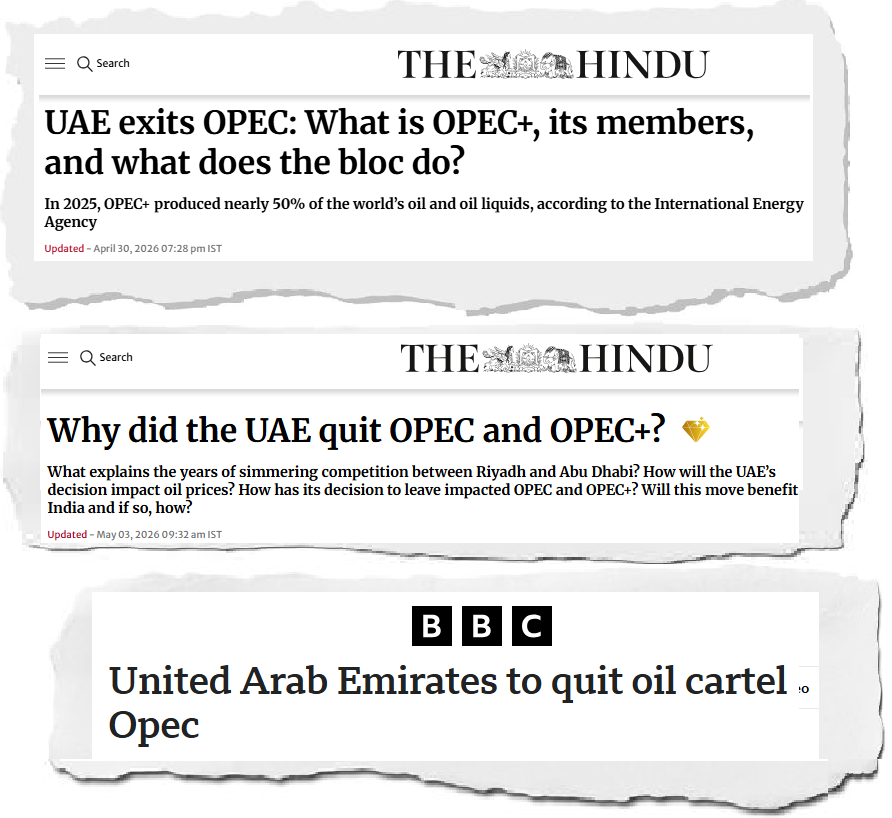
The Organization of the Petroleum Exporting Countries (OPEC) has suffered a major setback after the United Arab Emirates announced its withdrawal from both OPEC and OPEC+ in April 2026. The decision comes amid heightened geopolitical tensions in West Asia, particularly the ongoing Iran-related conflict and disruptions around the Strait of Hormuz.

The development has triggered debates regarding the future of OPEC, stability of global oil markets, regional rivalries in West Asia, and implications for major oil-importing countries such as India.

UPSC Relevance

GS-II: International Relations, India and West Asia, Global Energy Politics, Climate Transition, Multipolar World Order

GS-III: Energy Security, Economy, Infrastructure, Globalisation

What is OPEC?

The Organization of the Petroleum Exporting Countries was established in 1960 by Iran, Iraq, Kuwait, Saudi Arabia, and Venezuela to coordinate petroleum production policies and stabilise global oil prices.

Objectives of OPEC

  • Coordinate oil production policies among member countries.
  • Ensure stable oil prices in global markets.
  • Protect the interests of oil-producing nations.
  • Ensure regular supply of petroleum to consumers.
  • Secure fair returns on investments in the petroleum industry.

Currently, OPEC controls nearly 30% of global oil production, while the broader OPEC+ grouping accounts for around 40% of global supply.

What is OPEC+?

OPEC+ is an expanded grouping formed in 2016 that includes OPEC members along with major oil producers such as Russia, Kazakhstan, Mexico, Oman, and others.

The grouping was formed mainly to coordinate production cuts and stabilise prices after oil market volatility.

Difference Between OPEC and OPEC+

FeatureOPECOPEC+
NatureCore oil cartelExpanded alliance
MembersPrimarily Middle Eastern, African and Latin American oil exportersOPEC + non-OPEC producers
Key MemberSaudi ArabiaSaudi Arabia + Russia
Main ObjectiveManage oil supplyWider global production coordination

Why Did the UAE Leave OPEC?

Desire for Production Flexibility

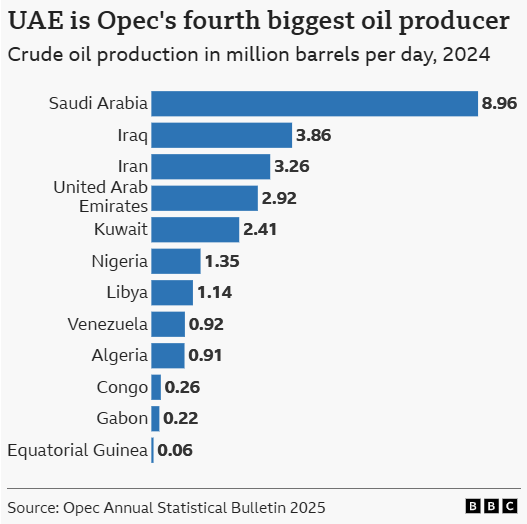
The UAE has heavily invested in expanding its oil production capacity and wants to produce more oil without being constrained by OPEC quotas.

The country reportedly aims to raise production capacity close to 5 million barrels per day.

Differences with Saudi Arabia

There have been long-standing disagreements between the UAE and Saudi Arabia regarding production limits, regional influence, and strategic priorities.

The UAE increasingly viewed Saudi-led quota restrictions as harmful to its economic interests.

Geopolitical Realignment in West Asia

The UAE has pursued an assertive foreign policy, strengthening ties with the United States and Israel after the Abraham Accords.

Its strategic calculations increasingly diverged from some OPEC members, especially Iran and Saudi Arabia.

Impact of Iran Conflict

The ongoing Iran conflict and disruptions around the Strait of Hormuz created supply shortages and volatility in global oil markets.

The UAE argued that it required greater agility and independent decision-making to respond quickly to changing market conditions.

Economic Diversification

The UAE’s economy is becoming increasingly diversified through finance, logistics, tourism, renewables, and sovereign wealth investments.

As a result, its economic interests are no longer fully aligned with traditional cartel-based oil management.

image 15

Why is the Strait of Hormuz Important?

The Strait of Hormuz is one of the world’s most critical oil transit routes.

Importance

  • Nearly one-fifth of global oil trade passes through it.
  • Connects the Persian Gulf to the Gulf of Oman and Arabian Sea.
  • Essential for oil exports from Saudi Arabia, Iraq, Kuwait, UAE, and Qatar.
  • Any disruption immediately affects global oil prices.

Recent tensions and attacks in the region have highlighted the vulnerability of global energy supply chains.

Implications of UAE’s Exit

Weakening of OPEC’s Cohesion

The UAE was one of OPEC’s largest and most technologically advanced producers.

Its exit weakens cartel discipline and may encourage other countries to prioritise national interests over collective quotas.

Reduced Pricing Power of OPEC

OPEC’s ability to influence oil prices depends on coordinated production cuts.

If more members disregard quotas, cartel influence over global markets could decline further.

Greater Oil Market Volatility

Instead of stable prices, the global oil market may witness sharper fluctuations due to geopolitical tensions and competitive overproduction.

Intensification of Gulf Rivalries

The move reflects growing strategic competition among Gulf countries, especially between the UAE and Saudi Arabia.

It also signals changing power dynamics in West Asia.

Impact on Global Energy Transition

The exit may accelerate competitive oil production in the short term, but it also reflects how countries are repositioning themselves for a future beyond oil dominance.

Implications for India

Energy Security Concerns

India imports nearly 85% of its crude oil requirements, with a substantial share coming from West Asia.

Instability in oil-producing regions directly affects India’s energy security.

Impact on Inflation and Economy

Higher oil prices can:

  • Increase import bills.
  • Widen the current account deficit.
  • Raise transportation and logistics costs.
  • Trigger inflationary pressures.

Strategic Importance of West Asia

The development reinforces the need for India to maintain balanced relations with:

  • Saudi Arabia
  • UAE
  • Iran
  • Israel

Push Towards Energy Diversification

The crisis underlines the importance of:

  • Renewable energy expansion.
  • Strategic petroleum reserves.
  • Green hydrogen initiatives.
  • Diversification of crude import sources.

Challenges Before OPEC

Internal Divisions

Member countries increasingly prioritise domestic economic interests over cartel discipline.

Rise of Non-OPEC Producers

Countries such as the United States, Brazil, and Canada have significantly increased production, reducing OPEC’s dominance.

Energy Transition

Global movement towards renewable energy and decarbonisation threatens long-term oil demand.

Geopolitical Fragmentation

Conflicts in West Asia complicate coordinated energy governance.

Way Forward

Reforming Global Energy Governance

OPEC and OPEC+ need more flexible and transparent mechanisms to accommodate changing geopolitical and economic realities.

Strengthening Energy Security

Countries like India must:

  • Diversify import sources.
  • Increase renewable energy capacity.
  • Build resilient supply chains.
  • Expand strategic oil reserves.

Accelerating Green Transition

Global dependence on fossil fuels can be reduced through:

  • Solar and wind energy.
  • Electric mobility.
  • Green hydrogen.
  • Energy-efficient infrastructure.

Regional Stability in West Asia

Diplomatic efforts to reduce tensions in the Gulf region are essential for stabilising global oil markets and trade routes.

Prelims Practice Questions

1. With reference to OPEC+, consider the following statements:

  1. OPEC+ includes both OPEC and non-OPEC oil-producing countries.
  2. Russia is a member of OPEC+.
  3. OPEC+ was created mainly to coordinate production cuts and stabilise oil prices.

Which of the statements given above are correct?

(a) 1 and 2 only
(b) 2 and 3 only
(c) 1 and 3 only
(d) 1, 2 and 3

Answer: (d)

2. The Strait of Hormuz is strategically important because:

(a) It connects the Mediterranean Sea and Red Sea
(b) A significant share of global oil trade passes through it
(c) It is the largest natural gas reserve region in the world
(d) It separates Europe and Africa

Answer: (b)

3. Which of the following countries are members of OPEC?

  1. Saudi Arabia
  2. Iran
  3. Russia
  4. Venezuela

Select the correct answer using the code below:

(a) 1, 2 and 4 only
(b) 1 and 3 only
(c) 2 and 4 only
(d) 1, 2, 3 and 4

Answer: (a)

Mains Practice Questions

  1. Discuss the strategic significance of the Strait of Hormuz in global energy politics
  2. “The UAE’s exit from OPEC reflects the changing geopolitics of energy in West Asia.” Discuss.
  3. Examine the implications of instability in West Asia for India’s energy security and economic stability.
  4. Critically analyse the relevance of OPEC in an era of renewable energy transition and rising non-OPEC oil production.

SC expands definition of Acid Attack Victim in Disabilities Act 

Open article →Download PDF

Why in News?

The Supreme Court of India expanded the definition of “acid attack victims” under the Rights of Persons with Disabilities Act (RPwD) Act, 2016, to include survivors who were forced to ingest acid or suffered internal organ damage without visible external disfigurement. 

UPSC Relevance: GS-2 Social Justice: Vulnerable Sections

Prelims: Rights of Persons with Disabilities Act (RPwD) Act, 2016. 

Key Highlights of the Supreme Court Judgment: 

  • Inclusion of Acid Ingestion Survivors: The Court ruled that:
    • Survivors forced to ingest acid are also “acid attack victims” under the RPwD Act.
    • Disability should not be determined merely by visible scars or external disfigurement.
    • Internal injuries causing long-term functional impairment must also qualify.

The judgment applies retrospectively from the date the RPwD Act came into force in 2016. The original 2016 Act restricted the definition to victims “disfigured” by throwing acid, failing to include those who survived internal injuries from ingestion. 

The ruling directs the central government to amend the Act’s schedule to incorporate the change. 

Significance of the Judgment: 

  • Bridges the gap in Welfare Access: Under the RPwD Act 2016, a disability certificate is necessary for accessing government compensation schemes, reservation benefits, rehabilitation support, healthcare assistance, pensions and social security benefits. Victims of acid ingestion were unable to access these protections as they were excluded from the statutory definition. The SC ruling aligns with constitutional principles of equality and dignity under Articles 14 and 21.
  • Consistency with Criminal Law: Under the Bharatiya Nyaya Sanhita, 2023, both throwing acid and administering acid are treated as equivalent offences carrying similar punishment. Hence, including ingestion survivors in welfare protections is legally coherent.

Rights of Persons with Disabilities Act, 2016:

The Rights of Persons with Disabilities Act, 2016 was enacted to fulfil India’s obligations under the United Nations Convention on the Rights of Persons with Disabilities (UNCRPD), which India ratified in 2007. 

  • Disabilities: The number of recognised disabilities increased from 7 to 21 under the Act. It includes conditions such as:
    • Acid attack victims
    • Dwarfism
    • Autism spectrum disorder
    • Cerebral palsy
    • Muscular dystrophy
    • Mental illness
    • Specific learning disabilities, etc.
  • Institutional Mechanisms: The Act provides for the establishment of: (i) Central Advisory Board on Disability and (ii) State Advisory Boards on Disability. These function as apex policy advisory and coordination bodies.
  • Disability Certificate:
    • A person with at least 40% of a specified disability, as certified by the competent authority, is considered a person with a benchmark disability. Such persons become eligible for various statutory benefits and reservations under the Act.
    • The competent authority for issuing disability certificate is a duly constituted Medical Board notified by the Central Government or the respective State Government.
  • Penalties and Enforcement: The Act prescribes penalties for offences against persons with disabilities, discrimination, and violations of its provisions.
  • Special Courts: State Governments are required to designate Special Courts in each district “as far as possible” for speedy trial of offences under the Act.

Rights and Entitlements under the RPwD Act: 

  • Reservation Provisions: 
    • Higher Education: At least 5% reservation in government and government-aided higher educational institutions for persons with benchmark disabilities.
    • Government Employment: At least 4% reservation in government jobs for persons with benchmark disabilities.
    • Poverty Alleviation: At least 5% reservation/allocation in poverty alleviation and certain development schemes.
  • Education Rights: Every child with benchmark disability between 6 and 18 years has the right to free education in a neighbourhood school or special school of choice.
  • Accessibility Provisions: The Act mandates the government to ensure accessibility in public buildings, transportation, information and communication systems, and services for persons with disabilities within a prescribed timeframe. The accessibility obligation applies primarily to public infrastructure, though certain provisions also extend to private entities providing public services. 

Laws are as good as their implementation. The effective implementation of the legislation requires comprehensive sensitisation of both bureaucracy and society to move from legal recognition to practical, inclusive participation for PwDs. 

UPSC Mains PYQ 2022 

Q. The Rights of Persons with Disabilities Act, 2016 remains only a legal document without intense sensitisation of government functionaries and citizens regarding disability. Comment. 

UPSC Mains PYQ 2017 

Q. Does the Rights of Persons with Disabilities Act, 2016 ensure effective mechanisms for empowerment and inclusion of the intended beneficiaries in society? Discuss. 

The RTE Act and the idea of social inclusion 

Open article →Download PDF

image 16

Why in News?

In January 2026, the Supreme Court reaffirmed the constitutional importance of Section 12(1)(c) of the Right of Children to Free and Compulsory Education (RTE) Act, 2009. The Court highlighted that the provision enables children from economically weaker and socially disadvantaged backgrounds to study alongside children from privileged families in the same classroom.

  • The judgment renewed national debate on equality in education, social inclusion, the role of private schools in fulfilling constitutional obligations, and the broader objective of reducing social segregation through schooling.

UPSC Relevance

GS-II: Education, Welfare Schemes, Vulnerable Sections, Social Justice, Constitutional Provisions, Fundamental Rights

What is the RTE Act?

The Right of Children to Free and Compulsory Education Act, 2009 operationalises Article 21A of the Constitution, which guarantees free and compulsory education to children between 6 and 14 years of age.

The Act came into force on April 1, 2010.

Key Features of the RTE Act

  • Free and compulsory elementary education for children aged 6–14 years.
  • Neighbourhood school concept.
  • Norms for pupil-teacher ratio and school infrastructure.
  • Ban on physical punishment and mental harassment.
  • Prohibition of screening tests and capitation fees.
  • Continuous and Comprehensive Evaluation (CCE).
  • Reservation of 25% seats in private unaided schools for children from disadvantaged groups and economically weaker sections under Section 12(1)(c).

Understanding Section 12(1)(c)

Section 12(1)(c) mandates private unaided non-minority schools to reserve at least 25% of entry-level seats for:

  • Economically Weaker Sections (EWS)
  • Socially disadvantaged groups such as Scheduled Castes, Scheduled Tribes, and other vulnerable categories

The State reimburses schools for these admissions to a prescribed extent.

Constitutional Objective

The provision is not merely an educational policy measure. It represents a constitutional strategy aimed at:

  • Promoting equality of status.
  • Reducing social segregation.
  • Creating shared public spaces across class and caste divisions.
  • Advancing substantive equality under the Constitution.

The Supreme Court emphasised that the provision helps create integrated classrooms where children from vastly different socio-economic backgrounds learn together.

Constitutional Basis of the Provision

Article 21A

Provides the fundamental right to free and compulsory education for children aged 6–14 years.

Article 14

Guarantees equality before law and equal protection of laws.

Article 15(4) and 15(5)

Enable special provisions for socially and educationally backward classes, including reservations in educational institutions.

Directive Principles of State Policy

Articles 38 and 46 direct the State to reduce inequalities and promote educational interests of weaker sections.

Social Inclusion Through Education

Breaking Social Barriers

India’s education system has historically reflected inequalities based on:

  • Class
  • Caste
  • Religion
  • Geography
  • Language

Section 12(1)(c) seeks to reduce these divisions by ensuring children study in shared institutional spaces.

Building Social Cohesion

Mixed classrooms can:

  • Reduce prejudice and discrimination.
  • Encourage empathy and social interaction.
  • Promote democratic values and constitutional morality.

Research cited in the article suggests that socially integrated classrooms improve pro-social behaviour without negatively affecting academic performance.

Expanding Social Capital

Children from disadvantaged families gain exposure to:

  • Better institutional culture.
  • Peer learning networks.
  • Higher aspirations.
  • Improved confidence and communication skills.

This helps break intergenerational cycles of poverty and exclusion.

Common Criticisms and Counterarguments

Criticism: It Encourages Privatisation of Education

Some argue that the provision weakens government schools and indirectly promotes private education.

Counterargument

The movement towards private schooling began much before the RTE Act due to concerns regarding:

  • Infrastructure quality
  • Teacher absenteeism
  • Learning outcomes

The provision does not reduce the State’s responsibility towards public education.

Instead, it recognises the reality that private schools are now major actors in India’s schooling ecosystem and should contribute to constitutional goals.

Challenges in Implementation

Resistance from Private Schools

Some schools continue to:

  • Discourage admissions.
  • Impose hidden costs.
  • Segregate students informally within campuses.

Hidden Financial Burdens

Even when tuition is reimbursed, families often struggle with:

  • Uniform costs
  • Transport expenses
  • Books and stationery
  • Extracurricular charges

Uneven State-Level Implementation

Implementation quality differs across States due to:

  • Weak monitoring mechanisms
  • Delayed reimbursements
  • Lack of awareness among beneficiaries
  • Poor grievance redressal systems

Social Stigma and Discrimination

Children admitted under the quota may sometimes face:

  • Social exclusion
  • Labelling
  • Psychological discrimination

This undermines the objective of genuine inclusion.

Positive Developments

Digital Admission Systems

States such as Rajasthan, Gujarat, and Delhi have introduced online admission systems to:

  • Improve transparency.
  • Reduce discretion.
  • Streamline reimbursements.
  • Increase accountability.

Improved Monitoring

Use of Management Information Systems (MIS) has strengthened:

  • Tracking of admissions
  • Verification processes
  • Financial reimbursements

High Retention Rates

The article notes retention rates above 90%, indicating that students are continuing their education successfully.

Broader Significance for Indian Democracy

Education is not only about literacy or employment; it is also about citizenship formation.

Integrated educational spaces help:

  • Strengthen constitutional values.
  • Promote fraternity.
  • Reduce social alienation.
  • Deepen democratic culture.

The provision reflects the constitutional vision that equality must be experienced in everyday life rather than remain merely a legal principle.

Way Forward

Strengthening Government Schools

The State must continue investing in:

  • Teacher quality
  • School infrastructure
  • Digital learning
  • Foundational literacy and numeracy

Public education remains central to educational equity.

Ensuring Genuine Inclusion

Governments should strictly monitor schools to prevent:

  • Informal discrimination
  • Segregation within classrooms
  • Hidden fee collection

Inclusion must extend beyond admission.

Timely Reimbursements

Delayed reimbursements discourage school participation. Efficient financial mechanisms are necessary for smoother implementation.

Awareness and Outreach

Many eligible families remain unaware of their rights under Section 12(1)(c). Local campaigns and community engagement are essential.

Strengthening Grievance Redressal

Accessible complaint mechanisms should be established to address:

  • Admission denials
  • Discrimination
  • Financial exploitation

Promoting Constitutional Values

Schools should actively promote:

  • Diversity
  • Inclusion
  • Equality
  • Respect for dignity

Education should become a tool for social transformation rather than reproduction of inequalities.

Prelims Practice Questions

1. With reference to the Right to Education (RTE) Act, 2009, consider the following statements:

  1. Article 21A provides the constitutional basis for the RTE Act.
  2. Section 12(1)(c) mandates reservation of seats in all private schools, including minority institutions.
  3. The RTE Act guarantees free and compulsory education to children between 6 and 14 years of age.

Which of the statements given above are correct?

(a) 1 and 2 only
(b) 1 and 3 only
(c) 2 and 3 only
(d) 1, 2 and 3

Answer: (b)

2. Which of the following Articles enable the State to make special provisions for socially and educationally backward classes in educational institutions?

  1. Article 15(4)
  2. Article 15(5)
  3. Article 21A

Select the correct answer using the code below:

(a) 1 and 2 only
(b) 2 and 3 only
(c) 1 and 3 only
(d) 1, 2 and 3

Answer: (a)

3. The primary objective of Section 12(1)(c) of the RTE Act is to:

(a) Privatise school education in India
(b) Promote merit-based admissions in private schools
(c) Advance social inclusion and equality through integrated classrooms
(d) Increase revenue generation for private schools

Answer: (c)

Mains Practice Questions

How can integrated educational spaces contribute to strengthening constitutional morality and democratic citizenship in India?

“Education is not merely a welfare measure but a constitutional instrument for achieving social justice.” Discuss in the context of the Right to Education Act.

Critically examine the role of Section 12(1)(c) of the RTE Act in promoting social inclusion in India.

Discuss the challenges in implementing inclusive education policies in India. Suggest measures to strengthen equitable access to quality education.

Cabinet Approves Increase in Supreme Court Judge Strength to 37

Open article →Download PDF

Why in News?

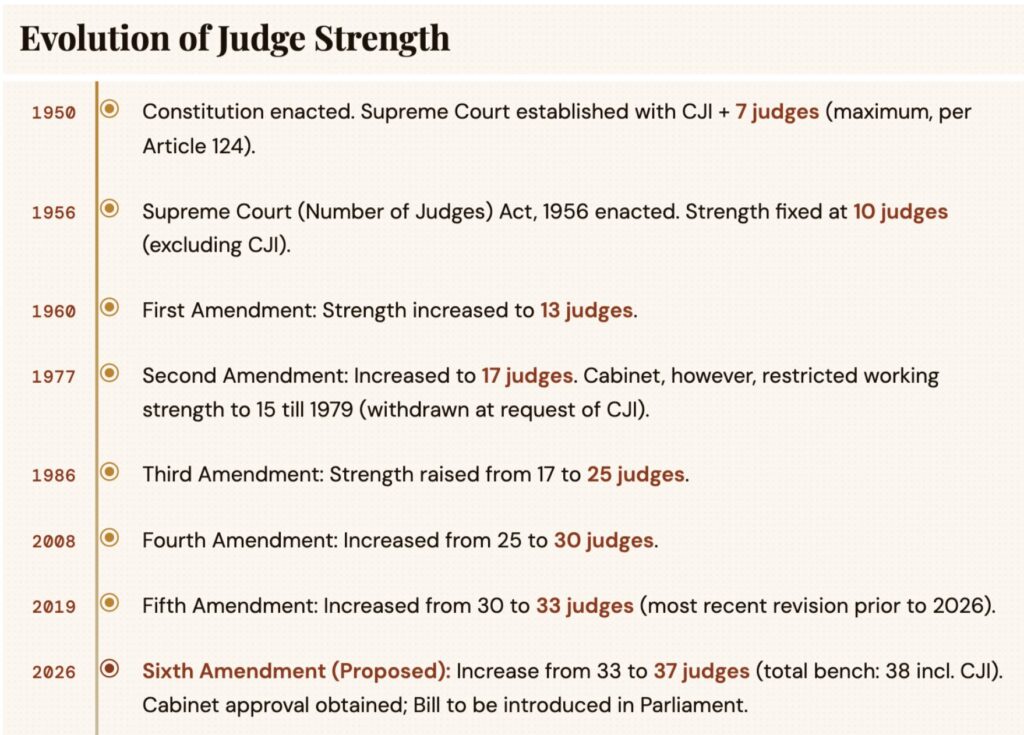
The Union Cabinet has cleared the Supreme Court (Number of Judges) Amendment Bill, 2026, to increase the strength of Supreme Court judges from 33 to 37 (excluding the Chief Justice of India). The bill seeks to amend the Supreme Court (Number of Judges) Act, 1956.

The total bench strength (including the CJI) will thus rise from 34 to 38. 

UPSC Relevance: GS-2 Polity and Governance: Judiciary

Prelims: Article 124; Appointment process of the Judiciary. 
Mains: Issues facing the Indian Judicial System. 

Constitutional & Legal Basis: 

  • Article 124(1) of the Constitution of India provides: “There shall be a Supreme Court of India consisting of a Chief Justice of India and, until Parliament by law prescribes a larger number, of not more than seven other Judges.”
    • This article gives Parliament the power to expand judicial strength through legislation, without requiring a constitutional amendment under Article 368. 
    • The Bill requires to be passed by both the Houses of Parliament with a simple majority. 

Salaries and allowances of SC judges are charged to the Consolidated Fund of India, a non-votable expenditure.

Timeline of Evolution of Judicial Strength: 

image 17

Significance of Expanded Sanctioned Strength: 

  • Reduction in Judicial Pendency: Over 92,000 cases are pending in the Supreme Court, spanning constitutional disputes, criminal appeals, civil matters, and PILs. The expansion aims to enhance the Court’s adjudicatory capacity and improve disposal rates.
  • Strengthening Constitutional Benches: A larger bench strength can facilitate: Frequent Constitution Bench formation, faster adjudication rate, and enhanced specialisation in commercial, technological, and environmental matters. 
  • Rule of Law & Access to Justice: The Supreme Court has held the right to a speedy trial as a component of Article 21. Thus, delays in justice delivery violate the fundamental right. Larger benches enable faster hearing of bail matters, habeas corpus, and fundamental rights cases. 
  • Greater scope for Diversity: Additional vacancies create an opportunity to improve representation in the higher judiciary by including: Women judges, Judges from underrepresented High Courts, SC/ST/OBC and minority communities and experts from specialised branches of law. 

Associated Challenges: 

  • Insufficient numbers: Even at 38, India has one SC judge per ~3.7 crore people, which is far below global standards. Former CJIs have called for a strength of 70+ judges. 
  • Structural delays in Appointment: Sanctioned strength increase is meaningful only if vacancies are filled swiftly. The collegium system (Second Judges Case 1993) controls appointments. Structural delays in the collegium-government interface remain unresolved. This can neutralise the benefit of increased sanctioned strength.
  • Collegium Opacity: The process of recommending names lacks statutory transparency, which raises concerns about accountability in judicial appointments. This can neutralise the scope for increasing diversity in judicial strength. 
  • Infrastructure gap: The existing Supreme Court building has been operating at near-capacity with 17 courtrooms and two registrar courts. Increased judges create an immediate need for additional dedicated support staff, specialised technical staff for digital, virtual, and hybrid hearing infrastructure.
  • Bottleneck at High Courts: Pendency in High Courts exceeds 60 lakh cases; District courts hold over 4 crore cases. The expansion of judicial strength alone is just a partial fix.

The expansion of SC’s sanctioned strength offers an opportunity to improve judicial efficiency and representation. However, the need of the hour is to address systemic issues in the collegium process (opacity, delays, and inadequate accountability) to strengthen the justice delivery system. 

UPSC Mains PYQ 2021:

Q. Discuss the desirability of greater representation of women in the higher judiciary to ensure diversity, equity and inclusiveness.

UPSC Mains PYQ 2017: 

Q. Critically examine the Supreme Court’s judgment on ‘National Judicial Appointments Commission Act, 2014’ with reference to the appointment of judges of the higher judiciary in India.

CJI’s Role in CEC and EC Appoint­ments was Tem­por­ary: SC 

Open article →Download PDF

Why in News?

The Supreme Court has begun hearing petitions challenging the constitutional validity of the Chief Election Commissioner and Other Election Commissioners (Appointment, Conditions of Service and Term of Office) Act, 2023, which excluded the Chief Justice of India (CJI) from the selection committee for appointing the Chief Election Commissioner (CEC) and Election Commissioners (ECs). 

The SC observed that the 2023 Supreme Court judgment requiring the CJI to be part of the selection process was designed to fill a legal vacuum and cannot automatically override a law subsequently enacted by Parliament.  

UPSC Relevance: GS-2 Polity and Governance: Constitutional Bodies

Prelims: Key facts about the Election Commission of India.
Mains: Election Commission of India: Associated Challenges. 

Election Commission of India: 

The Election Commission of India is a permanent, independent body established by the Indian Constitution to ensure free and fair elections in the country. 

  • Article 324 (1): Vests the superintendence, direction and control of elections to Parliament and State Legislatures in the Election Commission of India.
  • Art. 324(2): Appointments of CEC and ECs shall be made by the President, subject to any law made by Parliament. 

The Election Commission operated as a single-member body consisting only of the Chief Election Commissioner (CEC) till 1989. Presently, ECI is a three-member body comprising 1 CEC and 2 ECs. 

Appointment of the CEC and ECs: 

1. The Long Vacuum (1950- 2014): 

  • Article 324(2) of the Constitution required Parliament to enact a law for the appointment of the CEC and ECs. No such law was enacted for over seven decades. The appointments were made by the President of India on the advice of the Council of Ministers (effectively, the Prime Minister).

Advocate Anoop Baranwal filed a petition under Article 32 challenging the constitutionality of the executive-dominated appointment process, arguing it undermined the independence of the Election Commission. 

2. Anoop Baranwal v. Union of India (2023): 

  • The SC emphasised that the ECI must be insulated from executive dominance and directed that appointments should be made by a committee comprising:
    • Prime Minister of India
    • Leader of the Opposition
    • Chief Justice of India (CJI), until Parliament enacted a law. 

3. The CEC and Other EC (Appointment) Act, 2023: 

  • The Chief Election Commissioner and Other Election Commissioners (Appointment, Conditions of Service and Term of Office) Act was enacted in 2023. The President shall appoint the CEC and other ECs on the recommendation of a Selection Committee consisting of:
    • Prime Minister – Chairperson
    • Leader of the Opposition of the Lok Sabha – Member
    • Union Cabinet Minister to be nominated by the Prime Minister – Member

Criticism (Executive dominance and independence of ECI):

  • The Act replaces the CJI with a Union Cabinet Minister nominated by the Prime Minister in the selection committee, thus giving the executive an effective two-thirds voting majority. 
  • The key constitutional question is whether the 2023 Act violates constitutional principles such as institutional independence and free and fair elections. 

The Observation of the Supreme Court: 

The SC observed that the 2023 Supreme Court judgment in the Anoop Baranwal case was designed to fill a legal vacuum and cannot automatically override a law subsequently enacted by Parliament.  

  • Article 324(2) explicitly authorises Parliament to make a law regarding appointments.
  • The Anoop Baranwal judgment itself stated that the arrangement, including the CJI, would operate only until Parliament enacted a law.

The Election Commission is the guardian of free and fair elections, recognised as a basic structure of the Constitution. Any dilution of its institutional independence directly impacts democratic governance. 

UPSC PYQ 2017: 

Q. Consider the following statements:

1. The Election Commission of India is a five-member body.

2. The Union Ministry of Home Affairs decides the election schedule for the conduct of both general elections and bye-elections.

3. Election Commission resolves the disputes relating to splits/mergers of recognised political parties.

Which of the statements given above is/are correct?

(a) 1 and 2 only

(b) 2 only

(c) 2 and 3 only

(d) 3 only

Answer: (d) 

UPSC Mains PYQ 2022:

Q. Discuss the role of the Election Commission of India in the light of the evolution of the Model Code of Conduct. 

UPSC Mains PYQ 2018: 

Q. In the light of recent controversy regarding the use of Electronic Voting Machines (EVM), what are the challenges before the Election Commission of India to ensure the trustworthiness of elections in India?