3 current affairs published on Saturday, 8 November 2025
8 November 2025 Current Affairs for UPSC — every
Why-in-News article AnantamIAS published on Saturday, 8 November 2025, broken down with
Why in News?, the exact GS paper it feeds, sub-topic mapping, MCQ-ready facts and a
UPSC-style practice question. 3 articles in total, covering Polity, Economy, Environment, S&T, IR, Geography, History, Society and Internal
Security — the same Why-in-News + GS-paper-mapping + practice-question format the Compass uses across
every daily digest on the site.
Daily current affairs for UPSC is where new material enters your prep stream. Read this
8 November 2025 digest end-to-end in 25–35 minutes, attempt the practice question
at the foot of each article (it's MCQ for some, 10/15-marker for others), then bookmark the entries
that fall inside your active revision window. Everything stays cross-linked: tap any subject pill to jump
to that subject's hub, or use the table of contents above to skip straight to a specific story.
Why we publish daily current affairs separately from the monthly compilation: daily is learning,
monthly is revision. Use the daily page to add fresh material to your notes the day it breaks;
come back to the November 2025 compilation 60 days before Prelims when the
noise has settled and only the lasting takeaway is worth re-reading.
Context: Prime Minister Narendra Modi inaugurated the year-long commemoration of 150 years of the National Song “Vande Mataram” on 7th November 2025 at the Indira Gandhi Indoor Stadium, New Delhi. Written by Bankim Chandra Chatterjee on Akshaya Navami in 1875.
UPSC Relevance: Modern History.
PYQ:
Q. Who among the following is associated with ‘Songs from Prison’, a translation of ancient Indian religious lyrics in English? (2021)
Vande Mataram (meaning “I bow to thee, Mother”) is India’s national song, symbolizing reverence to the motherland and evoking patriotism and unity among citizens.
Written by:
Composed in Sanskritised Bengali by Bankim Chandra Chattopadhyay in the 1870s, it was first published in his novel Anandamath (1882).
History:
The song’s first public rendition was by Rabindranath Tagore at the 1896 Congress Session.
It became the anthem of India’s freedom struggle, sung in protests and revolutionary gatherings despite being banned by the British.
The Indian National Congress (1937) adopted its first two stanzas as the National Song, balancing inclusivity and secular appeal.
On January 24, 1950, the Constituent Assembly accorded Vande Mataram equal honour to the National Anthem “Jana Gana Mana.”
Features:
Spiritual Patriotism: Depicts the nation as a nurturing mother embodying both emotional and divine strength.
Secular Adaptation: Only the first two stanzas, devoid of religious imagery, are used officially to ensure inclusivity.
Cultural Symbolism: Serves as a unifying call cutting across linguistic and regional divides.
Historical Legacy: Its association with movements like Swadeshi (1905) and Quit India (1942) made it the lyrical soul of resistance.
Current Status:
Recognized by the Government of India as equal in stature to the National Anthem.
Instrumental version is played at the closing of every Parliament session.
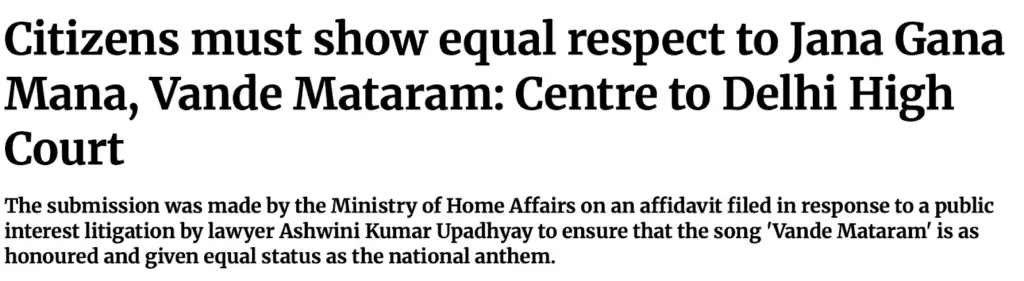
Citizens are encouraged to show equal respect to both Vande Mataram and Jana Gana Mana, as affirmed by a Delhi High Court affidavit (2022).
Context – The Forest Advisory Committee (FAC) of the Environment Ministry has recommended rationalising and standardising penalties imposed for violations of the Van (Sanrakshan Evam Samvardhan) Adhiniyam, 1980 (formerly the Forest Conservation Act).
Issue in brief:
Currently, states impose widely varying penalties for similar violations due to the absence of uniform guidelines. Earlier, authorities often required penal compensatory afforestation (penal CA)—restoring forest land equivalent to (or even double) the area illegally diverted. However, after the Supreme Court’s 2017 directions, the Ministry introduced penal Net Present Value (NPV)—a monetary penalty up to five times the standard NPV for unauthorized use of forest land. This created overlap and inconsistency between penal CA and penal NPV. The FAC now says that with penal NPV in place, penal CA must be rationalised to avoid double penalties, ensure proportionality, and bring uniform enforcement across states. A committee has submitted detailed recommendations (2024), which the Ministry is examining, to formalise a coherent national framework for dealing with forest violations.
What is Compensatory Afforestation?
It is the statutory mechanism by which the ecological loss caused by diversion of forest land for non-forest use is compensated by creating or improving forest cover on an equivalent area of non-forest land.
In simple terms: when forest is diverted (for a road, dam, mine, township, etc.), the project proponent must pay for and ensure planting and protection of forests elsewhere so that the net loss of the forest services is reduced.
Key terminologies associated with compensatory afforestation:
Terminology :
Explanation :
Compensatory Afforestation (CA)
Afforestation on equivalent non-forest land or double degraded forest land to compensate for forest diversion.
Net Present Value (NPV)
Monetary valuation of ecosystem services lost due to diversion; paid by project proponent.
Penal Compensatory Afforestation (Penal CA)
Additional afforestation imposed for illegal diversion or violation of clearance conditions.
Penal NPV
Financial penalty (up to 5× NPV) for illegal diversion as per Supreme Court directions.
CAMPA
Manages funds collected for CA/NPV; implementation done by State Forest Departments.
What is the process of compensatory afforestation?
Submission of proposal: The project proponent submits a proposal for diversion of forest land to the State Government. and the State Government sends the proposal to MoEFCC.
Scrutiny by the state & MoEFCC: Site inspection is done by the State Forest Department. Examination by the Regional Office (if area < 40 ha) and examination by the Forest Advisory Committee (FAC) (if major project). FAC evaluates: Ecological impact, Alternatives, Location feasibility and CA land suitability.
Stage-I approval (In-Principle Approval): MoEFCC grants Stage-I clearance with mandatory conditions like Identification & transfer of CA land, Payment of NPV (Net Present Value), Payment for CA cost, Provision for wildlife mitigation measures, FRA compliance requirements etc. NOTE (authoritative rule): At this stage, no work can start on the forest land.
Identification & transfer of CA Land:
Must be non-forest land equal in area to diverted forest land.
If non-forest land is not available: → CA is on degraded forest twice the diverted area.
CA land must be mutated in favour of State Forest Department.
Must be notified as Protected Forest.
The transfer must be completed before Stage-II approval.
Deposit of funds into CAMPA: CAMPA Act, 2016 & Rules 2018 mandates that the project proponent deposits:
CA cost
NPV charges
Additional wildlife mitigation charges
Any penal compensatory afforestation amount (if applicable)
Funds go to: State CAMPA Account and verified by Central CAMPA
Stage-II Approval (Final Approval): Forest (Conservation) Rules 2003/2023 mandates that MoEFCC issues Final Approval. After Stage-II approval, the project may begin work on forest land.
Implementation of compensatory afforestation: according to MoEFCC Guidelines 2009; CAMPA Rules 2018, after Stage-II clearance, State Forest Department (NOT the project proponent) carries out CA. The activities include:
Land preparation
Plantation using local/native species
Soil & moisture conservation
Boundary demarcation
Fire protection
Maintenance for 5–10 years
Funds for this are released by State CAMPA
What are the issues involved in this?
Poor ecological outcomes:
CAG Report (2013) and MoEFCC evaluation (2018) found plantation is often done on ecologically unsuitable lands and thus fails to achieve intended canopy density.
Monoculture plantations are often preferred and native species are ignored. Fast-growing exotics like Eucalyptus or Acacia deplete groundwater, reduce biodiversity, and offer low carbon storage — defeating the purpose of ecological restoration.
Carbon sequestration ability of newly grown trees can never match the ability to store Carbon Dioxide of old forests.
Legal and administrative issues:
Overlapping legal mandates: The Forest (Conservation) Act, CAMPA Act, and FRA (2006) overlap, creating procedural ambiguity. Example: timing of Gram Sabha consent — earlier before clearance, now (after 2023 rules) can be after in-principle approval, weakening community rights.
Post-clearance monitoring is poor; many CA sites are unverified or not geo-tagged.
Ineffective use of CAMPA funds:
Despite a corpus exceeding ₹95,000 crore (MoEFCC, 2024), utilisation remains poor (Delhi used only 23% during 2019–24).
CAG audit (2013) found discrepancies between funds released and plantation done
Funds often diverted to administrative or non-ecological works (like buildings or vehicles).
Social and Rights-Based Issues:
Many CA and diversion approvals ignore the Gram Sabha consent clause.
Plantations often restrict traditional use (fuelwood, NTFPs, grazing).
CA seldom designed to integrate with community-based forest management or Joint Forest Management Committees (JFMCs).
“Land for Land” Problem:
States struggle to find non-forest land for CA, leading to delay or use of degraded forest (2x area rule)
Quantitative bias, treating plantations as forests
Amendment-related
Narrow definition, new exemptions, diluted consent
“India’s compensatory afforestation system reflects a strong legal intent but weak ecological and social outcomes. Real compensation requires not just planting trees, but restoring ecosystems and empowering forest communities.”
What can be a way ahead?
Bring uniformity in Penal CA and Penal NPV by creating national uniform guidelines as recommended by Forest Advisory Committee report 2024.
Shift from plantation targets to ecological restoration standards as recommended by revised national Green India Mission. Focus should be given to native species composition, soil & moisture conservation, biodiversity recovery metrics, hydrological restoration.
Real time monitoring: following CAMPA rules 2018 for geo tagging, GIS monitoring, third party auditing and making the data public.
Strengthen community governance : Make Gram Sabha/JFMC participation compulsory in CA planning and introduce Livelihood Improvement Centres (as recommended under Revised GIM 2021).
Reform CAMPA fund utilisation and release mechanism: Parliamentary Standing Committee on Environment (2023) recommended performance-linked fund release based on verifiable survival rates and third party audit scores.
Context: The Election Commission (EC) is all set to announce the schedule for a country-wide roll-out of the Special Intensive Revision (SIR) of electoral rolls at a press conference in the next few days. The first phase of the process will be implemented in more than 10 States and one Union Territory, including election-bound Assam, Tamil Nadu, Puducherry, Kerala, and West Bengal.
UPSC Relevance
General Studies- II: Governance, Constitution, Polity, Social Justice and International relations.
Salient features of the Representation of People’s Act
What is SIR?
The Election Commission of India (ECI) is conducting Special Intensive Revision (SIR) of the electoral rolls to sanitize and upgrade voter lists. This will ensure that there are only genuine citizens in the lists and that errors such as duplication, registrations of deceased persons, and registrations of ineligible people are minimized. The SIR began as an experiment in Bihar ahead of the state’s Legislative Assembly elections in 2025. It is now a nationwide strategy that addresses issues that have existed for ages due to urbanisation, migration, and population change.
Key Constitutional Provisions
Article 324: Vests the ECI with superintendence, direction, and control over elections, including preparation of electoral rolls.
Article 326: Guarantees the right to vote to every citizen above 18 years, forming the bedrock of “one citizen, one vote.”
Statutory Framework: Representation of the People Act, 1950 (RP Act)
The RP Act operationalizes these provisions through a structured hierarchy of officials:
District Election Officer (DEO): District-level implementation.
Electoral Registration Officer (ERO) and Assistant EROs: Constituency-level preparation.
Booth Level Officers (BLOs): Grassroots verification and updates.
Section
Key Provision
Section 16
Disqualifies non-citizens from enrollment.
Section 19
Eligibility criteria: Age ≥18 on qualifying date (1st Jan/Apr/Jul/Oct); ordinarily resident in the constituency.
Section 20
Defines “ordinarily resident” – habitual, permanent ties; exceptions for service personnel, NRIs (via Section 20A, added 2010), and constitutional functionaries. Temporary absence does not disqualify.
Section 21
Authorizes summary revisions before elections and special revisions (like SIR) at ECI’s discretion, with recorded reasons.
The Registration of Electors Rules, 1960 (RER) supplements this, mandating self-declaration (Rule 8) and appeals (Section 24, RP Act) to DEO (15 days) and CEO (30 days).
Prelims Tip: Remember, electoral rolls are prepared per assembly constituency, aggregated for Lok Sabha segments. NRIs vote at their passport address.
Evolution and Need for SIR
Electoral rolls have undergone periodic updates since 1950, but rapid changes—India’s population grew from 36 crore in 1951 to 140 crore in 2021—necessitated intensive measures. Summary revisions occur annually or pre-election, but SIR is a “from-scratch” overhaul under Section 21.
Why SIR Now?
Demographic Pressures: Urbanization and migration led to 20+ years of unchecked additions/deletions in Bihar, risking duplicates (e.g., one person in multiple rolls) and ghost voters.
Constitutional Mandate: ECI’s duty under Article 326 to exclude non-citizens and include all eligibles.
Historical Precedent: Bihar’s last SIR was in 2003; nationwide efforts were sporadic until 2025.
The ECI’s June 24, 2025, order cited these as rationale, starting with Bihar (due for polls in November 2025) as a pilot.
Outcomes of Bihar SIR
The exercise achieved its core goals but sparked scrutiny over scale.
Metric
Before SIR (June 24, 2025)
After SIR (Sept 30, 2025)
Change
Total Electors
7.89 crore
7.42 crore
-47 lakh net
Additions
–
21.53 lakh (via Form 6)
+21.53 lakh
Deletions
–
65 lakh total (incl. 3.66 lakh ineligible)
-65 lakh
Success Factors: High stakeholder involvement (1.6 lakh BLAs, media campaigns); digital-physical roll access.
Challenges: Reports of errors (e.g., wrong photos, undeleted dead voters) in drafts; ~65 lakh deletions raised disenfranchisement fears, especially among migrants.
ECI hailed it as a “milestone,” but critics noted opaque deletion breakdowns.
Pros and Cons of SIR
Pros
Cons
Accuracy Enhancement: Removed duplicates/ghosts, ensuring “clean” rolls for fair polls.
Long-Term Integrity: Pilot for pan-India, addressing migration-induced duplicates.
Political Bias Allegations: Timing pre-Bihar polls fueled tampering claims.
Key Concerns: Migrants and Citizenship
Migrant Laborers
Ordinarily Resident Test: Gauhati HC (Manmohan Singh, 1999) emphasized “habitual/permanent” ties. Seasonal migrants (e.g., construction workers) retain home-state rolls, as they return periodically.
Impact: Strict enforcement could delete millions, disenfranchising them at work sites. Bihar SIR shared “permanently migrated” lists with parties, but many deletions affected returnees.
Citizenship Verification
ECI’s Limits: Not a Home Ministry function; SIR’s parentage proofs mimic NRC, burdening voters without legal authority.
Scale: Verifying 3 crore post-2003 entries in months was “gigantic,” per critics, leading to wrongful exclusions.
Judicial Scrutiny
The Association for Democratic Reforms (ADR) v. ECI (WP Civil 640/2025) challenged Bihar SIR as unconstitutional, alleging citizenship overreach and voter suppression.
Key Hearings: July 2025 petition; SC interim (July 10) allowed flexible docs. October 7/16 hearings—Bench (Justices Surya Kant, Joymalya Bagchi) adjourned, trusting ECI’s “awareness of duty” but directing detailed deletion data. Prashant Bhushan highlighted 21 lakh inclusions vs. 3.66 lakh exclusions, booth-level changes.
Status: Ongoing; next hearing pending.
Pan-India Rollout
Post-Bihar success, ECI announced phased SIR from November 2025:
Phase 1 (>10 States): 2026 poll-bound—Assam, Kerala, Puducherry, Tamil Nadu, West Bengal; others like Uttar Pradesh, Maharashtra follow.
Preparations: October 23 CEO meeting reviewed voter mapping, address standardization; TN prelims done.
Rationale: Nationwide duplicates/migration; Bihar as template.
Way Forward and Reforms
Legislative Push: Parliament to clarify ECI’s citizenship role; explore e-voting for 15 crore migrants.
Timeline Extensions: Stretch phases; integrate AI for verification.
Inclusive Documents: Mandate Aadhaar/ration cards; relax for migrants via self-declaration.
Migrant Protections: Amend RP Act/RER for remote voting; Aadhaar-seeding to curb multi-rolls without deletions.
Safeguards: BLAs as watchdogs; transparent deletion audits.