5 current affairs published on Friday, 7 November 2025
7 November 2025 Current Affairs for UPSC — every
Why-in-News article AnantamIAS published on Friday, 7 November 2025, broken down with
Why in News?, the exact GS paper it feeds, sub-topic mapping, MCQ-ready facts and a
UPSC-style practice question. 5 articles in total, covering Polity, Economy, Environment, S&T, IR, Geography, History, Society and Internal
Security — the same Why-in-News + GS-paper-mapping + practice-question format the Compass uses across
every daily digest on the site.
Daily current affairs for UPSC is where new material enters your prep stream. Read this
7 November 2025 digest end-to-end in 25–35 minutes, attempt the practice question
at the foot of each article (it's MCQ for some, 10/15-marker for others), then bookmark the entries
that fall inside your active revision window. Everything stays cross-linked: tap any subject pill to jump
to that subject's hub, or use the table of contents above to skip straight to a specific story.
Why we publish daily current affairs separately from the monthly compilation: daily is learning,
monthly is revision. Use the daily page to add fresh material to your notes the day it breaks;
come back to the November 2025 compilation 60 days before Prelims when the
noise has settled and only the lasting takeaway is worth re-reading.
Vessel Type and Class: INS Ikshak is the third vessel of the Survey Vessel Large (SVL) class. The earlier two vessels are:
INS Sandhayak (J18) (The first of the class)
INS Nirdeshak (J19) (The second of the class)
The ship was commissioned into the Indian Navy at a ceremonial event held at the Naval Base in Kochi on Thursday.
Strategic Importance: The commissioning significantly strengthens India’s hydrographic survey and maritime operational capabilities.
Versatile Platform: Beyond survey work, the ship is capable of operating as a platform for humanitarian assistance, disaster relief, and medical support operations.
Inclusivity Feature: INS Ikshak is the first SVL designed with dedicated women’s accommodation, highlighting the Navy’s commitment to inclusivity.
The fourth ship is named INS Sanshodhak (J24) and is currently launched, awaiting commissioning.
Sustainable Aviation Fuel (SAF)
The Minister for Civil Aviation, Ram Mohan Naidu, announced that the Centre will soon release a national policy on Sustainable Aviation Fuel (SAF).
SAF is aviation fuel derived from non-fossil sources.
“Drop-in” Fuel: Chemically similar to conventional jet fuel; can be blended (up to 50% currently) and used in existing aircraft engines and airport infrastructure without modification.
India’s Production Advantage: Minister Naidu highlighted India’s unique position as an agricultural powerhouse with over 750 million tonnes of available biomass, giving it the capacity to become a global leader in SAF production.
India has a surplus of 213 million tonnes of agricultural residue, along with adequate manufacturing capacity for SAF.
The global need for SAF is expected to rise sharply, from 2 million tonnes currently to 183 million tonnes by 2040.
India has set initial blending targets:
1% blending by 2027, requiring 30 million litres of SAF.
2% blending by 2028, requiring 62 million litres of SAF.
Local oil makers collectively have an annual production capacity of 70 million litres, indicating India is on course to meet domestic demand and emerge as a global producer.
GPS Spoofing
Aircraft flying over Delhi have been experiencing “severe” GPS spoofing for the past week. Occurrences have been reported within a 60-nautical-mile radius of the Capital.
Impact on Navigation: The spoofing is causing false navigation data, including incorrect aircraft positions and misleading terrain warnings.
Definition: GPS spoofing is a type of cyberattack that deliberately manipulates the Global Positioning System (GPS) signals a receiver is picking up.
The goal is to deceive the GPS receiver into calculating and displaying an incorrect position, navigation, and time (PNT) data, making the device (like an aircraft or ship) believe it is located somewhere it is not.
Safety Redundancy: Despite the issue, aircraft systems are built with several redundancies, such as the Inertial Reference System, which can operate safely for up to five hours even if a primary system fails.
Southeast Asia Scam Hubs
Recent Case: About 500 Indian citizens who fled the KK Park hub are set to be repatriated.
Scam centers are known as “compound crime” facilities—industrial, jail-like complexes secured by high walls and armed guards.
The model relies on human trafficking and forced labor to commit cybercrimes on an industrial scale.
Victims from countries including India, China, the Philippines, Vietnam, Africa, and Latin America are flown to regional hubs like Bangkok, then trafficked overland and forced across borders into Myanmar or Cambodia.
Once inside, passports are confiscated. Victims are told they have been “sold” and must work to pay off an invented “debt.” They endure 12-hour workdays running online scams and are tortured on refusal to work.
Example:KK Park in Myawaddy township, Karen State, Myanmar, is a notorious, purpose-built “scam city.”
Myanmar’s Civil War and Scam Hub Proliferation : The civil war and 2021 coup have created “failed state” conditions and a profound lack of rule of law, enabling scam centers to converge in inaccessible and autonomous non-state armed group-controlled territories and vulnerable border areas.
China’s crackdown (leading to the handover of 41,000 criminal suspects by the end of 2023), merely displaced operations south toward the Thai border (and to Mandalay and Yangon), causing scammers to pivot from Chinese victims to other nationalities.
Cambodia is a major hub, with centers in Sihanoukville, Bavet, and O’Smach, often in repurposed casinos or “Special Economic Zones.”
Criminal Enabler:The Huione Group, a financial services conglomerate, is identified as a “critical node” and the “world’s largest criminal marketplace” financially enabling these operations.
It allowed scammers to sell stolen data, malicious software, and money laundering services and broker deals between scammers and money “mules.”
A mule (specifically a money mule) is a person who is recruited to transfer or move illegally acquired money on behalf of criminals.
The “Pig Butchering” (Shà Thủ Pán) Scam – It’s a combined investment and romance scam where the term refers to “fattening” the victim (the pig) before “slaughtering” them (stealing all the money).
Scammers spend many days or weeks building trust with victims, often by faking a romantic relationship and they convince the victims to invest in fraudulent cryptocurrency platforms and then disappear with all the funds.
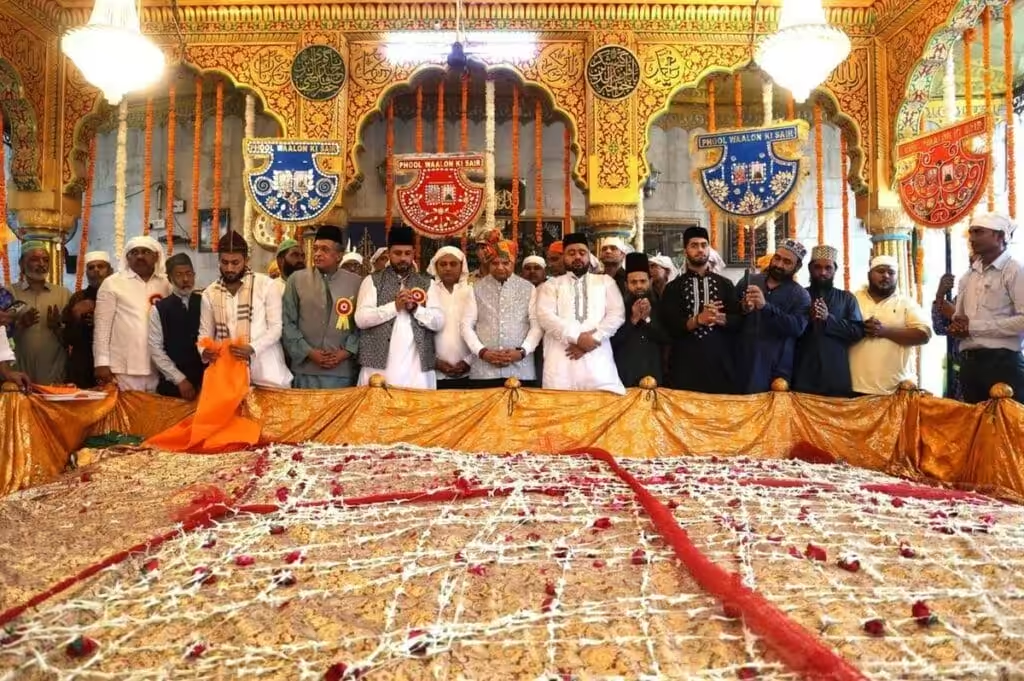
Why in News: Delhi’s centuries-old festival Phool Walon Ki Sair — symbolizing communal harmony — has been postponed to March 2026 due to delay and partial permissions from the Delhi Development Authority (DDA) for its venue at Aam Bagh, Mehrauli.
UPSC Relevance
Prelims, Questions are often asked about India’s cultural heritage and festivals.
PYQ
2017 Prelims
Consider the following pairs:
Traditions – Communities
1. Chaliha Sahib Festival – Sindhis
2. Nanda Raj Jaat Yatra – Gonds
3. Wari-Warkari – Santhals
Which of the pairs given above is/are correctly matched?
a) 1 only
b) 2 &3 only
c) 1 & 3 only
d) None of the above
2014 Prelims
Every year, a month-long ecologically important campaign/festival is held during which certain communities/tribes plant samplings of fruit-bearing trees. Which of the following are such communities/tribes?
a) Bhutia and Lepcha
b) Gond and Korku
c) Irula and Toda
d) Sahariya and Agariya
Phool Walon Ki Sair
Meaning: “Procession of the Flower Sellers.”
Celebrated in: Mehrauli, Delhi.
Nature: Week-long festival of Hindu–Muslim unity, reflecting Delhi’s Ganga–Jamuni tehzeeb.
Main Rituals: Floral offerings at Dargah of Khwaja Bakhtiar Kaki (Muslim site), and Temple of Goddess Yogmaya (Hindu site).
Organizer: Anjuman Sair-e-Gul Faroshan society.
Participants: Local citizens, artisans, and flower sellers.
Historical Background
Origin (1811): Started under Mughal Emperor Akbar Shah II; initiated by Queen Mumtaz Mahal Begum after fulfillment of a wish.
Banned (1942): Stopped by British during Quit India Movement.
Revived (1962): By PM Jawaharlal Nehru to promote secularism and India’s pluralistic ethos.
Phool Walon Ki Sair is a living symbol of India’s secular and syncretic heritage that links Mughal heritage with modern Delhi.It has also supported local artisans and flower sellers. Its postponement highlights tensions between urban governance and cultural freedom, underlining the need for sensitive heritage management.
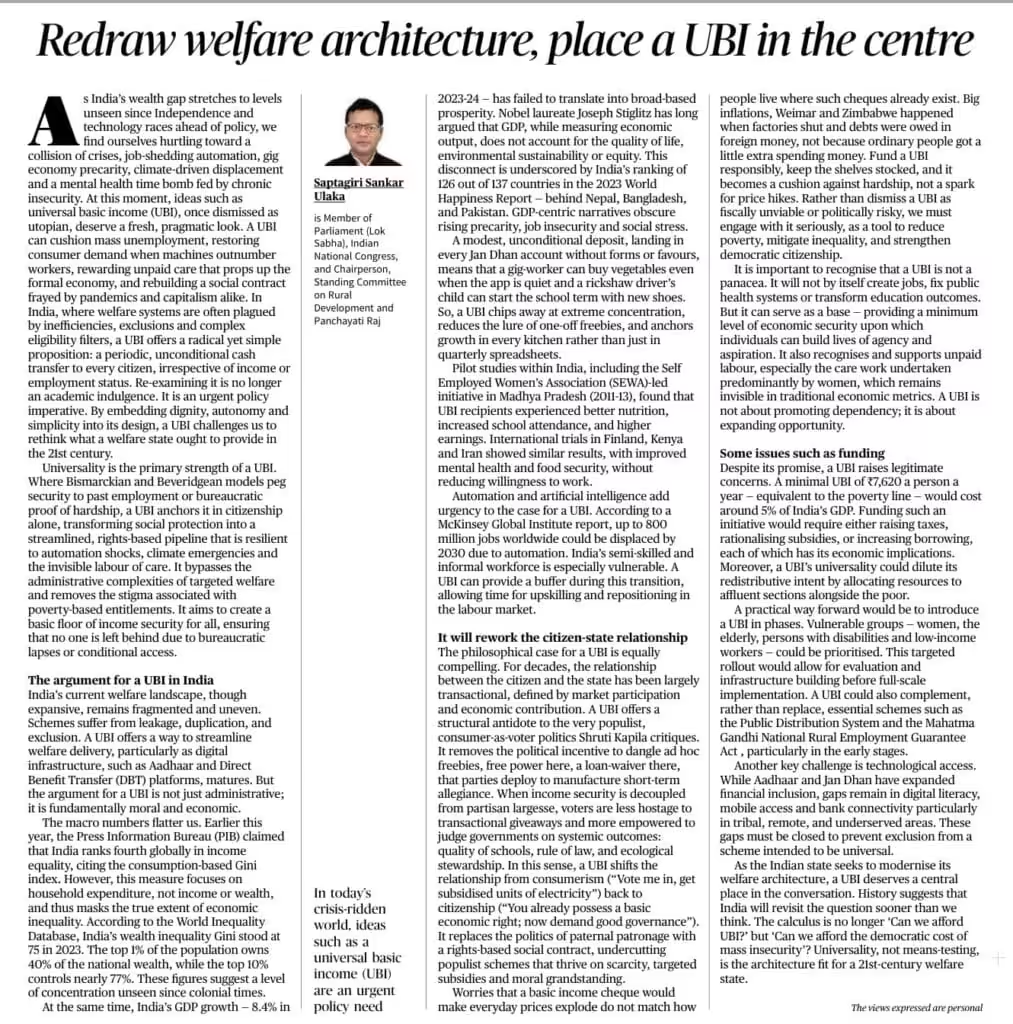
India’s current welfare system faces challenges like bureaucratic inefficiency, exclusion errors, and duplication of benefits. Amid economic slowdown, jobless growth, and rising automation, the author argues that India needs a universal, unconditional income transfer to ensure economic security and dignity for all citizens.
UPSC Relevance:
Economy and Social Justice
UPSC PYQ:
Q. Professor Amartya Sen has advocated important reforms in the realms of primary education and primary health care. What are your suggestions to improve their status and performance? (2016)
Universal Basic Income:
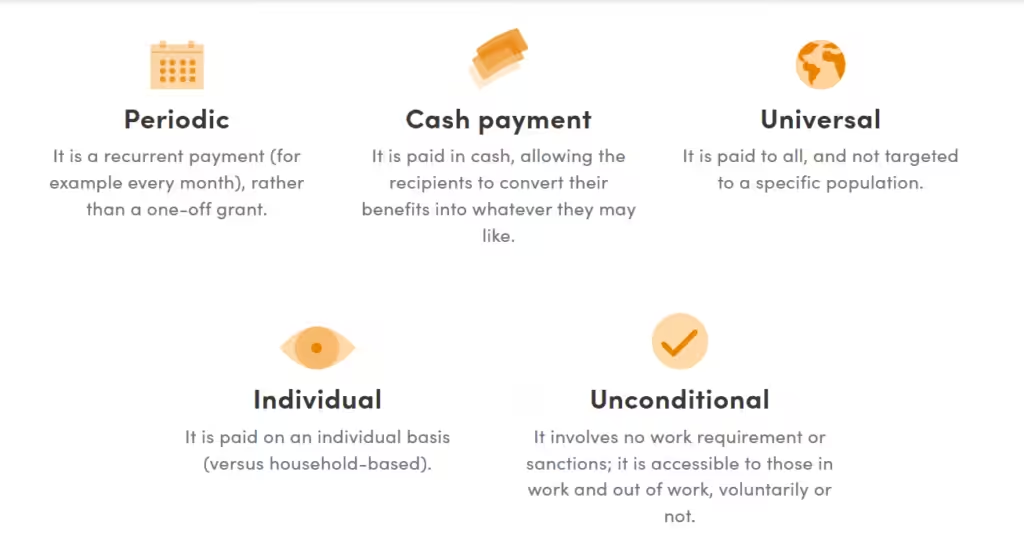
According to IMF: Universal basic income is an income support mechanism typically intended to reach all (or a very large portion of the population) with no (or minimal) conditions.
History of UBI:
In recent years, UBI went from a utopian proposal to a policy with growing currency. UBI experiments have been conducted in countries as different as Kenya, Finland, Namibia, India, and Canada.
In the United States, variants of the UBI proposal were very much alive in the early second half of the twentieth century—including through figures like Martin Luther King, Jr., and Milton Friedman—but the conversation did not pick up much in subsequent decades.
In India UBI debate first formally introduced in the 2016–17 Economic Survey as a possible future welfare model.
Adapted from Bidadanure, 2019, “The Political Theory of Universal Basic Income”
Why UBI is needed?:
Growing unemployment and informal labour issues.
Automation and AI threatening job security.
Rising inequality despite high GDP growth.
Policy discussions around rationalizing subsidies and Direct Benefit Transfer (DBT) inefficiencies.
Status of Universal Basic Income (UBI) in India
India currently does not have a full, nationwide Universal Basic Income (UBI) scheme.
However, the country has actively debated the concept and has implemented several large-scale Direct Benefit Transfer (DBT) cash schemes that function as a targeted or partial basic income for specific vulnerable groups.
The discussion around UBI gained significant policy traction after the Economic Survey 2016-17 formally proposed the idea as an alternative to the government’s complex web of subsidies and welfare programs.
Aspect
Description
Feasibility
India’s robust Jan-Dhan-Aadhaar-Mobile (JAM) trinity infrastructure has made the direct, digital transfer of cash (DBT) feasible on a massive scale, which is essential for a UBI system.
Pilot Projects
Small-scale, time-bound UBI pilots have been conducted, such as the SEWA (Self-Employed Women’s Association) pilot in Madhya Pradesh (2011-2012). These pilots showed positive impacts on health, nutrition, and productive investments without significantly discouraging work.
Challenges
The primary hurdles remain the high fiscal cost (estimated at 3.5% to 11% of GDP, depending on the benefit level), the risk of inflationary pressures, and the debate over replacing existing, well-established welfare schemes (like the Public Distribution System or MGNREGS).
In short, India is moving towards a model of Targeted Basic Income by expanding unconditional cash transfers to specific sections of the population rather than implementing a true universal scheme for all citizens.
Key Cash Transfer Schemes Resembling UBI
1. PM-KISAN (Pradhan Mantri Kisan Samman Nidhi)
Target Group: Landholding farmer families across the country (subject to specific exclusion criteria, like being a taxpayer or institutional landholder).
Mechanism: Unconditional income support.
Benefit:₹6,000 per year (transferred in three equal instalments of ₹2,000 every four months).
2. State-Specific Basic Income Schemes (Targeting Women)
Scheme Name
State
Monthly Benefit (Approx.)
Gruha Lakshmi
Karnataka
₹2,000
Mukha Mantri Ladli Behna Yojana
Madhya Pradesh
₹1,250
Kalaignar Magalir Urimai Thittam
Tamil Nadu
₹1,000
3. Rythu Bandhu Scheme (Telangana)
Benefit:₹10,000 per acre per year (₹5,000 per crop season for Kharif and Rabi).
Target Group: Land-owning farmers.
Mechanism: Unconditional cash transfer for investment support.
Arguments in Favour and Against UBI:
Favor
Against
Poverty and vulnerability reduction Poverty and vulnerability will be reduced in one fell swoop
Conspicuous spending Households, especially male members, may spend this additional income on wasteful activities.
Choice A UBI treats beneficiaries as agents and entrusts citizens with the responsibility of using welfare spending as they see best; this may not be the case with in-kind transfers.
Moral hazard (reduction in labour supply) A minimum guaranteed income might make people lazy and opt out of the labour market.
Better targeting of poor As all individuals are targeted, exclusion error (poor being left out) is zero though inclusion error (rich gaining access to the scheme) is 60 percent.
Gender disparity induced by cash Gender norms may regulate the sharing of UBI within a household – men are likely to exercise control over spending of the UBI. This may not always be the case with other in-kind transfers.
Insurance against shocks This income floor will provide a safety net against health, income and other shocks
Implementation Given the current status of financial access among the poor, a UBI may put too much stress on the banking system.
Improvement in financial inclusion Payment – transfers will encourage greater usage of bank accounts, leading to higher profits for banking correspondents (BC) and an endogenous improvement in financial inclusion. Credit – increased income will release the constraints on access to credit for those with low income levels.
Fiscal cost given political economy of exit Once introduced, it may become difficult for the government to wind up a UBI in case of failure.
Psychological benefits A guaranteed income will reduce the pressures of finding a basic living on a daily basis.
Political economy of universality – ideas for self-exclusion Opposition may arise from the provision of the transfer to rich individuals as it might seem to trump the idea of equity and state welfare for the poor.
Administrative efficiency A UBI in place of a plethora of separate government schemes will reduce the administrative burden on the state.
Exposure to market risks (cash vs. food) Unlike food subsidies that are not subject to fluctuating market prices, a cash transfer’s purchasing power may severely be curtailed by market fluctuations.
“Wiping every tear from every eye” based on the principles of universality, unconditionality, and agency—the hallmarks of a Universal Basic Income (UBI)—is a conceptually appealing idea.
Context: The Supreme Court of India is presently examining a critical constitutional question:
Is the freedom to vote a fundamental right under Article 19(1)(a), distinct from the right to vote, which is merely statutory under the Representation of the People Act, 1951?
The Union Government has argued that while the Right to Vote (RTV) is conferred purely by statute, the Freedom of Voting (FoV) — i.e., the act of expressing choice or dissent — is protected as a facet of freedom of speech and expression.
This debate was triggered by petitions challenging Section 53(2) of the RPA, 1951 and corresponding rules that allow automatic declaration of victory in uncontested elections, effectively denying citizens the opportunity to vote or express dissent via the NOTA (None of the Above) option.
UPSC relevance
Right to vote and to be elected in India is a (2017)
A Fundamental Right
B Natural Right
C Constitutional Right
D Legal Right
Centre’s Stance and Strategic Legal Position
The Centre’s affidavit carefully distinguishes two aspects:
Concept
Legal Character
Constitutional Basis
Right to Vote (RTV)
Statutory
Derived from Article 326 but operationalized by RPA 1951 – Section 62
Freedom of Voting (FoV)
Fundamental
Protected under Article 19(1)(a) as freedom of political expression
This nuanced stance allows the government to acknowledge FoV as a fundamental right (aligning with PUCL 2003 and NOTA 2013 judgments) while restricting judicial interference in procedural matters like uncontested elections, thereby keeping legislative control intact.
Conceptual Framework: Jus Suffragii vs Libertas Suffragii
Concept
Meaning
Legal Status
Jus Suffragii (Right to Vote)
Procedural right – permission to participate in elections
Constitutional / Statutory (Art 326 + RPA 1951)
Libertas Suffragii (Freedom of Voting)
Substantive right – freedom to express consent, dissent or neutrality
Fundamental (Art 19(1)(a))
Thus, RTV is quantitative — it grants the citizen access to the process; FoV is qualitative — it ensures that this process has expressive value and democratic meaning.
Constitutional and Statutory Framework
Article 326 – The Constitutional Foundation
Article 326 ensures adult suffrage, giving every citizen above 18 years the right to be included in the electoral roll.
However, courts have consistently held this to be a constitutional right, not a fundamental one.
It remains subject to legislative regulation under Articles 327–328, empowering Parliament and State Legislatures to make laws on the conduct of elections.
This constitutional design ensures flexibility in electoral administration without constant judicial scrutiny under Article 13.
Representation of the People Act, 1951 – Statutory Conferral
Section 62: Only registered voters can vote; disqualified persons (under RPA 1950, s. 16) cannot.
Section 53(2): When candidates equal seats → Returning Officer declares them elected without a poll.
Section 79(d): Defines electoral right – includes right to vote or refrain from voting.
Hence, the Right to Vote is a conferred privilege, not an inherent natural or fundamental right. It exists within the procedural confines of the RPA 1951.
Freedom of Voting (FoV) under Article 19(1)(a)
The Expression Dimension
Voting is a form of political speech. The act of choosing, rejecting, or abstaining embodies a voter’s political preference.
Judicial interpretation of Article 19(1)(a) includes the right to information, dissent, and silence – all essential to meaningful participation in democracy.
Limits under Article 19(2)
Any restriction on FoV must meet the test of reasonableness under Article 19(2).
Administrative or procedural convenience (like uncontested polls) cannot override this higher constitutional guarantee unless justified under the narrow grounds of sovereignty, security, or public order.
Judicial Evolution of FoV
Case
Year
Principle Established
Impact
PUCL v Union of India (2003)
2003
Distinguished Right to Vote (statutory) from Freedom of Voting (fundamental). Upheld secrecy of the ballot and voter choice as expression.
Constitutionalized the expressive element of voting.
PUCL v Union of India (NOTA Case)
2013
Recognized the right to dissent and NOTA as an extension of Article 19(1)(a).
Introduced NOTA button on EVMs → voter disapproval became visible, countable expression.
Shailesh Manubhai Parmar v ECI
2018
Held NOTA inapplicable to indirect elections (Rajya Sabha) – FoV cannot undermine parliamentary voting discipline.
Contextual limits of FoV clarified.
Interpretive Takeaway:
The Freedom of Voting (FoV) is an expression of democratic conscience; the Right to Vote (RTV) is a legislative instrument enabling it. When the two collide, constitutional expression must prevail over statutory convenience.
The Current Legal Flashpoint – Uncontested Elections and Section 53(2)
The Statutory Barrier
Section 53(2) directs that when candidates equal seats, the Returning Officer must declare them duly elected – no poll is held. This extinguishes any opportunity for voters to express dissent via NOTA, making FoV functionally meaningless in uncontested constituencies.
The Centre’s Defense
NOTA is not a candidate (RPA s. 79(b)); it is an expression, not an electoral contestant.
Hence, Section 53(2) remains valid until Parliament amends the RPA.
Treating NOTA as a candidate would create legislative consequences (re-polls, disqualifications) that exceed judicial competence.
Judicial Concerns
The Supreme Court has questioned whether automatic victory without polling undermines the substantive democratic will. The Bench observed that if large sections of voters are dissatisfied, the law should not render their collective silence invisible. This case therefore tests the boundary between parliamentary supremacy and constitutional expression.
Synthesis & Comparative Perspective
Feature
Right to Vote (RTV)
Freedom of Voting (FoV)
Legal Status
Constitutional + Statutory (Art 326 / RPA 1951)
Fundamental (Art 19(1)(a))
Nature
Procedural (Jus Suffragii)
Substantive / Expressive (Libertas Suffragii)
Scope
Eligibility, registration, act of voting
Informed choice, dissent (NOTA), information on candidates
Limitations
Disqualifications under RPA
Only reasonable restrictions under Art 19(2)
Protection Level
Ordinary legislative regulation
Strong constitutional scrutiny
The Road Ahead: Reform and Institutional Balance
1. Need for Statutory Realignment
To align FoV with constitutional ideals, reforms could include:
Amending Section 53(2) to mandate polling even in uncontested constituencies.
Defining NOTA as a recognized electoral category.
Prescribing re-election or disqualification in case of NOTA majority.
2. Separation of Powers
While judiciary guards fundamental freedoms, legislative initiative must translate expressive rights into enforceable electoral consequences. The Supreme Court may either strike down Section 53(2) as unconstitutional or direct Parliament to amend the RPA in conformity with Article 19(1)(a).
Conclusion
The distinction between the Right to Vote (RTV) and Freedom of Voting (FoV) lies at the heart of India’s constitutional democracy.
RTV → the means; FoV → the meaning.
RTV → granted by statute; FoV → protected by the Constitution.
Judicial activism—from PUCL (2003, 2013) to Shailesh Parmar (2018)—has transformed Indian elections from a mechanical process into an expressive democratic act. Yet, Section 53(2) exposes a structural flaw: procedural law currently suppresses fundamental expression.
Whether the Supreme Court chooses to strike down the provision or Parliament amends it, the outcome will decide whether India’s democracy remains quantitatively procedural or becomes qualitatively participatory.
The future of electoral democracy depends on whether the law merely counts votes or truly hears voices.
Union Finance Minister Nirmala Sitharaman said the Centre is holding discussions with the lenders and the Reserve Bank of India (RBI) for creating a ‘lot of big and world-class banks.
Q. With reference to the rule/rules imposed by the Reserve Bank of India while treating foreign banks, consider the following statements: [2024]
1. There is no minimum capital requirements for wholly owned banking subsidiaries in India.
2. For wholly owned banking subsidiaries in India, at least 50% of the board members should be Indian nationals.
Which of the following Statement is Correct?
(a) 1 only
(b) 2 only
(c) Both 1 and 2
(d) Neither 1 nor 2
Global Status of Indian Banks
Improved Financial Health: Indian banks have demonstrated a remarkable recovery from past stress, with improved asset quality, net interest margins, and credit growth, making them “far more mature” than a decade ago, according to the RBI Governor.
Global Ranking: Several Indian banks feature among the top global and Asia-Pacific lists, primarily based on market capitalization:
HDFC Bank, ICICI Bank, and the State Bank of India (SBI) are often cited among the top 25 global banks by market capitalization. For instance, in late 2024 data, HDFC Bank, ICICI Bank, and SBI ranked 13th, 19th, and 24th, respectively, globally by market cap.
In a ranking by assets in the Asia-Pacific region, SBI, HDFC Bank, and ICICI Bank were included in the top 50.
Focus on ‘World-Class’ Banks: The Indian government is actively pursuing the creation of more large, “world-class banks,” which may involve further consultation with the RBI and possible future consolidation or mergers.
International Hub Development: Initiatives like the International Financial Services Centre (IFSC) in GIFT City are working to increase the global financial activities of Indian banks, including evaluating transactions in offshore currencies like the Renminbi (CNH).
Large Banks in India
HDFC Bank is the largest by market capitalization, and also a leader in terms of total assets following its merger with HDFC Ltd.
State Bank of India (SBI) is generally considered the largest bank in India by total assets and overall size.
Need for Consolidation:
PSBs are fragmented, especially in comparison with other key economies.
The merger will enable the government to pay closer operational attention to the enlarged institution.
To protect the financial system and depositors’ money.
To build capacity to meet credit demand and sustain economic growth.
The need to bridge geographical gaps.
In 1991 Narasimhan Committee suggested that India should have fewer but stronger PSBs.
Positives:
Capital will be higher when merged together and will give a feeling of a stronger bank.
Large banks with larger lending capacity.
It will provide efficiencies of scale and help improve the quality of corporate governance for the banks.
Improvement in operational efficiency.
Cost of funds for the merged entity is expected to come down.
Bigger banks can attract more Current Account, Savings Account (CASA) deposits.
Banks will have the capacity to raise resources without depending on the State exchequer.
Improve the capacity of the banking system to absorb shocks that the markets may cause to it.
Technical inefficiency is one of the main factors responsible for banking crisis. The scale of inefficiency is more in case of small banks. Hence, merger would be good.
Mergers help small banks to gear up to international standards with innovative products and services with the accepted level of efficiency.
This will also end the unhealthy and intense competition going on even among public sector banks as of now. In the global market, the Indian banks will gain greater recognition and higher rating.
The volume of inter-bank transactions will come down, resulting in saving of considerable time in clearing and reconciliation of accounts.
The burden on the central government to recapitalize the public sector banks again and again will come down substantially.
Mergers make sure there is common unifying messaging.
Challenges:
Merger will affect regional flavour and end regional focus.
The argument that size is going to determine the future of the bank in a globalised scenario is facile. Remember the fate of large global banks, which collapsed during the global financial crisis? On the contrary, small banks have survived the crisis due to their nimbleness and the niche areas they operate in.
Immediate negative impact would be from pension liability provisions (due to different employee benefit structures) and harmonisation of accounting policies for bad loans recognition.
There are many problems to adjust top leadership in institutions and the unions.
Mergers will result in shifting/closure of many ATMs, Branches and controlling offices, as it is not prudent and economical to keep so many banks concentrated in several pockets, notably in urban and metropolitan centres.
The weaknesses of the small banks may get transferred to the bigger bank also.
New power centres will emerge in the changed environment. Mergers will result in clash of different organizational cultures. Conflicts will arise in the area of systems and processes too.
When a big bank books huge loss or crumbles, there will be a big jolt in the entire banking industry. Its repercussions will be felt everywhere.
Also, India right now needs more banking competition rather than more banking consolidation. In other words, it needs more banks rather than fewer banks. This does not mean that there should be a fetish about small-scale lending operations, but to know that large banks are not necessarily better banks.
Integration of technology platforms and cultures of these organisations.
The quantum of Gross NPA (GNPA) cannot change and will still have to be addressed.
Mergers are not the panacea in the context of PSBs
What should be ensured by the government?
The government shall not have any hidden political agenda, in bank mergers.
All stakeholders are taken into confidence, before the merger exercise is started.
After mergers, shares of public sector banks shall not be sold to foreign banks, foreign institutions and Indian corporate entities, beyond certain limit.
Whenever further divestment (dilution of government holdings) takes place, the government shareholdings shall not fall below 51% under any This will ensure that the ownership and control of public sector banks remain with the government.
The central government shall not rush through the process of bank mergers.
The decision with regard to selection of smaller/weaker banks for merger with larger/stronger banks is to be taken carefully and grouping of various banks for this purpose is the key issue involved. The government shall not yield to pressure from any political or social groups.
The acquiring bank shall not attempt to dominate or subsume the acquired bank. Good aspects of both the banks before merger shall be combined, in order to instil confidence in all stakeholders and to produce better results.
Personnel absorbed from the smaller bank shall undergo brief, intermittent training programs to get acquainted with the philosophies, processes and technology in the new environment. The management must be ready with a good roadmap for this and allot considerable budgetary resources for this purpose.
There shall be conscious and organized efforts to synthesize the differing organizational cultures, for the mergers to yield the desired results.
Conclusion:
Over the years economy has grown steadily, banking reforms have been steady and now it is the time for transformative change.
Merger is a good idea but should be carried out with right banks for right reasons.
Without addressing the governance issues in the banks, merging two or three public sector banks may not change the architecture.
Need proper management structure and selection of impactful CEO’s.
Merger only doesn’t improve performance matrix, it should happen with the package of many other things like having additional capital.
For economic growth to happen huge companies need credit and capital so actually mergers should have happened few years earlier.
Piecemeal consolidation will not provide a lasting solution and what is required is an integrated approach from all stakeholders including the government.