Why in News?
The Hindu reported in August 2026 on a peer-reviewed Science study in which genome language models helped design complete, functional bacteriophage genomes .
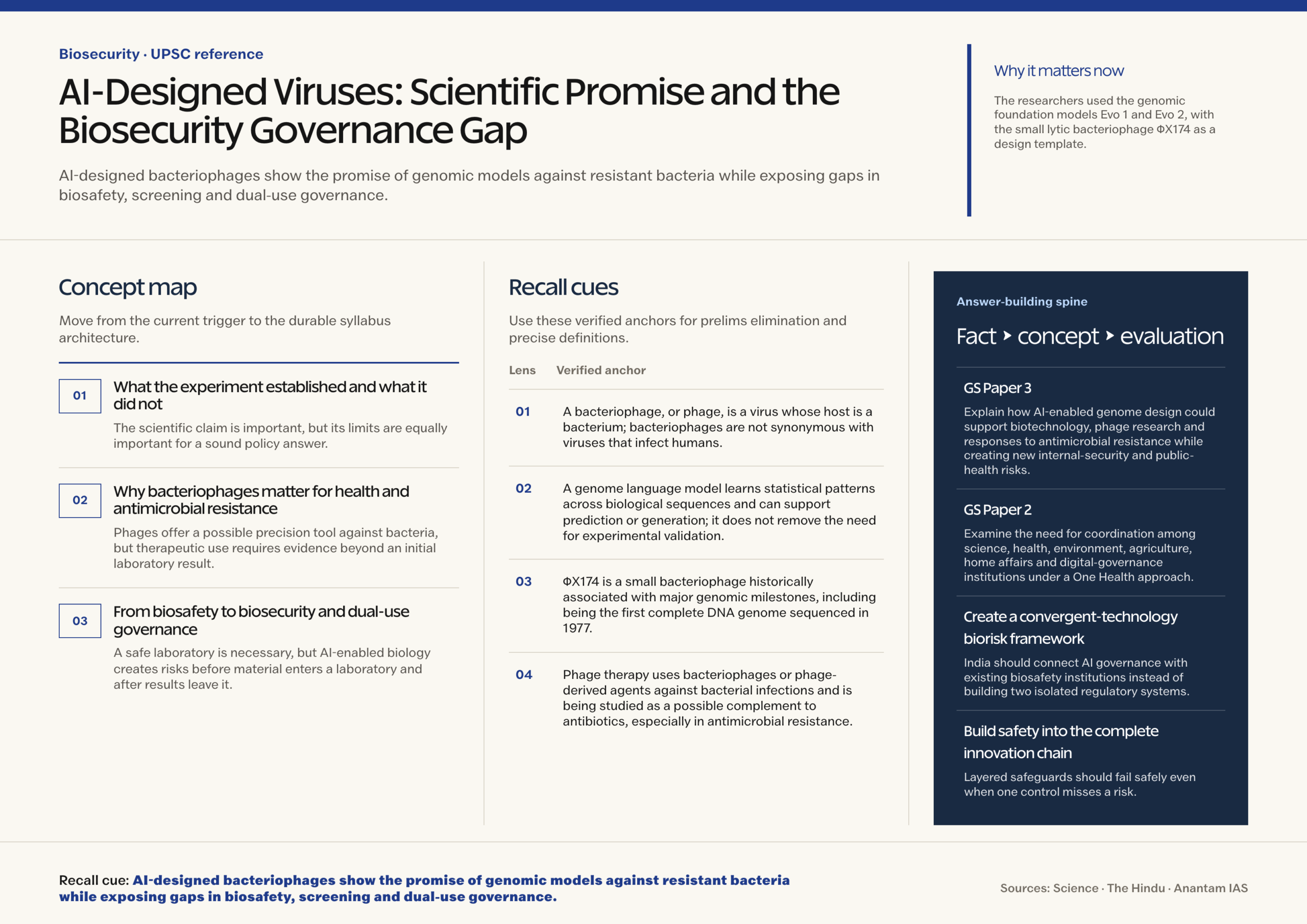
- The researchers used the genomic foundation models Evo 1 and Evo 2, with the small lytic bacteriophage ΦX174 as a design template.
- Experimental evaluation of 285 selected designs yielded 16 viable bacteriophages; the study did not create a virus capable of infecting humans, animals or plants.
- The successful phages retained a restricted host range in the tested laboratory system, while some contained combinations and mutations not observed in known natural sequences.
- Cocktails assembled from the generated phage diversity overcame resistance in three laboratory-evolved E. coli strains within the reported experimental setting, indicating a possible future route for phage therapy research.
- The authors excluded eukaryotic viruses from the relevant training data and used non-pathogenic bacterial hosts as safeguards, but model-level controls do not by themselves govern every future user, dataset, synthesis provider or laboratory.
- Bacteriophages are viruses that infect bacteria. Calling the study simply the creation of dangerous human viruses would be scientifically inaccurate and would inflate the immediate risk.
- The durable policy issue is capability diffusion: as AI models, biological data and DNA synthesis become more accessible, safety must cover the full research lifecycle rather than only the final laboratory experiment.
- India already has institutional biosafety machinery for recombinant DNA research and hazardous microorganisms, but AI-enabled biological design adds questions about computational screening, model access, provenance and cross-border coordination.
UPSC Relevance
Prelims Relevance
- A bacteriophage, or phage, is a virus whose host is a bacterium; bacteriophages are not synonymous with viruses that infect humans.
- A genome language model learns statistical patterns across biological sequences and can support prediction or generation; it does not remove the need for experimental validation.
- ΦX174 is a small bacteriophage historically associated with major genomic milestones, including being the first complete DNA genome sequenced in 1977.
- Phage therapy uses bacteriophages or phage-derived agents against bacterial infections and is being studied as a possible complement to antibiotics, especially in antimicrobial resistance.
- Biosafety primarily addresses accidental exposure or release, while biosecurity addresses loss, theft, diversion, unauthorised access and deliberate misuse; real biorisk management needs both.
- Dual-use research has legitimate scientific or public-health value but may also yield knowledge, methods or capabilities that can be misapplied to cause harm.
Mains Relevance
GS Paper 3
- Explain how AI-enabled genome design could support biotechnology, phage research and responses to antimicrobial resistance while creating new internal-security and public-health risks.
- Assess whether India’s present biosafety architecture can evaluate computational design, model access and synthesis screening in addition to conventional laboratory containment.
GS Paper 2
- Examine the need for coordination among science, health, environment, agriculture, home affairs and digital-governance institutions under a One Health approach.
- Evaluate the role and limitations of the WHO framework and the Biological Weapons Convention in governing fast-moving convergent technologies.
Essay
- Scientific freedom becomes durable only when institutions earn public trust through proportionate safeguards and accountable research practice.
Background and Context
What the experiment established and what it did not
The scientific claim is important, but its limits are equally important for a sound policy answer.
- The study showed that a genome language model could propose complete sequences from which researchers obtained functional bacteriophages. This is stronger evidence than a computer prediction alone because biological activity was observed experimentally.
- The viable phages infected the tested E. coli laboratory hosts. Bacteriophages depend on compatible bacterial receptors and cellular machinery; the result does not mean the generated viruses could infect human cells.
- Only 16 of the 285 experimentally evaluated designs were viable. That gap illustrates why generated sequence plausibility and real biological function are different questions.
- Some viable designs displayed substantial evolutionary novelty, showing that a model may search parts of sequence space not represented by a simple copy of a known natural virus.
- The result is a proof of capability, not evidence that general-purpose AI can reliably design any desired pathogen. Larger genomes, different host systems, safety constraints and complex biological interactions present harder problems.
Why bacteriophages matter for health and antimicrobial resistance
Phages offer a possible precision tool against bacteria, but therapeutic use requires evidence beyond an initial laboratory result.
- A lytic phage reproduces in a susceptible bacterium and destroys that bacterial cell. Its host specificity can reduce effects on unrelated microbes, unlike a broad-spectrum antibiotic, but the same specificity can narrow clinical coverage.
- AI-assisted design could expand the diversity of candidate phages and help researchers explore bacterial resistance mechanisms more systematically. This may support future personalised or targeted phage therapy against drug-resistant infections.
- The reported phage cocktails overcame resistance in three evolved bacterial strains in the study’s controlled system. This is promising preclinical evidence, not proof of safety or effectiveness in human patients.
- Clinical translation must examine toxicity, immune responses, bacterial host range, manufacturing consistency, resistance evolution and the possibility that a phage carries undesirable genes.
- The public-health rationale is strong because antimicrobial resistance reduces the effectiveness of existing medicines. Phage tools should complement antibiotic stewardship, infection prevention, surveillance and the search for new antimicrobials rather than replace them.
From biosafety to biosecurity and dual-use governance
A safe laboratory is necessary, but AI-enabled biology creates risks before material enters a laboratory and after results leave it.
- Biosafety reduces accidental exposure and release through risk assessment, containment, training, protective equipment and incident management. Biosecurity protects biological material, technology and information against unauthorised access, diversion or deliberate misuse.
- Dual-use research of concern is not defined by malicious intent alone. Legitimate work may generate methods, information or capabilities that could be misapplied, so governance must assess foreseeable consequences as well as purpose.
- AI changes the risk surface because the design stage can occur digitally, models and datasets can move across borders, and generated sequences can be unfamiliar to screening systems based mainly on exact matches to known hazards.
- The chain contains several control points: data curation, model training, access controls, user screening, output evaluation, funding review, institutional approval, sequence-order screening, laboratory containment, publication review and post-release monitoring.
- No single safeguard is sufficient. Training-data exclusions may reduce one class of output but can be weakened by a different dataset or model; synthesis screening addresses physical production but not all local assembly routes; publication review.
India's existing biosafety architecture
India has a legal and institutional base that can be adapted, though the present framework was not designed around generative biological models.
- The Rules, 1989, notified under the Environment (Protection) Act, 1986, cover manufacture, import, research, release and handling involving hazardous microorganisms and genetically engineered organisms or cells.
- The Recombinant DNA Advisory Committee reviews biotechnology developments and recommends safety regulations. The Review Committee on Genetic Manipulation monitors high-risk research and confined experiments, while institutional biosafety committees provide on-site review and monitoring.
- The Department of Biotechnology’s 2017 Regulations and Guidelines on Biosafety of Recombinant DNA Research and Biocontainment cover genetically engineered organisms and non-GE hazardous microorganisms, including viruses.
- This machinery is strongest around institutions, physical organisms and regulated laboratory activity. A governance review should clarify how it applies to model developers, cloud services, purely computational design, automated laboratories and synthesis intermediaries.
- India also needs coordination beyond DBT and the environment ministry, involving health surveillance, the IndiaAI safety ecosystem, cybersecurity authorities, customs and law-enforcement agencies, agriculture and animal-health bodies.
Way Forward
Create a convergent-technology biorisk framework
- Establish a standing expert mechanism spanning DBT, health, environment, agriculture, home affairs, MeitY, national security and ethics to periodically assess AI-biology capabilities and recommend proportionate controls.
- Define risk tiers by plausible consequence, model capability, host range, access and experiment context. Require stronger review for high-consequence design while keeping low-risk educational and basic-research work accessible.
- Clarify the jurisdiction and duties of model developers, universities, automated laboratories, synthesis providers and institutional biosafety committees.
Conclusion
- AI-designed bacteriophages mark a real change in biotechnology because a model helped move from sequence patterns to functional genome-scale design.
- The policy lesson is to govern the capability before a crisis forces crude restrictions.
UPSC Practice Questions
Prelims MCQ 1
With reference to bacteriophages and biosecurity, consider the following statements:
- Bacteriophages infect bacterial cells.
- Biosafety principally concerns prevention of accidental exposure or release, while biosecurity also concerns deliberate misuse and unauthorised access.
- Every bacteriophage can infect human cells if its genome is generated by artificial intelligence.
How many of the above statements are correct?
(a) Only one (b) Only two (c) All three (d) None
Answer: (b) Only two
Explanation:
Statements 1 and 2 are correct. Bacteriophages infect bacteria, and biosafety and biosecurity address overlapping but distinct risk categories. AI-assisted design does not change a phage into a virus that automatically infects human cells, so statement 3 is incorrect.
Prelims MCQ 2
Which one of the following correctly describes India’s Review Committee on Genetic Manipulation?
(a) It is a United Nations body that verifies compliance with the Biological Weapons Convention. (b) It is a parliamentary committee that approves all artificial-intelligence models. (c) It operates under the Department of Biotechnology and monitors safety aspects of specified research involving hazardous microorganisms and genetically engineered organisms. (d) It is a statutory regulator only for the clinical prescription of antibiotics.
Answer: (c) It operates under the Department of Biotechnology and monitors safety aspects of specified research involving hazardous microorganisms and genetically engineered organisms.
Explanation:
The RCGM functions under the Department of Biotechnology within India’s biosafety regulatory architecture. It monitors and reviews specified high-risk research and compliance involving hazardous microorganisms and genetically engineered organisms or cells.
UPSC Mains Questions
- AI-enabled genome design has converted biosecurity from a mainly laboratory-centred concern into a full-lifecycle governance challenge. Discuss with reference to India’s existing biosafety architecture. (250 words)
- How can India preserve the public-health promise of bacteriophage research while managing the dual-use risks of genomic foundation models? Suggest a proportionate regulatory framework. (250 words)
Sources: Science and The Hindu.
Frequently Asked Questions
Did artificial intelligence create viruses that can infect humans?
No. The reported study produced viable bacteriophages, which infect bacteria, using non-pathogenic E. coli laboratory hosts. The result demonstrates genome-scale generative capability, but it does not establish that the models created a human-infecting virus. The distinction is central to an.
What is a genome language model?
A genome language model learns statistical patterns in DNA or other biological sequences, much as a language model learns relationships among tokens. It can support prediction and sequence generation, but generated output must still pass computational review, safety assessment and.
Why are AI-designed bacteriophages useful?
They may help researchers explore a wider range of phages, study bacterial resistance and develop targeted candidates against drug-resistant bacteria. The 2026 study found promising activity in controlled laboratory systems. Clinical benefit still requires extensive evidence on safety, host range.
What is the difference between biosafety and biosecurity?
Biosafety focuses mainly on preventing accidental exposure to or release of biological agents through containment, training and risk management. Biosecurity focuses on preventing loss, theft, unauthorised access, diversion and deliberate misuse of biological material, technology or information. Effective biorisk governance.
How does India regulate risky biotechnology research?
India’s Rules, 1989 under the Environment (Protection) Act, 1986 provide the core framework for hazardous microorganisms and genetically engineered organisms or cells. National and institutional bodies, including the RCGM and institutional biosafety committees, review and monitor covered research and containment.
Tell Google you want more of this.
Add Anantam IAS as a preferred sourceOne tap, and this site shows up more often in your own Top Stories, AI Overviews and AI Mode. Remove it any time.