Why in News?
Chicago-based Nuclear fuel company Clean Core Thorium Energy (CCTE) has completed high-burnup irradiation tests for its patented ANEEL fuel at the Idaho National Laboratory in the US. The fuel achieved a record burnup of over 60 GWd/MTU.
| UPSC Relevance: GS-3 Science and Technology: Nuclear Technology Prelims & Mains: ANEEL Fuel; HALEU; India’s 3 stage Nuclear programme. |
What is ANEEL Fuel?
- Fuel Composition: ANEEL (Advanced Nuclear Energy for Enriched Life) is a blend of Thorium and HALEU (High-Assay Low-Enriched Uranium). HALEU is defined as Uranium enriched to greater than 5% and less than 20% of the U-235 isotope.
- Why combine Thorium with HALEU?
- Thorium itself is not directly fissile. It is a fertile material because inside a reactor it absorbs neutrons and transforms into fissile uranium-233. The produced uranium-233 can then undergo fission and generate energy.
- The reactors need a “driver fuel” to start and maintain neutron production. HALEU starts the reaction (provides the neutron flux), and Thorium gradually breeds new fuel. This creates a more efficient fuel cycle.
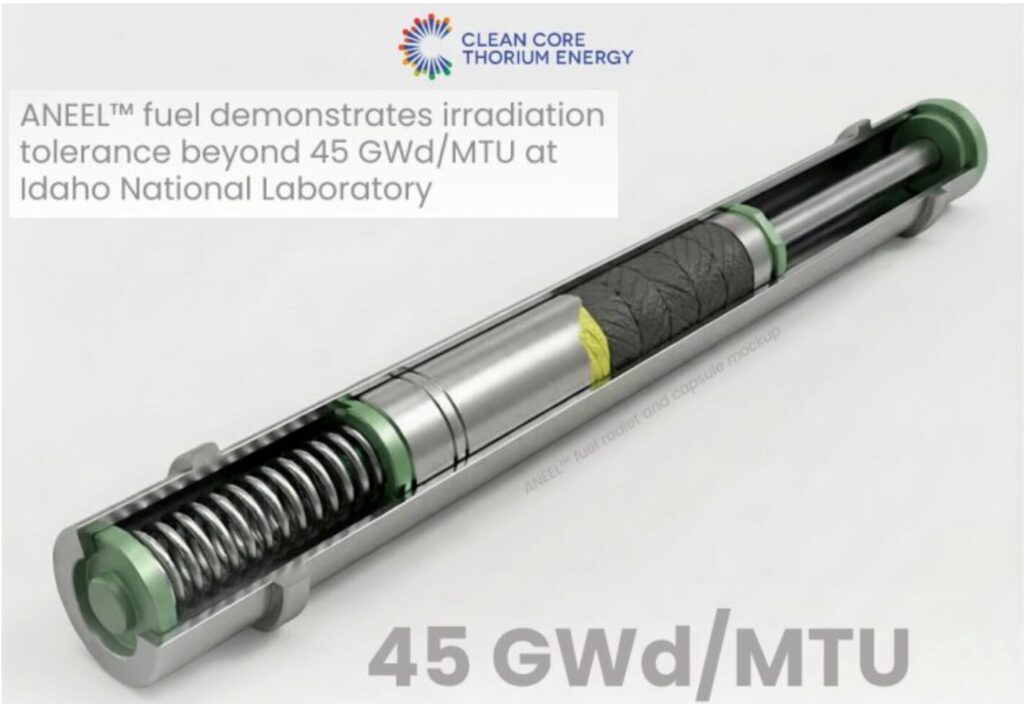
High-Burnup Rate of ANEEL Fuel:
Burnup Rate: Burnup measures how much energy is extracted from nuclear fuel before it is removed from the reactor. Simply: How efficiently was the Uranium/Thorium fuel used? It is measured in GWd/MTU. (GWd= Gigawatt-days of energy produced/ MTU= Metric Ton of Uranium fuel)
- Conventional PHWR/CANDU reactors achieve approximately 7 GWd/MTU.
- ANEEL fuel achieved a record burnup of over 60 GWd/MTU. This is more than eight times the typical discharge burnup of traditional Pressurised Heavy Water Reactors (PHWR).
Key Advantages of ANEEL Fuel:
- Reduced Nuclear Waste: Higher burnup rate means more fuel is consumed and less spent fuel remains. This cuts waste volumes and operational costs significantly.
- Better Efficiency: Since fuel lasts longer, fewer refuelling shutdowns are needed, and operational efficiency will improve. Implementing ANEEL fuel is expected to drop electricity costs by 20-30%.
- No Reactor Modifications: The fuel is designed as a drop-in replacement that can be used in existing PHWR fleets without needing any reactor modifications.
- Proliferation Resistance: The Thorium-HALEU blend results in spent fuel that is inherently more difficult to use for weapons, addressing proliferation concerns.
Significance of ANEEL Fuel for India:
- Boosts US-India Civil Nuclear Cooperation:
- Nuclear fuel company CCTE is only the second American company to have secured an export license from the US Department of Energy to sell nuclear technology to India in nearly two decades.
- Apart from exploring the development and deployment of ANEEL fuel in India, state-owned NTPC Ltd (India) and CCTE intend to collaborate for exploring the possible indigenisation of its manufacturing with local supply chain development, establishing a supply chain for HALEU, and the supply of Uranium to India with sovereign guarantee.
- ANEEL as an Accelerator to India’s Nuclear Program: ANEEL provides a shortcut: rather than waiting for Fast Breeder Reactors (FBRs) to breed U-233 from Thorium, it introduces Thorium into the fuel cycle now using existing PHWRs and HALEU as the driver fuel. This is a practical near-term bridge to Thorium utilisation while Stage-II FBRs face delays.
The SHANTI (Sustainable Harnessing and Advancement of Nuclear Energy for Transforming India) Act, 2025, allows private companies to participate in nuclear operations. This is a major governance shift that directly enables CCTE-type partnerships.
Associated Challenges:
- HALEU Supply Chain Risk: HALEU is currently produced at scale only in Russia and China. The US has only limited production. Dependence on foreign-origin HALEU could substitute one import dependency (Uranium) for another (enriched fuel), raising energy security questions.
- Open Fuel Cycle Limitation: HALEU-thorium blend in ANEEL is an open cycle fuel, i.e., the spent fuel is not amenable to reprocessing, and so it cannot be easily recycled. This differs from India’s traditional closed fuel cycle vision.
- Compatibility & Regulatory Hurdles: No operational power reactor in the world currently uses HALEU as fuel. India’s existing PHWRs were designed for natural uranium. Deployment requires clearances from the Atomic Energy Regulatory Board (AERB) and potentially the IAEA. Testing in a commercial power reactor is still pending.
Also Read: https://anantamias.com/current-affairs/transforming-indias-nuclear-energy-landscape/
UPSC Mains PYQ 2018
Q. With growing energy needs, should India keep on expanding its nuclear energy programme? Discuss the facts and fears associated with nuclear energy.
UPSC Mains PYQ 2017
Q. Give an account of the growth and development of nuclear science and technology in India. What is the advantage of the fast breeder reactor programme in India?
UPSC PYQ 2023
Q. Consider the following statements:
Statement I: India, despite having uranium deposits, depends on coal for most of its electricity production.
Statement-II: Uranium, enriched to the extent of at least 60%, is required for the production of electricity.
Which one of the following is correct in respect of the above statements?
(a) Both Statement I and Statement II are correct and Statement II is the correct explanation for Statement I
(b) Both Statement-I and Statement-II are correct and Statement-II is not the correct explanation for Statement-I
(c) Statement I is correct but Statement II is incorrect
(d) Statement I is incorrect but Statement II is correct
Answer: (c)
UPSC PYQ 2016
Q. India is an important member of the ‘International Thermonuclear Experimental Reactor’. If this experiment succeeds, what is the immediate advantage for India?
(a) It can use thorium in place of uranium for power generation
(b) It can attain a global role in satellite navigation
(c) It can drastically improve the efficiency of its fission reactors in power generation
(d) It can build fusion reactors for power generation
Answer: (d)
Tell Google you want more of this.
Add Anantam IAS as a preferred sourceOne tap, and this site shows up more often in your own Top Stories, AI Overviews and AI Mode. Remove it any time.