Why in News?
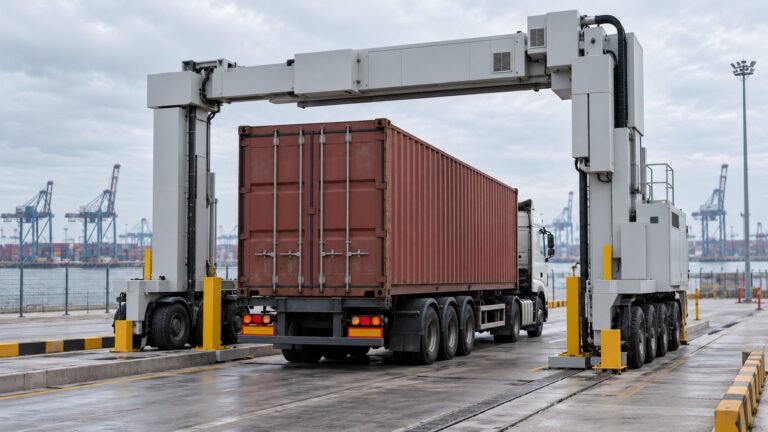
On 6 November 2026, the Ministry of Road Transport and Highways announced NHAI guidelines for barrier-free tolling on upcoming and ongoing national highway projects with four or more lanes.
- The National Highways Authority of India (NHAI) has specified how projects should plan tolling lanes, overhead gantries, signs and lighting.
- The design requirements enter project documents at the planning stage. Awarded projects adopt changes through applicable contract provisions.
- The ministry describes shorter queues and lower fuel use as expected benefits. Its announcement gives no measured savings.
- A toll plaza can create a bottleneck even where the highway has enough capacity between junctions.
- The layout must give drivers time to choose a lane and follow it through the tolling zone.
UPSC Relevance
Prelims Relevance
- MLFF means Multi-Lane Free Flow tolling.
- A gantry spans the roadway and can support tolling equipment.
- A variable message sign displays information that the operator can change.
- The circular covers four-lane and wider national highway projects within its stated scope.
Mains Relevance
GS Paper 3
- Explain how removing a compulsory stop changes the capacity needed at a collection point.
- Identify measures of safety and delay for evaluating a redesigned tolling zone.
GS Paper 2
- Compare incorporating a design change before award with implementing it under an existing contract.
Background and Context
Why Removing the Stop Changes the Plaza Layout
At a conventional toll plaza, vehicles arrive in a stream but pass the collection point one at a time in each booth lane.
- At a barrier, even a brief pause occupies the lane. If vehicles arrive faster than the booth releases them, the queue grows upstream and can extend back onto the approach road.
- Parallel booth lanes let several vehicles complete that stop at once. The approach can widen to distribute arrivals, then narrow again as drivers leave the booths and rejoin the highway.
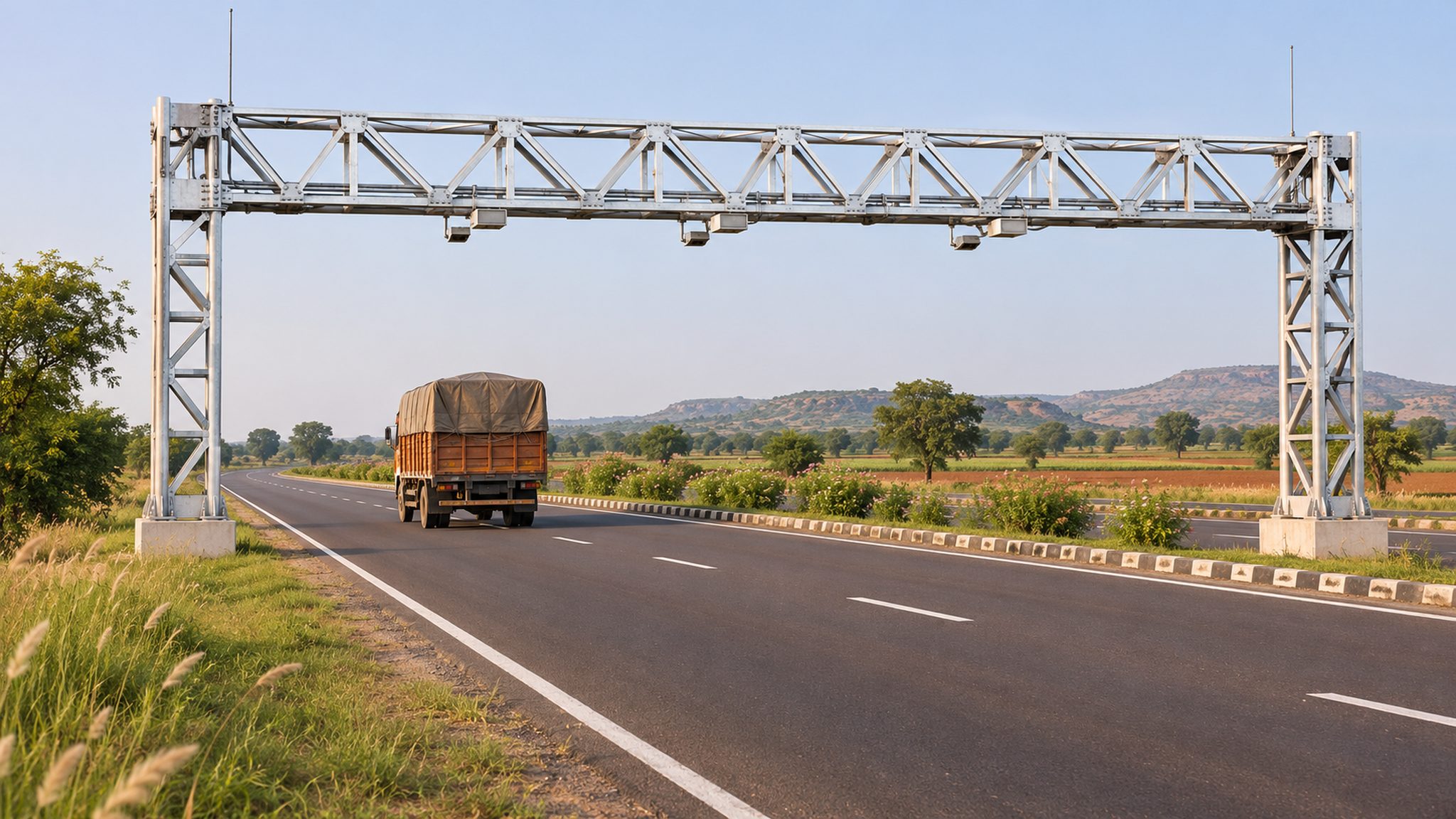
- With multi-lane free flow, vehicles pass through the collection zone while moving. An overhead gantry can carry tolling equipment across the carriageway, leaving the road surface available for through traffic.
- NHAI can now match the number of tolling lanes to the highway configuration. A design that needs less space for stationary vehicles can use the available road width more efficiently.
What Drivers Need on the Approach
Drivers who pass a gantry in moving traffic have less time to interpret an instruction than someone waiting at a booth.
- Advance signs give drivers time to recognise the tolling zone and settle into the correct lane. A direction first visible under the gantry leaves little room for a safe lane change.
- Variable message signs allow operators to give instructions suited to conditions on the road. A driver approaching a disrupted lane needs that information while there is still space to change course.
- Lighting helps drivers see the lane alignment and guidance through the zone at night. A clear approach in daylight can present a different problem when lane edges are harder to distinguish.
- Removing the compulsory stop should reduce idling and repeated acceleration. To assess the fuel benefit at a particular plaza, an evaluator would need traffic volumes and observations of actual delays.
- The circular provides for an operations and maintenance centre. Even with no booth barrier to lift, the operator needs a place from which to manage the plaza and maintain its facilities.
How the Project Stage Determines Adoption
Two stretches of comparable width can fall under the same circular but require different decisions before contractors can build the revised layout.
- At the Detailed Project Report stage, planners incorporate the new design into the project documents. This lets them specify the lane layout and gantry locations while the plans are still being prepared.
- For an awarded project, a contractor already has an agreed scope of work. NHAI directs adoption through applicable contractual provisions, so the agreement matters even if physical construction has barely begun.
- Field offices must include the requirements in upcoming projects and facilitate adoption on ongoing ones. Which documents need revision depends on how far the project has progressed when the design changes.
- A driver may ask whether an existing booth will disappear immediately. The project scope answers that question. The ministry described future and under-construction projects and gave no nationwide conversion date for operating plazas.
Way Forward
Check the Design Against Traffic on the Ground
- Record queue length and travel time before and after conversion at comparable times of day.
- Review night visibility from the approach and check where drivers first encounter each instruction.
- Document the approved design revision for each ongoing contract so field engineers can inspect what the contractor was asked to build.
Conclusion
- The gantry changes where collection happens. The gain depends on whether vehicles can reach it and leave it in a predictable stream, without queuing or weaving between lanes.
- Treat project readiness and live operation as separate questions. A signed design change establishes what will be built. Observed traffic after commissioning shows how well it works.
UPSC Practice Questions
Prelims MCQ 1
With reference to NHAI guidelines for multi-lane free flow tolling, consider the following statements:
- The guidelines cover future projects on four-lane and wider national highways.
- An awarded project adopts the revised design through applicable contractual provisions.
- The guidelines require every operational national highway plaza to convert on the same date.
How many of the above statements are correct?
(a) Only one (b) Only two (c) All three (d) None
Answer: (b) Only two
Explanation:
Statements 1 and 2 describe the scope and implementation route. The announcement gives no common conversion date for existing operational plazas.
Prelims MCQ 2
Which feature most directly explains why the lane configuration can change under multi-lane free flow tolling?
(a) Drivers can choose their own toll rate (b) The highway excludes all heavy vehicles (c) Vehicles can pass the tolling point while moving (d) All approaches must have identical lane counts
Answer: (c) Vehicles can pass the tolling point while moving
Explanation:
Removing the compulsory stop changes the space needed to queue and serve vehicles at parallel booths.
UPSC Mains Questions
- Explain how barrier-free tolling changes the design and safety requirements of a national highway toll plaza.
- How does the stage of a highway project affect the implementation of new infrastructure standards? Illustrate with the NHAI tolling guidelines.
Source: PIB, Ministry of Road Transport and Highways.
Frequently Asked Questions
What is multi-lane free flow tolling?
It is a toll collection arrangement in which vehicles travel through the collection zone without stopping at a booth barrier. The road layout and overhead infrastructure support collection across traffic lanes.
Which highway projects do the guidelines cover?
The ministry identifies upcoming and ongoing projects on national highways with four or more lanes. A project at the report stage incorporates the design in its documents. An awarded project follows its contract.
Does barrier-free travel remove the toll?
Vehicles still pass a fee collection point. Barrier-free describes how traffic moves through that point. A concession such as a local toll pass concerns the separate question of who pays which fee.
Why does a barrier-free plaza still need electronic signs?
Drivers approach at road speed and need enough distance to respond. Electronic variable message signs can communicate current guidance, while advance signs and lighting help drivers recognise the tolling zone.
Tell Google you want more of this.
Add Anantam IAS as a preferred sourceOne tap, and this site shows up more often in your own Top Stories, AI Overviews and AI Mode. Remove it any time.