Why in News?
On 6 November, the Commission for Air Quality Management invoked Stage III of the Graded Response Action Plan (GRAP) across the National Capital Region (NCR), bringing immediate restrictions on construction and demolition.
- Delhi recorded a daily average AQI of 382, in the Very Poor category. Unfavourable weather limited the dispersion of pollutants, and forecasts indicated a likely deterioration to Severe in the coming days.
- The GRAP subcommittee acted on that forecast. Stage III added controls to those already in force under Stages I and II, so agencies had to implement the three stages together.
- The construction schedule applies across the NCR. It identifies the operations that must stop, the smaller tasks that may continue and the categories of project eligible for wider exceptions.
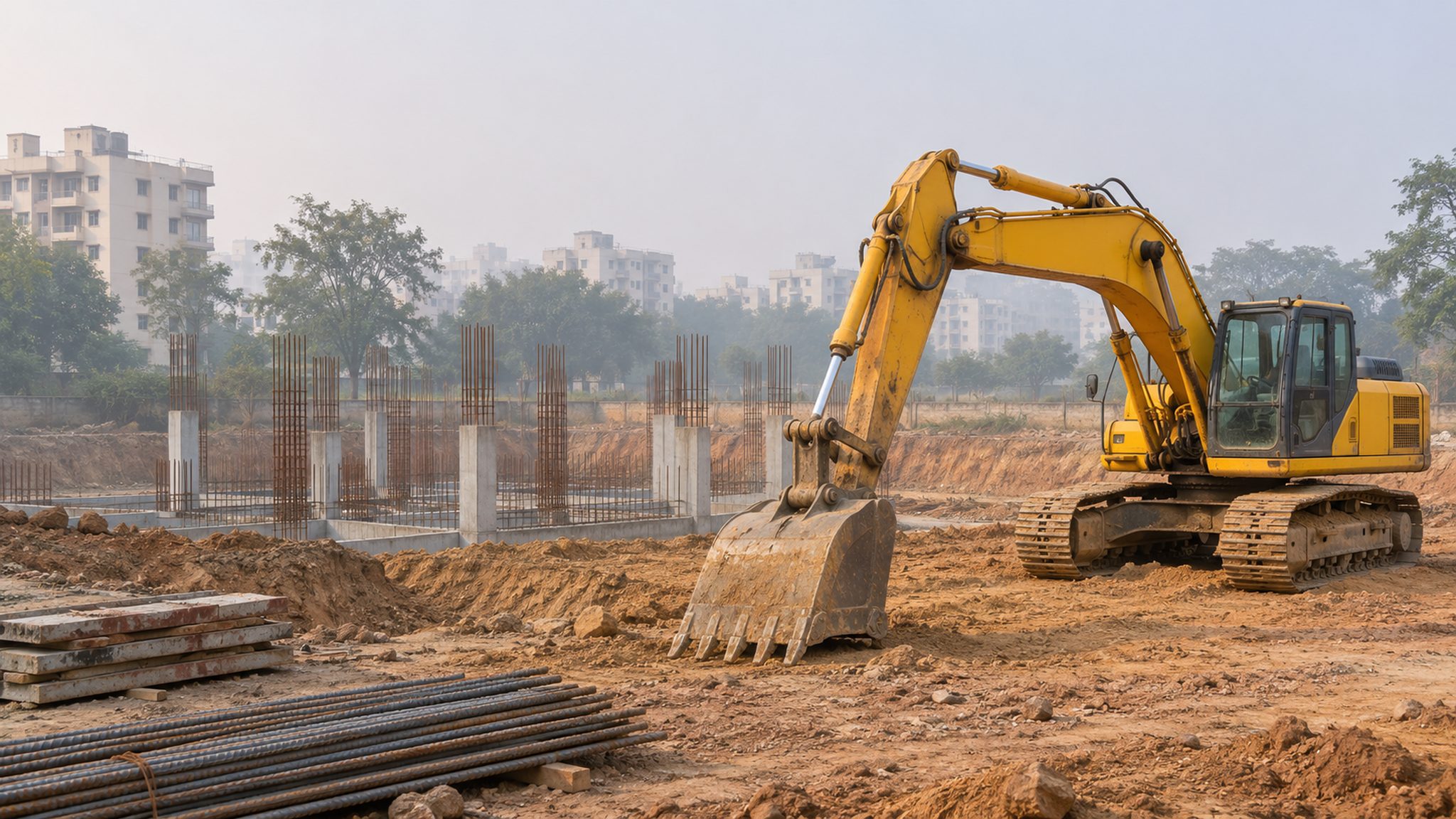
- On a single building site, an excavator may have to stop while a worker can continue a minor indoor repair. The task being performed matters when an inspector applies the order.
- Construction dust can leave the site twice, first during handling of loose material and again when wheels disturb dust on an unpaved road. The schedule addresses both points.
UPSC Relevance
Prelims Relevance
- CAQM and its GRAP subcommittee
- Delhi AQI and the regional scope of construction controls
- Stage III exceptions for specified work and project categories
- Duties of public and private plot owners
Mains Relevance
GS Paper 3
- Control of fugitive dust from urban construction
- Maintaining essential infrastructure during an air pollution episode
GS Paper 2
- Division of enforcement responsibilities across municipal and pollution control authorities
Background and Context
Which Construction Activities Face Restrictions?
The schedule follows dust from the ground being broken to the vehicle carrying material away.
- At the start of a project, excavation, filling and piling fall within the restricted list. An open trench dug to lay cables or pipes also comes within the list, subject to the project exceptions.
- As work moves above ground, the order covers brickwork and demolition. Taking down a wall and building one can both release dust, even though the two operations occur at different points in a project.
- The restriction on loading and unloading covers dusty material such as bricks, sand and cement inside or outside the project site. Moving the loading point beyond the gate does not remove the restriction.
- The schedule separately covers vehicles carrying construction material or demolition waste on unpaved roads. An inspection confined to the excavation pit would miss the route by which vehicles enter and leave.
Which Tasks Can Continue on an Ordinary Site?
A site supervisor can distinguish a narrowly permitted task from a larger operation using the examples in the Stage III schedule.
- The schedule restricts major welding and gas cutting. It expressly allows minor welding for mechanical, electrical and plumbing work, so both the scale of the job and its purpose matter.
- The restrictions on plastering and floor work allow minor indoor repairs or maintenance. Repairing a small patch of damaged indoor flooring differs from cutting and fixing tiles throughout a new building.
- Road construction and major repairs appear in the restricted list, while pothole repair is expressly permitted. A crew repairing a local road defect can rely on a narrower provision than one rebuilding the carriageway.
- Other less dusty activities outside the restricted list may continue if the site follows construction and demolition waste rules, dust prevention norms and applicable directions issued by the commission.
How Do Project Exceptions Work?
An exception for a named project category can cover a wider range of work than permission for a minor repair.
- The schedule allows construction at railway and metro facilities, hospitals and specified public infrastructure to continue, including listed operations. Sanitation works such as sewage treatment plants and water supply projects also qualify.
- For example, excavation for a public pipeline can fall within the linear public project exception. The same machine digging a basement at an ordinary private housing site faces the general excavation restriction.
- The exception extends to ancillary work specific to and supporting an eligible project. For a contractor claiming it, the practical question is which eligible project the work directly serves.
- Even on an eligible project, the agencies and plot owners remain responsible for dust and waste controls. The schedule assigns implementation roles to governments, pollution control authorities, urban local bodies and construction agencies.
Way Forward
Checking Compliance at the Worksite
- Record the activity observed, including any handling of loose material outside the site boundary.
- Identify the specific project category or minor task that permits work to continue.
- Check dust and waste controls at sites permitted to operate, including their approaches and loading points.
Conclusion
- The Stage III construction rules give two sites using the same equipment different obligations when one serves a listed essential project. Classify the activity and the project before deciding what may continue.
- For regional enforcement, connect the restriction to the source of exposure. Demolition, loading loose debris and moving it along an unpaved approach each offer a distinct point at which an agency can intervene.
UPSC Practice Questions
Prelims MCQ 1
With reference to the November Stage III construction controls, consider the following statements:
- The schedule allows pothole repair.
- Minor welding for mechanical, electrical and plumbing works is permitted.
- A hospital project is exempt from dust prevention norms.
How many of the above statements are correct?
(a) Only one (b) Only two (c) All three (d) None
Answer: (b) Only two
Explanation:
The schedule permits both specified tasks. Hospital projects must still comply with waste and dust control requirements.
Prelims MCQ 2
Which operation at an ordinary private housing project falls within the restricted list?
(a) Repairing a small patch of indoor plaster (b) Minor welding for a plumbing repair (c) Loading sand outside the project gate (d) Repairing a pothole on the approach road
Answer: (c) Loading sand outside the project gate
Explanation:
The restriction on handling dusty material extends to loading and unloading inside and outside the project site.
UPSC Mains Questions
- Explain how Stage III of GRAP reconciles control of construction dust with continuity of essential infrastructure work in the NCR.
- Why must a municipal inspection of a construction site examine material handling and transport as well as the work underway inside the site?
Sources: Commission for Air Quality Management and Press Information Bureau.
Frequently Asked Questions
Why did Stage III take effect at an AQI of 382?
Delhi was in the Very Poor category, with weather limiting dispersion. The subcommittee considered forecasts of Severe air quality and ordered Stage III measures to prevent further deterioration.
Can a metro project keep excavating?
Metro services and stations are among the listed project categories that can continue construction, including excavation, as long as they comply with dust prevention norms, waste rules and commission directions.
Can a builder unload sand outside a site gate?
The general restriction on loading and unloading dusty material covers locations inside and outside a project site. Moving delivery vehicles just beyond the gate does not create an exception.
Do all repair works have the same treatment?
The schedule allows specific tasks, including pothole repair and minor indoor repairs involving plaster or flooring. The extent and nature of the proposed repair determine which provision applies.
Tell Google you want more of this.
Add Anantam IAS as a preferred sourceOne tap, and this site shows up more often in your own Top Stories, AI Overviews and AI Mode. Remove it any time.