Why in News?
On 6 November, the Centre ordered weekly disclosure of commercial rice and paddy stocks across India and doubled the quantity of rice it aims to sell through open market auctions.
- Covered businesses in every state and Union Territory must update their stock declarations each Friday.
- Five southern states received central concurrence to impose limits where necessary through their own control orders.
- The revised 2026–27 auction target is 50 lakh metric tonnes. Private parties had bought 25 lakh metric tonnes by 31 October.
- A public authority needs to know where grain is held before deciding whether an apparent shortage warrants intervention.
- Measures that change commercial supply can take time to affect the price a household pays for its usual variety.
UPSC Relevance
Prelims Relevance
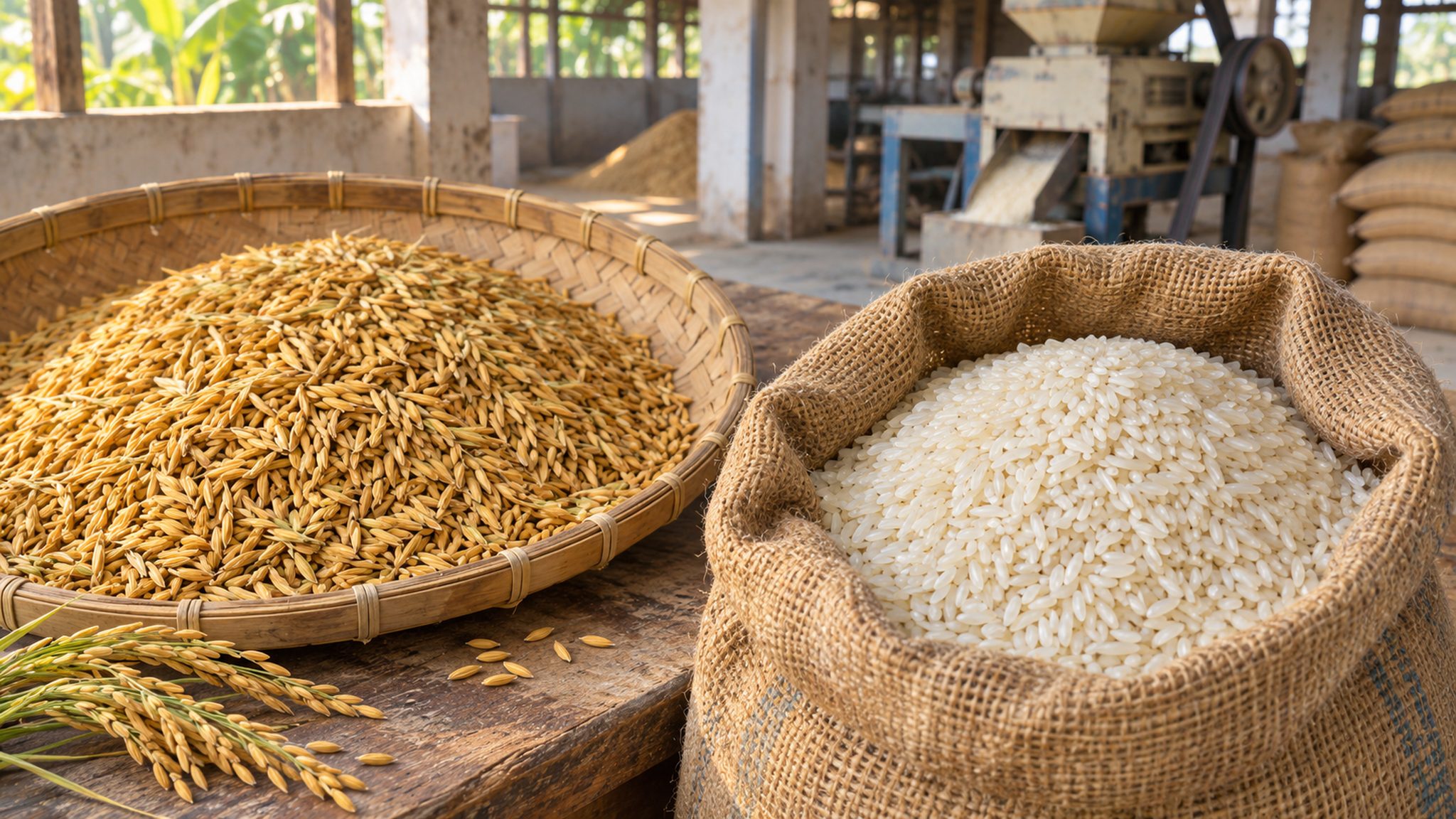
- Paddy is unhusked grain. The disclosure order lists it separately from categories of rice.
- Weekly reporting covers traders, wholesalers, retailers, large retail chains and processors or millers.
- A state control order specifies an applicable holding limit under the concurrence given to the five states.
- OMSS (D) is the Open Market Sale Scheme (Domestic). Private parties bought rice through e-auctions.
Mains Relevance
GS Paper 3
- Assess how stock information and sales from public inventories affect food availability and retail prices.
GS Paper 2
- Explain the respective roles of the Centre and the states in implementing the November measures.
Background and Context
What Does a Friday Stock Return Reveal?
A stock return records how much grain a business holds on the reporting date.
- A miller can hold paddy awaiting processing as well as rice ready for dispatch. Keeping the two entries separate helps officials distinguish grain in the production queue from rice available to wholesalers.
- The order also separates rice categories, including basmati, parboiled and broken rice. A large holding of one variety can coexist with thin supplies of the variety a local household normally buys.
- Successive Friday returns can flag an unusual build-up for inquiry. Deliveries arriving just before the reporting date, slower milling or difficulty finding transport could each account for a higher closing balance.
- An inventory figure alone gives no measure of grain condition. Storage losses can affect how much stock remains fit for sale, a distinction illustrated by the grain fumigation trials.
When Can a State Impose a Stock Limit?
Disclosure applies nationwide. The separate decision on holding limits gives five states room to respond to local market conditions.
- The Centre conveyed concurrence to Andhra Pradesh, Karnataka, Kerala, Tamil Nadu and Telangana. Each may issue an appropriate control order if it considers a limit necessary, up to 31 January 2027.
- For a trader in one of these states, compliance starts with the applicable state order. Its terms determine whether the trader’s holding exceeds a ceiling. The central announcement supplies no single nationwide tonnage threshold.
- A miller outside those five states still falls within the national reporting requirement. Conversely, submitting an accurate weekly return does not excuse a business from observing a holding limit that applies to it.
- The ministry invokes the Essential Commodities Act, 1955 in describing action for failure to register or breach of a prescribed limit. Evidence of excess holdings requires a comparison with the relevant legal ceiling.
How Does Auctioned Rice Reach the Market?
The Open Market Sale Scheme (Domestic) makes rice available to private buyers through electronic auctions.
- By the end of October, buyers had already purchased the quantity originally intended for the whole year. The revised auction target leaves an equal additional quantity to be sold before the financial year ends.
- An auction sale is an intermediate transaction. Buyers still have to take delivery and move the grain. The speed of release depends in part on foodgrain depot operations.
- Bharat Rice follows another route. The Centre is allocating additional rice to NAFED, NCCF and Kendriya Bhandar for wider sale to consumers, with particular attention to the southern states.
- To assess the retail effect, compare arrivals and prices for the same variety in the affected market after deliveries. A national auction total says little about when cheaper rice reaches a particular shop.
Way Forward
Check Availability Where Consumers Buy Rice
- Compare successive stock declarations with mill receipts and dispatches before attributing a rise in stocks to hoarding.
- Publish the applicable state control order where a limit is introduced so businesses can identify their obligations.
- Track auction deliveries and local shop prices separately to see whether increased supply reaches consumers.
Conclusion
- A stock declaration gives officials evidence to investigate a local shortage. A binding ceiling requires an applicable order. The two measures answer different questions about the same bags of grain.
- Judge open market sales by the rice that buyers take into distribution and the prices consumers subsequently face. The annual target sets the scale of intended intervention.
UPSC Practice Questions
Prelims MCQ 1
With reference to the November rice measures, consider the following statements:
- The stock declaration requirement extends to covered entities in Union Territories.
- The Centre prescribed one uniform holding limit for all Indian rice retailers.
- Paddy is a separate category in the weekly declaration.
How many of the above statements are correct?
(a) Only one (b) Only two (c) All three (d) None
Answer: (b) Only two
Explanation:
Statements 1 and 3 are correct. The Centre conveyed concurrence to five states to impose limits through their own control orders where necessary.
Prelims MCQ 2
Which figure records a completed transaction under OMSS (D)?
(a) The full revised annual auction target (b) The additional Bharat Rice allocation (c) Rice sold to private parties through e-auctions by 31 October (d) Rice held by a miller on the reporting date
Answer: (c) Rice sold to private parties through e-auctions by 31 October
Explanation:
The ministry reported completed sales of 25 lakh metric tonnes by that date. The revised target covers the full financial year.
UPSC Mains Questions
- Explain how stock disclosure and limits on commercial holdings address different food-market problems.
- How would you assess whether an increase in open market rice sales has improved affordability for households?
Source: PIB, Ministry of Consumer Affairs, Food & Public Distribution.
Frequently Asked Questions
Who must declare rice and paddy stocks each Friday?
The order covers traders and wholesalers, retailers, large retail chains and processors or millers across all states and Union Territories. They must update the stocks they hold by category.
Does the Centre’s concurrence set a limit for each trader?
The five southern states may introduce limits where they consider them necessary. The applicable state control order determines the ceiling and the obligations of a trader holding rice or paddy.
How much rice had been sold through open market auctions?
By 31 October, private parties had bought 25 lakh metric tonnes in the financial year. The Centre subsequently increased the annual auction sale target to 50 lakh metric tonnes.
How does Bharat Rice differ from an open market auction?
The government allocates Bharat Rice to designated agencies for sale to consumers. Under the domestic open market sale scheme, private buyers purchase rice through e-auctions before distributing it further.
Tell Google you want more of this.
Add Anantam IAS as a preferred sourceOne tap, and this site shows up more often in your own Top Stories, AI Overviews and AI Mode. Remove it any time.