Why in News?
On 3 November 2026, the Ministry of Road Transport and Highways and Bihar signed an agreement to desilt selected water bodies and use suitable excavated material in National Highway projects.
- Bihar’s Road Construction Department will coordinate implementation with the National Highways Authority of India (NHAI).
- The ministry identified 243 lakh cubic metres of suitable silt for use across 16 ongoing projects, a planned quantity rather than a record of deliveries.
- Use in future projects depends on engineering suitability and the required approvals.
- A highway needs fill to raise its formation above the surrounding ground. Reusing suitable excavated material can reduce demand for fresh earth from agricultural land.
- Improved drainage and reduced flood risk are aims of the agreement. Their assessment requires evidence from the water body after intervention.
UPSC Relevance
Prelims Relevance
- Desilting removes accumulated sediment from a selected water body.
- MoRTH specifications and relevant Indian Roads Congress codes guide testing for highway use.
- Bihar’s Road Construction Department is the nodal department.
- Reconciliation compares quantities extracted, transported and used.
Mains Relevance
GS Paper 3
- Explain how to evaluate the flood-management claim separately from the savings in fresh earth.
- Examine how contract monitoring can keep highway demand within river management limits.
Background and Context
Where Can Sediment Be Removed?
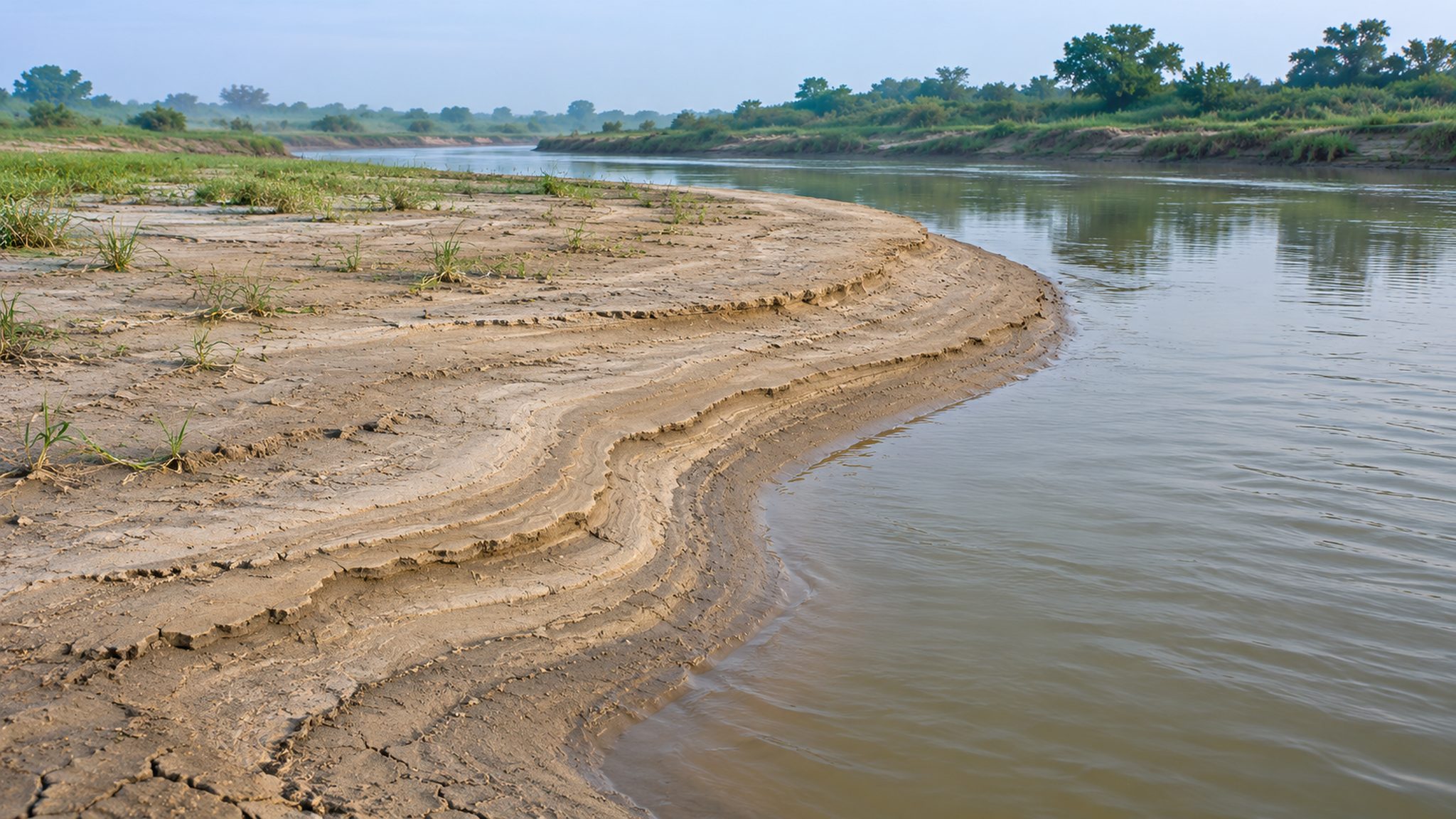
The decision begins at the water body. A deposit that is easy to reach may still be unsuitable for excavation.
- Sediment accumulates where flowing water deposits material. If a deposit obstructs a drainage path, removing it may improve local conveyance. The benefit depends on where the obstruction lies within the water body.
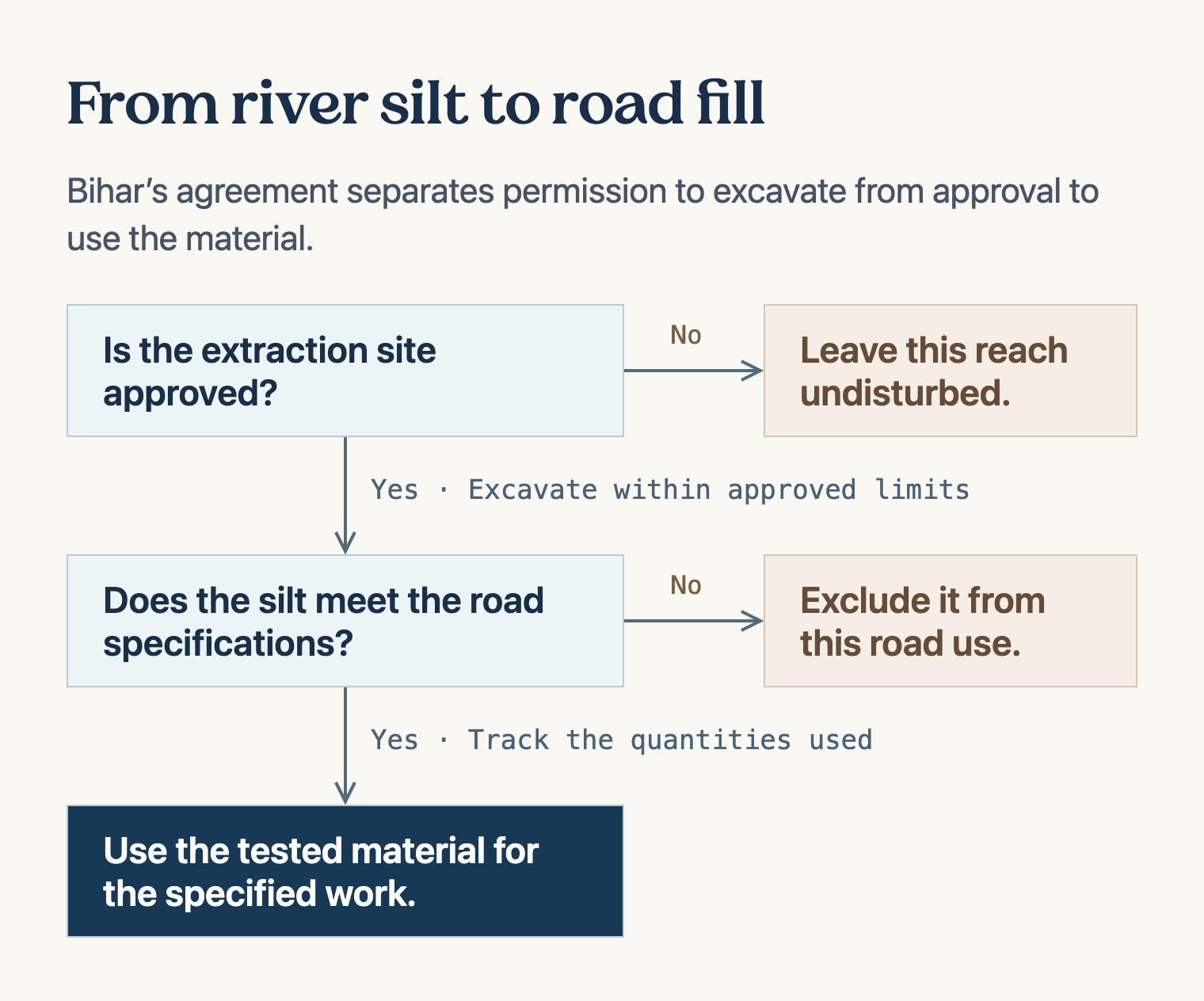
- Under the agreement, a technical assessment precedes excavation. Crews may remove material only at approved locations and within prescribed limits. A nearby highway’s demand for earth does not determine those limits.
- A deposit beside a riverbank or bridge needs particular care. Removing material changes the local bed profile, so site assessment must consider effects on banks, embankments, structures and the river ecosystem.
- Consider a site where surveys permit limited removal. An increase in the road contractor’s demand leaves the site’s extraction limit unchanged. Any remaining requirement must be met from another suitable source.
- The agreement identifies flood management as an objective. The amount excavated records work at a site. Establishing a reduction in flood risk requires examining what happened to flow and drainage afterward.
Which Excavated Material Can a Highway Use?
A site approval answers where excavation may occur. A road engineer faces a separate decision about the material that comes out.
- Material used as embankment fill forms part of the raised ground supporting a road. The intended use determines what the project must check before accepting a consignment of excavated earth.
- Sediment from different parts of a water body can vary in texture and moisture. The common description river silt gives a source, but by itself says little about how a particular sample performs.
- The ministry specifies material testing under applicable MoRTH specifications and relevant Indian Roads Congress codes. A test result is meaningful against the requirements of the intended highway work.
- If excavated material fails the relevant requirements, the existence of a nearby project cannot qualify it for that use. Counting it as highway fill would overstate the agreement’s usable supply.
- The resource benefit arises when accepted material replaces fresh earth that the project would otherwise obtain. Counting everything removed from the river would include material that never displaced any fresh excavation.
How Can Officials Trace the Quantities?
The agreement connects records at the excavation site, during transport and at the highway worksite.
- Joint measurement gives the agencies a common record of material removed. Comparing that figure with the approved site limit helps identify extraction beyond what the assessment permitted.
- A transport record tracks material moved away from the source. It supports checking where the excavated quantity went, but dispatch alone cannot establish that the receiving project used it.
- The road project records the quantity utilised. Comparing it with dispatched material helps officials investigate differences, including material awaiting use. A discrepancy calls for an explanation before anyone claims diversion.
- Bihar’s state-level coordination committee examines proposals, facilitates approvals and monitors implementation. Regular reconciliation gives it a specific operational question to resolve when site records and project records disagree.
Way Forward
Measure the River and Road Outcomes Separately
- Record the approved reach and limit alongside actual removal so field teams can check the two together.
- Tie each acceptance decision to its material test and intended project use.
- Compare drainage performance before and after excavation separately from the quantity of road fill accepted.
Conclusion
- Bihar’s agreement links a river-management decision to a construction opportunity. An approved reach can yield material that fails engineering tests, just as suitable material can lie in a reach where excavation is unsafe.
- The strongest evidence of resource conservation is suitable material actually used in place of fresh earth. River restoration requires its own evidence from the affected water body.
UPSC Practice Questions
Prelims MCQ 1
With reference to Bihar’s desilting agreement, consider the following statements:
- The Bihar Road Construction Department is the nodal department.
- Permission to extract sediment at a site establishes its suitability for highway use.
- Quantities extracted, transported and utilised are to be reconciled.
How many of the above statements are correct?
(a) Only one (b) Only two (c) All three (d) None
Answer: (b) Only two
Explanation:
Statements 1 and 3 are correct. The material requires separate testing under applicable highway specifications and codes.
Prelims MCQ 2
Which record provides the closest measure of excavated sediment put to productive highway use?
(a) Total sediment estimated in the water body (b) Maximum volume authorised for extraction (c) Tested material actually utilised in the highway work (d) Total volume dispatched from the excavation site
Answer: (c) Tested material actually utilised in the highway work
Explanation:
Actual utilisation captures the receiving project’s use. Resource savings also depend on whether that material replaced fresh earth.
UPSC Mains Questions
- How can reuse of river sediment in road construction reconcile demand for fill with the ecological limits of extraction?
- Distinguish the evidence needed to establish flood-management benefits from that needed to demonstrate savings in fresh earth.
Source: PIB, Ministry of Road Transport and Highways.
Frequently Asked Questions
Who will coordinate implementation in Bihar?
The Road Construction Department is Bihar’s nodal department. A state-level coordination committee will examine proposals, facilitate approvals, monitor implementation and resolve issues arising during work with NHAI.
Can all excavated silt go into a highway?
The material must pass appropriate tests for the intended work under applicable MoRTH specifications and relevant Indian Roads Congress codes. Approval to excavate a river reach addresses a different question.
Why compare extracted, transported and used quantities?
Each record describes a different stage. Comparing the three helps agencies trace what left the site, what moved to a project and how much the highway actually used.
Has Bihar demonstrated a reduction in flood risk through this agreement?
The announcement sets out flood management as an objective. Demonstrating a benefit would require evidence about conditions such as drainage or water-carrying capacity following work at the selected water body.
Tell Google you want more of this.
Add Anantam IAS as a preferred sourceOne tap, and this site shows up more often in your own Top Stories, AI Overviews and AI Mode. Remove it any time.