Why in News?
The Hindu reported on November 26 that Karnataka had approved a burns care policy connecting emergency treatment, specialist referrals and long-term rehabilitation.
- The approved design envisages district burns wards and an upgraded apex center at the Mahabodhi Burns Care Centre, BMCRI, to extend access to specialist services beyond existing concentrations.
- The report describes early rehabilitation alongside treatment, starting when clinically appropriate, with counseling and support for education, employment and community participation continuing through recovery.
- The Health Principal Secretary said implementation would follow Cabinet approval. The reported provisions describe the planned service network and cannot establish that every proposed facility is already operating.
- Referral coordination determines whether patients can reach the level of care their injuries require.
- Recovery includes physical function, psychological support and participation in daily life.
UPSC Relevance
Prelims Relevance
- Hub-and-spoke referral networks
- Continuum of care
- Burns registry
- Rehabilitation services
- District and tertiary care
Mains Relevance
GS Paper 2
- Public-health service delivery across levels of care
- Rehabilitation, social inclusion and accountability for implementation
Essay
- Health recovery and dignity
Background and Context
How the Referral Network Is Intended to Work
A hub-and-spoke network connects local services with a specialist institution through defined responsibilities and referral arrangements.
- The proposed district units would bring burns services closer to patients. The apex institution would support specialist treatment, training and technical guidance, with referral protocols linking primary, taluk, district and tertiary facilities.
- Referral protocols identify when and how care should move between facilities. Their practical value depends on communication, transport and a receiving service capable of providing the required support when the patient arrives.
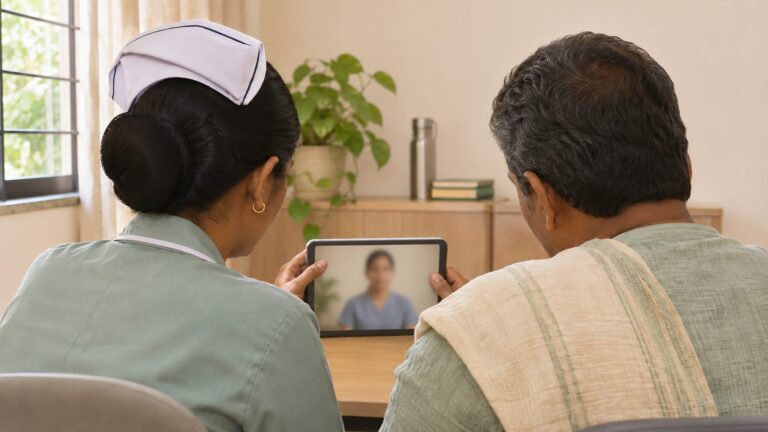
- The planned Centre of Excellence at BMCRI would also develop protocols and support telemedicine. These functions connect local teams with specialist expertise while keeping responsibility for individual care with the appropriate treating professionals.
- India’s national trauma and burns programme already frames services across pre-hospital, hospital and rehabilitation stages. Karnataka’s reported design applies a comparable continuity principle through a proposed state network.
- Service readiness involves staff and working systems as well as physical wards. Monitoring referrals, available specialist support and follow-up arrangements would help show whether the approved network becomes usable for patients.
Why Rehabilitation Begins During Recovery
Rehabilitation supports function and everyday participation, with timing and activities guided by the patient’s condition and professional assessment.
- The policy’s reported early rehabilitation provision connects physiotherapy with treatment when clinically appropriate. It places attention on recovery within the care pathway, while the treating team determines suitable interventions for each person.
- Occupational therapy can support everyday tasks during recovery. Simple equipment such as pegboards illustrates work on hand function; therapists choose activities according to individual assessment and the person’s rehabilitation needs.
- The reported support extends to psychological and social recovery. Counseling, reconstructive care and help returning to education or employment address different consequences, which may continue after acute hospital treatment has ended.
- Follow-up needs coordination across services. The same delivery problem appears in continuity of cancer care, although burn rehabilitation requires its own injury-specific assessment, professional skills and recovery pathway.
- Livelihood support connects recovery with participation in work and community life. Its assessment should examine whether people can access suitable services and resume chosen activities, alongside the treatment delivered within hospital walls.

What Approval and a Registry Can Establish
Policy approval establishes an administrative decision, while delivery records and survivor experience provide evidence about implementation.
- The proposed State Burns Registry would support systematic information collection. Useful records can help identify patterns in service use and outcomes, provided facilities apply consistent definitions and protect sensitive personal information.
- A registry depends on coverage and reporting quality. Missing facilities or incomplete follow-up can distort the picture of need. A recorded total should be interpreted with its reporting scope and collection method.
- The national programme links injury surveillance with coordination and capacity building. This makes information useful for service planning when it can reveal where referral, staffing or rehabilitation support requires attention.
- The Hindu also reports an activist’s demand to recognize disfigurement more explicitly in disability support. That demand identifies a contested inclusion issue; it does not establish a newly enacted benefit or eligibility rule.
- Access and affordability require attention throughout recovery. The distinction between public expenditure and household costs, discussed in National Health Accounts, helps evaluate how treatment-related burdens may persist for families.
Way Forward
Track Delivery Across the Care Pathway
- Publish facility readiness and referral responsibilities so patients and local providers can identify available services.
- Include rehabilitation access and follow-up in implementation monitoring alongside emergency treatment capacity.
- Use survivor feedback to assess barriers to education, livelihoods and social participation.
Conclusion
- A burns care network needs reliable connections between local treatment, specialist support and rehabilitation. Those connections determine whether the approved design becomes a continuous service.
- Implementation evidence should follow the patient’s recovery, including access to care and return to daily activities, while keeping announced provisions distinct from observed outcomes.
UPSC Practice Questions
Prelims MCQ 1
With reference to a hub-and-spoke healthcare network, consider the following statements:
- A specialist hub can provide technical support to local facilities.
- Referral protocols help coordinate movement between levels of care.
- Approval of a network proves that all proposed facilities are operational.
How many of the above statements are correct?
(a) Only one (b) Only two (c) All three (d) None
Answer: (b) Only two
Explanation:
Statements 1 and 2 are correct. Operational readiness needs separate implementation evidence.
Prelims MCQ 2
Which factor most directly affects the interpretation of a burns registry’s recorded totals?
(a) The state’s total population alone (b) The date on which the registry was approved (c) The coverage and completeness of reporting (d) The distribution of beds at the apex hospital alone
Answer: (c) The coverage and completeness of reporting
Explanation:
Recorded totals depend on which facilities and cases are covered and how completely information is submitted.
UPSC Mains Questions
- Explain how a hub-and-spoke network can improve access to burns care. What implementation conditions are necessary?
- Discuss why rehabilitation and social participation should be included when evaluating injury-care policies.
Sources: The Hindu and Directorate General of Health Services.
Frequently Asked Questions
What has Karnataka approved?
The Hindu reports that Karnataka has approved a policy covering prevention, treatment, rehabilitation and social reintegration of burns survivors. The proposed network links district facilities with an apex specialist center.
Is the proposed network already operational?
The report describes Cabinet approval and planned facilities. The Health Principal Secretary said implementation would follow. Actual readiness requires evidence about staffed facilities, referral arrangements and services available to patients.
Why include rehabilitation during treatment?
Rehabilitation supports recovery of function and everyday participation. The policy envisages early rehabilitation when clinically appropriate, with the treating team determining suitable timing and activities according to the patient’s condition.
Does the policy establish new disability benefits for disfigurement?
The report includes an activist’s demand for explicit recognition of disfigurement in disability support. That demand should be distinguished from enacted eligibility rules or benefits already available under a specific legal framework.
Tell Google you want more of this.
Add Anantam IAS as a preferred sourceOne tap, and this site shows up more often in your own Top Stories, AI Overviews and AI Mode. Remove it any time.