Why in News?
ICAR-IIHR inaugurated its Centre of Excellence for Genome Editing in Horticultural Crops, including a BSL-II laboratory, in Bengaluru on 15 November 2026.
- The PIB release identifies a new research facility at the Indian Institute of Horticultural Research, not an approved genome-edited variety.
- A Farmers’ Advanced Training Centre was also inaugurated during the visit; its outreach function is distinct from contained biotechnology research.
- The announcement emphasizes genome resources, research prioritization and scientific capacity; it supplies no trial results establishing gains from the new centre.
- Genome editing in horticulture connects crop improvement with biosafety: changing a DNA sequence and demonstrating a useful agricultural trait answer different questions.
- Containment, field evaluation and variety release are separate milestones; an infrastructure inauguration cannot establish that all have been completed.
UPSC Relevance
Prelims Relevance
- Genome editing: targeted alteration of a DNA sequence.
- CRISPR-Cas: one family of genome-editing tools.
- BSL-II: a biosafety containment designation, not a variety approval.
- SDN-1 and SDN-2: editing categories relevant to India’s regulatory framework.
- IBSC: Institutional Biosafety Committee.
Mains Relevance
GS Paper 3
- Agricultural biotechnology: connect laboratory research to crop performance and farmer needs.
- Risk governance: distinguish evidence about the edit, containment and agricultural use.
Essay
- Responsible innovation: scientific capacity earns public value through verifiable outcomes.
Background and Context
What a targeted edit changes
A precise DNA target helps define an experiment; it does not guarantee the desired crop performance.
- Genome editing alters selected DNA sequences. Researchers start with a biological question, such as whether changing a gene affects disease susceptibility, rather than assuming every edit will improve a crop.
- CRISPR-Cas can direct a DNA-cutting enzyme toward a selected sequence. Cellular repair then creates a change; researchers must identify the resulting sequence instead of inferring success from delivery of the tool.
- SDN-1 uses repair without a DNA template, while SDN-2 uses a template to guide a targeted change. These categories describe how an edit is produced, not the size of its agricultural benefit.
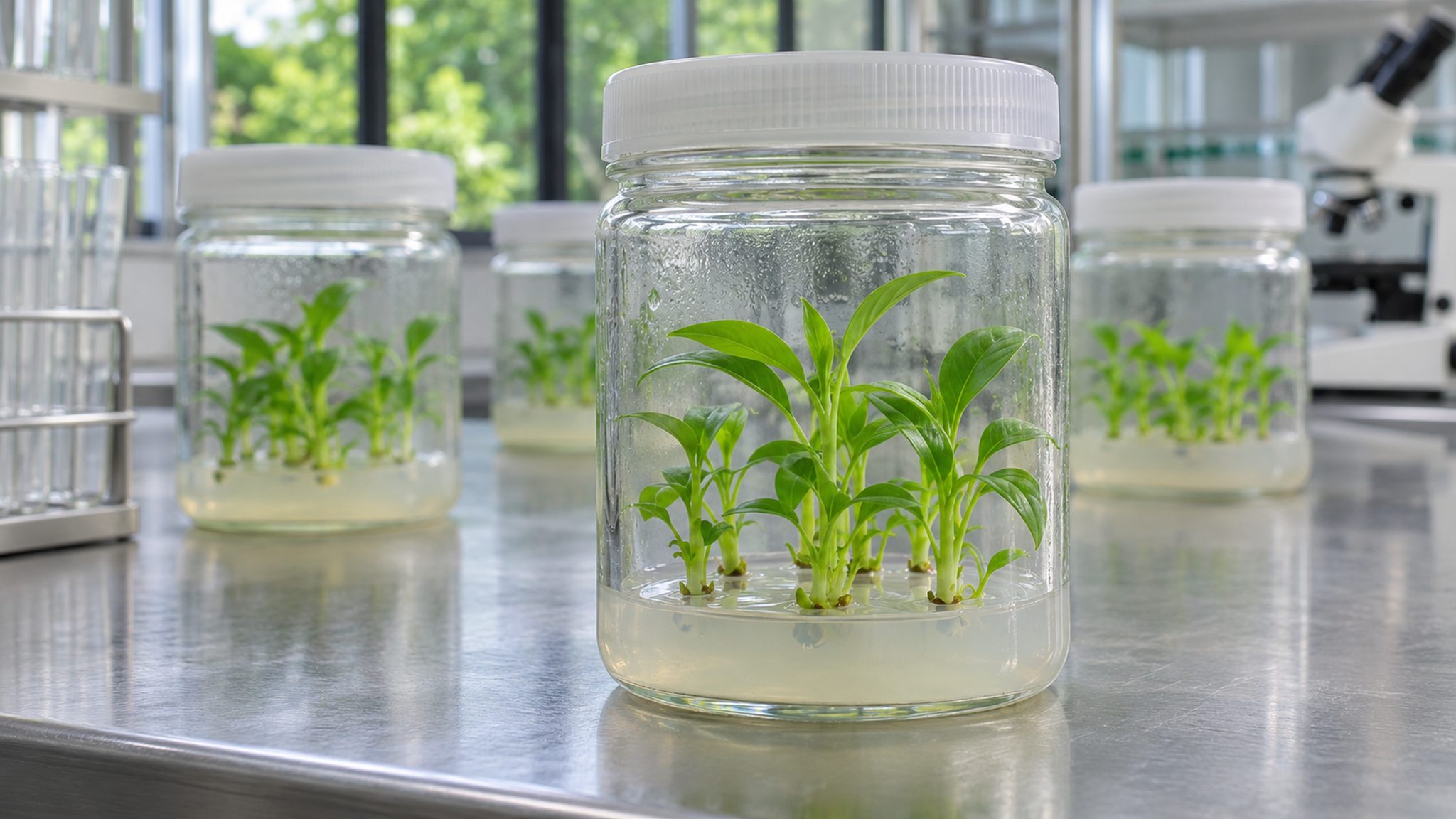
- Plant regeneration connects edited cells with whole plants. A useful experiment must establish that the regenerated plant carries the intended change; a modified cell alone is not a farmer-ready planting material.
- Trait assessment asks whether the change produces the intended characteristic. Even a confirmed DNA edit needs biological testing because a sequence result alone cannot establish disease resistance, nutritional improvement or stable productivity.
What laboratory containment establishes
Containment governs how research is handled; the experiment must separately establish what the plant actually does.
- The new centre includes a BSL-II laboratory, according to PIB. This identifies a facility for contained work; the announcement does not provide evidence of successful editing in a named horticultural crop.
- Biocontainment combines appropriate facilities, equipment and working practices to reduce exposure and unintended release. It supports controlled research rather than making every organism or experiment automatically acceptable within the laboratory.
- Molecular characterization checks the intended alteration and relevant introduced DNA. This separates evidence about the plant’s genetic composition from claims about its performance under drought, pests or other growing conditions.
- Controls make experimental results interpretable: comparison with suitable unedited material helps test whether an observed difference is associated with the edit rather than simply with differences in the growing environment.
- Institutional biosafety review remains distinct from an inauguration. DBT’s SOPs guide applicants and Institutional Biosafety Committees for contained activities and the assessment of relevant genome-edited plants before exemption conditions are met.
From experimental plant to usable variety
The evidence must move from a verified edit to a useful trait and then to performance under relevant cultivation conditions.
- Field evaluation addresses conditions a laboratory cannot reproduce fully. Researchers need evidence on performance under relevant environments; promising results from controlled conditions cannot by themselves establish dependable benefits for farmers.
- Variety release is a separate milestone from laboratory construction or molecular confirmation. The applicable pathway depends on the product; the PIB announcement does not identify a newly released variety from this centre.
- Under India’s framework, qualifying SDN-1 and SDN-2 plants free of exogenous introduced DNA receive a specified regulatory exemption. This is conditional, not a blanket exemption for every genome-editing experiment or product.
- Farmer value requires more than a desirable laboratory trait. An evaluation should consider crop quality, planting-material access and performance under cultivation before translating scientific promise into claims about income or yield.
- The release reports farmers’ experiences with existing practices and technologies during a separate interaction. Those observations cannot be presented as measured benefits of genome-edited crops developed by the newly inaugurated centre.
Way Forward
Make each claim match its evidence
- Publish research milestones separately: the verified edit, trait-testing results and field evidence should not be compressed into a single claim of crop improvement.
- Document biosafety decisions and the basis for any exemption, including the editing category and evidence relevant to introduced DNA.
- Choose farmer-relevant traits and compare candidate material with suitable existing varieties before claiming a practical advantage.
Conclusion
- A genome-editing centre adds research capacity. Its public value depends on verified edits, useful traits and subsequent performance evidence, rather than on the existence of a sophisticated laboratory alone.
- Keep the milestones separate: containment supports research, genetic testing characterizes the plant, and field evidence supports agricultural claims. None can substitute for the others.
UPSC Practice Questions
Prelims MCQ 1
With reference to genome editing in horticultural crops, consider the following statements:
- A confirmed targeted DNA change alone establishes higher field yield.
- A BSL-II laboratory designation is distinct from approval of a crop variety.
- SDN-2 editing uses a DNA template to guide the change.
How many of the above statements are correct?
(a) Only one (b) Only two (c) All three (d) None
Answer: (b) Only two
Explanation:
Statements 2 and 3 are correct. Field performance requires separate evidence; DNA confirmation alone cannot establish a yield advantage.
Prelims MCQ 2
Which evidence most directly establishes that a targeted genome edit occurred in a regenerated plant?
(a) Inauguration of its research laboratory (b) Farmer attendance at a training event (c) Molecular characterization of the target DNA sequence (d) The laboratory’s biosafety designation
Answer: (c) Molecular characterization of the target DNA sequence
Explanation:
Sequence characterization tests the genetic change directly. Infrastructure, outreach and containment designations do not establish that the intended edit occurred.
UPSC Mains Questions
- Explain why genome-editing capacity, laboratory containment and evidence of agricultural performance must be assessed separately.
- How can public horticultural research institutions connect genome-editing research with farmer needs while maintaining credible biosafety oversight?
Sources: PIB, Ministry of Agriculture & Farmers Welfare and Department of Biotechnology: Genome-edited plant review SOPs.
Frequently Asked Questions
What was inaugurated at ICAR-IIHR?
A Centre of Excellence for Genome Editing in Horticultural Crops, including a BSL-II laboratory, opened in Bengaluru on 15 November 2026. PIB also reported the inauguration of a Farmers’ Advanced Training Centre.
Does a BSL-II laboratory mean a crop is approved?
No. BSL-II concerns laboratory biosafety containment. It does not establish that a particular plant has the intended edit, performs well in cultivation, or has completed the applicable variety-release pathway.
Is genome editing always the insertion of a foreign gene?
No. Genome editing can alter existing sequences. SDN-1 and SDN-2 describe targeted editing approaches; the presence or absence of introduced DNA must be established for the relevant regulatory treatment.
Did the announcement establish higher yields from edited crops?
No. The release announced research infrastructure, not trial results for a new edited variety. Farmers’ reported experiences with existing practices during the visit are separate from outcomes of the new centre.
Tell Google you want more of this.
Add Anantam IAS as a preferred sourceOne tap, and this site shows up more often in your own Top Stories, AI Overviews and AI Mode. Remove it any time.