Why in News?
The Directorate General of Foreign Trade (DGFT), under the Ministry of Commerce and Industry, has prohibited the export of specified lithium-ion battery waste and scrap containing black mass, with immediate effect.
- The move aims to ensure that valuable critical minerals recovered from discarded batteries are recycled and refined domestically, strengthening India’s mineral security and battery manufacturing ecosystem.
| UPSC Relevance: GS-3 Economy: Critical Minerals; Circular Economy; GS-3 Environment: Waste Recycling Prelims: Black Mass; Lithium-ion batteries; Battery Waste Management Rules 2022; National Critical Mineral Mission. |
Understanding Lithium-ion Battery Recycling:
What is Black Mass?
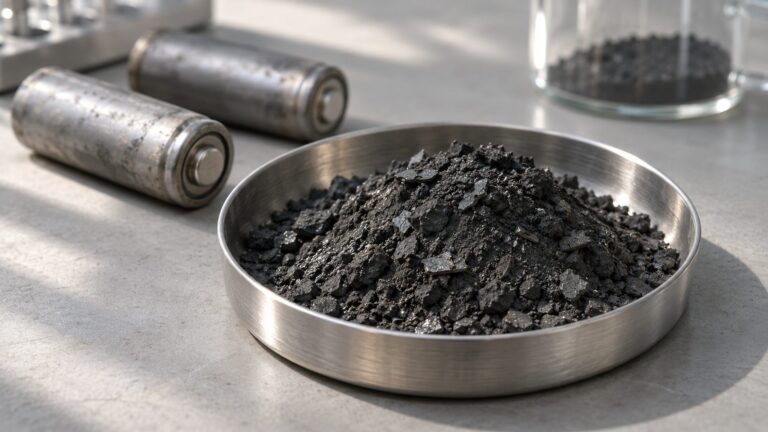
- Black mass is a powder-like material obtained by dismantling, shredding and processing end-of-life lithium-ion batteries and battery manufacturing waste.
- It contains recoverable quantities of valuable materials, including lithium, cobalt, nickel, manganese and graphite.
- Further processing, including hydrometallurgical and pyrometallurgical methods, can recover these materials for reuse in battery manufacturing.
Thus, retaining it within India can help domestic recyclers and refiners develop capabilities to extract higher-value materials instead of exporting partially processed waste.
Why Battery Recycling Matters?
- Growing demand for critical minerals: The global transition towards electric mobility, renewable energy storage and digital technologies is increasing demand for lithium, cobalt, nickel, manganese and graphite.
- Supply-chain concentration: Mining and processing of several critical minerals are geographically concentrated, particularly in China-dominated processing supply chains. This exposes countries to geopolitical tensions, export restrictions and supply disruptions.
- India’s import dependence: India has limited domestic availability and processing capacity for several critical minerals, making diversification of mineral sources a strategic priority.
- Growing battery waste: India is witnessing rapid EV adoption, with over 8.7 million EVs on its roads by FY 2025-26. The growing use of batteries in EVs, smartphones and electronic devices will generate substantial quantities of end-of-life batteries.
Battery recycling offers an opportunity to recover valuable minerals from discarded products, reducing dependence on primary mining and imports. This process is also known as ‘urban mining’. It is estimated that recycling could meet about 10% to 12% of India’s lithium demand for EV battery manufacturing.
Existing Policy Framework:
1. Battery Waste Management Rules, 2022:
- Notified by the Ministry of Environment, Forest and Climate Change, the rules establish an Extended Producer Responsibility (EPR) framework for environmentally sound battery waste management.
Key provisions:
- Extended Producer Responsibility (EPR): Producers, including manufacturers and importers, are responsible for ensuring the collection and recycling/refurbishment of batteries introduced into the market.
- Coverage: Applies to all types of batteries, including EV, portable, automotive and industrial batteries.
- EPR certificates: A centralised online portal developed by the Central Pollution Control Board (CPCB) facilitates registration and exchange of EPR certificates between producers and recyclers.
- Recycled material requirements: Producers are required to incorporate prescribed minimum percentages of domestically recycled materials in new batteries from FY 2027-28 onwards.
2. National Critical Mineral Mission (2025):
- Launched to strengthen India’s critical mineral supply chains through domestic exploration, overseas acquisitions, processing and recycling.
- Promotes recovery of critical minerals from secondary sources, including battery waste and electronic waste.
3. Incentive Scheme for Critical Mineral Recycling:
- A ₹1,500-crore incentive scheme was approved in 2025 to develop domestic recycling capacity for extracting critical minerals from secondary sources such as battery waste and e-waste.
- It seeks to encourage investment in recycling and mineral recovery infrastructure.
Challenges in Developing India’s Battery Recycling Ecosystem:
- Informal recycling: A significant proportion of electronic waste enters informal recycling channels, where unsafe dismantling and rudimentary extraction methods can cause environmental pollution and resource losses. E.g., Material recovery rates are just 10%-20%, compared with over 90% in formal recycling facilities.
- Inadequate collection infrastructure: Fragmented collection networks, limited consumer awareness and poor reverse logistics make it difficult to aggregate sufficient quantities of end-of-life batteries.
- Technological limitations: Different battery chemistries require different recycling processes. Recovering minerals at high purity and efficiency remains technologically challenging.
- Economic viability: High initial capital costs, fluctuating mineral prices and uncertain feedstock availability can make recycling facilities financially vulnerable, particularly during the early stages of EV adoption.
- Environmental concerns: Improper battery handling and recycling can cause fires, toxic emissions, soil contamination and water pollution.
- Regulatory enforcement: Effective implementation of EPR provisions requires reliable tracking of batteries, monitoring of recyclers and prevention of illegal disposal and diversion.
Way Forward:
- Strengthen collection mechanisms: Establish accessible battery collection and take-back systems through EV manufacturers, dealerships, service centres and authorised recyclers.
- Formalise the recycling ecosystem: Integrate informal waste workers into organised collection networks through training, registration and safe working practices.
- Promote R&D: Encourage collaboration between industry, research institutions and startups to develop cost-effective recycling technologies with higher recovery rates and mineral purity.
- Ensure policy certainty: Provide long-term incentives, patient capital and predictable regulatory frameworks to encourage investment in recycling facilities.
- Adopt design for recycling: Encourage battery manufacturers to develop batteries that are easier to dismantle, repair, repurpose and recycle.
- Develop quality standards: Establish standards for recovered minerals, black mass processing, battery characterisation and second-life applications.
- Strengthen traceability: Use digital tracking mechanisms to monitor batteries throughout their lifecycle and improve compliance with EPR obligations.
Battery recycling should be treated as an integral component of India’s critical mineral security strategy rather than merely a waste-management activity. While recycling cannot replace primary mining or eliminate import dependence, it can provide a valuable secondary source of critical minerals, strengthen domestic processing capabilities and improve supply-chain resilience.
India must build a circular battery ecosystem in which the EV revolution does not end with the disposal of a battery but creates a new source of strategic resources.
Mains Practice Question:
Q. India’s transition towards electric mobility must be accompanied by the development of a robust battery recycling ecosystem. Discuss its significance for critical mineral security and the circular economy.
Tell Google you want more of this.
Add Anantam IAS as a preferred sourceOne tap, and this site shows up more often in your own Top Stories, AI Overviews and AI Mode. Remove it any time.