Why in News?
On November 11, the Commerce Ministry announced that India had prohibited exports of lithium-ion battery black mass to retain a source of critical minerals for domestic recyclers.
- The Directorate General of Foreign Trade changed the export classification from free to prohibited through its November 10 notification.
- The change took immediate effect and applies until further orders. The Foreign Trade Policy’s transitional arrangements still apply.
- The Commerce Ministry release identifies the covered material by its description and ITC(HS) code 85491400.
- Plants need a steady supply of secondary feedstock to recover minerals from battery waste.
- The government reports that some Indian recyclers have imported feedstock even as black mass produced domestically went overseas.
UPSC Relevance
Prelims Relevance
- Black mass is an intermediate material from battery recycling.
- Recoverable elements can include lithium, nickel, cobalt and manganese.
- The DGFT sits within the Department of Commerce.
- The prohibition concerns exports of a specified material.
Mains Relevance
GS Paper 3
- Assess how industrial capacity and feedstock availability interact in a circular economy.
- Explain the trade-off between keeping secondary resources at home and ensuring enough domestic refining capacity.
Essay
- Yesterday’s waste can become tomorrow’s resource when institutions connect collection to recovery.
Background and Context
What Is Battery Black Mass?
A discarded battery still contains materials that a manufacturer might use again. Several industrial steps stand between the used cell and a recovered mineral.
- Two streams can supply a recycling plant. End-of-life batteries come from products already used, while manufacturing scrap arises before a battery reaches the customer. Both can yield black mass.
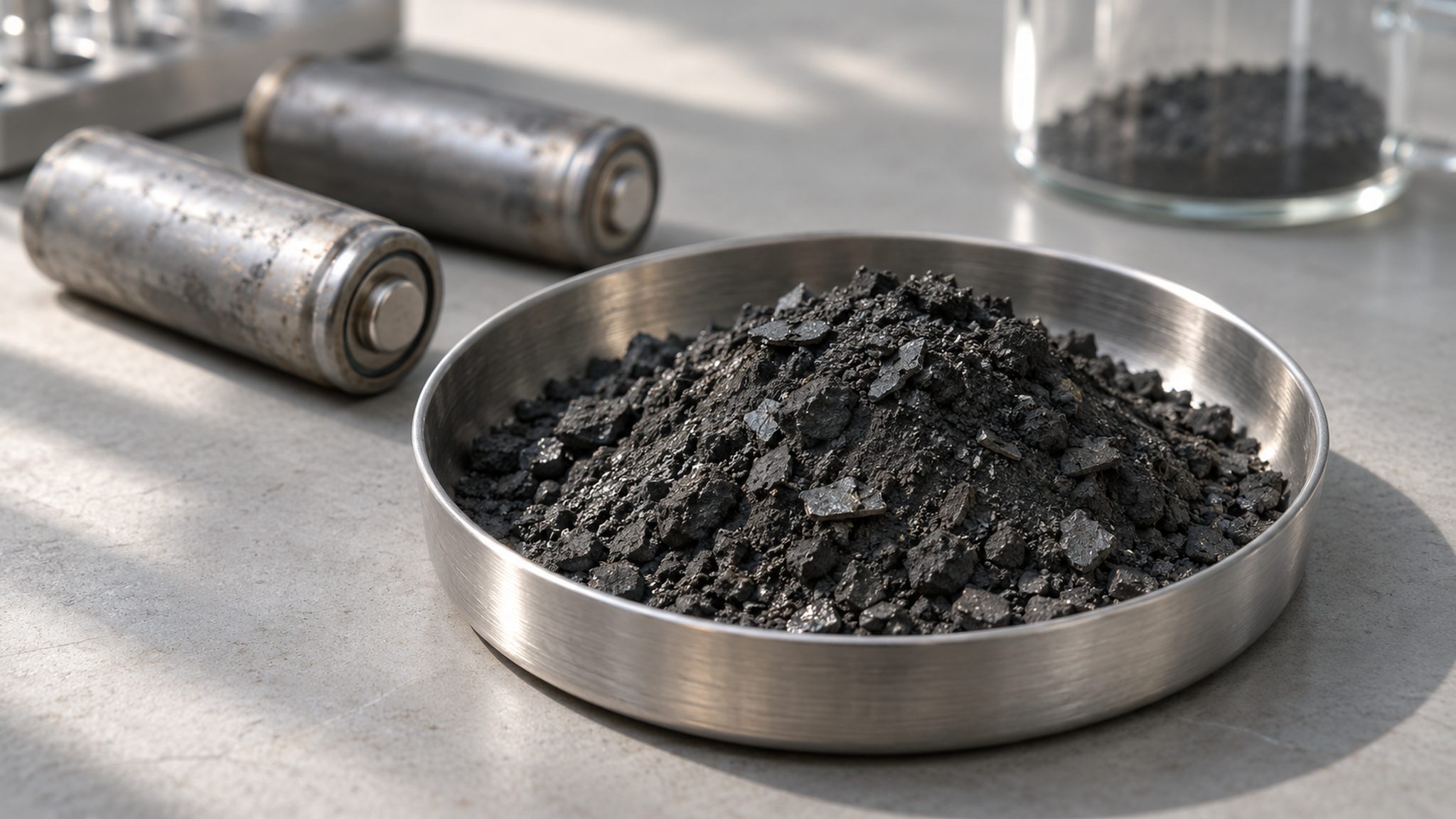
- At a recycling facility, shredding battery material yields a powdery fraction called black mass. The term describes a mixture at an intermediate stage, before the constituent minerals have been separated.
- The powder can contain lithium, cobalt, nickel and manganese. A statement that each batch contains equal quantities of all four would go beyond the ministry’s description of the material.
- A refiner receives this mixture as feedstock. Its value lies in what the plant can recover and separate for subsequent use. A tonne of powder cannot be counted as a tonne of recovered lithium.
- Recovering minerals from products and industrial scrap is often called urban mining. It draws on material already in the economy, whereas a primary mine starts with a naturally occurring mineral deposit.
Which Exports Does the Notification Cover?
To read the measure accurately, identify the direction of trade, the named product and its position in the tariff classification.
- The export policy governs a shipment leaving India. A manufacturer buying black mass from a domestic supplier for refining is making a different transaction from an exporter selling that material overseas.
- The cited tariff heading covers a broader family of unsorted battery waste and scrap without lead, cadmium or mercury. The notification identifies lithium-ion battery black mass within that family.
- Read the product description alongside the code. A question about exports of finished electric vehicles or unused battery cells refers to different products and cannot be answered by applying this notification.
- The DGFT made the change effective immediately, until further orders. Its duration depends on a subsequent policy decision. The ministry did not announce a fixed expiry date for the prohibition.
- For shipments straddling the date of the change, the notification preserves the transitional arrangements under paragraph 1.05 of the Foreign Trade Policy. An earlier order alone should not be assumed to qualify.
Why Does Keeping Feedstock Matter?
The ministry identifies a mismatch between the refining capacity already built in India and the supply of battery material available to run it.
- A recycling plant needs enough incoming material to operate its equipment regularly. When domestic powder is exported and a local plant imports replacement feedstock, collection and final mineral recovery occur in different economies.
- Keeping more domestic black mass available could raise capacity utilisation. The plant must still obtain the material, process it safely and recover useful minerals before the trade measure can affect metal supply.
- This distinction also explains how the export rule relates to capital support for mineral processing. Investment support acts on plant capacity, while the trade rule acts on the destination of its input.
- The environmental case depends on sound handling of a hazardous material. Retaining the powder in India places the recovery stage within domestic oversight, but the destination alone says little about the quality of processing.
- To assess import dependence, follow the chain to usable output. The announcement describes an expected benefit. Evidence would include how much domestic feedstock plants processed and what quantities of minerals they recovered.
Way Forward
Track Recovery Alongside Retention
- Measure domestic deliveries of black mass to refiners alongside material held in stock.
- Compare actual mineral recovery with the amount of black mass that entered processing.
- Check environmental compliance where recyclers store, transport and process the material.
Conclusion
- India has changed where a specific secondary resource can be sold. Domestic refiners gain a chance to secure material that might previously have gone abroad.
- For a Mains answer, connect the trade decision to feedstock availability, plant use and mineral recovery. Each step provides a separate point at which to evaluate the policy.
UPSC Practice Questions
Prelims MCQ 1
With reference to lithium-ion battery black mass, consider the following statements:
- Battery manufacturing scrap can yield black mass.
- Black mass can serve as a source of critical minerals.
- The November notification prohibits imports of black mass.
How many of the above statements are correct?
(a) Only one (b) Only two (c) All three (d) None
Answer: (b) Only two
Explanation:
Manufacturing scrap can yield black mass with recoverable minerals. The DGFT change governs exports, so the third statement is incorrect.
Prelims MCQ 2
Which observation would most directly show progress towards the mineral recovery objective of this export measure?
(a) A rise in the number of electric vehicle registrations (b) A larger announced budget for new mines (c) An increase in usable minerals recovered from domestically generated black mass (d) A larger stock of unprocessed powder at collection centres
Answer: (c) An increase in usable minerals recovered from domestically generated black mass
Explanation:
Measured recovery connects domestic feedstock to usable mineral supply. Growing stocks alone say little about the output of refineries.
UPSC Mains Questions
- Explain how the availability of secondary feedstock can constrain India’s critical mineral strategy even after investment in refining capacity.
- Assess the economic and environmental conditions under which retaining battery black mass could reduce reliance on primary minerals.
Source: PIB, Ministry of Commerce and Industry.
Frequently Asked Questions
How does black mass differ from a spent battery?
A spent battery is a used cell or battery assembly. Black mass is a powdery intermediate obtained during the processing of batteries or manufacturing waste, from which refiners can recover minerals.
Who changed India’s export policy for battery black mass?
The Directorate General of Foreign Trade, within the Department of Commerce, changed the classification through a November 10 notification. The Commerce Ministry announced the decision on November 11.
Does the prohibition cover every item under the battery waste heading?
The tariff code covers a broader category of battery waste and scrap. The notification specifically identifies lithium-ion battery black mass, so readers should consider its product description alongside the code.
Why would an Indian recycler import feedstock?
The ministry reports that some domestic recyclers faced inadequate supplies even while India exported black mass. An operating plant needs a regular flow of suitable material to use its refining capacity.
Tell Google you want more of this.
Add Anantam IAS as a preferred sourceOne tap, and this site shows up more often in your own Top Stories, AI Overviews and AI Mode. Remove it any time.