Why in News?
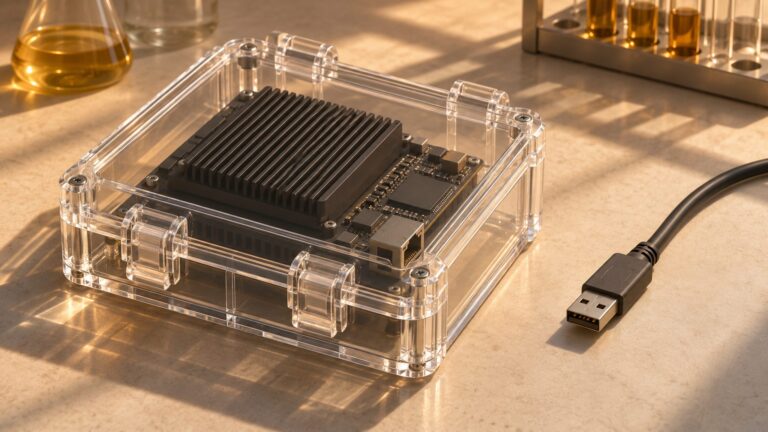
Temple, a wearable health-monitoring device launched by Deepinder Goyal, co-founder of Zomato and Blinkit, claims to monitor changes in cerebral blood flow and provide insights into brain health and ageing.
However, medical experts have questioned its claims, particularly the scientific validity of its proprietary Brain Flow (Temple-BF) index and its ability to measure blood flow within the brain.
| UPSC Relevance: GS-3 Science and Technology: Emerging Technology; Developments and applications in everyday life. Prelims: Photoplethysmography (PPG), Wearable health technologies Mains: Wearable health technologies: Benefits & concerns. |
What is Temple?
- Temple is a wearable device attached to the side of the head (temple region) that uses optical sensors to monitor changes in blood flow in underlying tissues.
- It combines physiological signals to generate a proprietary Brain Flow index, intended to indicate changes in cerebral circulation and brain-related health.
- The device is also associated with broader claims concerning biological ageing, health-related entropy and voice-based digital assistance.
How does Temple Work?
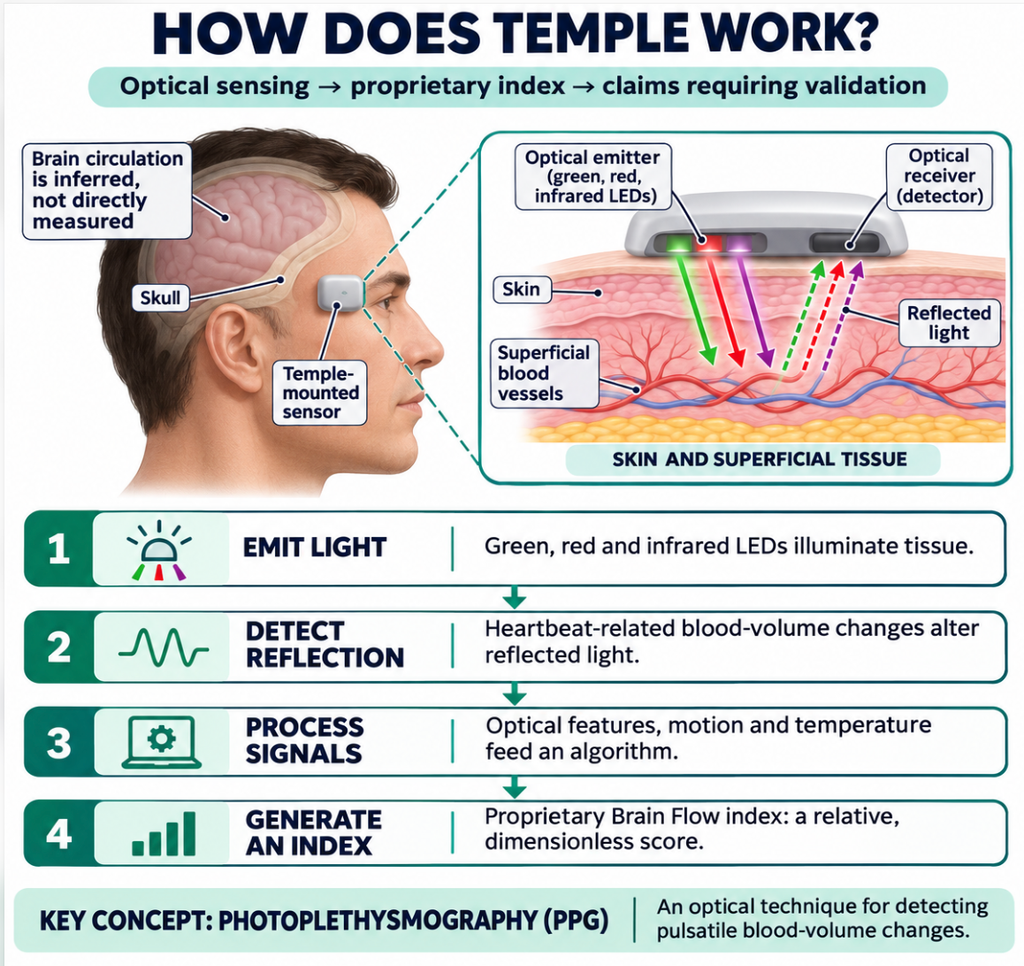
Temple uses a technique related to Photoplethysmography (PPG), an optical method that detects changes in blood volume beneath the skin.
- Optical sensing: It emits green, red and infrared light into the skin and measures the reflected light.
- Blood-volume changes: Blood absorbs light, and variations in blood volume during each heartbeat alter the intensity of reflected light.
- Physiological signals: The device analyses pulse amplitude, pulse shape, heart rate, blood oxygen-related signals, skin temperature and movement.
- Brain Flow index: These signals are combined through a proprietary mathematical model to generate the Temple-BF score.
Why is Cerebral Blood Flow Important?
- The brain accounts for approximately 20% of the body’s energy consumption and requires a continuous supply of oxygen and glucose through blood circulation.
- Reduced cerebral blood flow has been associated with ageing, cognitive decline and an increased risk of dementia.
- Research has also explored links between impaired cerebral circulation and neurological conditions such as Alzheimer’s disease.
Reduced blood flow may contribute to cognitive decline, but brain tissue loss associated with cognitive decline may also reduce the brain’s blood-flow requirements.
Conventional methods of measuring cerebral blood flow
| Technique | What it measures? |
| Magnetic Resonance Imaging (MRI) | Estimates blood flow through brain tissue. |
| Transcranial Doppler (TCD) | Measures blood-flow velocity in major arteries supplying the brain. |
| Near-Infrared Spectroscopy (NIRS) | Uses light to monitor changes in haemoglobin and blood oxygenation in tissues. |
Key Scientific Concerns:
- Measurement versus inference: The sensor primarily detects changes in blood flow in the skin and underlying tissues. Measuring blood-flow changes in superficial tissues is not equivalent to measuring blood flow within the brain. Inferring cerebral blood flow from these signals requires further scientific validation.
- Temple’s preliminary studies provide some evidence of its measurement capabilities, but do not establish its clinical usefulness. The studies involve small participant groups and limited experimental conditions.
- The proprietary algorithm behind the Brain Flow index is not sufficiently transparent, making its interpretation and comparison across individuals difficult.
- Long-term studies establishing its ability to predict dementia, cognitive decline, longevity or other health outcomes are lacking.
Temple’s measurement capabilities should be tested through larger, peer-reviewed studies involving diverse age groups and populations. Developers should disclose the methodology, limitations and validation standards underlying proprietary health indices.
Thus, Wearable health technologies should be subject to appropriate scrutiny based on their intended medical claims, particularly when marketed for disease detection or clinical decision-making.
Mains Practice Question:
Q. Wearable health technologies are expanding the possibilities of preventive healthcare, but their scientific and regulatory limitations remain significant. Discuss.
Tell Google you want more of this.
Add Anantam IAS as a preferred sourceOne tap, and this site shows up more often in your own Top Stories, AI Overviews and AI Mode. Remove it any time.