Why in News?
On 10 November, the Ministry of Coal reported two NTPC applications under its surface coal and lignite gasification scheme and opened a third application round.
- One NTPC application proposes urea. The other proposes methanol and dimethyl ether (DME).
- The ministry announced receipt of the applications at the close of Round 2. Its release gives no selection decision for either proposal.
- Eligible entities have until 11 January 2027 to apply in Round 3.
- Gasification gives a solid fuel a second industrial role as a chemical feedstock.
- The products that a plant could supply depend on the equipment installed downstream of its gasifier.
UPSC Relevance
Prelims Relevance
- Surface gasifier and solid feedstock
- Syngas constituents and uses
- Urea as a nitrogenous fertiliser
- Methanol and dimethyl ether as distinct industrial chemicals
Mains Relevance
GS Paper 3
- Assess the trade-off between domestic feedstock security and the environmental costs of coal conversion.
- Distinguish industrial capacity announcements from evidence of sustained production.
Background and Context
What Happens Inside a Surface Gasifier?
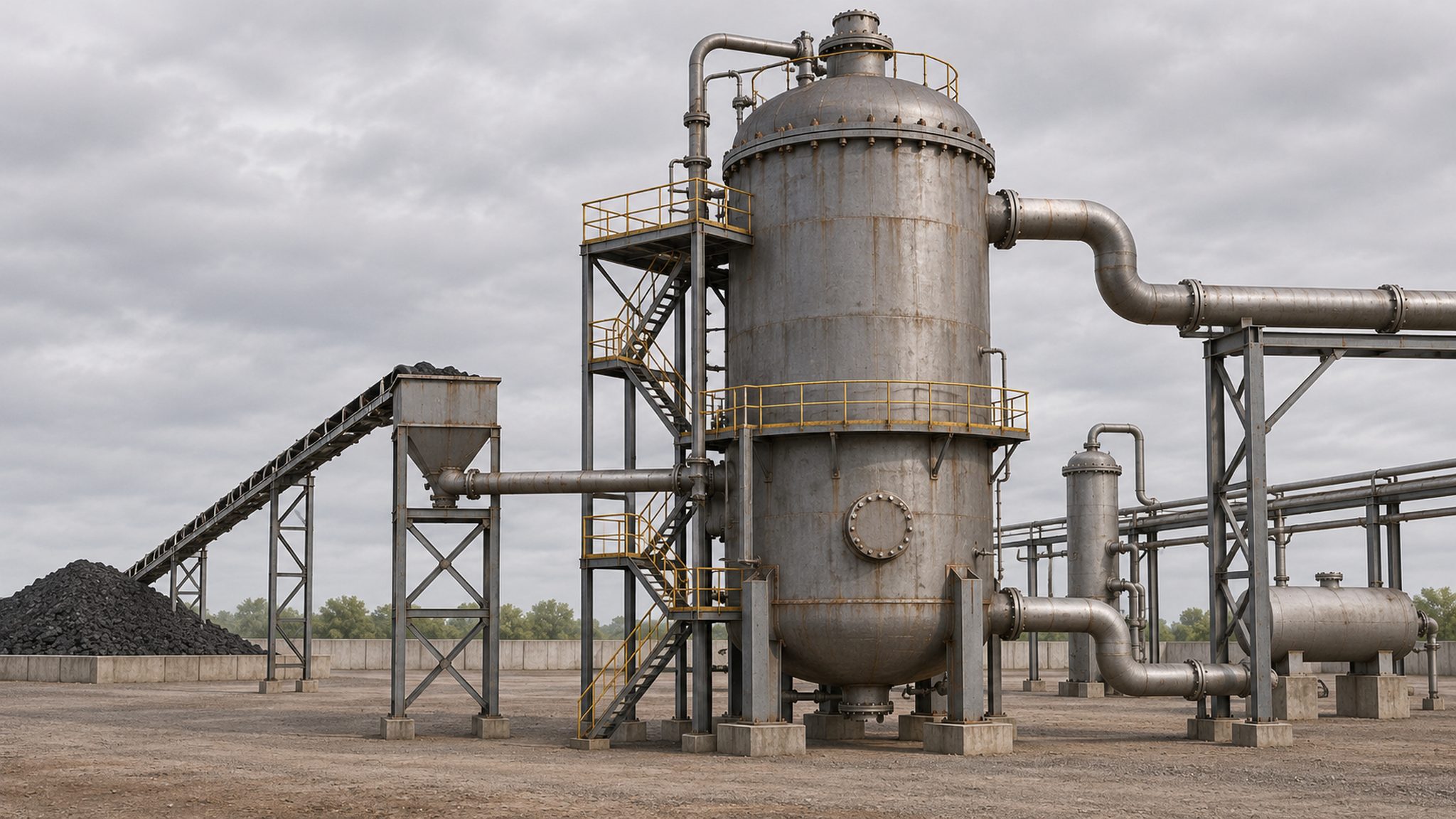
A surface gasification plant receives mined coal or lignite above ground. Its gasifier is the vessel where the solid feed first becomes a usable gas stream.
- In a boiler, combustion releases heat that can raise steam to drive a turbine. The plant designer values how much useful heat the fuel can deliver to the steam circuit.
- In a gasifier, the oxygen supply is limited relative to complete combustion. Part of the coal’s chemical energy remains in gas molecules that can leave the vessel and undergo further processing.
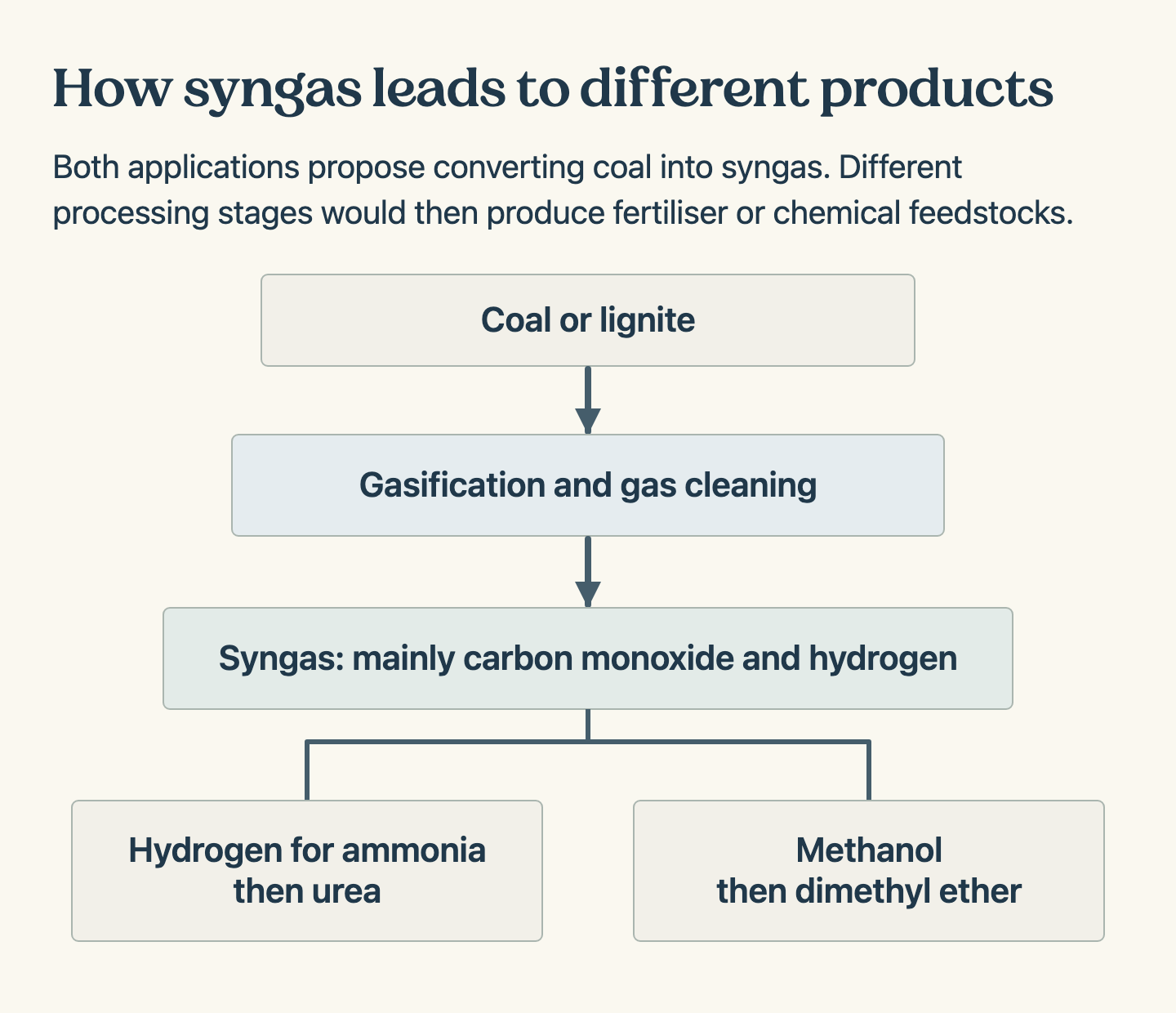
- Two important components of synthesis gas, usually shortened to syngas, are carbon monoxide and hydrogen. A stream containing both can supply raw materials for chemical production.
- The raw gas also carries material that downstream equipment cannot readily accept. Gas cleaning removes contaminants before the gas enters the next stage, where the chosen product determines the processing requirements.
- The word surface identifies where conversion takes place. An underground coal gasification process converts coal within the seam, an important distinction when assessing where an operation interacts with land and water.
How Can Syngas Supply Different Industries?
The two NTPC applications illustrate a choice that arises after gasification. The same type of intermediate can support different final products.
- For a urea route, hydrogen obtained from the gas stream can supply ammonia manufacture. Ammonia and carbon dioxide then provide the inputs for urea, a fertiliser that supplies nitrogen to crops.
- For a methanol route, the processed gas provides building blocks for making the alcohol. Methanol can itself enter industrial markets or serve as an intermediate for producing another chemical.
- Dimethyl ether can be produced from methanol. This relationship explains why a proposal might name both products, while leaving open the precise plant design and its planned split between outputs.
- Read the proposal’s product boundary carefully. A tonne of coal handled, a volume of syngas produced and a tonne of finished fertiliser describe three different stages of the same industrial chain.
- The ministry’s announcement identifies intended products. Establishing how much fertiliser or chemical a project can actually supply requires evidence from the downstream units that produce and dispatch those products.
How Should a Gasification Proposal Be Assessed?
Application, selection, commissioning and sustained output answer different questions about industrial policy. Each stage requires its own evidence.
- An application records the developer’s intention to seek support. A selection decision would establish that the proposal had cleared the relevant assessment. Receipt alone establishes only the first stage.
- Commissioning would show that a plant had begun operating. Output records over time would show whether its equipment, coal supply and buyers can sustain production at the level envisaged.
- Domestic coal can reduce exposure to imported industrial feedstocks if the resulting chemical reaches users at a viable cost. A count of applications cannot establish how much import demand will shift.
- The carbon balance follows the coal beyond the gasifier. Mining, processing and the eventual use of the product can all affect emissions, even where the plant removes pollutants from the gas.
- Assess water and land impacts alongside energy security. A comparison between alternative ways to supply the same chemical should consider local water availability, mine impacts and waste handling across the production chain.
Way Forward
Track Each Project Through to Saleable Output
- Publish selection decisions and subsequent commissioning milestones separately.
- Report output in units of the actual product alongside feedstock use.
- Compare environmental impacts per unit of finished product against the alternative supply route.
Conclusion
- Gasification links domestic coal to chemical production through syngas. The downstream route determines whether the plant supplies an input for fertiliser or a chemical such as methanol.
- The November applications establish interest in two product routes. Evidence of industrial performance will come from project selection, operation and measured deliveries to users.
UPSC Practice Questions
Prelims MCQ 1
With reference to surface coal gasification, consider the following statements:
- Syngas can contain carbon monoxide and hydrogen.
- Coal gasification under this scheme necessarily takes place within an unmined coal seam.
- The Round 2 announcement confirmed commercial production of urea by NTPC.
How many of the above statements are correct?
(a) Only one (b) Only two (c) All three (d) None
Answer: (a) Only one
Explanation:
Statement 1 is correct. Surface gasification takes place above ground. The release described applications and their proposed products.
Prelims MCQ 2
Which observation would most directly demonstrate that a gasification project was meeting its fertiliser supply objective?
(a) Receipt of an application (b) Installation of a coal conveyor (c) Opening another application round (d) Sustained deliveries of finished urea from the plant
Answer: (d) Sustained deliveries of finished urea from the plant
Explanation:
Finished urea deliveries establish that both the gasification and downstream chemical production stages are supplying the intended market.
UPSC Mains Questions
- How could surface coal gasification contribute to industrial feedstock security in India? Examine the environmental trade-offs.
- Which indicators would you use to evaluate a gasification incentive scheme from application through commercial production?
Sources: PIB, Ministry of Coal and US National Energy Technology Laboratory.
Frequently Asked Questions
What did NTPC propose in Round 2?
It submitted two applications. One proposes urea and the other proposes methanol and dimethyl ether. The ministry reported the applications when the round closed on 10 November.
What is syngas?
Synthesis gas is a gas mixture whose useful constituents include carbon monoxide and hydrogen. Processing and cleaning allow it to supply different industrial routes, including chemical manufacture.
Why is a gasifier different from a boiler?
A boiler recovers heat from combustion. A gasifier converts solid feed into a gas stream that retains chemical energy and can supply molecules for downstream industrial processing.
How should the climate impact be compared?
Use the same finished product as the basis for comparison. Examine the emissions associated with mining and processing, plant energy use and the fate of carbon in the product.
Tell Google you want more of this.
Add Anantam IAS as a preferred sourceOne tap, and this site shows up more often in your own Top Stories, AI Overviews and AI Mode. Remove it any time.