Why in News?
On 10 November, the COP31 co-presidents called for sustained support for the Global Climate Observing System as funding gaps threatened long-running measurements on land and at sea.
- The World Meteorological Organization identified gaps in ocean measurements and fragile funding for stations, satellite missions and the specialists who maintain the records.
- The draft GCOS High-Priority Action Plan was open for public review. Its priorities include protecting essential observations, filling gaps and maintaining international coordination.
- The call to action sought sustained backing. The announcement did not specify binding national contributions.
- A new station can improve spatial coverage immediately. Measuring change at that site requires readings accumulated over time.
- When an instrument changes, a parallel measurement period helps scientists judge how much of an apparent shift comes from the equipment.
UPSC Relevance
Prelims Relevance
- GCOS identifies requirements for observations of the atmosphere, ocean, ice and land.
- An essential climate variable is a physical, chemical or biological variable that contributes to describing Earth’s climate.
- In-situ observations measure conditions at the location of an instrument.
- Metadata describe how, where and when a measurement was made.
Mains Relevance
GS Paper 3
- Explain how station maintenance, data stewardship and staff continuity support environmental monitoring.
- Assess the advantages and limits of combining satellite and surface observations.
GS Paper 2
- Examine the role of international cooperation in sustaining national observing networks.
Essay
- The value of a public institution can lie in the observations it preserves across generations.
Background and Context
What Does a Climate Station Actually Measure?
A station produces a sequence of local observations. The conditions under which staff collect each reading determine what comparisons they can make later.
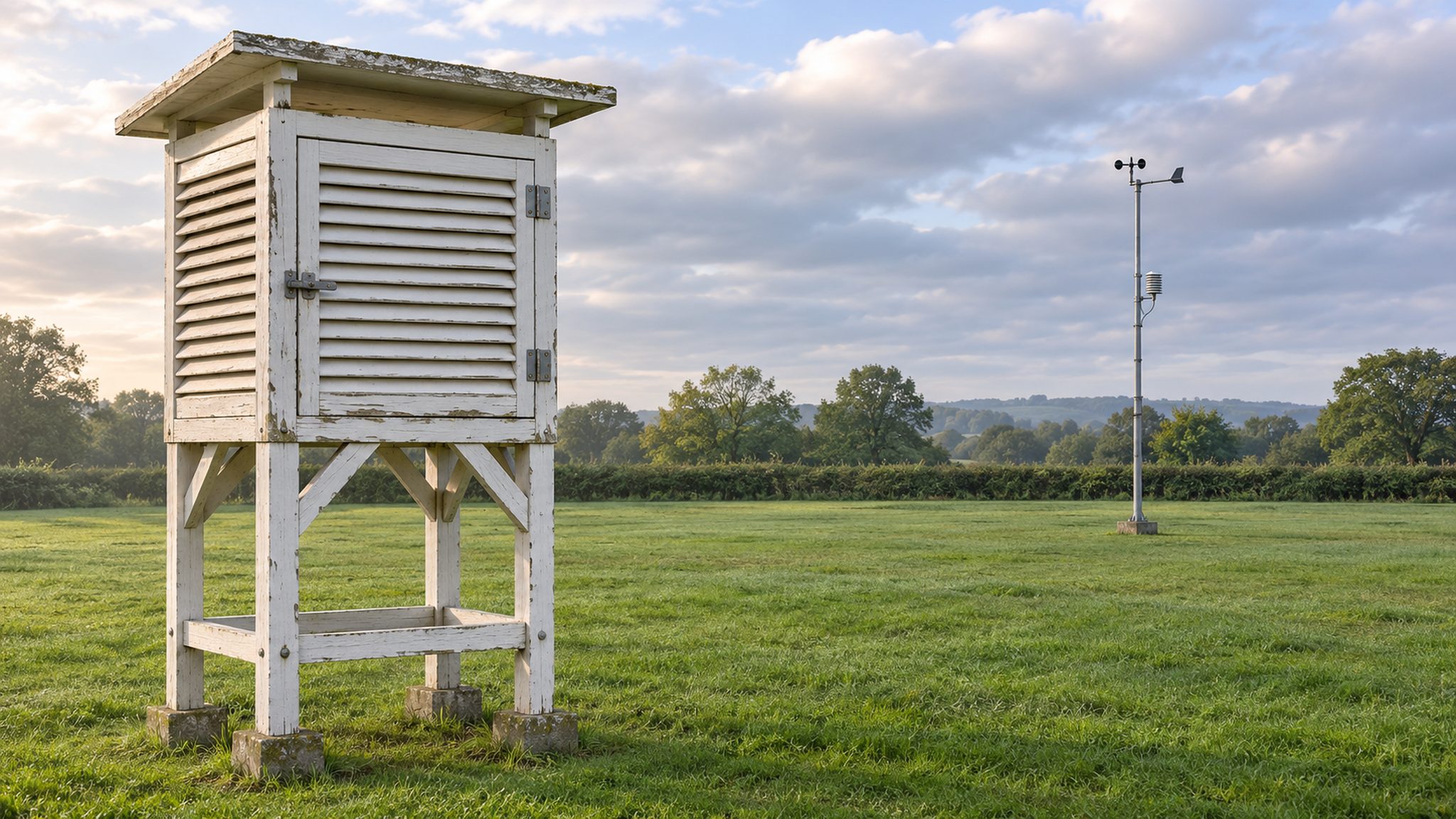
- A Stevenson screen shelters air-temperature instruments from direct sun and rain. Its louvered sides admit air, allowing a thermometer inside to measure conditions in a shaded, ventilated enclosure.
- The exposure of the instrument matters. Moving a screen from an open field to a sheltered courtyard changes its surroundings, even if the operator keeps the same thermometer and observation schedule.
- A station history records moves, changes in instruments and changes in observation times. A scientist investigating an abrupt shift can check whether it coincides with one of those events.
- A regional average draws on several sites. Closing the only high-altitude observing station in a district changes which elevations the remaining network represents, even if every surviving station works perfectly.
How Do Overlapping Measurements Protect the Record?
Consider a station replacing an ageing thermometer. Both instruments can measure the same air for a period before the older one leaves service.
- With parallel observations, staff compare paired readings under a range of local conditions. If the replacement consistently reads warmer than the old instrument, the pairs expose a difference that requires investigation.
- Calibration checks an instrument against a reference. That test and the field comparison answer different questions because the new sensor and its housing may respond differently to conditions at the station.
- If the old instrument stops in April and the new one starts in May, seasonal change and equipment change occur together. Comparing the two monthly averages alone cannot separate their contributions.
- Analysts can compare a suspected break with nearby records and station notes. The evidence for an adjustment is stronger when several independent checks point to the same date and direction.
- The GCOS monitoring principles recommend sufficient overlap to assess differences between instruments. The needed duration depends on the observing system and the conditions it must capture.
Where Do Satellites and Ocean Instruments Fit?
Different platforms observe different parts of the same system. Filling a geographical gap and maintaining a comparable time series are separate tasks.
- A satellite can repeatedly observe areas with few surface stations. Scientists derive climate variables from its measurements and use independent observations to check how well those estimates represent conditions on the ground.
- A moored buoy repeatedly samples a particular ocean location and can carry sensors below the surface. Surface imagery alone cannot recover the same local sequence of subsurface readings after an instrument stops.
- At COP31, WMO drew attention to gaps in equatorial moorings in the western Pacific. Gaps in that region reduce the information available to scientists studying the evolution of El Niño.
- A funding interruption can break a record even when a replacement platform eventually arrives. A later observation describes later conditions. Reconstructing the missing interval requires estimates whose uncertainty must accompany the result.
Way Forward
Fund the Handover Alongside the Replacement
- Budget for parallel operation when introducing a replacement instrument or satellite sensor.
- Preserve raw observations and metadata together so analysts can review adjustments if methods improve.
- Identify poorly observed locations before expanding networks and provide for staff, maintenance and data transmission over the life of each site.
Conclusion
- In a question on measurement quality, examine the instrument history before interpreting an abrupt jump. A simultaneous change at nearby stations has different evidentiary value from a jump confined to one recently altered site.
- For a question on international cooperation, connect coverage to geography and continuity to time. A new station can improve the first while sustained observation and documented handovers build the second.
UPSC Practice Questions
Prelims MCQ 1
With reference to climate observations, consider the following statements:
- Parallel operation can help identify differences between old and new instruments.
- A station relocation is relevant metadata for interpreting a climate series.
- Satellite observations can complement measurements made at the surface.
How many of the above statements are correct?
(a) Only one (b) Only two (c) All three (d) None
Answer: (c) All three
Explanation:
Paired readings help assess instrument differences, station histories document changes in exposure, and different platforms provide complementary information.
Prelims MCQ 2
A station replaces its thermometer exactly when an abrupt rise appears in its temperature record. Which evidence would best help assess the instrument change?
(a) The purchase price of the replacement (b) Simultaneous readings from both thermometers under comparable conditions (c) A photograph of the station taken decades earlier (d) The total number of stations worldwide
Answer: (b) Simultaneous readings from both thermometers under comparable conditions
Explanation:
Paired observations hold local weather broadly constant and reveal consistent differences between the instruments.
UPSC Mains Questions
- How do station metadata and overlapping measurements affect confidence in estimates of long-term climate change?
- Why do improvements in satellite observation leave a continuing need for investment in land stations and ocean instruments?
Sources: World Meteorological Organization and GCOS Climate Monitoring Principles.
Frequently Asked Questions
Why does climate monitoring need an overlap period?
Simultaneous observations let analysts compare two instruments under the same local conditions. They can then examine whether a change in equipment introduced a consistent difference across the handover.
What is the role of GCOS?
GCOS assesses climate observation needs, identifies gaps and promotes coordination among observing programmes. National and international operators contribute measurements from stations, ocean platforms and satellites.
Can a new station fill a historical gap?
A new station adds observations from its start date. Researchers may estimate earlier conditions from other records, but they must document the evidence and uncertainty behind those estimates.
What did the COP31 co-presidents announce?
They called for support for the observing system. A draft action plan was under public review and addressed essential observing capabilities, gaps in coverage, data protection and international coordination.
Tell Google you want more of this.
Add Anantam IAS as a preferred sourceOne tap, and this site shows up more often in your own Top Stories, AI Overviews and AI Mode. Remove it any time.