Why in News?
The revised GRAP schedule approved by CAQM on 28 September 2026 brings selected controls into an earlier stage and extends construction-dust monitoring beyond municipal boundaries.
- Actions concerning diesel generator sets and entry of buses meeting BS-IV or lower standards move from Stage II to Stage I.
- Sonipat joins the listed districts covered by specified petrol and diesel four-wheeler restrictions; this is not a restriction on every vehicle across Haryana.
- Eligible construction and demolition projects beyond municipal limits enter the dust-monitoring framework; the 500-square-metre plot-area threshold remains unchanged.
- Approval changes the schedule; it does not establish that every GRAP stage or listed restriction is currently in force.
- Regional coordination matters because the revised measures cover vehicle entry, specified neighbouring districts and construction activity outside municipal boundaries.
- Targeted enforcement depends on reading vehicle category, emission standard, registration location and stage together, rather than treating GRAP as one blanket ban.
UPSC Relevance
Prelims Relevance
- GRAP: Graded Response Action Plan.
- CAQM: Commission for Air Quality Management in National Capital Region and Adjoining Areas.
- Stage reassignment versus actual invocation of a stage.
- Vehicle emission class versus vehicle category.
- Construction-dust registration threshold and territorial coverage.
Mains Relevance
GS Paper 3
- Emergency pollution response and sustained source control.
- Regulating transport emissions and construction dust across an urban region.
GS Paper 2
- Coordination across municipal, state and regional authorities.
Essay
- Environmental governance requires clear boundaries of responsibility even when pollution crosses administrative borders.
Background and Context
An earlier stage changes the response schedule
GRAP organises pollution-response measures into stages; selected actions now sit earlier in the framework.
- Stage reassignment matters because an action previously located in a later stage can be required earlier when the relevant stage applies. The change concerns timing within the response framework, not merely wording.
- Actions involving diesel generator sets and entry of BS-IV and lower-standard buses from NCR and adjoining states shift into Stage I. The release does not describe an unconditional ban on all buses.
- Repeated actions concerning dust, municipal solid waste and transport are merged in Stage I. Consolidating the schedule can clarify instructions, but administrative simplification alone does not demonstrate reduced emissions on the ground.
- The Citizens Charter for each stage receives additional dos and don’ts. Distinguish these public-facing instructions from the separate responsibilities of enforcement authorities, construction operators and vehicle owners under the applicable measures.
- Schedule approval and stage invocation answer different questions: what measures the framework contains, and which measures apply at a particular time. This announcement provides no basis for claiming today’s AQI or active bans.
Vehicle restrictions depend on several conditions
Read emission standard, vehicle class, territorial reach and stage together before applying a restriction.
- The specified four-wheeler restrictions extend to Sonipat alongside Gurugram, Faridabad, Ghaziabad and Gautam Budh Nagar. The listed coverage must not be rewritten as a restriction covering every district of Haryana.
- The relevant classes are BS-III petrol and BS-IV diesel or lower-standard light motor vehicles. An emission-standard label describes the category named in the rule; it does not make all private cars identical.
- For Stage III, the schedule explicitly mentions entry into Delhi by diesel BS-IV or lower-standard light and medium goods vehicles registered outside Delhi. Registration location is part of this particular entry restriction.
- The essential-commodities exemption is removed for specified BS-IV and lower-standard goods vehicles: light and medium goods vehicles in Stage III, and trucks or heavy goods vehicles in Stage IV. Class and stage remain important.
- For a case-based question, identify fuel, emission standard, vehicle category and route before applying the restriction. Carrying an essential commodity cannot automatically settle eligibility when the relevant exemption has been removed.
Dust oversight follows development beyond municipal limits
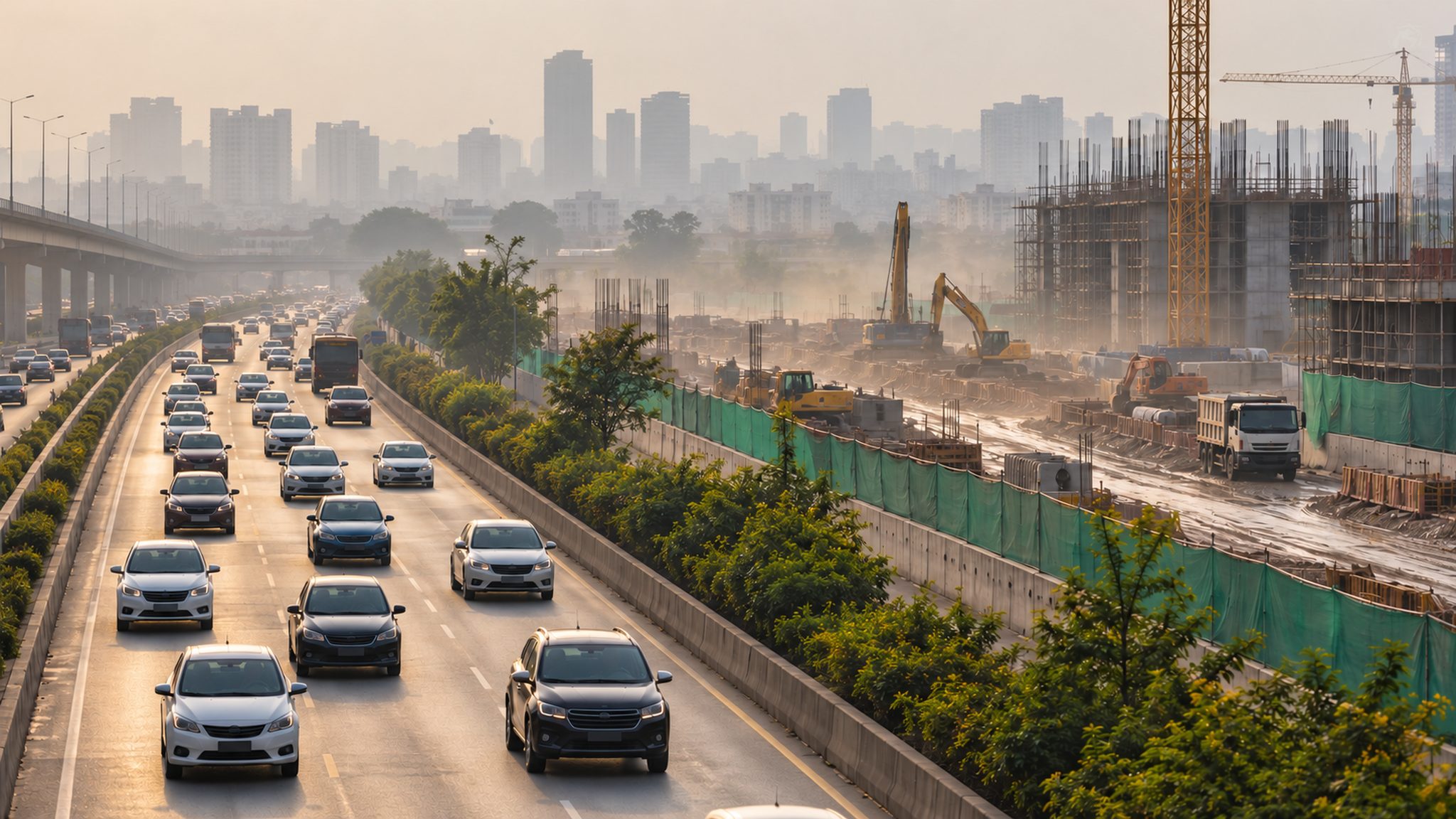
A separate amendment extends dust monitoring to eligible construction sites beyond municipal boundaries.
- Municipal boundaries do not necessarily contain the whole developed region. The amendment reaches eligible projects in urban, controlled and development areas beyond those limits, subject to the relevant statutory or planning framework.
- Industrial development areas, industrial zones and highway corridor zones are also included where applicable. This is a defined extension of coverage, not a claim that every rural construction site falls under identical requirements.
- The existing plot-area threshold of at least 500 square metres stays unchanged. The policy changes where eligible projects are monitored; it does not announce a newly lowered size threshold for registration.
- The mechanism uses web-portal registration and monitoring of construction-dust control measures. Registration makes projects visible to the system, but checking whether dust controls operate requires follow-through beyond the existence of an online entry.
- The governance distinction is between coverage and compliance. Bringing a qualifying site into the monitored universe addresses an oversight gap; it does not by itself establish that the site has controlled its emissions.
Emergency measures need proportionality and follow-through
The revision distinguishes essential maintenance, public exposure and enforcement.
- A minor relaxation under Stage III includes pothole repair. A specified maintenance exception should be read narrowly; the announcement does not support describing it as permission to restart all construction activity.
- Physical sports competitions scheduled in NCR during November and December should be appropriately rescheduled with local air-quality trends in view, according to the advisory noted by CAQM; student health is the stated concern.
- Emergency response can restrain selected activities during pollution episodes. In a Mains answer, pair that function with sustained source control; recurring restrictions alone are not evidence that underlying emissions have been durably reduced.
Way Forward
Make applicability and compliance visible
- Publish stage-specific notices that state vehicle classes, territorial coverage, exemptions and the applicable date clearly.
- Map newly covered construction sites against planning boundaries, then verify registration and functioning dust controls through inspections.
- Track compliance outcomes, not merely portal entries; explain corrective requirements clearly to operators and affected residents.
Conclusion
- Revised GRAP combines earlier placement of selected controls with more precise vehicle coverage and a wider construction-dust monitoring area. Read the schedule as a conditional framework, not proof of restrictions currently operating everywhere.
- For answers, distinguish timing, coverage and enforcement. Each addresses a different weakness in pollution governance; credible assessment requires checking both the applicable order and whether the affected source actually complies.
UPSC Practice Questions
Prelims MCQ 1
With reference to the revised GRAP schedule approved in September 2026, consider the following statements:
- Selected diesel-generator and bus-entry actions move from Stage II to Stage I.
- The construction-dust monitoring amendment lowers the existing plot-area threshold.
- Approval of the revised schedule means all stages are automatically operating.
How many of the above statements are correct?
(a) Only one (b) Only two (c) All three (d) None
Answer: (a) Only one
Explanation:
Only the first statement is correct. The threshold remains at least 500 square metres, and schedule approval must not be confused with invocation of every stage.
Prelims MCQ 2
Which distinction best explains the construction-dust monitoring amendment?
(a) It replaces site monitoring with voluntary reporting. (b) It expands eligible territorial coverage while retaining the size threshold. (c) It exempts all sites beyond municipal boundaries. (d) It applies the same restrictions to every rural building.
Answer: (b) It expands eligible territorial coverage while retaining the size threshold.
Explanation:
The amendment extends the existing monitoring mechanism to eligible projects beyond municipal limits in specified statutory or planning areas; the existing threshold remains unchanged.
UPSC Mains Questions
- Emergency air-pollution controls require both precision and regional coordination. Discuss with reference to the revised GRAP schedule.
- Explain why extending construction-dust monitoring beyond municipal boundaries can improve environmental governance. What implementation gaps may remain?
Source: PIB, Ministry of Environment, Forest and Climate Change.
Frequently Asked Questions
What is the main change in the revised GRAP schedule?
Selected controls concerning diesel generator sets and bus entry move to an earlier stage. The revision also adjusts specified vehicle restrictions and expands the reach of construction-dust monitoring beyond municipal boundaries.
Does approval mean every GRAP restriction is active?
No. Approval defines the revised schedule. Whether a particular restriction applies at a particular time depends on the applicable stage and order; the announcement does not establish that every stage is operating.
Did CAQM reduce the construction-dust registration threshold?
No. The existing threshold of plot area equal to or greater than 500 square metres remains unchanged. The amendment expands eligible territorial coverage under the relevant statutory and planning frameworks.
Are all vehicles in Haryana covered by the Sonipat change?
No. Sonipat is added to specified district coverage for named petrol and diesel four-wheeler categories. The announcement does not impose an all-vehicle restriction across every district of Haryana.
Tell Google you want more of this.
Add Anantam IAS as a preferred sourceOne tap, and this site shows up more often in your own Top Stories, AI Overviews and AI Mode. Remove it any time.