Why in News?
The Himalayan Urban Bio-Sheds initiative was launched during the 17–18 November 2026 Parvat Manthan Conclave, with pilot implementation planned in three towns across Himachal Pradesh, Uttarakhand and Sikkim.
- The National Institute of Urban Affairs is undertaking HUBS with support from the environment ministry and National Mission on Himalayan Studies, in partnership with IUCN.
- HUBS seeks to connect water, waste, biodiversity and ecosystem health within a common urban planning framework.
- The official announcement describes a planned pilot; it does not report completed implementation or measured improvements in the three towns.
- The conclave recommended including carrying-capacity assessments in statutory master plans. A conference recommendation does not itself change planning law.
- A town depends on surrounding catchments for water and sends waste beyond individual properties. Its service problems cannot always be resolved within its administrative boundary.
- The planning challenge is to align land use and service demand with ecological conditions, while identifying which institutions must act together.
UPSC Relevance
Prelims Relevance
- HUBS means Himalayan Urban Bio-Sheds.
- The initiative is undertaken by NIUA, with environment-ministry and NMHS support and an IUCN partnership.
- The announced pilot covers three towns across Himachal Pradesh, Uttarakhand and Sikkim; the release does not identify the towns.
- Ecological boundaries follow natural relationships, while municipal boundaries define administrative jurisdiction.
- Carrying capacity connects development pressure with resource availability, infrastructure capacity and ecological sensitivity.
Mains Relevance
GS Paper 3
- Explain why watershed conservation and urban services require joint planning in mountain settlements.
- Assess how carrying-capacity evidence can inform land-use decisions without treating an assessment as a permanent population ceiling.
GS Paper 2
- Examine inter-jurisdictional coordination, institutional responsibility and the financing of shared ecological assets.
Essay
- Urban resilience depends on the landscapes that support a settlement as well as the infrastructure inside it.
Background and Context
What an Urban Bio-Shed Connects
HUBS places urban development within the wider ecological system supporting it, rather than treating municipal services as separate engineering tasks.
- The initiative brings water, waste, biodiversity and ecosystem health into one planning framework. Its purpose is to make decisions about urban services consistent with the ecological conditions on which those services depend.
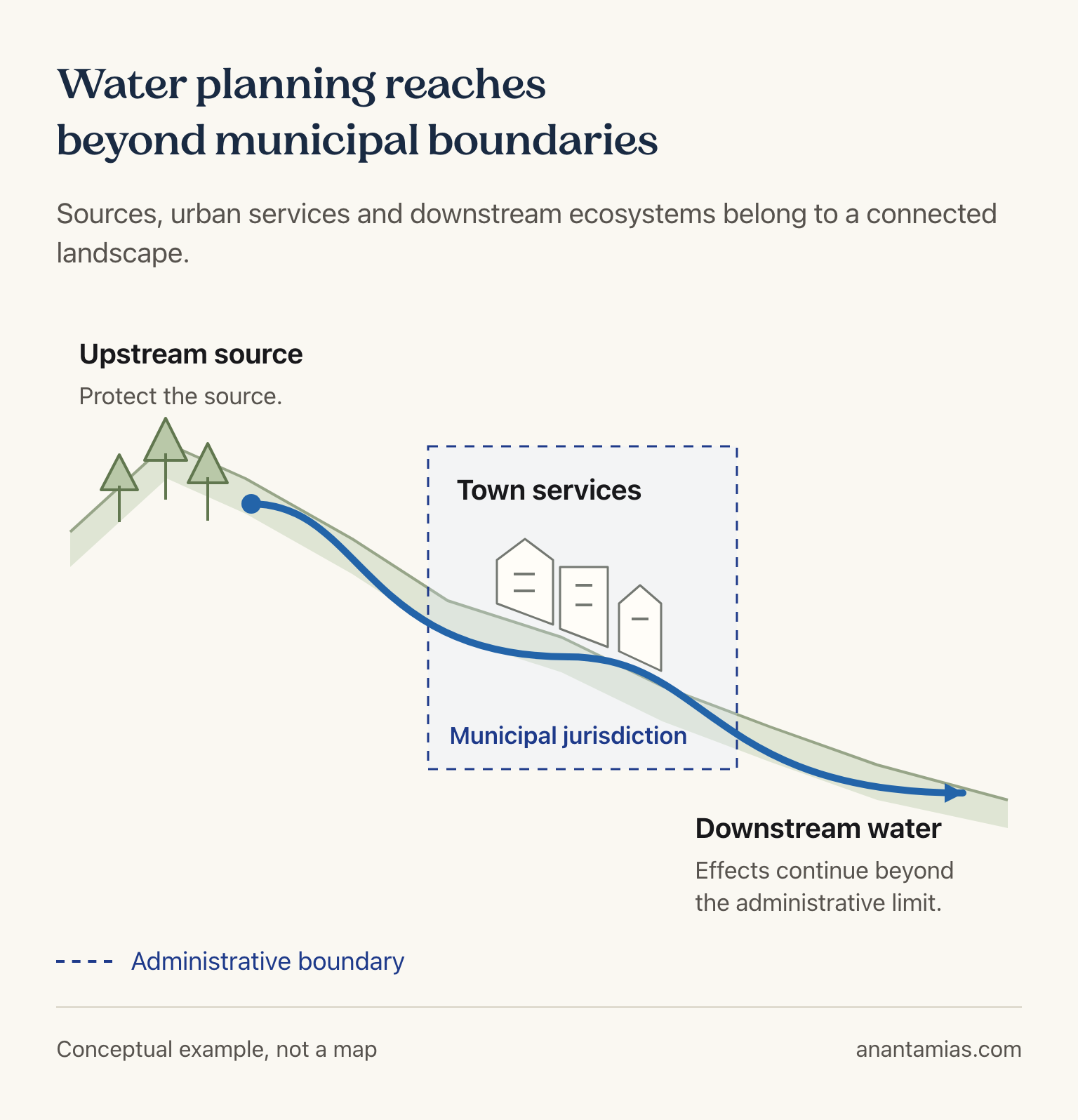
- A catchment is an area draining towards a common outlet. It follows terrain and drainage relationships, so its extent need not coincide with the jurisdiction of the urban authority using its water.
- Municipal boundaries determine an authority’s administrative reach. An ecological planning area asks a different question: which upstream sources, settlement pressures and downstream effects must be considered together to keep services sustainable?
- For example, a town may draw water from an upstream landscape outside its limits. Protecting the source then requires cooperation with the institutions responsible for that land, alongside investment in pipes and treatment.
- The planned three-town pilot is an opportunity to examine this integrated approach. The announcement establishes its intended direction; it supplies no results showing that water security or biodiversity has already improved.

How Ecological Limits Inform Urban Decisions
Carrying-capacity assessment examines development pressure against available resources and service systems; it becomes useful when it informs actual land-use choices.
- The conclave recommended integrating water availability, biodiversity and ecological sensitivity into land-use planning. These factors help explain why expanding a settlement cannot be judged solely by the availability of land for construction.
- Service demand includes pressures from residents and visitors. The released Haridwar assessment examines population and tourism pressures on infrastructure, illustrating why a town’s needs cannot be inferred from its resident population alone.
- Carrying capacity should be read as an evidence-based planning assessment, not a universal number applicable to every hill town. Local water conditions, infrastructure and ecological sensitivity must shape the assessment and its interpretation.
- A proposed development may require both source protection and service investment. Adding supply infrastructure without examining the condition of its source leaves the underlying ecological dependency outside the investment decision.
- The recommendation to include assessments in statutory master plans identifies a route from evidence to planning decisions. It is not proof that every Himalayan state has already adopted a binding common requirement.
Why Coordination Matters Beyond the Town
An integrated plan needs institutions able to act across boundaries and budgets that support the services and ecosystems identified in the assessment.
- Shared planning must identify who manages a water source, who supplies the town and who handles waste. A common problem definition is useful only when responsibilities for the linked decisions are clear.
- Upstream protection and downstream effects connect neighbouring communities. Municipal improvements should be assessed alongside their effects outside the town, rather than assuming a cleaner municipal area means the wider ecological problem has disappeared.
- The conclave discussed cluster-based planning and project aggregation as financing approaches. Shared projects could address connected needs, but these recommendations do not establish that a particular joint project has received approval or funding.
- Environmental monitoring can help compare planned improvements with actual conditions. Publicly explaining what is measured and which institution responds would make ecological planning more accountable than a one-time assessment alone.
- HUBS differs from a sanitation assessment: its stated purpose is integrated ecological planning. Local source assessment remains important because a regional framework cannot substitute for evidence about individual sites.
Way Forward
Connect the Pilot to Decisions
- Publish pilot baselines and responsibilities so changes in water, waste and ecosystem conditions can be assessed against clearly stated starting conditions.
- Use catchment and service-demand evidence when comparing land-use and infrastructure choices, with participation from affected communities outside municipal limits.
- Clarify the legal status of proposed planning changes before presenting conference recommendations as mandatory rules.
- Link shared projects to identifiable operating responsibilities and financing arrangements, rather than leaving cross-boundary cooperation dependent on occasional meetings.
Conclusion
- HUBS offers a framework for connecting Himalayan urban services with the ecological systems supporting them. Its planned pilot should be evaluated through implementation evidence, rather than treated as a demonstrated improvement at launch.
- The durable planning lesson is to match the scale of decisions to the scale of the problem: municipal authority matters, but water sources, waste effects and ecological relationships may extend beyond its boundary.
UPSC Practice Questions
Prelims MCQ 1
With reference to the Himalayan Urban Bio-Sheds initiative, consider the following statements:
- It seeks to integrate water, waste, biodiversity and ecosystem health into urban planning.
- Its announced pilot is planned in three towns across Himachal Pradesh, Uttarakhand and Sikkim.
- Its launch automatically made carrying-capacity assessments a binding statutory requirement in every Himalayan state.
How many of the above statements are correct?
(a) Only one (b) Only two (c) All three (d) None
Answer: (b) Only two
Explanation:
Statements 1 and 2 match the official announcement. Including carrying-capacity assessments in statutory master plans was a conclave recommendation, not an automatically enacted legal requirement.
Prelims MCQ 2
Why might Himalayan urban water planning need to extend beyond a municipal boundary?
(a) Municipal authorities have no role in water services. (b) Every catchment is identical to a municipal jurisdiction. (c) Water sources and ecological effects may lie outside the authority’s administrative limits. (d) An ecological plan automatically transfers all land to the urban authority.
Answer: (c) Water sources and ecological effects may lie outside the authority’s administrative limits.
Explanation:
Natural drainage relationships and administrative jurisdiction need not coincide. Planning may require cooperation across boundaries; it does not remove municipal responsibilities or automatically change land ownership.
UPSC Mains Questions
- Explain how catchment-scale planning can improve water security in Himalayan towns. What institutional difficulties arise when ecological and municipal boundaries differ?
- Discuss the value and limitations of carrying-capacity assessments in Himalayan urban planning. How can pilot initiatives generate evidence for subsequent planning decisions?
Source: PIB, Ministry of Housing and Urban Affairs.
Frequently Asked Questions
What is the Himalayan Urban Bio-Sheds initiative?
HUBS is an NIUA initiative intended to integrate water, waste, biodiversity and ecosystem health into urban planning. Its announced pilot is planned in three towns across Himachal Pradesh, Uttarakhand and Sikkim.
Does the HUBS announcement identify the three pilot towns?
The PIB release identifies the three states but does not name the pilot towns. It describes planned implementation, so neither town identities nor completed environmental improvements should be inferred from the announcement.
How does a catchment differ from a municipal area?
A catchment is defined by drainage towards a common outlet. A municipal area is defined administratively. Water sources and ecological effects can cross those administrative limits, creating a need for coordinated planning.
Are carrying-capacity recommendations already binding law?
The conclave recommended incorporating carrying-capacity assessments into statutory master plans. That recommendation does not by itself enact a legal requirement. Adoption through the applicable planning processes would need to be established separately.
Tell Google you want more of this.
Add Anantam IAS as a preferred sourceOne tap, and this site shows up more often in your own Top Stories, AI Overviews and AI Mode. Remove it any time.