Why in News?
The Hindu’s November 20 coverage highlighted Indonesian fires, following a November 17 Copernicus report on persistent burning and haze across Southeast Asia.
- CAMS estimated Indonesia’s cumulative fire emissions were approaching 200 megatonnes of carbon by mid-November, remaining well below the exceptional 2015 level.
- The report described prolonged haze in Kalimantan and Sumatra, with smoke affecting neighbouring Singapore and Peninsular Malaysia.
- CAMS combined fire-emission estimates and atmospheric forecasts to examine the persistence and movement of smoke.
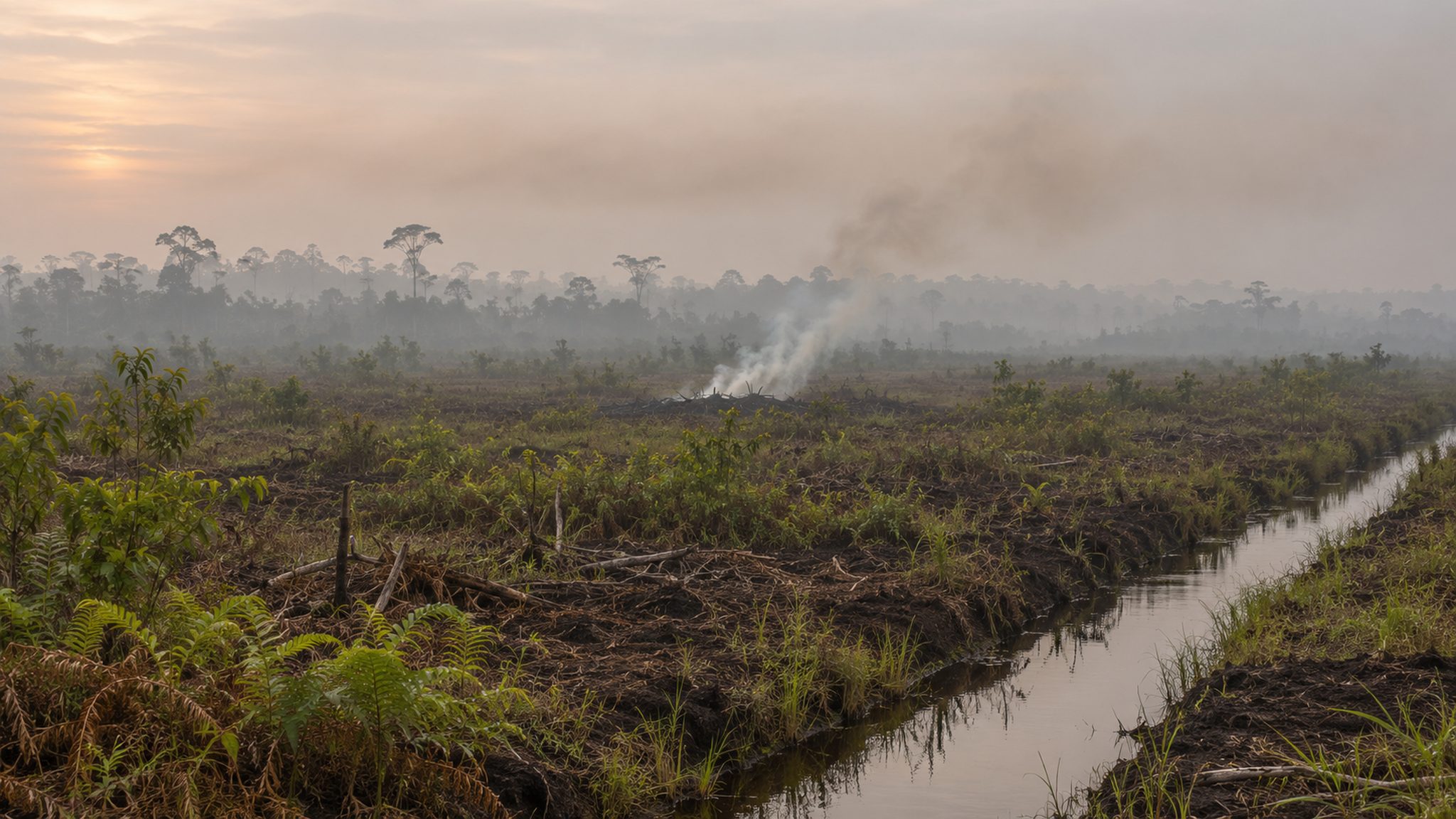
- Drained peat can sustain prolonged smouldering during dry conditions, connecting land management with regional air quality.
- Different measurements describe emissions, airborne particles and atmospheric haze, so their units and interpretation require care.
UPSC Relevance
Prelims Relevance
- Peat is accumulated partly decomposed organic material.
- El Niño can intensify dry conditions in Indonesia.
- GFAS uses satellite fire radiative power observations to estimate emissions.
- Aerosol optical depth describes an atmospheric column.
- PM2.5 refers to fine particulate matter.
Mains Relevance
GS Paper 3
- Land management, persistent peat fires and regional pollution.
- Environmental monitoring and interpretation of different evidence types.
GS Paper 2
- Transboundary coordination for timely air-quality information.
Background and Context
Why Drained Peat Can Keep Burning
Peatland conditions help explain why smoke can persist after a fire becomes less visually dramatic.
- Peat accumulates organic material where decomposition is limited by wet conditions. When a peatland is drained, its surface can become drier and more exposed to burning during periods of low rainfall.
- Smouldering is prolonged combustion that can continue without a large visible flame. CAMS identifies drained peat as a source of persistent smoke and greenhouse-gas emissions during Indonesia’s dry season.
- El Niño can intensify regional dryness, increasing vulnerability where combustible material and ignition sources are present. The report treats it as one contributing influence within a wider combination of environmental and land-use conditions.
- Persistence matters because repeated emissions can sustain poor air quality over many days. A short-lived reduction in visible flames or the arrival of some rain does not by itself establish that all hotspots have ended.
- Spatial variation also matters. CAMS reported substantial differences between provinces, so a national total can conceal where burning is concentrated and where the practical need for monitoring is greatest.
What the Three Measurements Describe
Emissions, near-surface concentrations and atmospheric-column observations answer different questions about the same fire episode.
- Carbon emissions quantify the mass of carbon released over a defined area and period. The report’s megatonnes of carbon describe a cumulative emissions estimate, rather than the concentration of particles inhaled at a location.
- Surface PM2.5 concentration describes fine-particle mass in a volume of near-ground air, commonly expressed in micrograms per cubic metre. Its interpretation depends on the location and averaging period of the observation or forecast.
- Aerosol optical depth expresses how particles affect light passing through an atmospheric column. It is dimensionless and includes particles above the surface, making their vertical distribution important when relating it to ground-level conditions.
- Fire radiative power provides a satellite-observed input to GFAS emissions estimates. Converting an observation into emissions requires a model, so the resulting totals should retain their stated estimation basis and time window.
- Measurement continuity makes comparisons more meaningful when methods and coverage remain consistent. This is also the central concern in maintaining long-term climate observation records.
How Smoke Becomes a Regional Problem
Atmospheric transport connects burning in one area with haze and particle concentrations elsewhere.
- Wind transport can carry smoke across administrative and national boundaries. CAMS described haze affecting Singapore and Peninsular Malaysia, illustrating why local air conditions can depend on emissions outside the immediate jurisdiction.
- Plume height and mixing influence how much smoke reaches the surface. An elevated layer may contribute to optical depth while having a different relationship with ground-level particle concentrations than a low-lying plume.
- Model evaluation compares forecasts with independent observations. CAMS checked aerosol optical-depth forecasts against AERONET measurements, which supports assessment of that variable while leaving other quantities to their appropriate observations and validation.
- Exposure assessment needs information about concentrations where people spend time and for how long. Emission totals alone cannot supply this detail, which also matters when using air-pollution evidence in public policy.
- Source attribution requires evidence linking emissions, atmospheric movement and observations. A hazy photograph or one elevated reading cannot by itself identify the exact contribution of a particular fire to conditions at another site.
Way Forward
Connect Land and Atmospheric Monitoring
- Track persistent hotspots alongside peatland conditions so changes in rainfall are assessed against continuing fire activity.
- Report units and time windows clearly when communicating emissions, particle concentrations and optical depth.
- Compare forecasts with observations and share regional information promptly so authorities can follow smoke movement across borders.
Conclusion
- Peat-fire management requires attention to the land conditions sustaining combustion and the atmosphere carrying its emissions.
- Sound interpretation starts by asking what a number measures, where it applies and over what period it was calculated.
UPSC Practice Questions
Prelims MCQ 1
With reference to fire and smoke monitoring, consider the following statements:
- Carbon emissions can be expressed as a mass over a specified period.
- Aerosol optical depth represents an atmospheric-column property.
- A national fire-emission total directly determines every city’s surface PM2.5 concentration.
How many of the above statements are correct?
(a) Only one (b) Only two (c) All three (d) None
Answer: (b) Only two
Explanation:
The first two statements are correct. Surface concentrations also depend on transport, mixing and local conditions.
Prelims MCQ 2
Which observation most directly helps assess fine-particle concentration near ground level at a particular location?
(a) A cumulative national carbon-emission total (b) A count of provinces (c) A surface PM2.5 measurement with a defined averaging period (d) A photograph of distant haze alone
Answer: (c) A surface PM2.5 measurement with a defined averaging period
Explanation:
A surface measurement records the relevant particle concentration at the monitoring location and period. Wider totals and images provide different information.
UPSC Mains Questions
- Explain how drained peatlands and atmospheric transport can turn seasonal fires into a regional environmental problem.
- Distinguish carbon-emission estimates, surface PM2.5 concentrations and aerosol optical depth in assessing a smoke episode.
Source: Copernicus Atmosphere Monitoring Service.
Frequently Asked Questions
Why can peat fires persist?
Drained peat can become dry and sustain smouldering for long periods. Continued burning releases smoke even when large flames are absent, making hotspot monitoring important.
What does a megatonne of carbon measure?
It measures carbon mass. In a fire-emissions estimate, it refers to carbon released over a defined area and period, rather than particle concentration at a particular monitoring site.
Does aerosol optical depth give surface PM2.5 directly?
Aerosol optical depth describes particles through an atmospheric column. Relating it to surface PM2.5 requires information about vertical distribution, particle properties and atmospheric conditions.
Why can haze cross national borders?
Winds can transport smoke from fire regions into neighbouring countries. Plume height, mixing and changing weather influence where the smoke travels and how it affects surface air.
Tell Google you want more of this.
Add Anantam IAS as a preferred sourceOne tap, and this site shows up more often in your own Top Stories, AI Overviews and AI Mode. Remove it any time.