
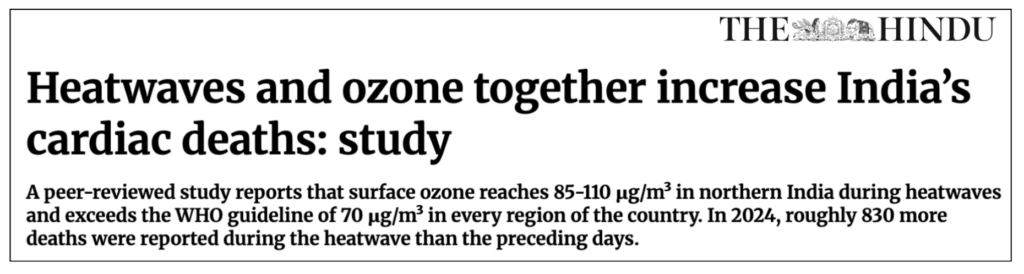
Why in News?
A study reported by The Hindu and the Indian Express (June 2026) finds that heatwaves occurring alongside high levels of ground-level (tropospheric) ozone significantly increase cardiac and cardiovascular deaths in India — the two stressors together prove far more lethal than either acting alone.
The finding reframes extreme heat as not just a thermal hazard but an air-quality event: hot, sunny, stagnant days that drive heat illness are the very conditions that cook up dangerous ozone, compounding the strain on the heart.
- Ground-level ozone is a secondary pollutant — it is not emitted directly but forms when nitrogen oxides (NOx) and volatile organic compounds (VOCs) react in sunlight.
- It is the same chemistry behind photochemical smog, so ozone peaks on hot, bright, low-wind days — exactly when heatwaves strike.
- The combined heat-plus-ozone exposure raises cardiovascular stress (blood pressure, clotting, inflammation), pushing up cardiac deaths beyond what heat alone explains.
- India’s Heat Action Plans (HAPs) warn about temperature but rarely factor in air pollution co-exposure, leaving a policy blind spot.
The development matters in the context of:
- Most heat-death tolls and HAPs treat heat and air pollution as separate problems; this study shows they interact and amplify each other.
- It links three durable syllabus threads — climate change and heat extremes, air-quality regulation, and public health — into one governance challenge.
UPSC Relevance
Prelims Relevance
- Tropospheric (ground-level) ozone — secondary pollutant; harmful to lungs and heart
- Stratospheric ozone — the protective “ozone layer” that absorbs UV; distinct from ground-level ozone
- Ozone precursors — NOx and VOCs reacting in sunlight
- Photochemical smog — brown haze formed by the same sunlight-driven reactions
- NAAQS — National Ambient Air Quality Standards (notified for 12 pollutants, including ozone)
- CPCB — Central Pollution Control Board; sets and monitors standards
- AQI — National Air Quality Index covers 8 pollutants, including O3
- NCAP — National Clean Air Programme (launched 2019)
- Urban Heat Island (UHI) — cities run hotter than surrounding rural areas
- Heat Action Plan (HAP) — the Ahmedabad 2013 plan was India’s first
- IMD heatwave criteria — based on temperature thresholds/departures
Mains Relevance
GS Paper 3
- Environmental pollution and degradation; secondary pollutants and their health impacts.
- Climate change and disaster management — heatwaves as a notified disaster and the need for integrated heat-air warnings.
GS Paper 2
- Issues relating to the health sector and the governance of preventive public health.
- Coordination across pollution-control boards, disaster authorities and health departments.
Essay
- When the air we breathe turns against the heart: invisible costs of a warming city.
- Development, heat and health: who pays the price of the urban summer?
Background and Context
Ground-level ozone vs the ozone layer
Ozone is the same molecule (O3) in two very different roles — protective high up, harmful at the surface.
- Stratospheric ozone (10-50 km up) forms the protective ozone layer that absorbs harmful ultraviolet (UV) radiation — “good” ozone, governed globally by the Montreal Protocol.
- Tropospheric (ground-level) ozone sits near the surface where we breathe — “bad” ozone, a toxic air pollutant and greenhouse gas.
- Ground-level ozone is a secondary pollutant: it is not emitted from any chimney or tailpipe directly.
- It is created when NOx (from vehicles, power plants) and VOCs (fuels, solvents, paints) react in strong sunlight.
- Because sunlight drives the reaction, ozone concentrations typically peak on hot afternoons — the link to heat is chemical, not coincidental.
Why heat and ozone arrive together
The weather that produces a heatwave is the same weather that brews ozone and photochemical smog.
- Heatwaves bring clear skies, intense sun and stagnant, low-wind air — ideal for the photochemical reactions that make ozone.
- Stagnant air traps pollutants and lets ozone build up instead of dispersing.
- This is the chemistry of photochemical smog — a brown summer haze, distinct from winter particulate smog.
- The Urban Heat Island effect makes cities hotter than their surroundings, intensifying both heat stress and ozone formation.
- So a single hot, sunny, windless day stacks two health hazards on top of each other — extreme heat and high ozone.
How the combination harms the heart
Heat and ozone each stress the cardiovascular system, and together they push vulnerable people over the edge.
- Heat stress forces the heart to work harder — raising heart rate, thickening the blood through dehydration, and straining circulation.
- Ground-level ozone triggers airway and systemic inflammation, oxidative stress and changes that can raise blood pressure and clotting risk.
- The study finds that the two together raise cardiac/cardiovascular deaths more than the sum of their separate effects.
- The worst hit are the elderly, people with existing heart or lung disease, outdoor workers, and the urban poor without cooling.
- Crucially, ozone harm occurs even at levels once thought safe, and outdoors, where masks offer little protection.
How India regulates and monitors ozone
Ozone is already a regulated pollutant, but monitoring and warning systems lag behind the heat-ozone reality.
- Ground-level ozone is one of the pollutants under India’s National Ambient Air Quality Standards (NAAQS), notified by the CPCB under the Air (Prevention and Control of Pollution) Act, 1981.
- Ozone is also one of the 8 pollutants reflected in the National Air Quality Index (AQI).
- The National Clean Air Programme (NCAP), launched in 2019, targets particulate pollution in non-attainment cities, but ozone gets far less policy attention than PM2.5.
- Surface-ozone monitoring is patchy, so its true health burden across Indian cities is poorly mapped.
- Tackling ozone requires cutting its precursors — NOx and VOCs — not the pollutant itself, which makes control indirect and harder.
The policy blind spot in Heat Action Plans
India’s heat-warning machinery largely ignores the air-quality dimension of a hot day.
- India’s first Heat Action Plan was the Ahmedabad model (2013), now copied by many states and cities.
- HAPs focus on temperature thresholds, early warnings, cooling shelters, hydration and rescheduling outdoor work.
- Few HAPs integrate air-quality / ozone alerts, even though the worst heat days are also the worst ozone days.
- Heatwaves are not yet a notified disaster under the national Disaster Management Act, limiting dedicated funding.
- The study’s message: warnings should be joint heat-and-air-quality advisories, especially for the heart-vulnerable.
Way Forward
Issue joint heat-air warnings
- Combine IMD heat alerts with CPCB ozone/AQI data into a single advisory for hot, high-ozone days.
- Flag risk explicitly to the elderly and people with heart and lung disease.
Upgrade Heat Action Plans
- Build an air-quality trigger into every Heat Action Plan, not just temperature.
- Equip primary health centres to anticipate cardiac and respiratory surges on peak heat-ozone days.
Cut ozone precursors
- Reduce NOx and VOC emissions from vehicles, power plants, refineries and solvents.
- Expand surface-ozone monitoring and bring ground-level ozone firmly into NCAP targets.
Cool the city
- Counter the Urban Heat Island with green cover, cool/reflective roofs and shaded public spaces.
- Protect outdoor and informal workers with rest-shade-water rules and rescheduled hours.
Conclusion
The study’s insight is deceptively simple: a heatwave is rarely just hot — it is also smoggy, because the same blazing, stagnant air that overheats the body is what cooks ground-level ozone. Treating the two as one combined hazard, rather than separate problems, is the key shift.
For India, where summers are lengthening, and cities are warming, the answer is to fuse heat and air-quality governance — joint warnings, ozone-aware Heat Action Plans, and steady cuts to NOx and VOCs — so the country protects not just against the heat, but against the hidden chemistry that turns a hot day deadly for the heart.
UPSC Practice Questions
Prelims MCQ 1
With reference to ground-level (tropospheric) ozone, consider the following statements:
- It is a secondary pollutant formed by the reaction of nitrogen oxides and volatile organic compounds in sunlight.
- It is the same protective ozone that forms the stratospheric ozone layer, shielding the Earth from ultraviolet radiation.
- It is one of the pollutants covered under India’s National Ambient Air Quality Standards.
How many of the above statements are correct?
(a) Only one (b) Only two (c) All three (d) None
Answer: (b) Only two
Explanation:
Statements 1 and 3 are correct. Statement 2 is wrong — ground-level ozone is a harmful surface pollutant, distinct from the protective stratospheric ozone layer; though chemically the same molecule, its role and location differ.
Prelims MCQ 2
Ground-level ozone concentrations in Indian cities typically peak under which of the following conditions?
(a) Cold, foggy winter mornings with low sunlight
(b) Hot, sunny, low-wind summer afternoons
(c) Heavy monsoon downpours with high humidity
(d) Cool, windy nights with rapid air mixing
Answer: (b) Hot, sunny, low-wind summer afternoons
Explanation:
Ozone forms through sunlight-driven photochemical reactions, so it builds up on hot, bright, stagnant days — the same conditions that produce heatwaves and photochemical smog.
UPSC Mains Questions
- “Extreme heat in Indian cities is increasingly also an air-quality crisis.” In light of the link between heatwaves and ground-level ozone, examine the cardiovascular health risks and the gaps in current Heat Action Plans. (250 words)
- Distinguish between stratospheric and tropospheric ozone, and discuss why ground-level ozone is a difficult pollutant to regulate in India. (150 words)
- Climate change and air pollution are often treated as separate challenges. Discuss how heatwaves and ground-level ozone illustrate the case for integrated environmental-health governance. (250 words)
Sources: The Hindu and Indian Express.
Frequently Asked Questions
What is ground-level ozone?
Ground-level or tropospheric ozone is ozone (O3) near the Earth’s surface, where we breathe. Unlike the protective ozone layer high in the stratosphere, it is a harmful air pollutant. It is a secondary pollutant, formed when nitrogen oxides and volatile organic compounds react in sunlight, and it is a key ingredient of photochemical smog.
How is it different from the ozone layer?
They are the same molecule but in opposite roles. Stratospheric ozone, 10-50 km up, shields us from harmful ultraviolet radiation and is “good” ozone. Ground-level ozone sits at the surface, irritates the lungs and strains the heart, and is “bad” ozone. So ozone is protective high above us but toxic down where we live.
Why do heatwaves and ozone occur together?
Ozone forms through sunlight-driven reactions, so it builds up on hot, bright, stagnant days. Those are exactly the conditions that cause heatwaves: clear skies, intense sun and low winds that trap pollutants. The same weather that overheats the body also cooks ozone, stacking two health hazards on the same day.
How does the heat-ozone mix affect the heart?
Heat makes the heart work harder and thickens the blood through dehydration, while ground-level ozone triggers inflammation and can raise blood pressure and clotting risk. The study finds that together they push up cardiac and cardiovascular deaths more than either does alone, with the elderly and people with heart or lung disease most at risk.
How does India regulate ground-level ozone?
Ground-level ozone is one of the pollutants under the National Ambient Air Quality Standards set by the Central Pollution Control Board under the Air Act, 1981, and it features in the National Air Quality Index. But monitoring is patchy, and the National Clean Air Programme focuses mainly on particulate matter, so ozone gets less attention than PM2.5.
What should Heat Action Plans add?
Most Heat Action Plans, modelled on the Ahmedabad 2013 plan, warn only about temperature. They should add an air-quality or ozone trigger, issue joint heat-and-air advisories, alert heart-vulnerable groups, and prepare health centres for cardiac surges on peak heat days. Cutting ozone precursors and cooling cities through greenery and reflective roofs also helps.
Tell Google you want more of this.
Add Anantam IAS as a preferred sourceOne tap, and this site shows up more often in your own Top Stories, AI Overviews and AI Mode. Remove it any time.