
Why in News?
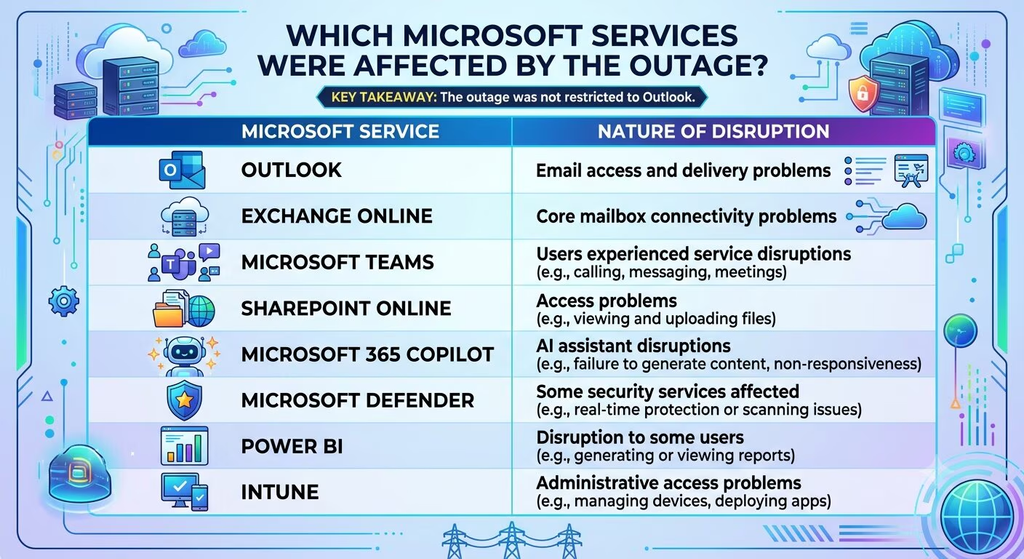
A global outage of Microsoft’s productivity suite, Microsoft 365, during November 12-13, 2026, disrupted access to Outlook and other services. Microsoft attributed the disruption to a fault during an upgrade of its network capacity and apologised to affected users.
In India, the outage affected email support and communication systems of airlines, including IndiGo and Akasa Air, while Air India had to reroute its email services.
The incident highlights India’s growing dependence on global cloud service providers and raises important questions about regulatory oversight, mandatory outage reporting and data protection.
| UPSC Relevance: GS-2 Polity and Governance: Accountability; GS-3 Science and Technology: Cloud services; Data protection. Prelims & Mains: Dependence on cloud service providers and associated Risks |
Does Indian Law require Microsoft to Report the Outage?
No explicit legal mandate directly forces a cloud provider like Microsoft to report a non-cyberattack technical outage under a single, unified rule. Instead, three distinct legal and regulatory frameworks are relevant.
(i) CERT-In Directions under the Information Technology Act, 2000:
The Indian Computer Emergency Response Team (CERT-In) is the national agency for responding to cybersecurity incidents under Section 70B of the IT Act, 2000.
- Direction: Under the CERT-In directions (2022), companies (specified entities, including service providers, intermediaries, data centres and body corporates) must report cyber incidents within six hours. The reportable incidents include data breaches, data leaks, unauthorised access, attacks on IT systems and other specified cyber incidents.
- Limitation: The directions primarily cover cybersecurity incidents and do not explicitly cover service outages caused by technical faults, software upgrades or infrastructure failures in the absence of a cyberattack.
However, under Section 70B(6), CERT-In can call for information and issue directions to service providers and other covered entities, enabling it to seek explanations regarding an incident.
(ii) RBI Directions on Outsourcing of IT Services:
- The RBI’s directions on managing risks in outsourcing of IT services (2025) require regulated banks using cloud services to assess risks associated with outsourcing critical IT services, vendor dependence, and maintain exit strategies.
- Limitation: These directions primarily regulate RBI-regulated entities and their outsourcing arrangements. They do not establish a universal direct reporting obligation for cloud providers across all sectors.
(iii) Digital Personal Data Protection (DPDP) Act, 2023:
- The DPDP Act introduces obligations relating to personal data security and breach reporting.
- The Act includes unauthorised processing of personal data and accidental disclosure, acquisition, sharing, use, alteration, destruction or loss of access to personal data that compromises its confidentiality, integrity or availability.
- The framework requires Data Fiduciaries to notify the Data Protection Board of India and affected individuals of personal data breaches.
- Penalties: Failure to take reasonable security safeguards to prevent personal data breaches can attract a penalty of up to ₹250 crore under the Act.
- Limitation: A temporary service outage does not automatically qualify as a personal data breach. Its classification depends on whether it involves a qualifying loss of access to personal data and compromises its availability. Further, the primary reporting responsibility rests with the Data Fiduciary, which may be the customer organisation using Microsoft’s services, rather than the cloud provider acting as a Data Processor.
The phased implementation of the DPDP framework also means that the relevant breach-reporting obligations are scheduled to become operational in May 2027.
Global Regulatory Approach:
Several countries have moved towards regulating major cloud service providers directly, recognising their importance to financial systems, public administration and critical digital infrastructure.
| Country / Framework | Key Regulatory Provisions |
| European Union – DORA | The Digital Operational Resilience Act places critical third-party ICT service providers, including major cloud vendors, under direct oversight by European financial supervisory authorities. |
| European Union – NIS2 Directive | Covers cloud computing providers across sectors. Significant incidents must be reported to the competent authority within 24 hours, followed by a detailed notification within 72 hours. |
| United Kingdom | The Bank of England’s critical third parties regime enables direct oversight of designated technology providers whose services are important to financial institutions. |
| Singapore | Its digital infrastructure regulatory framework requires designated large data centres and cloud service providers to obtain licences and report service interruptions. |
| South Korea | Following the 2022 KakaoTalk disruption caused by a data-centre fire, large digital platforms and data centres have been required to submit disaster management plans since July 2023. |
What are Indian Customers’ Options?
- Contractual Recourse: Customers are mostly bound by Microsoft’s Service Level Agreements (SLAs), which typically offer limited financial remedies like service credits (discounts on future subscription bills) rather than consequential damage claims.
- Strategic Diversification / Indigenous Alternatives: The Union government reported to the Lok Sabha in December 2025 that over 12.68 lakh official email accounts had migrated to Zoho (a Chennai-based indigenous platform), reducing foreign dependency. However, domestic providers similarly lack mandatory uptime reporting duties to CERT-In.
Key Issues and Regulatory Gaps in India:
- Absence of mandatory outage reporting: India lacks a uniform framework requiring major cloud providers to report significant technical disruptions, irrespective of whether they result from cyberattacks.
- Ambiguity in data breach classification: It remains unclear when temporary loss of access to cloud-hosted personal data qualifies as a reportable breach under the DPDP framework.
- Limited direct oversight: Unlike the EU and UK, India does not have a comprehensive cross-sector framework for directly supervising systemically important cloud service providers.
- Dependence on contractual accountability: Individual organisations must often rely on Service Level Agreements (SLAs) and contractual remedies, which may not adequately address large-scale disruptions.
- Concentration risk: Heavy dependence on a few global cloud providers creates systemic vulnerabilities, as a single infrastructure failure can affect multiple sectors simultaneously.
- Domestic providers face similar gaps: Shifting services to Indian vendors may reduce external dependence, but does not automatically ensure accountability or operational resilience.
Way Forward:
- Introduce mandatory outage reporting: Expand CERT-In’s reporting framework to cover major technical failures, infrastructure disruptions and prolonged service unavailability, irrespective of their cause.
- Clarify DPDP provisions: Provide clear guidance on when temporary loss of access to personal data constitutes a reportable breach and distinguish between the obligations of Data Fiduciaries and Data Processors.
- Adopt risk-based reporting thresholds: Define significant outages based on duration, geographical spread, number of affected users and the criticality of the service.
- Strengthen domestic capabilities: Promote Indian cloud infrastructure and data centres while ensuring that domestic providers are subject to appropriate standards of transparency, resilience and accountability.
- Enhance transparency: Require providers to publish incident reports detailing the cause, duration, affected services and corrective measures, subject to legitimate security and confidentiality considerations.
The Microsoft outage exposes gaps in India’s regulatory framework, particularly the absence of mandatory reporting of major technical failures. India needs to move beyond a cybersecurity-centric approach towards a broader digital operational resilience framework that ensures transparency, accountability, business continuity and protection of users.
Mains Practice Question:
Q. The growing dependence on cloud computing has made service outages a matter of public interest rather than merely a contractual issue. Examine the regulatory gaps in India’s framework for ensuring accountability of cloud service providers.
Tell Google you want more of this.
Add Anantam IAS as a preferred sourceOne tap, and this site shows up more often in your own Top Stories, AI Overviews and AI Mode. Remove it any time.