Why in News?
Growing dependence on satellite-based services and emerging threats such as satellite jamming, spoofing, cyberattacks and electronic warfare have highlighted the need for India to develop a comprehensive space-security doctrine.
While India has established a Joint Military Space Doctrine and an institutional framework for space activities, a broader national approach is needed to integrate civilian agencies, the armed forces and private-sector operators.
| UPSC Relevance: GS-3 Science and Technology: Space Technology Prelims: Outer Space Treaty, India’s Existing Space-Security Framework Mains: Need for Comprehensive Doctrine on Space Security; Weaponisation of Space |
Strategic significance of Space Security:
Outer space has evolved from a domain of scientific exploration into critical infrastructure supporting economic activity, governance and national security.
- Civilian applications: Satellites support telecommunications, banking, navigation, weather forecasting, agriculture, disaster management and logistics.
- Military applications: Space assets provide secure communications, positioning, navigation and timing (PNT), intelligence, surveillance and reconnaissance (ISR), and battlefield coordination.
- Economic security: Satellite-derived data and services underpin transport, financial networks, digital connectivity and critical infrastructure.
- Strategic autonomy: Indigenous capabilities such as NavIC reduce dependence on foreign satellite-based services and strengthen India’s ability to protect its national interests.
Disruption of space-enabled services can produce cascading effects on the ground, affecting military operations, economic activity and essential public services.
Changing threat landscape: From destruction to disruption:
Space-related threats are expanding beyond the physical destruction of satellites to the disruption of the services and networks they support.
| Nature of threat | Mechanism and implications |
| Kinetic threats | Anti-satellite (ASAT) weapons can physically destroy satellites, generating space debris and disabling critical capabilities. |
| Jamming | Interference with satellite signals can disrupt communication and navigation services. |
| Spoofing | Transmission of false signals can mislead navigation systems, affecting aircraft, ships and military operations. |
| Cyberattacks | Satellites, ground stations, control networks and data links can be targeted to compromise operations or manipulate information. |
| Electronic warfare | Electromagnetic interference can degrade satellite communications and navigation without physically damaging spacecraft. |
| Orbital interference | Unusual proximity operations by satellites can create security concerns because routine inspection and maintenance may be difficult to distinguish from hostile activities. |
Unlike physical destruction, non-kinetic attacks can temporarily disable or degrade space services without visibly damaging satellites. This makes detection, attribution and proportionate response more difficult.
The vulnerability extends beyond satellites to ground stations, communication networks, user terminals and commercial service providers.
International Legal and Governance Framework:
The existing international framework provides principles for peaceful use and cooperation in outer space, but does not comprehensively address emerging threats such as cyberattacks, jamming and other forms of hostile interference.
- Outer Space Treaty, 1967:
- Article IV prohibits placing nuclear weapons or other weapons of mass destruction in orbit or stationing them in outer space.
- Article VI makes states internationally responsible for national space activities, including those undertaken by non-governmental entities, requiring their authorisation and continuing supervision.
- Article IX requires states to undertake international consultations where their activities may cause potentially harmful interference with the peaceful exploration and use of outer space.
- UN Open-Ended Working Group on reducing space threats (2022-24): Provided a platform to discuss threats to space systems and responsible behaviour in outer space.
- COPUOS (United Nations Committee on the Peaceful Uses of Outer Space): Promotes international cooperation and the peaceful and sustainable use of outer space.
India’s Existing Space-Security Framework:
India has developed important institutional and technological capabilities, but these need to be integrated into a comprehensive national framework.
- Indian Space Policy, 2023: Provides the overarching framework for space activities and encourages private-sector participation. It assigns distinct roles to ISRO, IN-SPACe and NewSpace India Limited (NSIL).
- Defence Space Agency (DSA): Coordinates the development of India’s military space capabilities.
- Defence Space Research Organisation (DSRO): Supports research and development of defence-related space technologies.
- ISRO System for Safe and Sustainable Space Operations Management (IS4OM): Coordinates space situational awareness and space-sustainability activities to safeguard Indian space assets.
- Network for Space Objects Tracking and Analysis (NETRA): Seeks to strengthen indigenous tracking and monitoring of space objects.
- Mission Shakti (2019): Demonstrated India’s indigenous anti-satellite capability through a direct-ascent ASAT test in low Earth orbit.
- Antariksha Abhyas (2024): India’s first space-focused military exercise, conducted by the Defence Space Agency, to assess threats and strengthen preparedness.
ISRO’s Indian Space Situational Awareness Report (ISSAR-2025) recorded 18 collision-avoidance manoeuvres for Indian satellites in low Earth and geostationary orbits during 2025. It also highlighted growing orbital congestion and the need for stronger indigenous tracking capabilities.
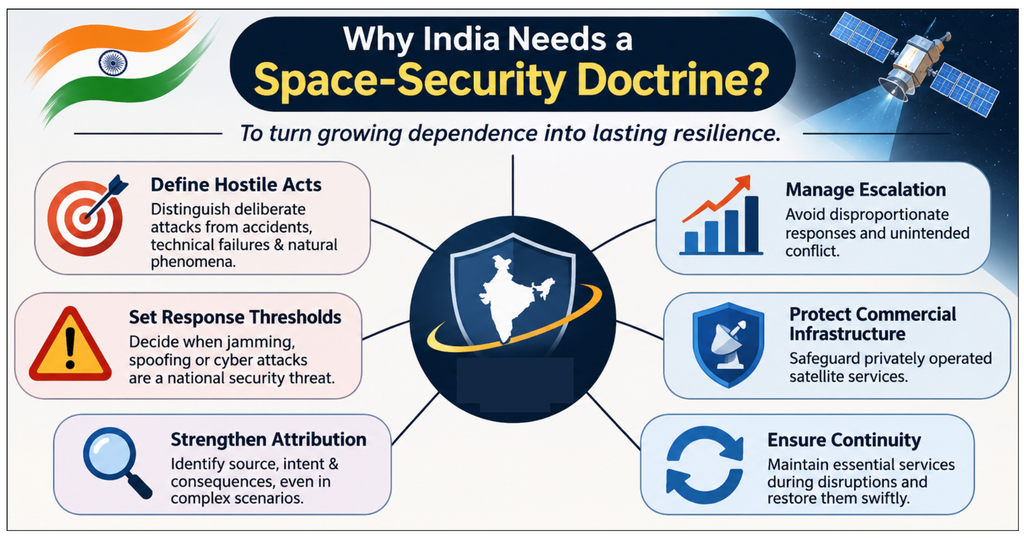
Policy gap: Existing arrangements provide important foundations for space activities, military preparedness and space situational awareness. However, India needs a common national framework connecting threat assessment, attribution, crisis response and recovery across civilian and military systems.
Key Pillars of a Comprehensive National Space-Security Doctrine:
India’s doctrine should move beyond protecting individual satellites towards securing the entire space ecosystem.
- Clear response and attribution mechanisms: Establish protocols to assess the nature, origin, intent and impact of interference. Define institutional responsibilities and proportionate responses while accounting for uncertainty and escalation risks.
- Space-domain awareness (SDA): Strengthen indigenous ground-based radars, optical telescopes and space-based sensors to monitor orbital activities, identify anomalies and improve early warning and attribution. Initiatives such as NETRA and IS4OM can be further developed.
- Resilience and redundancy: Develop multiple satellite systems across different orbital regimes (LEO, MEO and GEO), alternative communication links and terrestrial backups so that disruption of one system does not cripple essential services.
- Cybersecurity and electronic protection: Establish robust security standards for satellites, ground stations and user terminals, including encryption, secure command links, anti-jamming technologies and regular vulnerability assessments.
- Public-private coordination: Involve ISRO, the armed forces, IN-SPACe, private satellite operators and critical-service providers in information sharing, incident reporting, joint exercises and crisis management.
- Rapid recovery and reconstitution: Develop spare satellite capacity, alternative ground stations, responsive launch capabilities and arrangements for accessing commercial services to restore disrupted capabilities quickly.
- International cooperation: Strengthen information sharing on space activities, collision avoidance, debris mitigation and responsible behaviour to reduce the risks of conflict and accidental interference.
The Joint Military Space Doctrine (2025) provides an important foundation for military preparedness; a broader national space-security framework must complement it by integrating civilian agencies, commercial operators and critical-service providers.
India’s space security should be measured not merely by the capabilities it develops, but by its ability to preserve essential services, withstand disruptions and recover quickly.
Mains Practice Question:
Q. Space has evolved into critical infrastructure underpinning India’s economic activity and national security. Discuss the emerging threats to space-based assets and examine the need for a comprehensive national space-security doctrine.
Tell Google you want more of this.
Add Anantam IAS as a preferred sourceOne tap, and this site shows up more often in your own Top Stories, AI Overviews and AI Mode. Remove it any time.