Why in News?
On 6 October 2026, the Physics Nobel was awarded to Francis Halzen for contributions to IceCube and the discovery of high-energy neutrinos of astrophysical origin.
- The Nobel announcement recognises scientific leadership behind an international observatory and a new way of investigating energetic processes in the universe.
- IceCube uses a cubic kilometre of Antarctic ice equipped with optical sensors, making rare particle interactions observable through the light they generate.
- The crucial mechanism is indirect detection: a neutrino interaction produces charged secondary particles, whose light provides a measurable signal.
- Neutrino astronomy adds particle evidence to observations made with light, helping investigate cosmic environments that accelerate particles to high energies.
- A detected event and an identified source are different conclusions; reconstructing a signal does not automatically pinpoint the object that produced it.
UPSC Relevance
Prelims Relevance
- Neutrinos have no electric charge and interact weakly with matter.
- IceCube is a neutrino observatory in Antarctic ice near the South Pole.
- Cherenkov light is emitted by charged particles moving faster than light travels in that medium.
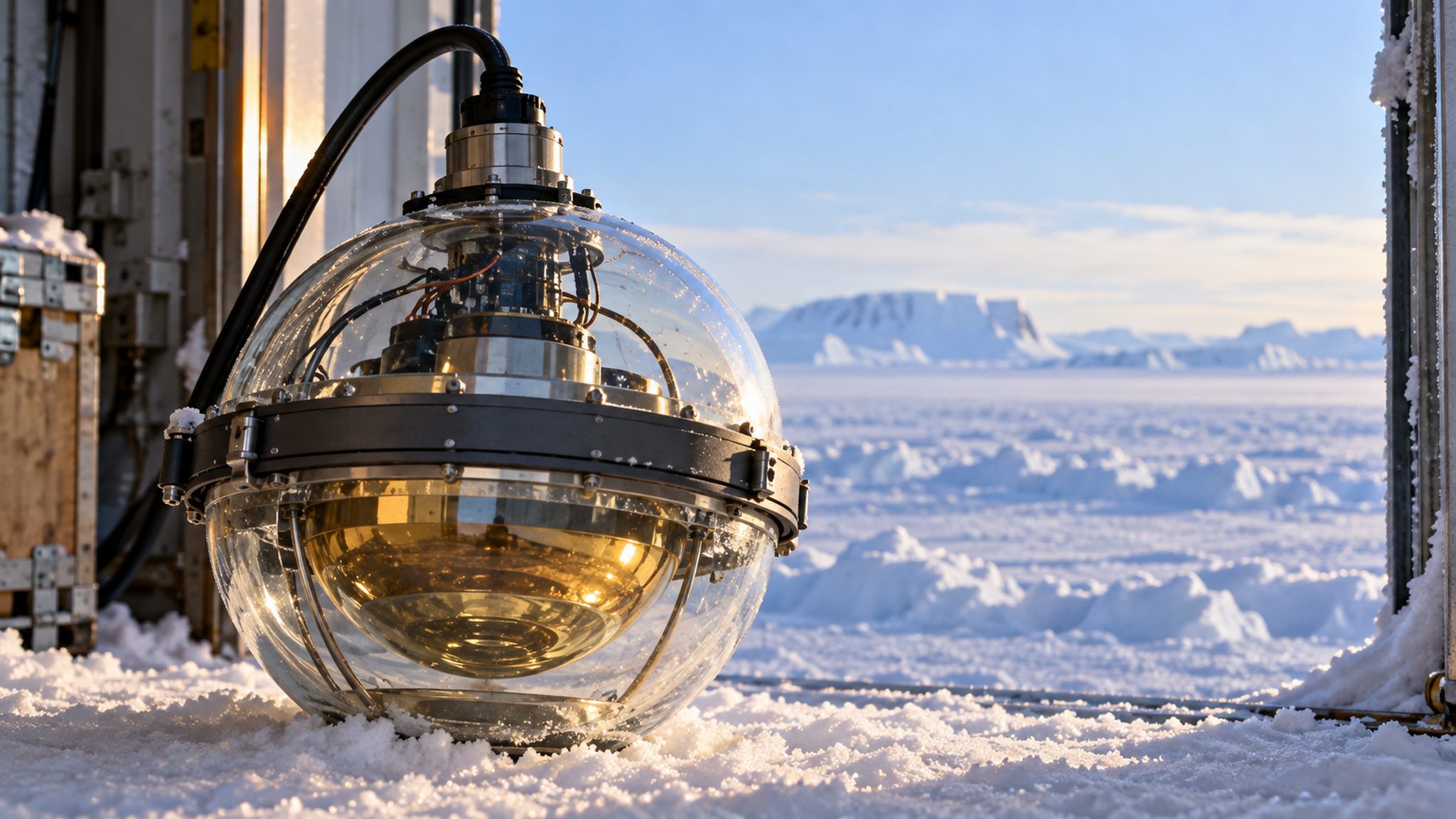
- Digital optical modules detect light rather than directly photographing neutrinos.
- Atmospheric muons and neutrinos form backgrounds in cosmic-neutrino searches.
Mains Relevance
GS Paper 3
- Indirect measurement and uncertainty in scientific discovery.
- Neutrino astronomy as a complement to observations using electromagnetic radiation.
Essay
- Scientific knowledge grows by turning invisible processes into testable evidence.
Background and Context
Why Antarctic Ice Can Act as a Detector
A neutrino usually passes through matter unnoticed; a large, transparent detector gives researchers more opportunities to record its rare interactions.
- Neutrinos are electrically neutral particles with very small masses. Their lack of electric charge means magnetic fields do not deflect them as they deflect charged cosmic-ray particles travelling through space.
- This makes neutrinos useful cosmic messengers: their arrival directions can carry information about where they originated. Identifying a particular source still depends on the quality and interpretation of the detected event.
- Rare interactions explain the detector’s large size. Adding more instrumented material increases opportunities for an interaction; it does not mean the ice stops or captures every neutrino passing through it.
- Deep Antarctic ice provides both interaction material and a medium through which secondary light can travel. Its transparency lets separated sensors record a common event rather than requiring a sensor at the interaction itself.
- The IceCube Collaboration describes optical modules on vertical strings frozen into boreholes. This arrangement samples light across a large volume, while surface equipment collects the digitised information for analysis and reconstruction.
From a Neutrino Interaction to a Light Pattern
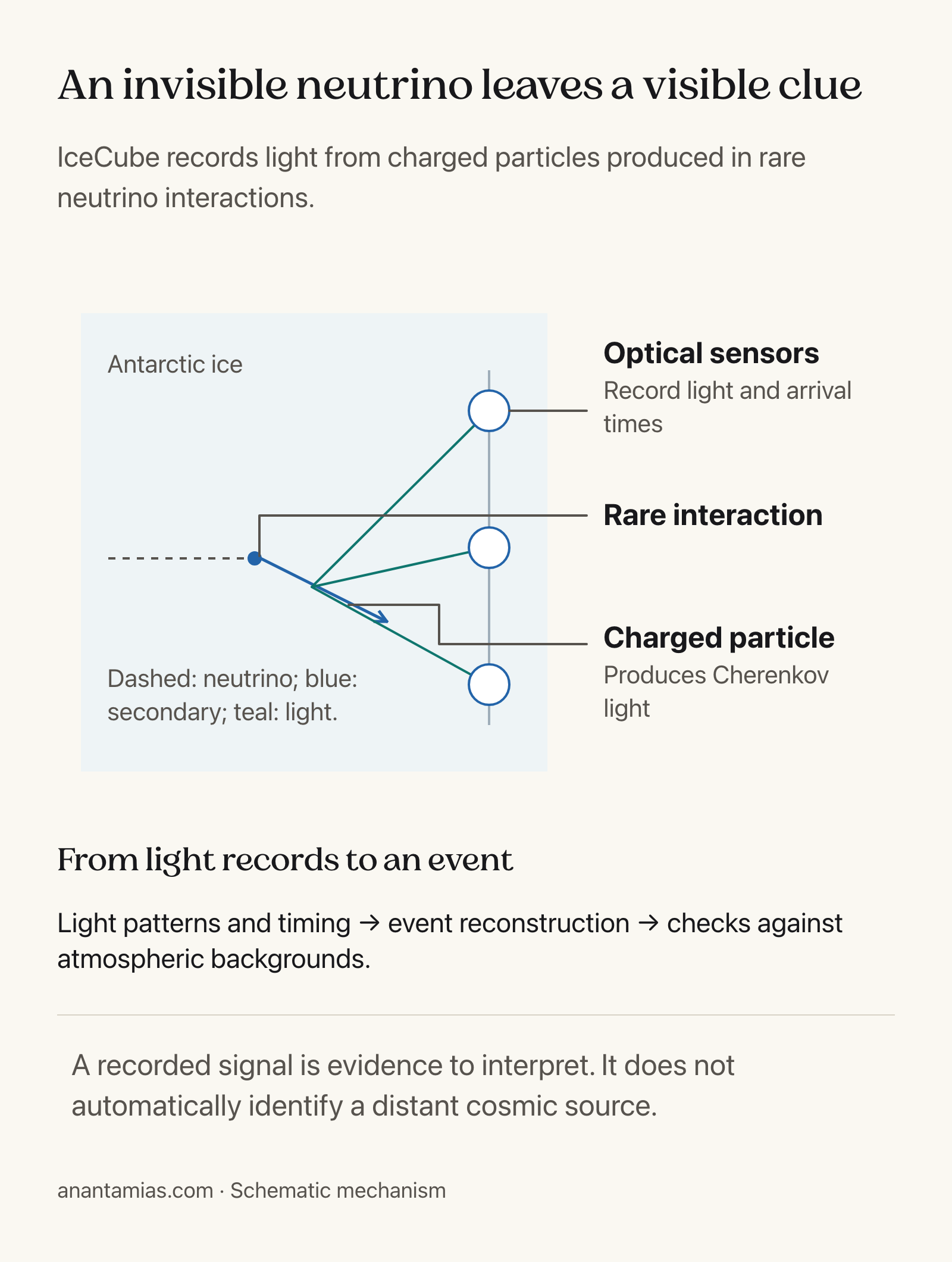
The instrument measures light from secondary charged particles, then uses its timing and distribution to reconstruct the event that produced it.
- A neutrino interaction with matter can produce energetic charged particles. The neutrino itself is not photographed; the experiment infers its involvement from the observable particles and light generated in the interaction.
- A sufficiently fast charged secondary produces Cherenkov radiation while moving through ice. The relevant threshold is the speed at which light travels in ice, not the greater speed of light in a vacuum.
- No vacuum-speed limit is broken by this effect. Light travels more slowly through a material than in a vacuum, so a particle can outrun light in ice without exceeding the universal vacuum limit.
- Optical modules record the arriving light and assign time stamps. Combining readings from many locations is more informative than one flash because it reveals how the detected pattern develops across the instrumented volume.
- Event reconstruction uses that light pattern to estimate properties such as direction and energy. These are measurements with uncertainty, not an ordinary camera image showing a visible neutrino flying from a named star.
Why a Signal Still Needs Background Checks
Finding light in the detector starts the investigation; establishing an astrophysical neutrino signal requires separating it from other particles and nearby production processes.
- Cosmic-ray interactions in Earth’s atmosphere produce muons and neutrinos. These can generate detector signals, so a neutrino detected at the South Pole need not have travelled from a distant cosmic accelerator.
- Atmospheric backgrounds require careful event selection. IceCube research uses information such as direction, energy and where an event starts to distinguish likely cosmic-neutrino signals from competing explanations for the recorded light.
- Earth can filter atmospheric muons in searches looking through the planet. Atmospheric neutrinos remain a background, so removing one interfering particle population does not eliminate every alternative origin for an event.
- Directional reconstruction helps search the sky, but its precision depends on the event. A source claim needs evidence beyond naming whichever astronomical object happens to lie near an estimated arrival direction.
- The durable distinction is detection versus interpretation: observed light supports an inferred particle interaction, while assigning a cosmic origin and associating a source require further analysis. Neither step constitutes a gravitational-wave detection.
Way Forward
Strengthen the Chain of Evidence
- Improve detector calibration and reconstruction so uncertainties in light propagation and sensor response are reflected in reported event properties.
- Report background rejection and source uncertainty alongside candidate events, keeping probable associations distinct from established conclusions.
- Combine appropriate particle and electromagnetic observations when investigating a candidate source, without assuming that coincident detections automatically share an origin.
Conclusion
- IceCube converts rare interactions into usable evidence through charged secondary particles, Cherenkov light and timed optical measurements; the ice is an active part of the measurement system.
- For UPSC, remember the limits alongside the mechanism: faster than light in ice does not mean faster than light in vacuum, and reconstructing a neutrino event does not identify every cosmic source.
UPSC Practice Questions
Prelims MCQ 1
With reference to neutrino detection in IceCube, consider the following statements:
- A neutrino interaction can produce charged secondary particles.
- Cherenkov emission requires the charged particle to exceed the speed of light in a vacuum.
- Optical sensors record light that helps reconstruct the event.
How many of the above statements are correct?
(a) Only one (b) Only two (c) All three (d) None
Answer: (b) Only two
Explanation:
Statements 1 and 3 are correct. Cherenkov radiation requires a charged particle to move faster than light travels in the medium, not faster than light in a vacuum.
Prelims MCQ 2
Why must atmospheric backgrounds be considered when searching for cosmic neutrinos?
(a) Every atmospheric particle is electrically neutral (b) Antarctic ice prevents all neutrino interactions (c) Cosmic-ray interactions in the atmosphere produce particles that can contribute detector signals (d) Neutrinos are deflected towards the South Pole by Earth’s magnetic field
Answer: (c) Cosmic-ray interactions in the atmosphere produce particles that can contribute detector signals
Explanation:
Atmospheric muons and neutrinos can form backgrounds. A recorded event needs analysis before it is attributed to a distant astrophysical source.
UPSC Mains Questions
- Explain how IceCube uses Antarctic ice to detect neutrinos indirectly. Why is Cherenkov radiation consistent with the vacuum speed limit? (150 words)
- Discuss the contribution of neutrino astronomy to understanding energetic cosmic processes. Distinguish event detection, background rejection and source identification. (250 words)
Sources: Nobel Prize official press release and IceCube Collaboration detector overview.
Frequently Asked Questions
Does IceCube photograph neutrinos directly?
No. A rare neutrino interaction produces secondary particles, which can emit detectable light. IceCube records the light pattern and its timing, then reconstructs the event rather than photographing the neutrino itself.
Why is so much ice needed?
Neutrinos interact only rarely with matter. A large instrumented volume increases opportunities to observe an interaction, while transparent deep ice allows the resulting light to reach optical sensors at different locations.
Does Cherenkov radiation violate the speed of light?
No. A charged particle can travel faster than light moves through ice while remaining slower than light in a vacuum. Cherenkov emission concerns the medium’s light speed, not a violation of the vacuum limit.
Does each detected neutrino reveal a distant source?
No. Atmospheric processes also produce neutrinos, and reconstructed directions have uncertainties. Establishing an astrophysical origin and associating an individual source require additional analysis beyond detecting the event’s light in the instrument.
Tell Google you want more of this.
Add Anantam IAS as a preferred sourceOne tap, and this site shows up more often in your own Top Stories, AI Overviews and AI Mode. Remove it any time.