Why in News?
India recently conducted a nationwide test of an Indigenous Cell Broadcast Emergency Alert System, where smartphones emitted loud alerts with vibration. A pop-up message flashed on screens in English, Hindi and other languages with the headline ‘extremely severe alert’.
| UPSC Relevance: GS-3 Science and Technology: New Emerging Technology Prelims: Indigenous Cell Broadcast Emergency Alert System; Cell Broadcast Technology |
Indigenous Cell Broadcast Emergency Alert System:
- The Indigenous Cell Broadcast Emergency Alert System has been developed by the Centre for Development of Telematics (C-DOT), the Department of Telecommunications’ (DoT) research and development centre.
- It is integrated under the SACHET (System for Advanced Cellular Emergency Transmission) platform
- Aim: To strengthen disaster preparedness by replacing/augmenting the existing SMS-based alert mechanism, which is often ineffective during emergencies.
What is Cell Broadcast Technology?
- Cell Broadcast is a method of simultaneously sending short messages to multiple mobile phones within a defined geographic area.
- Developed in the 1990s by the European Telecommunications Standards Institute (ETSI).
- Widely used globally as a standard emergency warning system.
How does Cell Broadcast Technology work?
- Mobile towers continuously communicate with nearby devices.
- In Cell Broadcast Technology (CB):
- A single message is transmitted from a cell tower.
- It is simultaneously delivered to all devices connected to that tower.
- It is a one-way communication system (no user response needed).
Thus, the system essentially works by sending a single message from a mobile network tower to all phones connected to that tower at the same time, instead of sending individual SMS messages.
Key Features of Cell Broadcast Technology:
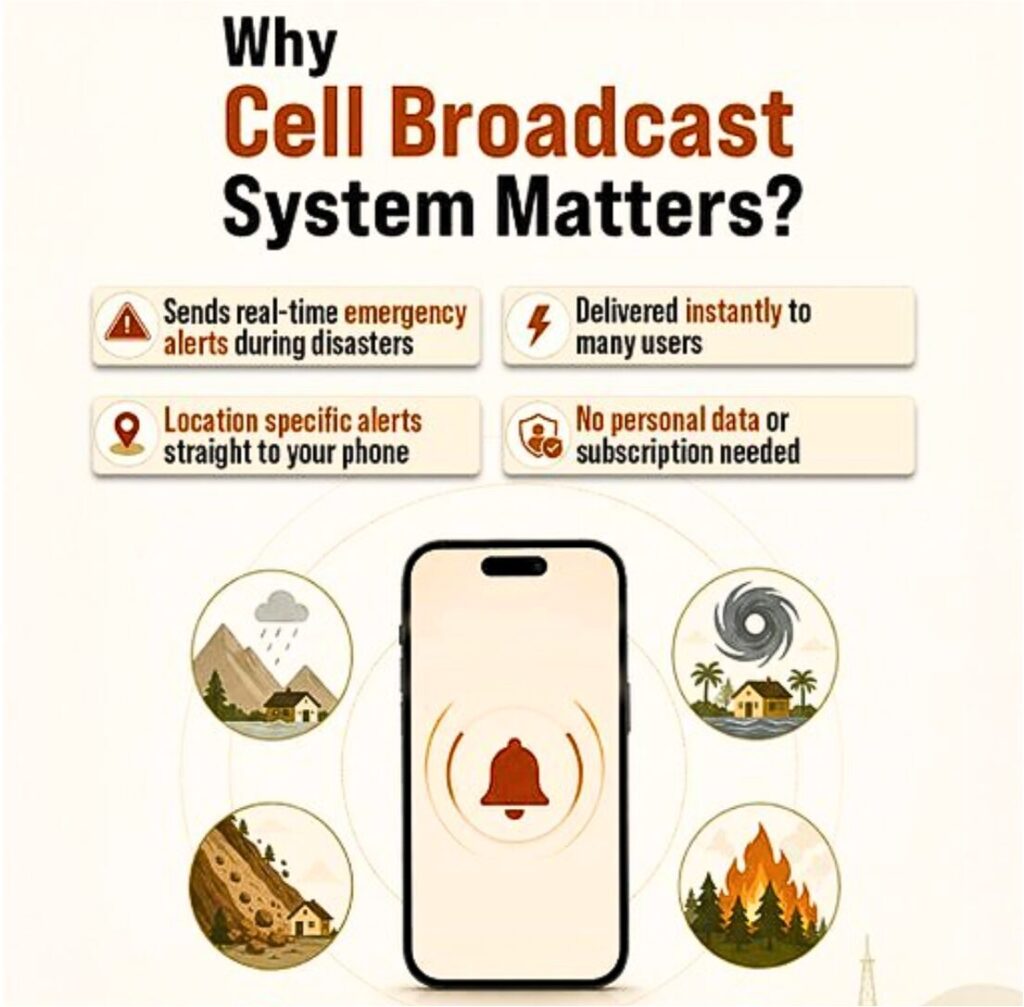
- Precise geographic targeting (Location-specific alerts): It can reach a very large number of devices at once, or, in the case of hazards affecting only a small area, be sent to just a limited number of handsets.
- One-to-many technology: One message can be sent to millions of devices within a few seconds.
- Instant message delivery: The system overrides any network congestion, allowing messages to be delivered instantaneously.
- No dependence on user databases: CB works by distributing content through specific cell tower sites based on a subscriber’s location. It uses no personal data. Mobile phones can receive messages without the need for users to share phone numbers or location data.
- Needs no app or subscription: The only requirement is that the phone is switched on and configured to accept such messages (Settings → Safety and emergency →Wireless emergency alerts →Test alerts).
- High Visibility: It can override all ongoing tasks on a mobile phone, including calls, and would be delivered even when the device is on silent or Do-Not-Disturb mode.
- Inclusive: Works for Visitors/foreigners and multilingual users.
Cell Broadcast vs SMS Alerts:
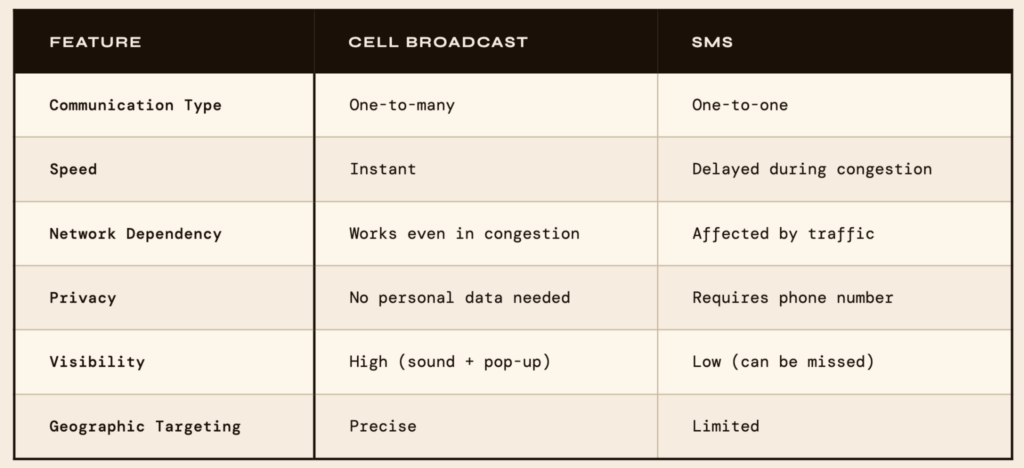
India’s adoption of Cell Broadcast technology marks a paradigm shift from reactive to proactive disaster management. As climate-related disasters become more frequent and severe, technologies such as cell broadcast become extremely important for survival.
Practice MCQ:
Q. With reference to Cell Broadcast technology, consider the following statements:
1. It enables one-to-many communication within a specific geographic area.
2. It requires prior registration of mobile numbers to send alerts.
3. It completely replaces the existing SMS-based alert system.
Which of the statements given above is/are correct?
(a) 1 and 3 only
(b) 2 and 3 only
(c) 1 only
(d) 1, 2 and 3
Answer: (c)
UPSC PYQ 2019
Q. With reference to communication technologies, what is/are the difference/differences between LTE (Long-Term Evolution) and VoLTE (Voice over Long-Term Evolution)?
1. LTE is commonly marketed as 3G and VoLTE is commonly marketed as advanced 3G.
2. LTE is a data-only technology and VoLTE is voice-only technology
Select the correct answer using the code given below.
(a) 1 only
(b) 2 only
(c) Both 1 and 2
(d) Neither 1 nor 2
Answer: (d)
Tell Google you want more of this.
Add Anantam IAS as a preferred sourceOne tap, and this site shows up more often in your own Top Stories, AI Overviews and AI Mode. Remove it any time.