
Why in News?
On August 22, the Supreme Court set aside the National Green Tribunal’s (NGT) December 2017 judgment holding the organisers of the 2016 World Culture Festival responsible for environmental damage to the Yamuna floodplain in Delhi. The Court directed the refund of the ₹5 crore deposited by the organisers (Vyakti Vikas Kendra India, associated with the Art of Living Foundation), as environmental compensation.
The judgment highlights: How should liability for ecological damage be determined when the affected ecosystem was already degraded before the alleged violation?
| UPSC Relevance: GS-2 Polity and Governance: Environmental Jurisprudence; GS-3: Environment and Biodiversity: Conservation; EIA Prelims: National Green Tribunal Act 2010; Polluter Pays Principle, Precautionary Principle and Public Trust Doctrine Mains: Environmental accountability: Role of judiciary and NGT. |
Background: World Culture Festival and Yamuna Floodplain:
- The World Culture Festival was organised from March 11-13, 2016, on approximately 25 hectares of the Yamuna floodplain upstream of the DND Flyway in Delhi. The land had been allotted to the organisers by the Delhi Development Authority (DDA).
- Environmental activists raised concerns that preparations for the event, including levelling, construction of roads, ramps and pontoon bridges, had damaged the floodplain ecosystem.
- December 2017: NGT held the organisers responsible for environmental damage and directed them to undertake restoration measures.
- August 2026: The Supreme Court subsequently set aside this judgment, finding that the NGT had failed to adequately establish the ecological condition of the land before the event and determine the additional damage attributable to the organisers.
Key Issues Highlighted by the Supreme Court:
- Failure to establish pre-existing ecological conditions: The floodplain was reportedly degraded even before the land was allotted for the festival. NGT had also recorded the non-implementation of earlier restoration directions in 2015. The committee constituted by the NGT failed to establish a reliable baseline against which the additional damage caused by the festival could be measured.
- Weaknesses in the environmental assessment: The Supreme Court questioned the evidentiary value of the committee’s findings. Relying on post-facto or intermittent committee inspections (E.g., comparing random Google Earth images or inspecting 16 months later) cannot reliably reconstruct pre-event soil compaction, wetland presence, or hydrological function.
The Court highlighted the need for a scientifically defensible assessment of activities such as soil compaction, land levelling and construction to establish additional ecological damage.
Important Environmental Law Principles Involved:
(i) Polluter Pays Principle:
- The principle requires those responsible for environmental pollution or degradation to bear the costs of preventing, controlling and remedying the damage caused.
- It is an established principle of Indian environmental jurisprudence and is reflected in Section 17 of the National Green Tribunal Act, 2010.
The Supreme Court reiterated that environmental liability cannot be imposed merely because degradation exists; a causal link between the alleged polluter’s actions and the damage must first be established.
(ii) Precautionary Principle:
- The precautionary principle requires preventive action where there is a threat of serious or irreversible environmental damage, even in the absence of complete scientific certainty. It places emphasis on anticipating and preventing ecological harm rather than merely compensating for it after it occurs.
In the present case, the Court criticised the DDA for permitting an event on an active floodplain without taking adequate preventive measures.
(iii) Public Trust Doctrine:
- The doctrine recognises that natural resources such as rivers, forests, wetlands and floodplains are held by the State in trust for the public. The State cannot treat these resources as ordinary commercial assets or permit their use in a manner that compromises their ecological functions.
The Court held that the DDA, as the authority responsible for the management and ecological maintenance of the Yamuna floodplain, had failed to discharge its public duties adequately.
Relevant Provisions of the National Green Tribunal Act, 2010:
The judgment highlights the importance of correctly applying the statutory provisions governing environmental liability and restoration.
| Provision | Significance |
| Section 15 | Empowers the NGT to provide relief, compensation and restitution of damaged property and the environment. |
| Section 17(1) | Provides for liability to pay compensation where damage results from an accident or adverse impact of an activity or operation. |
| Section 17(2) | Allows equitable apportionment of liability where damage results from the combined effect of several activities rather than a single activity. |
| Section 17(3) | Requires the NGT to apply the principle of no-fault liability in cases of accidents. |
The NGT had invoked the principle of no-fault liability under Section 17(3) to hold the organisers responsible. The Supreme Court held that the provision specifically applies to accidents, whereas the present dispute did not involve an accident.
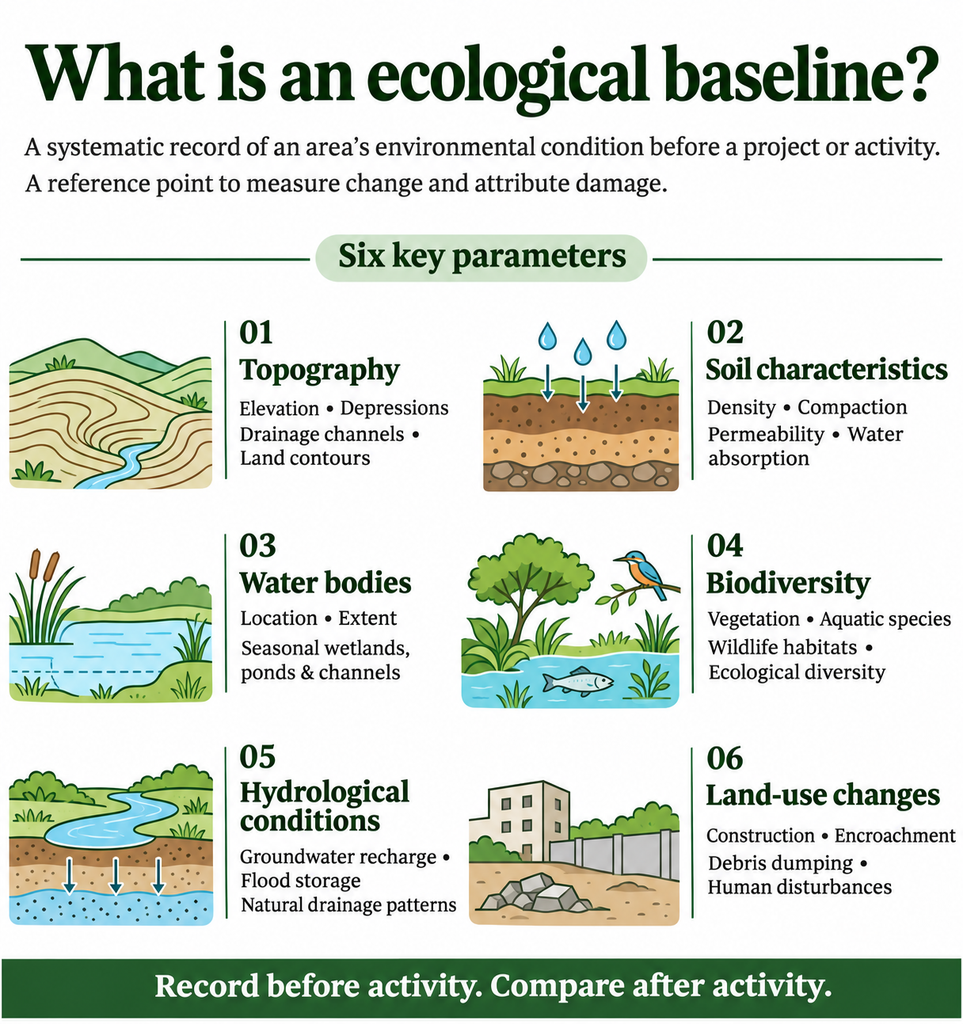
| What is an Ecological Baseline? An ecological baseline is a systematic record of the environmental condition of an area before a proposed project or activity. It provides a reference point for measuring subsequent environmental changes and attributing damage. |
Challenges in Environmental Governance in India:
- Weak baseline documentation: Environmental assessments often lack sufficiently detailed, location-specific and long-term ecological data.
- Fragmented institutional responsibility: Multiple agencies are responsible for river management, land-use regulation, wetland conservation and urban development, resulting in accountability gaps.
- Weak enforcement: Environmental clearance conditions and restoration directions are not always effectively implemented.
- Cumulative ecological degradation: Multiple activities, including encroachment, construction, pollution and waste dumping, contribute to environmental damage, making individual attribution difficult.
- Inadequate scientific monitoring: Dependence on occasional inspections and satellite imagery without adequate ground-truthing can weaken environmental assessments.
- Delayed environmental adjudication: Prolonged litigation can make ecological restoration more difficult and undermine timely accountability.
Way Forward:
- Institutionalise baseline ecological assessments: Make pre-activity ecological baseline surveys mandatory before allotting floodplains, wetlands and other ecologically sensitive public lands for permitted activities. Record topography, soil characteristics, water bodies, vegetation and biodiversity through geo-tagged photographs, GIS mapping and field measurements.
- Strengthen environmental monitoring: Introduce periodic environmental audits and independent third-party inspections. Use satellite imagery, remote sensing, drones and ground-based measurements to monitor changes in sensitive ecosystems.
- Improve accountability and liability determination: Clearly identify the environmental responsibilities of project proponents, land-allotting authorities and regulatory agencies. Apply the polluter pays principle based on scientifically established causation.
- Strengthen protection of ecological commons: Prevent the commercial or non-ecological use of active floodplains and wetlands where it threatens their ecological functions.
- Ensure timely environmental justice: Strengthen the technical capacity of the NGT through access to independent environmental scientists, hydrologists and ecological experts. Promote time-bound environmental adjudication and implementation of restoration orders.
Environmental compensation must be linked to the damage attributable to the responsible party. It cannot become a mechanism for transferring the State’s pre-existing ecological restoration obligations to a private entity.
Practice Mains Question:
Q. ‘Environmental liability cannot be effectively enforced without reliable ecological baseline assessments.’ Discuss in the context of India’s environmental governance framework.
Practice Prelims MCQ:
Q. Consider the following statements about the NGT Act, 2010:
1. Section 17(2) permits equitable apportionment of liability for damage resulting from several activities.
2. Section 20 requires application of the precautionary principle.
3. Section 17(3) makes every occupier liable for historical environmental damage regardless of causation.
Which of the statements given above are correct?
(a) 1 and 2 only
(b) 2 and 3 only
(c) 1 and 3 only
(d) 1, 2 and 3
Answer: (a) Statement 3 incorrectly treats occupation as sufficient proof of responsibility.
Tell Google you want more of this.
Add Anantam IAS as a preferred sourceOne tap, and this site shows up more often in your own Top Stories, AI Overviews and AI Mode. Remove it any time.