Why in News?
Human-wildlife conflict (HWC) has emerged as a major ecological and governance challenge across India and several developing regions of the world. Rising incidents involving elephants, tigers, leopards, wild boars and other wildlife species have renewed attention on the need for sustainable coexistence between conservation goals and human livelihoods. Recent discussions have focused on improving compensation systems, ecological planning, wildlife corridors and community-based conservation approaches.
UPSC Relevance
Prelims Relevance
- Wildlife Protection Act, 1972, Project Elephant and Project Tiger, Wildlife corridors and protected areas, Human-wildlife conflict mitigation measures, IUCN, biodiversity conservation
Mains Relevance
GS Paper 3
- Conservation, environmental degradation and biodiversity, Human-animal conflict, climate change, Sustainable development, land-use planning
GS Paper 2
- Governance challenges in environmental management, Role of local communities, decentralised conservation
Essay
- Development versus conservation
- Ecological justice and sustainability
- Climate change and resource conflicts
Background and Context
Human-wildlife conflict refers to interactions between humans and wild animals that result in harm to people, property, livelihoods or wildlife itself. Such conflicts include:
- Crop damage by elephants and wild boars
- Livestock predation by leopards, tigers and wolves
- Human deaths or injuries caused by wild animals
- Retaliatory killings of wildlife
Historically, wildlife populations and human settlements were separated by extensive forests and natural landscapes. However, rapid population growth, infrastructure expansion, urbanisation and agricultural intensification have fragmented habitats and increased overlap between human and wildlife spaces.
India is one of the world’s megadiverse countries and also among the most densely populated. This creates a unique challenge where biodiversity-rich regions often coincide with heavily populated rural landscapes.
According to government data:
- India records hundreds of human deaths annually due to elephant attacks.
- Thousands of livestock are lost each year to predators.
- Railway lines, highways and mining activities increasingly intersect wildlife habitats.
The issue has therefore evolved beyond a conservation concern into a broader socio-economic, developmental and governance challenge.
Understanding the Ecological Basis of Human-Wildlife Conflict
Habitat Fragmentation
Forests are increasingly fragmented due to:
- Roads and railway projects
- Mining activities
- Dams and hydropower projects
- Agricultural expansion
- Urban sprawl
Fragmentation disrupts wildlife movement corridors and isolates animal populations.
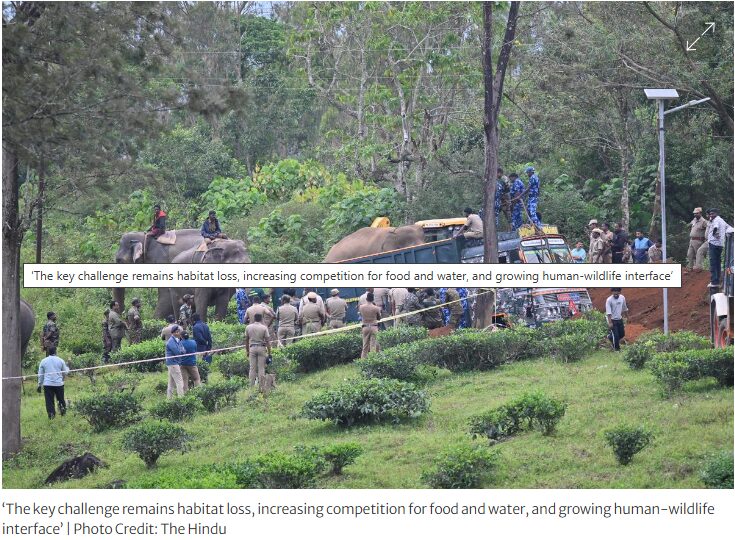
Large mammals such as elephants require extensive migratory routes for food, water and breeding. When these pathways are blocked, animals move through villages and farms, increasing conflict.
Decline of Natural Prey and Food Sources
Carnivores such as leopards and tigers may attack livestock when natural prey populations decline due to habitat degradation or poaching.
Similarly:
- Wild boars raid crops
- Monkeys exploit human food waste
- Elephants enter farms during food shortages
These behaviours are adaptive ecological responses rather than deliberate aggression.
Climate Change and Ecological Stress
Climate change is intensifying:
- Water scarcity
- Droughts
- Forest fires
- Altered vegetation patterns
This affects resource availability for wildlife and pushes animals closer to human settlements.
For example:
- Drought conditions in elephant habitats can increase crop-raiding incidents.
- Shrinking water bodies force wildlife to enter villages in search of water.
Human-Wildlife Conflict in India
India experiences some of the world’s most complex forms of HWC due to:
- High biodiversity
- Dense human population
- Dependence on forests for livelihoods
Major Conflict Zones
Elephant Corridors
States such as:
- Assam
- Odisha
- Karnataka
- Kerala
- West Bengal
- Jharkhand
face recurrent elephant-related conflicts.
India has identified more than 100 elephant corridors, many of which are fragmented or encroached upon.
Tiger and Leopard Landscapes
Conflicts involving big cats are common in:
- Maharashtra
- Uttarakhand
- Madhya Pradesh
- Karnataka
Leopards increasingly inhabit peri-urban landscapes due to shrinking habitats.
Wild Boar and Monkey Conflicts
Agricultural regions near forest boundaries face severe crop losses from:
- Wild boars
- Monkeys
- Nilgai
These species adapt quickly to human-modified environments.
Constitutional and Legal Dimensions
Constitutional Provisions
Article 48A
Directs the State to protect and improve the environment and safeguard forests and wildlife.
Article 51A(g)
Makes it a Fundamental Duty of citizens to protect the natural environment and show compassion for living creatures.
Right to Life under Article 21
The Supreme Court has expanded Article 21 to include environmental protection and ecological balance.
Wildlife Protection Act, 1972
The Act provides:
- Legal protection to wildlife species
- Creation of national parks and sanctuaries
- Regulation of hunting and trade
It remains the cornerstone of wildlife conservation in India.
Forest Rights Act, 2006
The Act recognises forest-dwelling communities’ rights over forest resources. Balancing conservation goals with community rights remains an important governance challenge.
Important Supreme Court Judgments
T.N. Godavarman Thirumulpad Case
Expanded judicial oversight over forest conservation.
Centre for Environmental Law, WWF-India vs Union of India
Highlighted the importance of species conservation and ecological protection.
Government Initiatives and Policy Measures
Project Elephant
Launched in 1992, it focuses on:
- Elephant conservation
- Protection of corridors
- Reducing human-elephant conflict
Project Tiger
Apart from tiger conservation, the project indirectly supports habitat preservation and ecological connectivity.
National Wildlife Action Plan (2017–2031)
It emphasises:
- Landscape-based conservation
- Community participation
- Scientific conflict mitigation
National Board for Wildlife (NBWL)
Acts as an advisory body for wildlife conservation policies and protected area management.
Use of Technology
Several States use:
- Drone surveillance
- GPS collaring
- Early-warning systems
- SMS alerts
- Thermal imaging
However, effectiveness varies depending on local conditions and administrative capacity.
Community-Based Conservation Approaches
International experiences show that conflict management is more successful when local communities become active stakeholders.
African Models
Countries such as Botswana and Namibia use:
- Community-based natural resource management
- Revenue-sharing from eco-tourism
- Local stewardship mechanisms
This aligns economic incentives with conservation goals.
South Asian Examples
Bhutan
Community forestry programmes have improved coexistence and reduced ecological pressure.
Nepal
Predator-proof livestock enclosures and coordinated grazing systems have reduced livestock losses.
These models highlight the importance of decentralised and locally adapted solutions.
Challenges in India’s Existing Approach
Delays in Compensation
Although compensation mechanisms exist, many victims face:
- Delayed payments
- Complex paperwork
- Low compensation amounts
Marginalised communities are often the most affected.
Inadequate Land-Use Planning
Infrastructure projects frequently ignore ecological connectivity. Roads, railways and linear projects cut through wildlife corridors.
This increases:
- Animal mortality
- Habitat fragmentation
- Human-wildlife encounters
Weak Local Participation
Conservation policies are sometimes implemented in a top-down manner without adequate community consultation.
Local communities may therefore perceive wildlife as an economic burden rather than a shared ecological resource.
Retaliatory Killings
Crop damage and livestock loss often trigger:
- Poisoning of wildlife
- Electrocution
- Illegal hunting
This threatens already vulnerable species.
Limitations of Technical Solutions
Measures such as:
- Solar fencing
- Tranquilisation
- Fertility control
may provide temporary relief but cannot substitute long-term ecological restoration.
Experts argue that habitat degradation and resource scarcity are the root causes of conflict.
Economic and Social Dimensions
Human-wildlife conflict disproportionately affects:
- Small farmers
- Tribal communities
- Forest-dependent populations
Crop losses and livestock deaths can severely affect rural incomes.
Women and children are also vulnerable because:
- They often collect fuelwood and water from forests.
- They travel through wildlife-prone areas.
Thus, HWC is also linked to:
- Rural poverty
- Livelihood insecurity
- Social justice
Importance of Wildlife Corridors
Wildlife corridors are ecological pathways connecting fragmented habitats.
They are essential for:
- Seasonal migration
- Genetic exchange
- Long-term species survival
The Supreme Court and conservation agencies have repeatedly emphasised corridor protection.
For example:
- The Nilgiri elephant corridor is one of India’s most important wildlife movement routes.
- Kaziranga-Karbi Anglong corridors in Assam are critical for elephant and rhino movement.
Securing such corridors is central to reducing conflict.
The Need for Ecological Governance
Conservation cannot succeed through policing alone. Human-wildlife conflict requires integrated ecological governance involving:
- Forest departments
- Local communities
- Urban planners
- Disaster management agencies
- Agricultural departments
Landscape-level planning is necessary to reconcile development and conservation objectives.
Way Forward
Strengthening Habitat Connectivity
Protection and restoration of wildlife corridors should become a central element of infrastructure and land-use planning.
Environmental Impact Assessments must adequately account for:
- Animal movement routes
- Habitat fragmentation
- Long-term ecological impacts
Eco-sensitive infrastructure such as wildlife overpasses and underpasses should be expanded.
Improving Compensation Systems
Compensation mechanisms should be:
- Timely
- Transparent
- Technology-enabled
- Accessible in local languages
Direct Benefit Transfer (DBT)-based compensation can reduce delays and corruption.
Insurance-based approaches may also be explored for crop and livestock losses.
Community-Centred Conservation
Local communities should be treated as partners rather than obstacles to conservation.
Measures may include:
- Revenue-sharing from eco-tourism
- Community forest management
- Employment in conservation activities
- Participatory monitoring systems
This can improve trust and reduce hostility toward wildlife.
Scientific and Data-Driven Planning
Conflict mitigation should be based on:
- GIS mapping
- Wildlife movement data
- Climate projections
- Behavioural ecology studies
Scientific monitoring can help predict conflict-prone areas and enable preventive action.
Climate-Resilient Conservation Strategies
Climate adaptation plans should integrate wildlife conservation and ecosystem management.
Restoration of:
- Wetlands
- Water bodies
- Grasslands
- Forest ecosystems
can reduce ecological stress and improve resource availability.
Education and Awareness
Public awareness programmes should focus on:
- Safe behaviour in conflict zones
- Ecological literacy
- Community preparedness
School curricula and local governance institutions can play an important role in building coexistence-oriented attitudes.
Strengthening Institutional Coordination
Human-wildlife conflict is an inter-sectoral issue requiring coordination among:
- Forest departments
- Revenue departments
- Rural development agencies
- Infrastructure ministries
Integrated governance frameworks are essential for long-term conflict reduction.
Conclusion
Human-wildlife conflict is not merely an isolated conservation issue but a reflection of deeper ecological and developmental imbalances. As human activities increasingly reshape landscapes, interactions with wildlife are becoming more frequent and complex.
The challenge before India is not to eliminate wildlife from human spaces, but to create landscapes where both humans and wildlife can coexist sustainably. This requires balancing ecological protection with livelihood security through scientific planning, community participation and inclusive governance.
A durable solution lies in recognising that conservation and human welfare are not competing goals but mutually interconnected components of sustainable development.
Practice Questions
With reference to human-wildlife conflict in India, consider the following statements:
- Habitat fragmentation is one of the major causes of increasing human-wildlife conflict.
- Article 48A of the Constitution relates to protection of wildlife and environment.
- Project Elephant was launched before Project Tiger.
How many of the above statements are correct?
(a) Only one
(b) Only two
(c) All three
(d) None
Answer: (b) Only two
Explanation:
- Statement 1 is correct. Habitat fragmentation increases encounters between humans and wildlife.
- Statement 2 is correct. Article 48A directs the State to protect the environment and wildlife.
- Statement 3 is incorrect. Project Tiger was launched in 1973, while Project Elephant was launched in 1992.
Which of the following are important objectives of wildlife corridors?
- Facilitating genetic exchange among wildlife populations
- Reducing habitat fragmentation
- Supporting seasonal migration of animals
Select the correct answer using the code below:
(a) 1 and 2 only
(b) 2 and 3 only
(c) 1 and 3 only
(d) 1, 2 and 3
Answer: (d) 1, 2 and 3
Explanation:
Wildlife corridors help connect fragmented habitats, support migration, and maintain genetic diversity among wildlife populations.
Mains Questions
- Examine the ecological, socio-economic and institutional causes of human-wildlife conflict in India. Suggest a balanced strategy for promoting coexistence between humans and wildlife.
- Human-wildlife conflict in India is increasingly becoming a governance and developmental challenge rather than merely a conservation issue. Discuss.
Tell Google you want more of this.
Add Anantam IAS as a preferred sourceOne tap, and this site shows up more often in your own Top Stories, AI Overviews and AI Mode. Remove it any time.