

Why in News?
On 11 November, the Union Cabinet approved the continuation of the Credit Guarantee Fund for Micro Units (CGFMU) through March 2031 and reduced the standard annual guarantee fee.
- The standard annual guarantee fee falls from 1% to 0.75%. Self-help groups retain their separate fee schedule.
- For working capital, the amount disbursed determines the basis of cover. For a term loan, the basis is the outstanding amount.
- The decision covers the Sixteenth Finance Commission cycle, from FY 2026–27 through FY 2030–31.
- A credit guarantee can make a viable business easier to finance when its owner has little property to pledge as collateral.
- Risk sharing changes the lender’s potential loss. A borrower’s repayment capacity still depends on sales, expenses and the timing of cash receipts.
UPSC Relevance
Prelims Relevance
- Identify the lending institution as the recipient of guarantee protection.
- Connect the National Credit Guarantee Trustee Company Limited (NCGTC) with CGFMU.
- Distinguish the amount disbursed from the outstanding loan balance.
- Recognize eligible Jan Dhan overdrafts and self-help group loans alongside Mudra loans.
Mains Relevance
GS Paper 3
- Explain how guarantees address collateral constraints in microenterprise credit.
- Assess whether an expansion in lending is accompanied by sustainable repayment.
GS Paper 2
- Distinguish the public trustee’s risk-sharing function from a bank’s loan appraisal.
Essay
- Access to productive credit depends on how institutions allocate risk.
Background and Context
Who Receives the Loan and Who Receives the Guarantee?
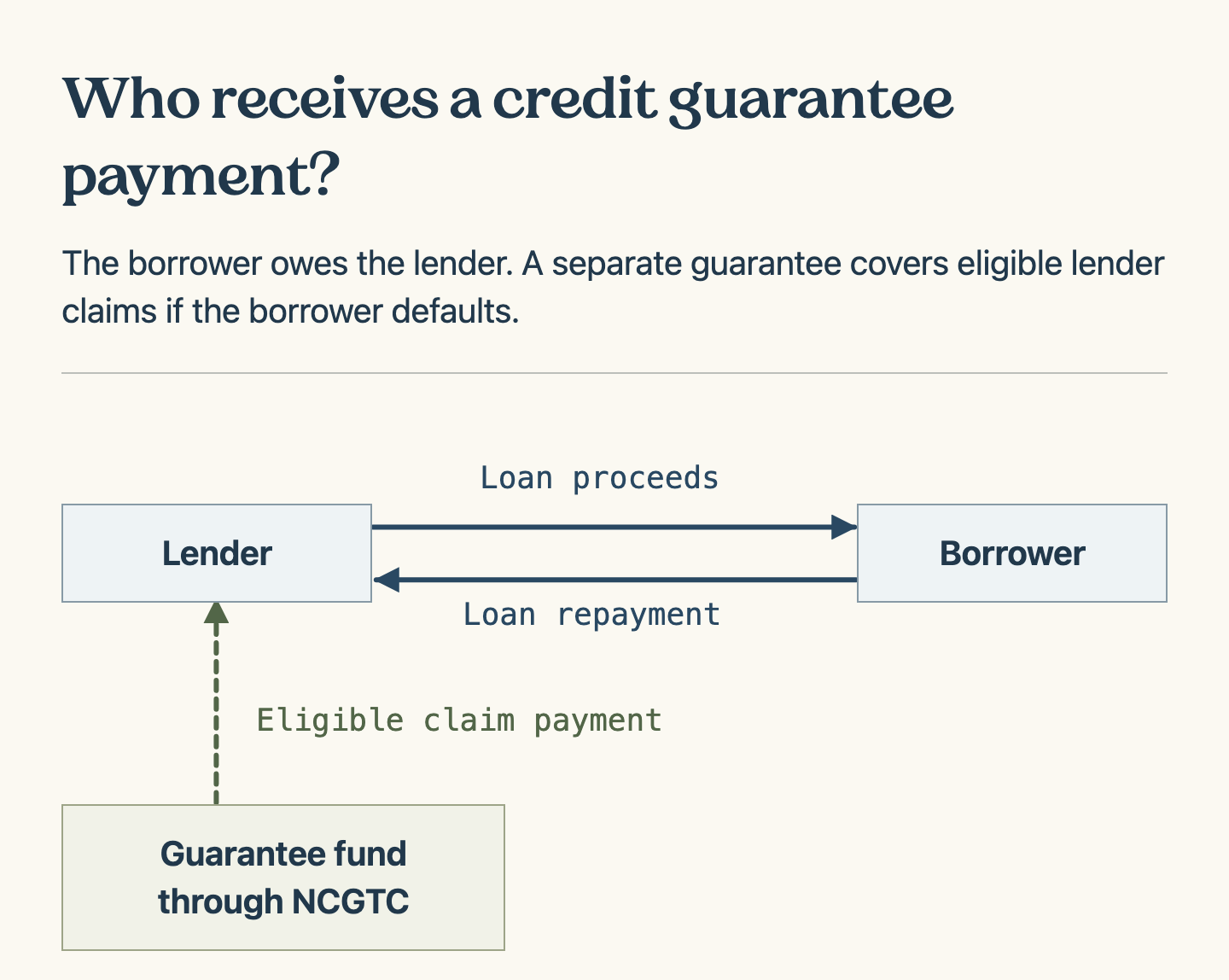
A single loan creates two relationships. Follow the money in each to identify who can claim protection when repayment fails.
- The microenterprise borrows from a lending institution under an eligible facility. The lender releases the money to finance the enterprise and records the amount owed under the loan agreement.
- Through NCGTC, the fund provides the lending institution with cover against eligible default risk. The trustee’s role concerns the guarantee, while the bank or other eligible institution handles the customer’s loan.
- When an enterprise repays on schedule, its payments go to the lender. The business meets its obligations from its own resources, just as it would on another business loan.
- If the enterprise defaults, the lender can seek payment under the guarantee terms. An eligible claim compensates the lender for covered loss. The borrower receives no claim money and remains liable for repayment.
- A loan waiver would require a separate decision about the borrower’s obligation. In an exam question, identify whose claim the policy changes before describing its effect on the household or enterprise.
Why Does the Basis of Cover Depend on the Loan?
Consider a pottery business that needs clay for its next batch and a wheel that it expects to use for several years.
- A working-capital limit can finance clay and packaging while the potter waits for customers to pay. A business can draw less than the bank has authorized it to use.
- For this facility, the Cabinet links guarantee coverage to the disbursement amount. A sanctioned ceiling alone does not show how much credit the lender actually released to finance the business.
- A term loan can finance the wheel. As the enterprise repays principal in instalments, the amount it still owes on that loan falls even though the original purchase price stays the same.
- The outstanding amount supplies the reference for term-loan coverage. Using the initial sanction throughout the loan’s life would overlook principal already repaid and overstate the balance exposed to default.
- Both measures identify an exposure base. To calculate a claim amount, one would also need the applicable guarantee terms. The Cabinet announcement alone does not supply a percentage of loss payable on each account.

Which Facilities Qualify and What Does the Fee Buy?
Start with the type of facility, then ask how the government prices access to guarantee protection.
- The fund covers eligible Pradhan Mantri Mudra Yojana loans to microenterprises up to ₹20 lakh. The ceiling describes the eligible credit facility and cannot be read as the guaranteed payment after default.
- The decision also includes qualifying Pradhan Mantri Jan Dhan Yojana overdrafts and loans to self-help groups within the specified portfolio band. Eligibility depends on the terms for the particular category.
- A guarantee fee pays for protection against default risk. Interest is the price of borrowing under the loan contract. A lower guarantee fee does not specify the interest rate any individual borrower will pay.
- The Cabinet kept the self-help group fee schedule unchanged. When interpreting the revised standard fee, identify the loan category first. Applying one rate across every eligible facility would give the wrong result.
Way Forward
Track Lending and Repayment Together
- Publish repayment outcomes alongside the value of loans supported to show how new borrowers fare over time.
- Compare claims against the corresponding exposure base when assessing the fund’s performance.
- Explain repayment obligations at sanction so borrowers understand what the guarantee protects.
Conclusion
- The guarantee can help enterprises obtain formal credit by sharing a lender’s default risk. An enterprise’s debt and the lender’s right to make a claim arise under separate arrangements.
- For a question about coverage, first identify the facility type. The amount released on working capital and the balance left on a term loan answer different questions about how much money is at risk.
UPSC Practice Questions
Prelims MCQ 1
With reference to CGFMU, consider the following statements:
- Guarantee protection is provided to lending institutions through NCGTC.
- The coverage basis for a term loan is its outstanding amount.
- An eligible guarantee claim automatically cancels the borrower’s repayment obligation.
How many of the above statements are correct?
(a) Only one (b) Only two (c) All three (d) None
Answer: (b) Only two
Explanation:
Statements 1 and 2 are correct. Claim payments protect lenders against covered losses. A guarantee claim does not itself waive the underlying debt.
Prelims MCQ 2
Which measure does the Cabinet decision use as the basis of guarantee coverage for a working-capital limit?
(a) Projected annual sales (b) Value of the proprietor’s assets (c) Amount disbursed (d) Full sanctioned ceiling in every case
Answer: (c) Amount disbursed
Explanation:
The disbursement amount reflects credit released under the working-capital limit. The outstanding amount is the specified basis for a term loan.
UPSC Mains Questions
- Explain how a public credit guarantee can expand access to formal finance while preserving borrowers’ repayment obligations.
- Why should a guarantee fund distinguish between sanctioned limits, disbursements and outstanding balances when measuring credit exposure?
Source: PIB, Union Cabinet.
Frequently Asked Questions
Who receives the credit guarantee?
The lending institution receives protection against eligible default risk through NCGTC. The microenterprise receives funds under its loan agreement and uses those funds for the purpose for which it borrowed.
Can a borrower claim a CGFMU payout?
The lender holds the guarantee protection. A borrower facing difficulty with repayment still owes the debt under its loan agreement, even when the lender makes an eligible guarantee claim.
How is coverage measured for term loans?
The outstanding amount provides the basis of coverage for a term loan. As principal is repaid, the remaining balance changes. The announced rules use disbursement for working-capital limits.
Did the Cabinet change the interest rate on Mudra loans?
The announced reduction applies to the standard annual guarantee fee. A lending institution’s loan interest rate is a separate charge. The decision also retained the existing fee schedule for self-help groups.
Tell Google you want more of this.
Add Anantam IAS as a preferred sourceOne tap, and this site shows up more often in your own Top Stories, AI Overviews and AI Mode. Remove it any time.