Why in News?
Recently, Bengaluru-based startup GalaxEye successfully launched Mission Drishti aboard a SpaceX Falcon 9 rocket from Vandenberg Space Force Base, California, the US.
| UPSC Relevance: GS-3 Science and Technology: Space Technology Prelims: OptoSAR satellite; Mission Drishti; SAR technology; GalaxEye |
Mission Drishti:
- Drishti is the world’s first OptoSAR satellite — a fusion of optical and Synthetic Aperture Radar (SAR) imaging on a single platform.
- Developed by: GalaxEye Space (an IIT Madras alumnus, Bengaluru-based startup).
- Orbit: Placed in Low Earth Orbit (500 (±) 10 kms). Sun-synchronous LEO.
- Size/Weight: ~190 kg, making it India’s largest privately built Indian Earth Observation satellite.
- Resolution: The satellite provides fused imagery with a resolution of ~1.8 meters.
- Primary Use: Earth observation- agriculture, disaster response and defence.
Basics of Satellite Imaging Technology:
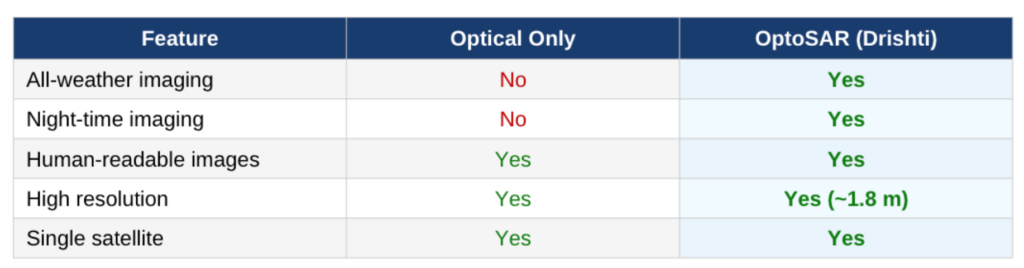
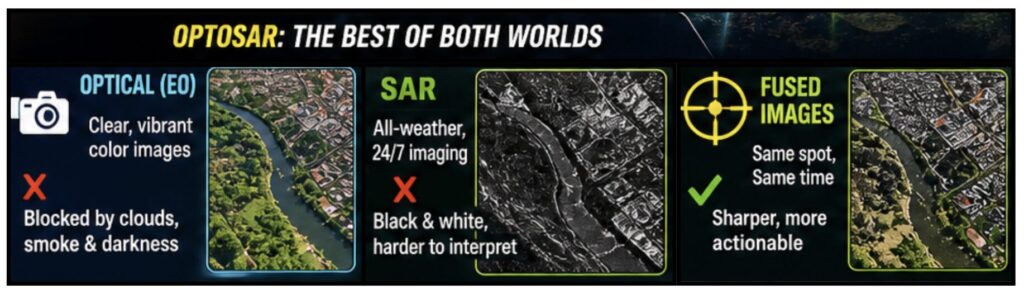
- Optical Imaging: Optical (or Electro-Optical) sensors act as digital cameras, capturing visible light and producing clear, human-interpretable images. Limitation: Blocked by clouds, smoke, and darkness.
- Synthetic Aperture Radar (SAR): SAR is an active, all-weather sensor that emits microwave radar pulses and records the reflected signal to generate images. The SAR technology satellites are able to image during clouds, rain, darkness, i.e, works 24/7 in all weather. Limitation: Images generated are black-and-white and harder to interpret without expertise.
OptoSAR combines both technologies (optical & SAR) on a single satellite.
What is OptoSAR Technology?
- Drishti is the world’s first satellite to combine Electro-Optical (EO) and SAR sensors in a single satellite. It carries an optical multispectral imager and a SAR sensor that capture images of the exact same spot at the exact same time.
- This peculiar approach removes problems like mismatched angles or time gaps that occur when combining data from two separate satellites. The result is sharper, more useful pictures with the best of both worlds, featuring optical clarity plus all-weather reliability.
- Advantage: This allows for 24/7, all-weather, high-resolution imagery (approx. 1.2 – 3.6 meters). The data is highly valuable for defence, agriculture, and disaster management.
Significance for India:
- Strategic & Defence: Round-the-clock surveillance of borders, coastlines, and sensitive zones. Reduces dependence on foreign satellite data for national security.
- Agriculture & Food Security: Monitors crop health even during monsoon cloud cover. Supports precision agriculture and early warning for crop failures.
- Disaster Management: Rapid detection of floods, forest fires, and cyclone damage in any weather or light condition. Aids faster relief operations by providing near-real-time imagery.
- Infrastructure & Urban Planning: Consistent monitoring of coastal erosion, infrastructure projects, and urban sprawl.
Mission Drishti marks a landmark in India’s evolving private space ecosystem. The Indian Space Policy 2023 opened the sector to private players, and ISRO’s IN-SPACe agency has been instrumental in facilitating approvals for startups. GalaxEye received strong support from ISRO for this mission.
Key Facts: India’s other notable private space milestones include Skyroot Aerospace’s Vikram-S (first private Indian rocket, 2022) and Agnikul Cosmos’s Agnibaan (world’s first 3D-printed semi-cryogenic rocket engine, 2024).
Practice MCQ:
Q. With reference to Mission Drishti, consider the following statements:
1. It is the world’s first satellite to integrate Optical and Synthetic Aperture Radar (SAR) imaging on a single platform.
2. It operates only during the daytime and requires clear weather conditions for imaging.
3. It has been placed in a Sun-synchronous Low Earth Orbit (LEO).
4. It is India’s largest privately developed Earth Observation satellite.
Which of the statements given above are correct?
(a) 1 and 3 only
(b) 1, 3 and 4 only
(c) 2 and 4 only
(d) 1, 2, 3 and 4
Answer: (b)
Tell Google you want more of this.
Add Anantam IAS as a preferred sourceOne tap, and this site shows up more often in your own Top Stories, AI Overviews and AI Mode. Remove it any time.