Why in News?
The Hindu reported on November 22 that Odisha counted 92 landslides across six districts so far in 2026, citing a November 19 Assembly reply.
- The disclosure followed destructive October 28 landslides in Ganjam and Kandhamal, with damaged roads isolating settlements.
- The reported events affected homes, access routes and livelihoods in hill communities.
- The November report brings attention to Eastern Ghats slope risk and the need to investigate vulnerable locations.
- A rainfall trigger acts on terrain whose soil, rock and drainage conditions influence failure.
- Damage also depends on exposure, including where people live and which roads connect them to essential services.
UPSC Relevance
Prelims Relevance
- Landslide as downslope movement of rock, debris or soil.
- Pore-water pressure within soil and its influence on stability.
- Susceptibility, hazard and exposure as distinct assessment terms.
- Drainage as a slope-management measure.
Mains Relevance
GS Paper 3
- Connect rainfall and terrain assessment with settlement planning.
- Explain why road disruption increases the consequences of slope failure.
Background and Context
Why Hill Settlements Face Unequal Risk
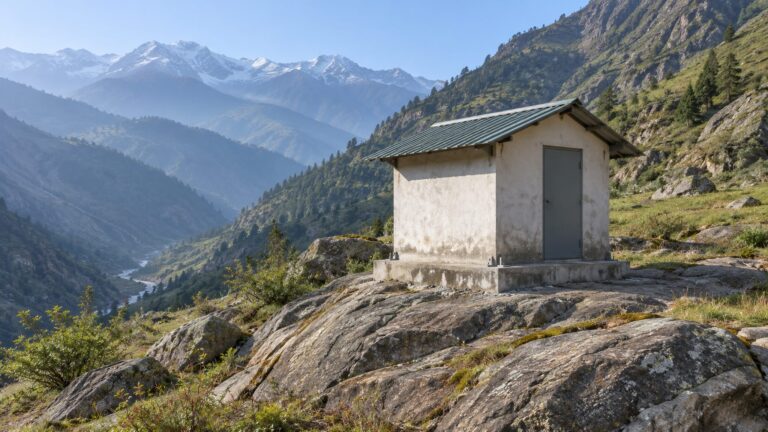
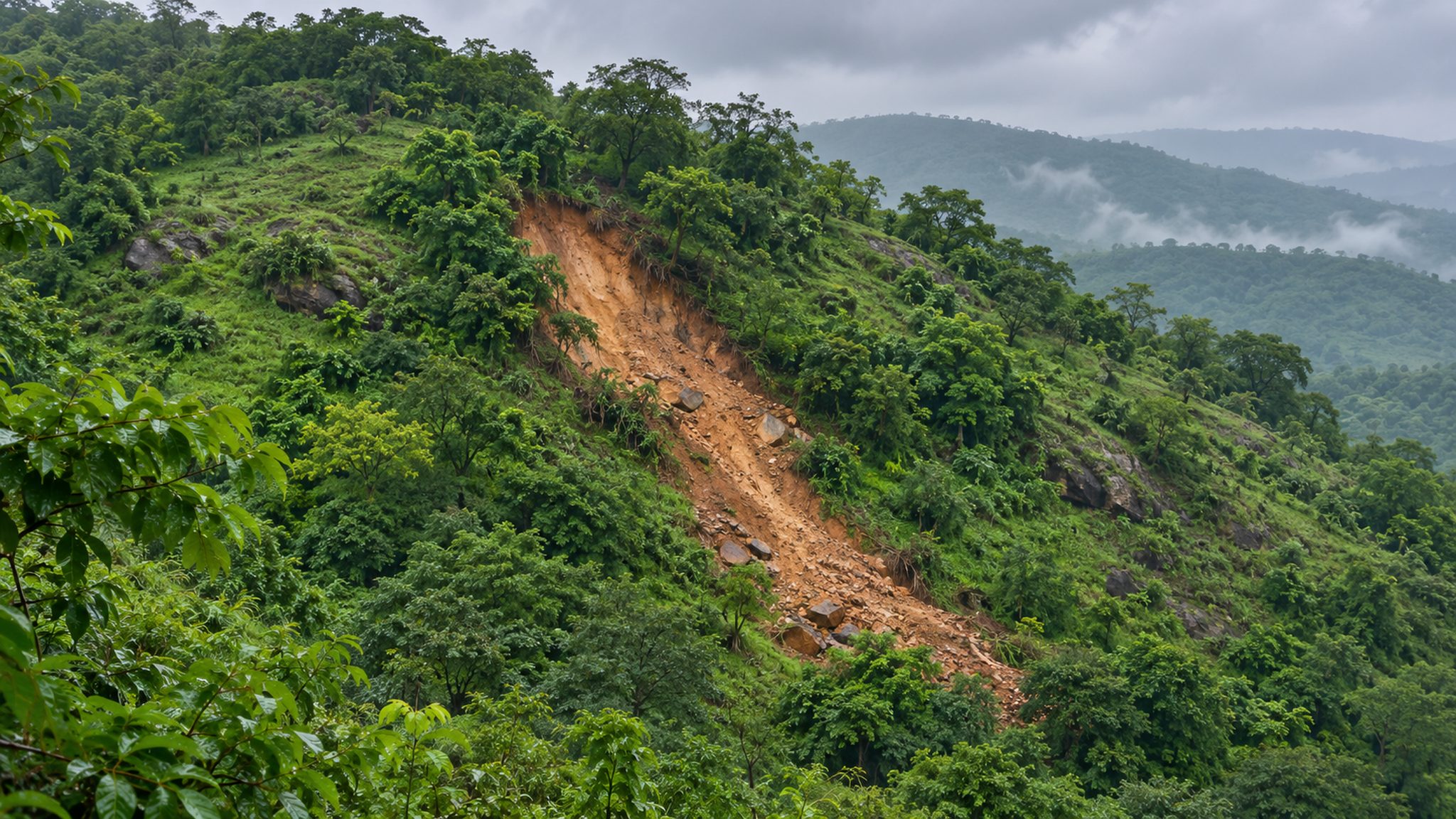
A landslide begins when earth material moves downhill, but the consequences depend on the route it takes and what lies below.
- Local terrain matters even within the same hill range. Differences in slope steepness, curvature and geological material change how a hillside responds to a rainstorm passing across a wider area.
- Landslides include falling rock, sliding masses and flowing debris. Movement can be rapid or slow, so one label covers events with different warning signs, travel distances and consequences for nearby communities.
- Runout extends the affected area beyond the initial failure. Soil and rock moving into a valley or across a road can damage locations downhill from the slope where movement began.
- Access disruption compounds the direct damage. Odisha’s reported road losses illustrate how a failed slope can interrupt treatment, relief delivery and rehabilitation even for households whose buildings remain standing.
- Site investigations must establish the conditions at affected villages. A general explanation involving rainfall, altered slopes or vegetation cannot identify the contribution of each factor to a particular failure without evidence.
How Rainwater Can Weaken a Slope
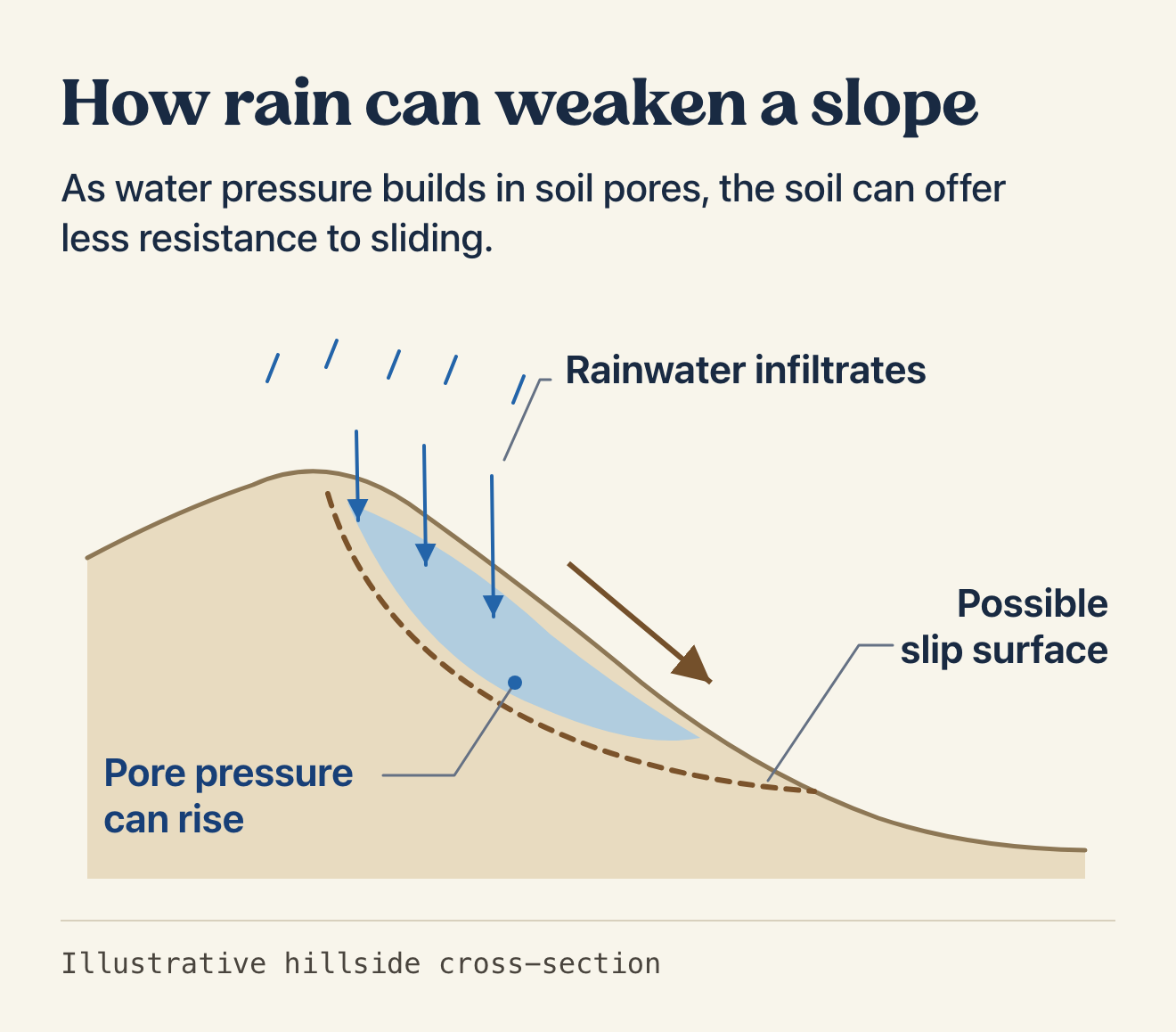
Rain changes conditions inside the ground as well as on its surface, which explains why rainfall totals alone cannot describe stability.
- Infiltration moves part of the rainfall into soil and fractures. The resulting water distribution depends on local materials and drainage, so neighbouring slopes can develop different subsurface conditions during one storm.
- Pore-water pressure is pressure exerted by water within the spaces in soil. When it rises, the effective stress holding grains together can decrease, reducing resistance to sliding along a potential failure surface.
- Gravity continues to pull material downhill while resisting forces change. Failure becomes possible when the available resistance becomes insufficient, which makes slope geometry and material strength relevant alongside the amount of rain.
- Drainage conditions influence the movement and storage of water within a hillside. Engineers assess these pathways when choosing measures because a treatment that works on one slope may be unsuitable for another location.
- Drainage management addresses this water pathway. NDMA guidance describes intercepting surface water and removing subsurface water, with measures selected through slope assessment and maintained so channels continue to carry water safely.
From Susceptibility to Risk Decisions
Mapping becomes useful when it connects the likelihood of slope failure with people, buildings and services that could be affected.
- Susceptibility identifies terrain relatively prone to landsliding. It guides closer investigation, while a warning about possible failure during a storm requires additional information about changing conditions and the expected time window.
- Exposure records people and assets within the possible impact area. Two similarly unstable slopes can create different levels of danger because settlements, roads and public facilities occupy different positions around them.
- Vulnerability describes how severely exposed people or structures may be harmed. Limited evacuation access or dependence on a single road can increase the consequences even when the physical slide is relatively localized.
- Planning can use both terrain and service information. The broader ecological planning approach connects development decisions to natural systems, while individual slope safety still requires evidence from that location.
- Warnings need workable action arrangements. As with multi-hazard warning coverage, a message reaches practical value when people can understand it and use an available evacuation route or safe destination.
Way Forward
Investigate Slopes and Protect Access
- Prioritize field assessment around damaged settlements and essential access routes, recording drainage, soil and rock conditions.
- Keep drainage maintenance connected to engineering assessments so diverted water does not create a new downstream problem.
- Plan evacuation and alternative access with communities whose health care and supplies depend on vulnerable roads.
Conclusion
- Eastern Ghats landslide risk requires attention to water within slopes and the settlements around them. Rainfall provides a trigger, while local ground conditions shape how a particular hillside responds.
- A useful disaster-management answer links susceptibility, exposure and vulnerability to concrete decisions about investigation, drainage, settlement location and access. Recorded incidents help identify priorities for this work.
UPSC Practice Questions
Prelims MCQ 1
Which statement about rainfall and landslides is correct?
(a) Every landslide requires complete soil saturation. (b) Equal rainfall produces identical stability on neighbouring slopes. (c) Rising pore-water pressure can reduce resistance to sliding. (d) Rainfall totals alone establish the precise time of failure.
Answer: (c) Rising pore-water pressure can reduce resistance to sliding.
Explanation:
Pore-water pressure affects effective stress and the resistance available within soil. Local materials and slope conditions also matter, and landslides can occur in partly saturated material.
Prelims MCQ 2
A road and a health centre lie below a slope prone to failure. Their presence in the possible impact area describes which component of disaster risk?
(a) Exposure (b) Rainfall intensity (c) Pore-water pressure (d) Rock weathering
Answer: (a) Exposure
Explanation:
Exposure concerns the people and assets located where a hazard can affect them. The likelihood of slope failure and the susceptibility of terrain are separate considerations.
UPSC Mains Questions
- Explain how rainfall can destabilize a hillside and discuss the role of drainage in reducing landslide risk.
- Using hill settlements as an example, distinguish susceptibility, exposure and vulnerability in disaster-risk planning.
Sources: The Hindu and National Disaster Management Authority.
Frequently Asked Questions
What is a landslide?
A landslide is the downslope movement of rock, soil or debris. Different forms include rockfalls, slides and debris flows, with movement ranging from slow deformation to rapid and destructive events.
Why can heavy rainfall trigger slope failure?
Rainwater can enter soil and change the pressure within its pores. Rising pore-water pressure can reduce resistance to movement, while gravity continues to pull slope material downhill.
Does all soil need to be saturated before a landslide?
Some landslides occur in partly saturated soil. Rainfall, soil moisture and pressure measurements together provide a fuller account of changing ground conditions than rainfall totals alone.
Why does a blocked hill road increase disaster impacts?
A damaged road can interrupt access to health care, supplies and relief. The resulting isolation can affect people beyond the houses directly struck by the moving soil or rock.
Tell Google you want more of this.
Add Anantam IAS as a preferred sourceOne tap, and this site shows up more often in your own Top Stories, AI Overviews and AI Mode. Remove it any time.