Why in News?
French chemist Henri B. Kagan and Japanese chemist Kensō Soai have been jointly awarded the Nobel Prize in Chemistry 2026 for their groundbreaking discoveries of non-linear effects and asymmetric autocatalysis in organic synthesis.
| UPSC Relevance: GS-3 Science and Technology: Nobel Prize in Chemistry Prelims: Nobel Prize in Chemistry 2026 |
What are Chiral Molecules?
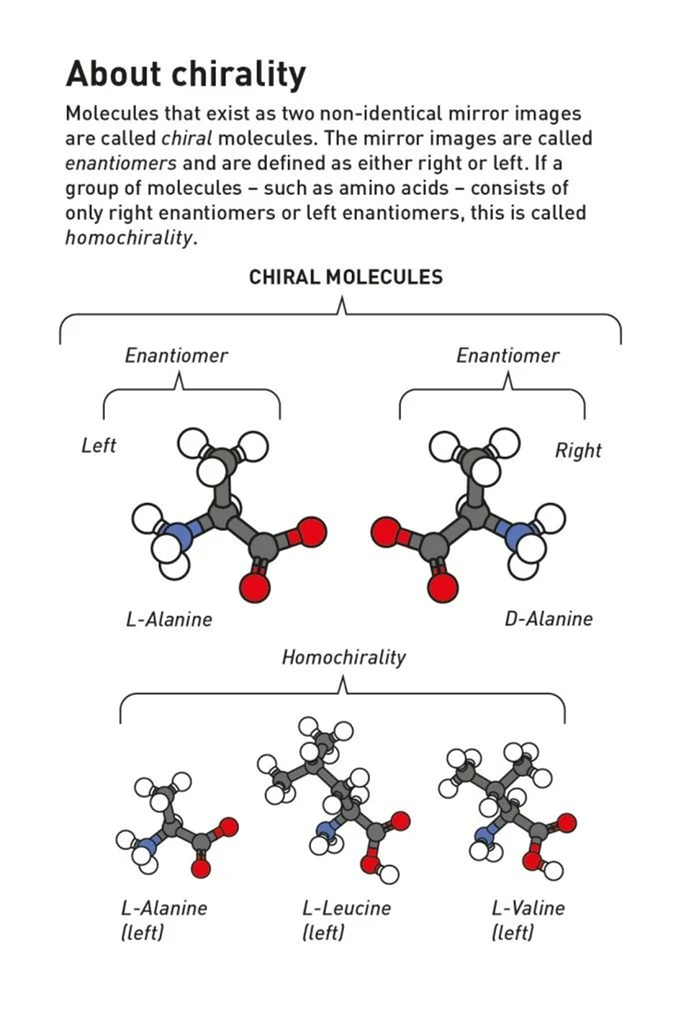
- Chirality (Molecular Handedness): The geometric property of a molecule whose mirror image cannot be superimposed on itself, much like how our left and right hands cannot be perfectly aligned.
- Enantiomers: The two mirror-image forms of a chiral molecule. They possess identical chemical formulas and atomic connectivity but have different three-dimensional spatial arrangements.
- Biological Homochirality: Living systems exhibit strict structural uniformity, overwhelmingly utilising only one specific molecular handedness:
- Proteins are composed exclusively of L-amino acids (left-handed).
- DNA and RNA possess backbones made strictly of D-sugars (right-handed).
- Standard laboratory synthesis under symmetric, achiral conditions naturally produces a racemic mixture, i.e., an equal (50:50) ratio of both enantiomers.
What is Asymmetric Synthesis?
- In standard chemical reactions, creating chiral molecules yields an equal mix of both mirror images. However, target industries require only one specific form.
- Asymmetric synthesis refers to specialised chemical methods designed to selectively produce a single desired enantiomer over its mirror image.
This precision is critical because two mirror-image molecules interact differently with chiral biological receptors, determining whether a chemical behaves as a remedy or a toxin.
Example: Why does Molecular Chirality matter?
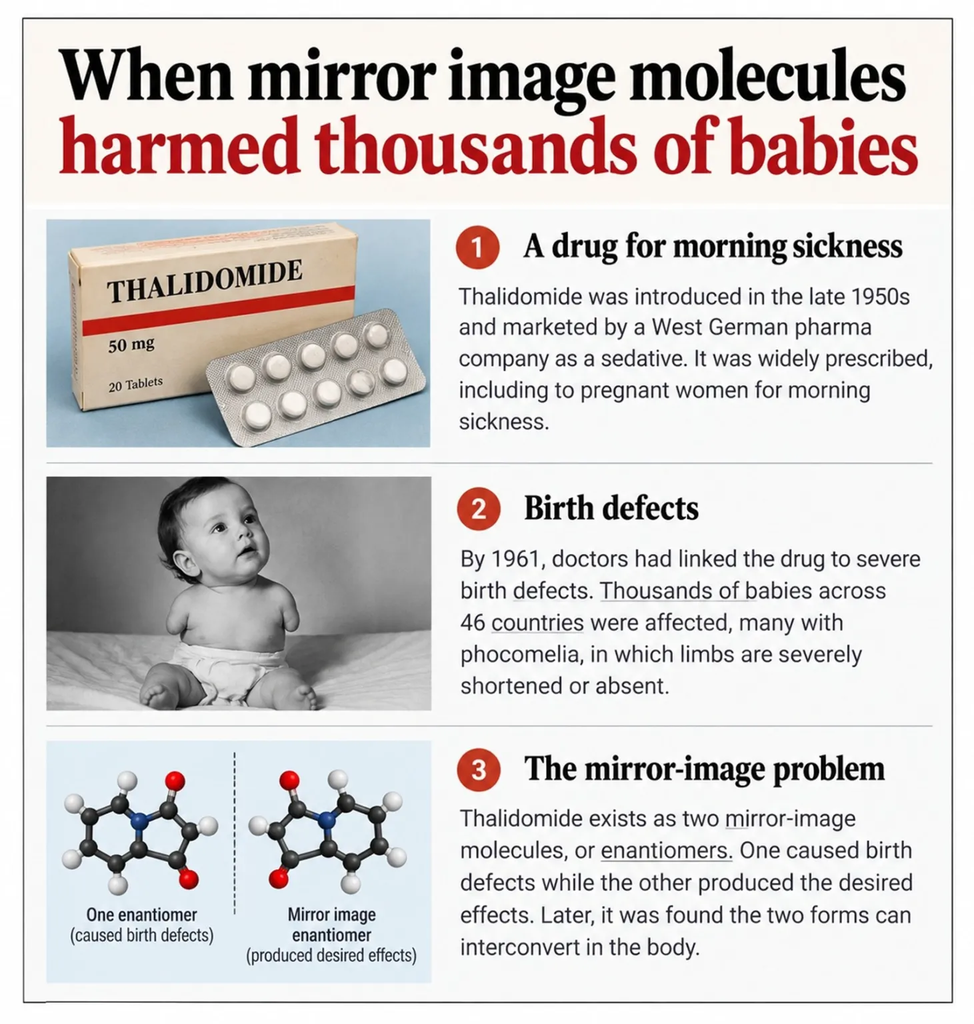
- Chirality is fundamental to pharmacology and toxicology. A tragic historical example is Thalidomide in the 1950s: one enantiomer effectively treated morning sickness, but its mirror-image counterpart caused severe birth defects.
- Achieving absolute control over chirality allows modern chemists to engineer highly selective chemical reactions, ensuring drug safety, efficacy, and structural integrity.
What did the Nobel Laureates discover?
(i) Henri B. Kagan (Amplification through Non-linear Effects):
- Kagan challenged the traditional assumption that the purity of a product must linearly match the purity of the catalyst.
- He proved that an impure chiral catalyst can still yield a highly pure, single-enantiomer product. He demonstrated that small initial chemical imbalances can be dramatically amplified during a reaction.
(ii) Kensō Soai (Amplification through Asymmetric Autocatalysis):
- Soai designed a self-replicating chemical process known as the “Soai Reaction,” where the product acts as its own catalyst.
- By introducing a minute trace of one enantiomer, the reaction triggers a self-reinforcing loop. The molecule rapidly copies itself while actively suppressing its mirror image. The final product is a virtually 100% pure single-enantiomer product, perfectly mimicking how nature creates life’s building blocks.”
Why do these Discoveries Matter?
- Advanced Pharmaceutical Manufacturing: Enables cost-effective, precise scale-up of pure, single-enantiomer drugs. This eliminates toxic enantiomeric byproducts and improves therapeutic safety.
- Chemical synthesis (Agrochemicals, Flavours, and Fragrances): Ensures commercial efficacy. For example, one enantiomer of carvone smells like spearmint, while its mirror image smells like caraway seeds. Selective synthesis ensures predictable sensory and biological results.
- Optimised Catalyst Design: The discovery of non-linear effects helps scientists decipher complex catalytic pathways, allowing them to optimise reaction conditions using cheaper, partially pure catalysts.
- Decoding the Origins of Life (Astrobiology): It provides a mathematically sound, chemical mechanism explaining how a tiny initial asymmetry on early Earth could self-amplify into the absolute biological homochirality that characterises all terrestrial life today.
Kagan showed how reactions can amplify molecular asymmetry, while Soai demonstrated how this amplification can become self-reinforcing. Their work links precise chemical manufacturing with the deeper question of how life acquired its molecular handedness.
Tell Google you want more of this.
Add Anantam IAS as a preferred sourceOne tap, and this site shows up more often in your own Top Stories, AI Overviews and AI Mode. Remove it any time.