A year ago, between 1:05 and 1:27 am on 7 May 2025, Indian armed forces struck nine terror-linked sites across Pakistan and Pakistan-occupied Kashmir. The 22-minute window of Operation Sindoor closed one chapter and opened another in India’s counter-terrorism doctrine. The Operation Sindoor anniversary, marked across cantonments and headquarters in May 2026, is less a commemoration and more a stocktake.
The strike followed the 22 April 2025 Pahalgam terror attack that killed 26 civilians, mostly Hindu tourists, in Jammu and Kashmir’s Baisaran meadow. India’s response was calibrated, joint, and rapid. One year later, former Director General of Military Operations Lieutenant General Rajiv Ghai has publicly stated that Pakistan asked India to stop after the strikes; the armed forces have used the anniversary to remind the region of demonstrated deep-strike capability.
The Operation Sindoor anniversary therefore matters as a doctrinal moment, not just a memorial one. This article walks through what happened, what changed in India’s strategic posture, what worked, what remains brittle, and what UPSC aspirants need to retain from the operation and its first-year report card.
Quick Facts
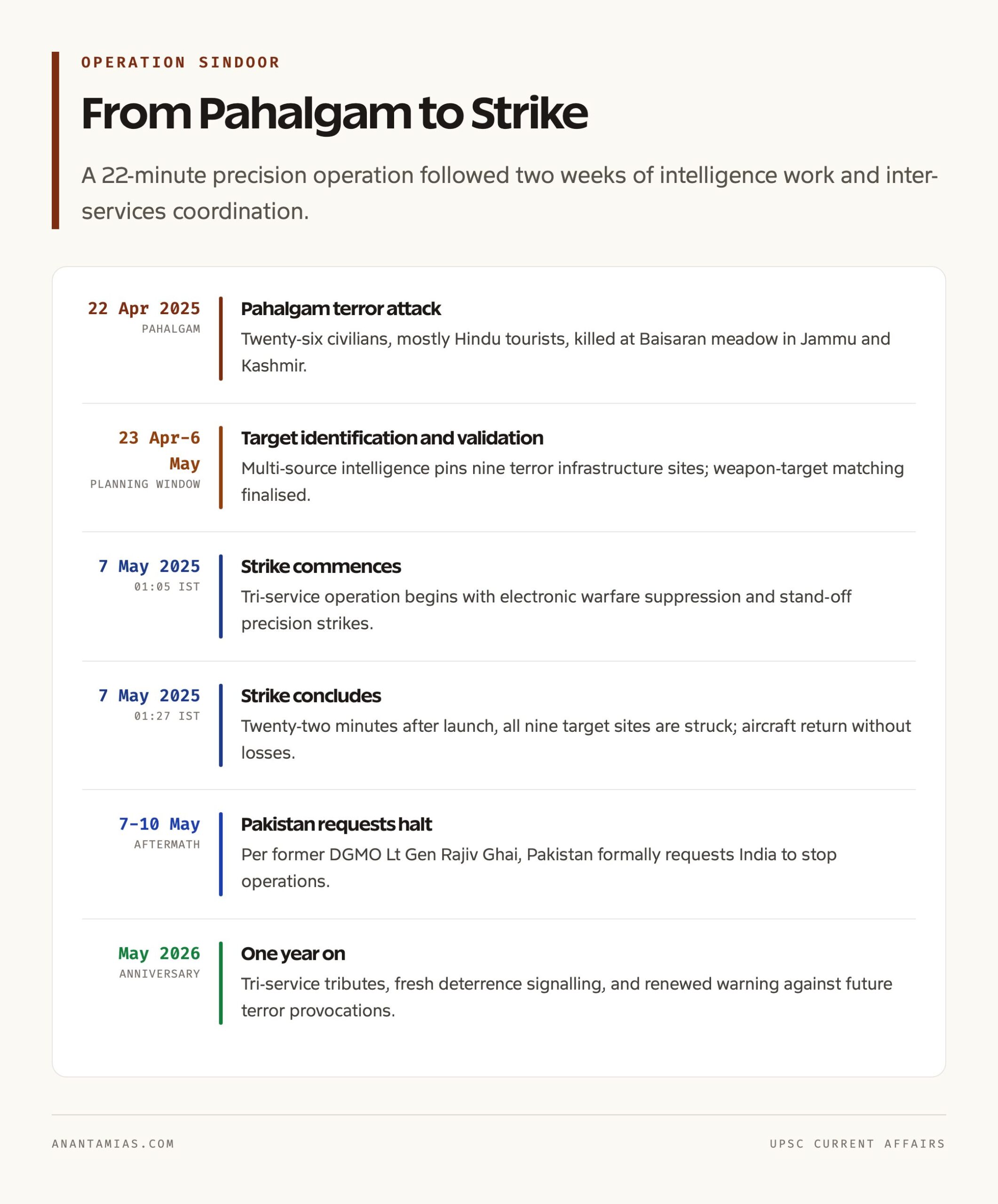
- Trigger event: Pahalgam terror attack, 22 April 2025; 26 civilians killed.
- Strike date and time: 7 May 2025, 1:05 am to 1:27 am (22 minutes).
- Targets hit: nine terror infrastructure sites, including Bahawalpur, Muridke, Kotli, and Muzaffarabad area camps.
- Forces involved: Indian Air Force, Indian Army, and Indian Navy assets in a joint operation.
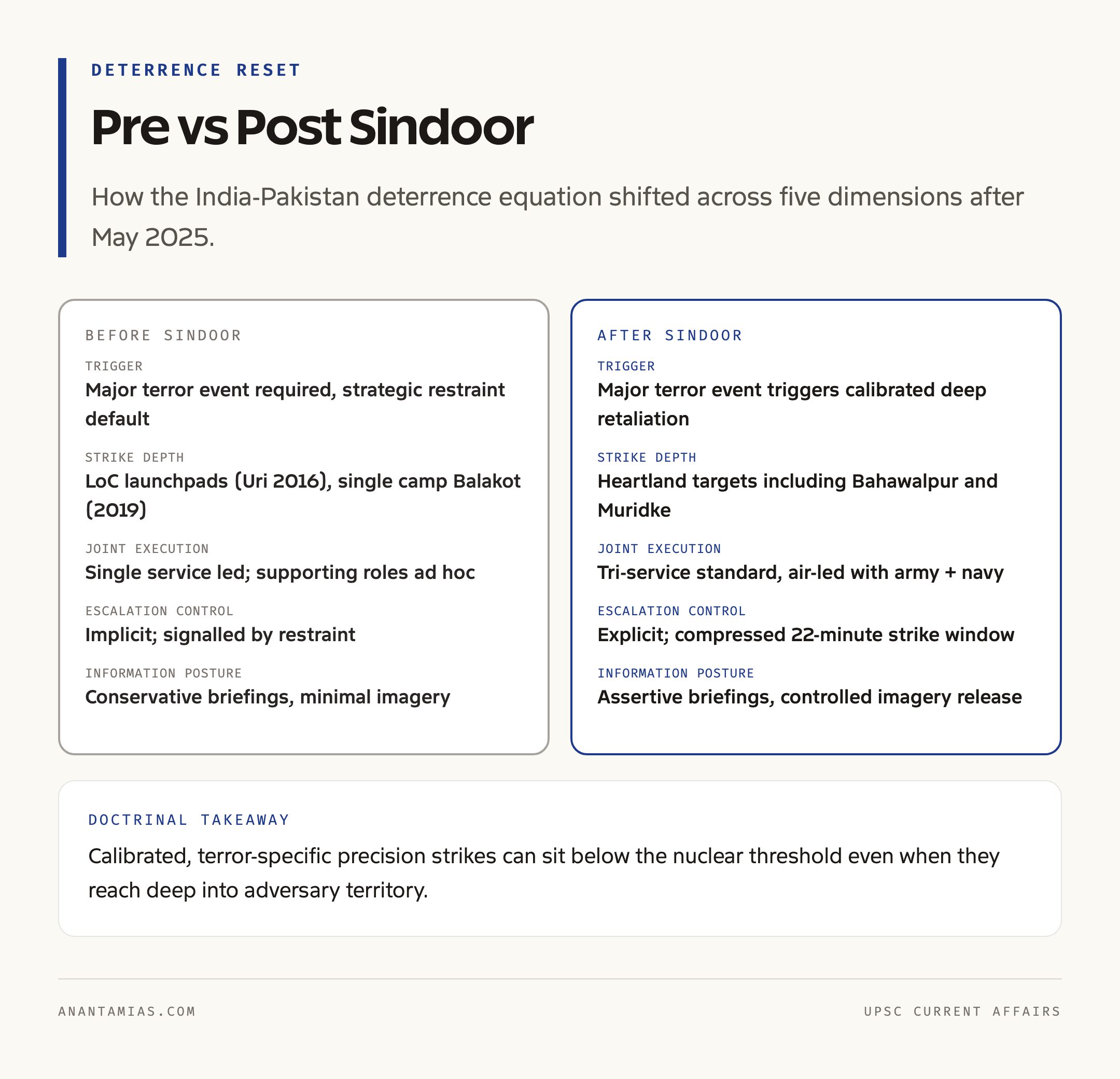
- Doctrinal shift: moved from retaliation under provocation to anticipatory precision strike with stated red lines.
- Anniversary year: May 2026 marked with tri-service tributes and renewed deterrence signalling.
What Just Happened on the Anniversary
The Operation Sindoor anniversary in May 2026 was marked at South Block, at field commands, and across air-force stations. Tri-service statements emphasised that the 7 May 2025 strikes demonstrated deep-strike capability and that any future provocation would be met with calibrated force. The Chief of Defence Staff, the three service chiefs, and senior commanders attended events at the National War Memorial and at frontline air bases.
In a widely covered interview, former DGMO Lt Gen Rajiv Ghai stated that Pakistan formally requested India to halt operations once the strikes had landed and damage assessments became public. He framed Sindoor as a calibrated and precise response that achieved its goals while avoiding a prolonged conflict. The armed forces also released previously unreleased imagery and damage assessment material to underscore the precision of the strike package.
Parallel commemorations highlighted policy choices since: deepened triservice integration, expanded surveillance over the western theatre, and a more assertive information posture. Indian diplomatic channels used the anniversary to remind partners that the threshold for state-tolerated terror has shifted.
Background and Historical Context
Our companion piece on the Operation Sindoor parliament debate brief and the year-after Operation Sindoor reset with Azerbaijan trace the political and diplomatic afterlife of the strike. India’s response menu for cross-border terror has evolved across four phases. The first, from Kargil 1999 through 2008, was characterised by strategic restraint backed by diplomatic isolation: Operation Parakram, the post-Mumbai diplomatic offensive, and consistent emphasis on Pakistan’s state sponsorship of terror groups such as Lashkar-e-Taiba and Jaish-e-Mohammed.
The second phase opened with the 2016 surgical strikes after the Uri attack, when Indian special forces crossed the Line of Control at multiple points and struck launchpads. The third phase began with the Balakot air strike of 26 February 2019, in response to Pulwama, which took the response across the international boundary using IAF Mirage 2000 jets and stand-off precision-guided munitions.
Operation Sindoor is the fourth and most consequential phase. It widened the geography of legitimate Indian targets to include terror leadership compounds deep inside Pakistan’s heartland, including Bahawalpur and Muridke, the home bases of Jaish-e-Mohammed and Lashkar-e-Taiba. The political signal was unmistakable: terror infrastructure anywhere on Pakistani territory is a fair target after a major terror event traced back to it.
Key Provisions of the New Posture
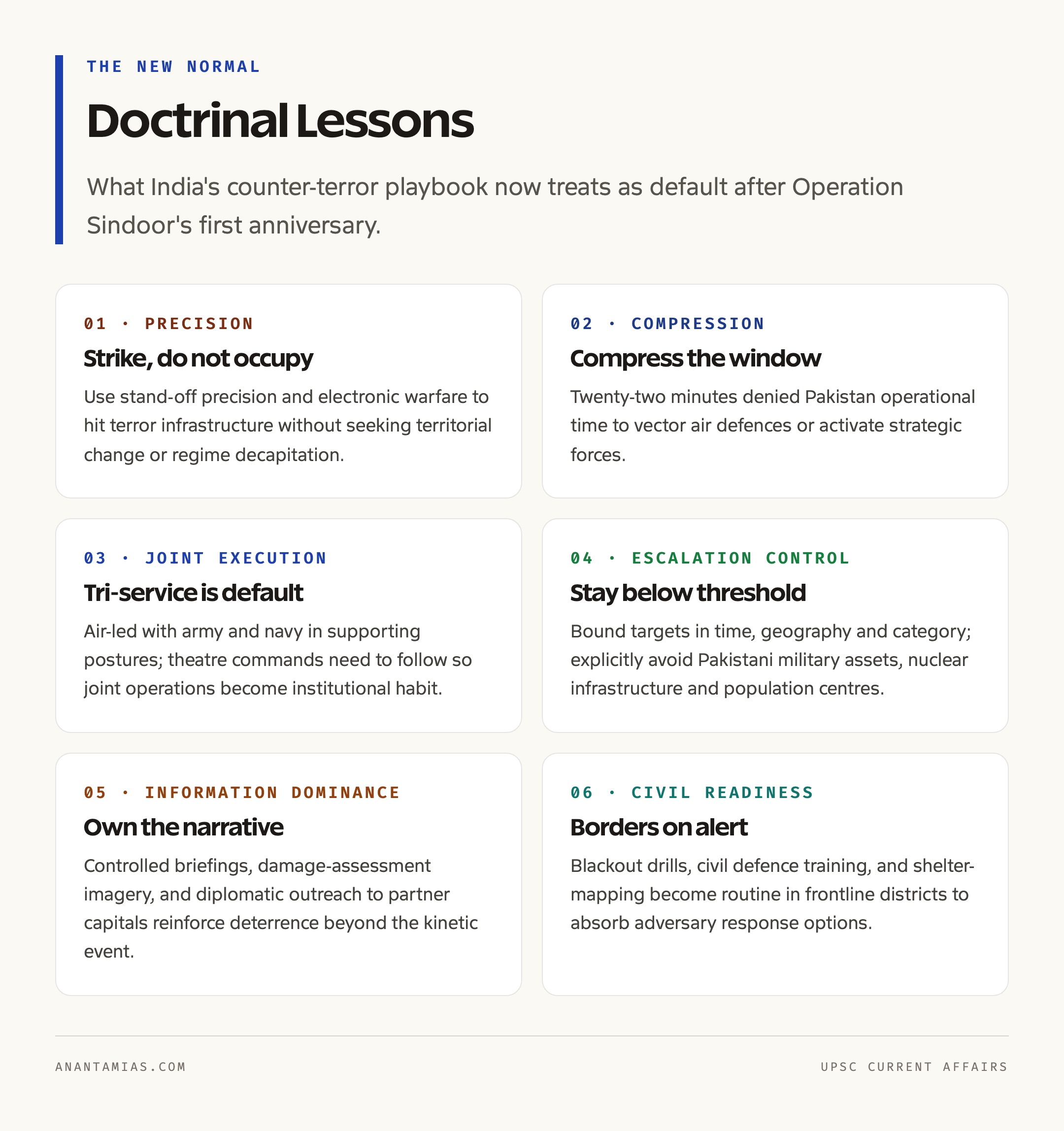
Three doctrinal threads run through India’s post-Sindoor posture. First is the principle of proportional but expanded depth. The retaliation no longer stops at launchpads near the Line of Control; it extends to handler residences, training facilities, and ideological hubs across Pakistan. Second is the principle of joint execution. Sindoor was an air-led but tri-service operation, with navy assets positioned in the Arabian Sea and army formations on heightened alert across the western theatre.
Third is the principle of compressed time. The 22-minute strike window denied Pakistan operational time to scramble fighters, vector air defences, or activate strategic forces in any coordinated way. Subsequent commentary by India’s leadership has emphasised that future responses will follow a similar compressed, surgical template rather than open-ended conventional escalation.
The post-Sindoor security architecture also tightened civilian readiness. Border districts now run regular blackout drills, civil defence training, and shelter-mapping exercises. The Information and Broadcasting Ministry has formalised wartime communication protocols that draw on the Sindoor experience.
Why It Matters
The Operation Sindoor anniversary matters because deterrence is a perishable commodity. The strike’s credibility depends on demonstrated willingness, demonstrated capability, and consistent diplomatic backing. One year on, all three elements have been reinforced. Diplomatic engagement with Gulf partners, European capitals, Russia, and Quad members has emphasised India’s restraint in the face of provocation and its precision in retaliation.
For internal security, Sindoor changed the calculus inside Jammu and Kashmir, layered on long-standing India-Pakistan relations dynamics. Local recruitment into terror outfits has slowed, infiltration metrics remain elevated but more contested, and the focus has shifted to over-ground worker networks, narco-terror funding, and drone-based weapon drops. The cost of running terror operations against India has risen, even as the threat has not vanished.
For UPSC GS Paper III, the operation sits at the intersection of internal security, defence acquisition, civil-military relations, and foreign policy. It is now a default reference for questions on counter-terrorism, deterrence, and tri-service synergy.
Detailed Analysis: What Sindoor Actually Demonstrated
Operationally, Sindoor demonstrated four capabilities. One, target intelligence: nine sites were identified, validated, and prioritised through multi-source intelligence including signals, imagery, and human networks. Two, weapon-target matching: the strike package used a mix of stand-off precision munitions and stand-in capability, calibrated to limit collateral damage to civilian infrastructure.
Three, electronic warfare and air-defence suppression: Pakistani air-defence radars and command-and-control nodes were jammed or degraded during the strike window, enabling clean ingress and egress. Four, escalation management: the strikes were tightly bounded in time, geography, and target type, signalling clearly that the action was terror-specific and not aimed at Pakistani military assets or population centres.
What Sindoor did not do is also important. It did not aim for regime decapitation, it did not target Pakistani nuclear infrastructure, and it did not seek territorial change. That self-restraint is what allowed the strikes to be both punishing and contained.
Comparative Perspective
Counter-terror precision strikes are not unique to India. The United States has used similar templates against Al-Qaeda and ISIS leadership in Afghanistan, Iraq, and Syria. Israel has run a longer-standing campaign against Hamas, Hezbollah, and Iranian Revolutionary Guard targets across Syria and Lebanon. Turkey conducts regular precision strikes against PKK leadership in northern Iraq.
What distinguishes Sindoor is the South Asian nuclear backdrop. India and Pakistan are both nuclear-armed states, and the operation tested the long-standing assumption that conventional retaliation between them is foreclosed by nuclear deterrence. Sindoor demonstrated that calibrated, terror-specific strikes can sit below the nuclear threshold even when they reach deep into adversary territory. That is a contribution to the global literature on limited war under nuclear conditions, not just to India’s own doctrine.
Challenges
The Operation Sindoor anniversary also surfaces uncomfortable continuities. Cross-border terror infrastructure has not been dismantled; it has been dispersed and hardened. Drone-based weapon and narcotic drops along the Punjab and Jammu sectors continue. Recruiting patterns inside Kashmir have evolved but not collapsed. Pakistan’s deep state retains the political logic of using non-state actors against India, even if the cost has risen.
A second challenge is the China-Pakistan axis. Pakistan’s air defences and surveillance systems increasingly draw on Chinese platforms; some commentary around the Sindoor anniversary has flagged a China-Pakistan-Turkey supply chain that complicates future strike planning. India will need to invest harder in stand-off precision, electronic warfare, and offensive cyber to maintain its edge.
A third challenge is sustaining doctrinal clarity. Future provocations will not look identical to Pahalgam. Some will be smaller, some larger, some ambiguous. The hardest test of the post-Sindoor doctrine will be calibrating response to events that fall in the grey zone.
Prelims Pointers
- Operation Sindoor was launched on 7 May 2025; the strike window was 1:05 am to 1:27 am (22 minutes).
- It was triggered by the Pahalgam terror attack of 22 April 2025, which killed 26 civilians.
- Targets included nine terror infrastructure sites; key locations named in official briefings include Bahawalpur and Muridke.
- The operation was tri-service, led from the air with army and navy in supporting postures.
- The 2016 Uri-response surgical strikes and 2019 Balakot air strike are the immediate doctrinal predecessors.
- Lt Gen Rajiv Ghai was the Director General of Military Operations at the time of Operation Sindoor.
Mains Questions
- Operation Sindoor marks a shift from retaliation to anticipatory precision strike in India’s counter-terror doctrine. Analyse the operational and strategic implications. (GS Paper III, Internal Security)
- Discuss the role of tri-service synergy in modern Indian military operations with reference to Operation Sindoor. What further integration is required? (GS Paper III, Security Forces)
- Examine the impact of Operation Sindoor on India-Pakistan deterrence dynamics under nuclear conditions. (GS Paper II, International Relations)
- India’s response options to cross-border terror have evolved from strategic restraint to deep precision strike. Trace this evolution and evaluate its sustainability. (GS Paper III, Internal Security)
Way Forward
Sustaining the post-Sindoor deterrence requires sustained investment, not just commemoration. India must continue funding stand-off precision, indigenous electronic warfare, hypersonic glide vehicles, and integrated air-defence systems. The theatre command rollout, debated since the Kargil Review Committee, needs faster political and bureaucratic closure so that joint operations become institutional habit rather than ad hoc.
Diplomatically, India must keep the global narrative focused on Pakistan’s state-sponsored terror apparatus, working with FATF processes, UN sanctions committees, and partner intelligence agencies. Domestically, the over-ground worker network in Jammu and Kashmir, narco-terror channels in Punjab, and digital radicalisation pipelines need continued attention. The Operation Sindoor anniversary is a reminder that doctrine, like deterrence, must be renewed every year.
Frequently Asked Questions
What was Operation Sindoor?
Operation Sindoor was a tri-service Indian military operation conducted in the early hours of 7 May 2025. It struck nine terror infrastructure sites across Pakistan and Pakistan-occupied Kashmir within a 22-minute window, in response to the Pahalgam terror attack of 22 April 2025.
Why is it called Sindoor?
The codename references the loss suffered by widows of the Pahalgam attack victims, most of whom were tourists. The naming choice was a deliberate political and emotional signal of the operation’s intent.
How is the Operation Sindoor anniversary being marked?
The first anniversary in May 2026 was marked with tri-service tributes, ceremonies at the National War Memorial and frontline air bases, public statements by senior commanders, and the release of additional damage assessment material to reinforce deterrence.
What did the operation actually target?
It hit nine terror-linked sites, including handler residences and training facilities associated with Jaish-e-Mohammed at Bahawalpur and Lashkar-e-Taiba at Muridke, plus camps and launchpads in Pakistan-occupied Kashmir.
Did Pakistan retaliate?
Pakistan attempted limited responses in the days following Sindoor, including drone and missile activity along the Line of Control. According to the former DGMO, Pakistan eventually requested India to stop, indicating that the calibrated escalation worked.
How does Sindoor differ from Balakot?
Balakot in 2019 was an air-led strike on a single camp at Jaba Top in Khyber-Pakhtunkhwa. Sindoor was a coordinated tri-service operation against nine sites across a much wider geography, including Pakistan’s Punjab heartland.
What doctrinal shift does Sindoor represent?
It established precision retaliation across Pakistani territory, including the heartland, as a credible response to major terror events. It also embedded compressed time, joint execution, and explicit escalation management as standard features of Indian doctrine.
What are the current security threats one year on?
Drone-based weapon and narcotic drops along the western border, evolving recruitment patterns in Jammu and Kashmir, hardened terror infrastructure dispersed across Pakistan, and the China-Pakistan-Turkey supply axis remain active concerns.
Has India-Pakistan diplomatic engagement resumed?
Engagement remains limited and conditional. India’s stated position is that talks and terror cannot proceed in parallel; until verifiable action is taken against terror infrastructure, normal channels remain narrow.
Why does the Operation Sindoor anniversary matter for UPSC?
It is now a default reference for counter-terror doctrine, tri-service synergy, deterrence under nuclear conditions, and India-Pakistan relations. Expect prelims fact questions and mains essays drawing on the operation across GS Papers II and III.
Tell Google you want more of this.
Add Anantam IAS as a preferred sourceOne tap, and this site shows up more often in your own Top Stories, AI Overviews and AI Mode. Remove it any time.