Why in News?
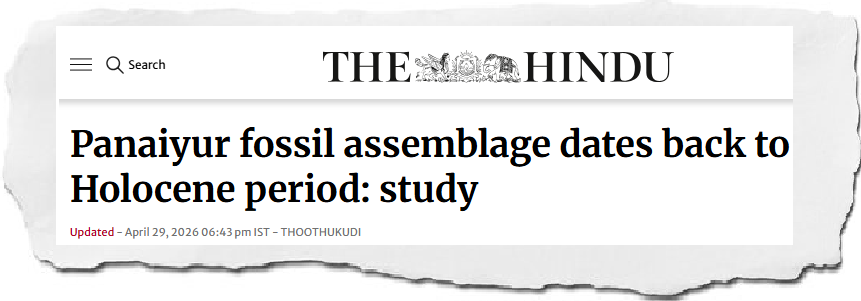
A recent study by the Zoological Survey of India has identified a fossil assemblage at Panaiyur in Thoothukudi district, Tamil Nadu, dating to the middle–late Holocene period (≈ 8,000–12,000 years ago). The findings provide important evidence on past coastal environments and long-term ecological stability in the Gulf of Mannar region.
UPSC Relevance
GS-I: Indian Geography (Coastal geomorphology), Physical Geography, Prehistory
GS-III: Environment & Ecology, Conservation, Climate Change
What is the discovery?
A recent study by the Zoological Survey of India has identified a fossil assemblage at Panaiyur in Thoothukudi district, Tamil Nadu, dating to the middle–late Holocene period (≈ 8,000–12,000 years ago).
This finding is important because Holocene studies help reconstruct past climates, sea levels, and coastal changes, which are highly relevant for present-day climate change analysis.
How was the age determined?
The researchers used standard geological and paleontological methods:
- Stratigraphy: The position of fossils within sediment layers indicates relative age.
- Sedimentology: Sandy–silty deposits with shell concentrations are typical of Holocene coastal environments.
- Fossilisation level: The degree of preservation suggests relatively recent geological origin.
- Comparative analysis: Matching with known Quaternary deposits in the region.
These methods together confirm the fossils belong to the Holocene epoch of the Quaternary Period.
What was found?
The fossil assemblage includes:
- 104 specimens
- Four taxonomic groups, mainly:
- Bivalves (e.g., clams, oysters)
- Gastropods (snails)
A key observation is that all identified species are still living (extant) in the Gulf of Mannar region today.
Key Scientific Inferences
1. Environmental Continuity
The similarity between fossil and present-day species indicates that:
- The marine ecosystem has remained broadly stable for thousands of years.
- Core factors like temperature, salinity, and ocean circulation have not drastically changed.
This is significant for understanding long-term ecological resilience.
2. Evidence of Coastal Changes
The fossil site lies about 5 km inland from the present coastline, suggesting:
- Shifts in shoreline over time, likely due to:
- Sea-level changes
- Sediment deposition
- Coastal geomorphological processes
This supports the idea that coasts are dynamic systems, constantly evolving.
3. Depositional Environment
The fossils indicate:
- Shallow marine to estuarine conditions
- Mixed sandy-muddy substrates
- Moderate water circulation
- Marine to brackish salinity
This helps reconstruct past coastal ecosystems, useful in climate modelling.
Why is this important?
1. Climate Change & Sea-Level Studies
Holocene is the most recent geological epoch and is often used as a baseline to understand current global warming trends.
Such findings help compare:
- Past natural climate variability
- Present anthropogenic changes
2. Coastal Vulnerability in India
India has a long coastline, and regions like the Gulf of Mannar are ecologically sensitive.
Understanding past coastal shifts helps in:
- Predicting future sea-level rise impacts
- Planning coastal zone management
3. Biodiversity Conservation
The Gulf of Mannar is a biodiversity hotspot.
The study shows:
- Long-term stability of marine ecosystems
- Need to protect them from modern threats like:
- Pollution
- Coral bleaching
- Overfishing
What is the Holocene Epoch?
The Holocene Epoch:
- Began around 11,700 years ago after the last Ice Age
- Characterised by:
- Stable climate
- Rise of human civilisation
- Witnessed major sea-level rise due to glacial melting
Practice Questions
Prelims
Q1. With reference to the Holocene epoch, consider the following statements:
- It began after the last Ice Age.
- It is part of the Quaternary Period.
- It is characterised by complete absence of sea-level changes.
Which of the statements given above is/are correct?
(a) 1 and 2 only
(b) 2 and 3 only
(c) 1 only
(d) 1, 2 and 3
Answer: (a)
Explanation: Sea levels did change significantly during the Holocene due to glacial melting.
Mains
Q. Discuss how paleontological findings from coastal regions can help in understanding climate change and coastal vulnerability in India.
Tell Google you want more of this.
Add Anantam IAS as a preferred sourceOne tap, and this site shows up more often in your own Top Stories, AI Overviews and AI Mode. Remove it any time.