Why in News?
On 11 November, the Department of Telecommunications reported that the government had sanctioned 26,000 additional mobile network sites to extend service to areas with remaining coverage gaps.
- The 4G Saturation Project targets rural and remote villages that previously lacked fourth-generation mobile connectivity.
- The ministry separately reported that 18,291 BSNL sites commissioned under the existing rollout carried traffic in October.
- The department credited both the public project and private operator expansion for progress in extending coverage.
- Scattered settlements raise the cost of serving each potential subscriber where many households live far apart.
- Village coverage describes the geographic reach of service. Affordability and actual use require evidence from households.
UPSC Relevance
Prelims Relevance
- The Department of Telecommunications oversees the saturation project.
- BSNL operates sites under the public rollout.
- Commissioning marks entry into service.
- Backhaul carries traffic between a local site and the wider network.
Mains Relevance
GS Paper 3
- Explain how dispersed demand affects the economics of extending telecom infrastructure.
- Choose indicators that distinguish investment approval from reliable service.
GS Paper 2
- Assess whether rural households can use digital public services once mobile coverage reaches their settlement.
Essay
- Infrastructure can widen opportunity when households can afford to use the service it delivers.
Background and Context
What Changes When a Site Is Commissioned?
A sanction authorises expansion. An operating site must connect a handset to the wider network before a subscriber can place a call or use mobile data.
- A sanctioned site belongs to the approved programme of work. Operators still have to identify a workable location, provide power, install equipment and connect that location to their network.
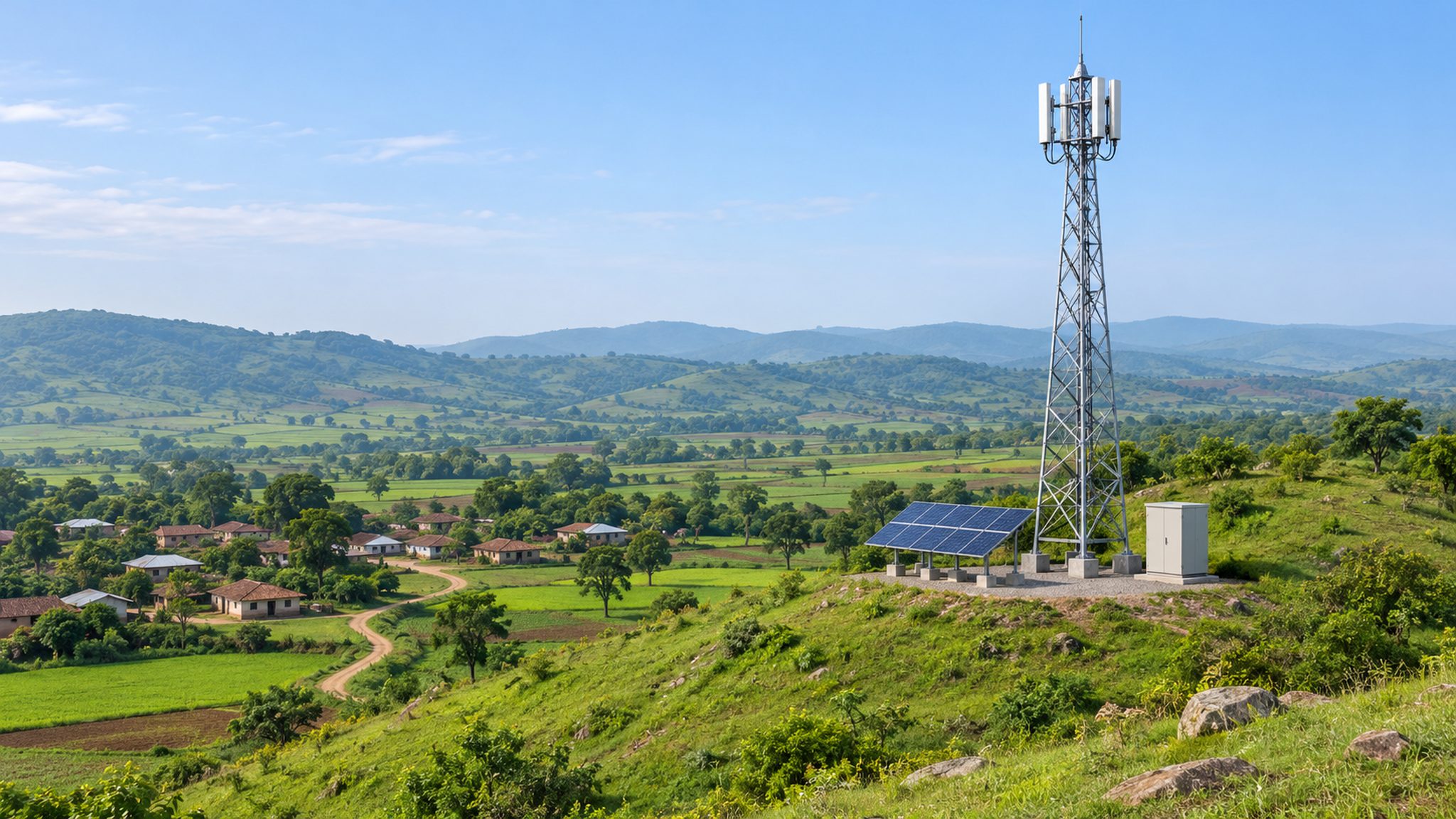
- The tower raises the antennas above nearby obstacles. The radio equipment exchanges signals with phones within reach, while the power supply keeps that equipment available to subscribers.
- The backhaul connection carries calls and data onward. A photograph of an erected mast can establish that construction progressed, while a successful connection tests whether the installed equipment can deliver service.
- When a site is commissioned, it enters service. Traffic recorded there supplies further evidence that subscribers connected during the reporting period. A site could still experience interruptions on other days.
- For a remote hill settlement, maintenance access matters alongside installation. A long journey to replace a failed power component can leave residents without service even after the site enters the commissioned inventory.
How Do Sites Relate to Village Coverage?
The unit changes from a network location to a settlement when the department measures geographic coverage. The two counts answer different questions.
- One radio site may reach homes in neighbouring villages. Counting each installation as one newly connected village would overlook settlements that share a site and villages served by several installations.
- Within a village, terrain can change reception over short distances. A handset on an open road may connect readily while a hamlet behind a ridge receives a weaker signal from the same site.
- An assessment of geographic reach should identify where measurements were taken. A village-centre reading gives limited information about a distant habitation whose residents follow another route to the market or clinic.
- The ministry reports progress by both BSNL and private providers. To attribute a newly covered settlement to the public project, an evaluator needs its earlier coverage status and the operator that extended service.
What Does Traffic Tell Us About Household Access?
A connection that carries data has served a user. Traffic totals alone cannot show how many households can afford a handset or a recurring recharge.
- A maximum daily user count identifies the busiest day in the reporting period. It cannot establish how many distinct users connected across the month because many people return on successive days.
- A monthly data total adds the volume transferred by users. Identical totals could result from a few heavy users or from many light users, with different implications for access across a community.
- For affordability, ask whether a household can buy a suitable device and maintain a data plan. A household survey can record these barriers even where network measurements show a working signal.
- For service quality, test whether a user can complete a task at the time and place it matters. Submitting an application from home requires a stable connection throughout the transaction.
Way Forward
Measure Delivery at Each Stage
- Publish commissioning dates alongside approvals and report how long sites remain available.
- Check signal reach in outlying habitations as well as village centres, recording the location and time of each observation.
- Pair traffic figures with household evidence on device access, recharge costs and tasks residents can complete.
Conclusion
- Follow the evidence from approval to a working site, then ask which settlements it reaches and which households use it. Each step requires an observation matched to that question.
- For an answer on inclusive growth, combine the ministry’s rollout figures with an example of a household facing a weak signal or an unaffordable recharge. Specify the remedy for that particular barrier.
UPSC Practice Questions
Prelims MCQ 1
With reference to rural mobile connectivity, consider the following statements.
- A sanctioned site has already begun carrying user traffic.
- A single commissioned site can serve more than one village.
- The maximum daily user count gives the number of distinct users over a month.
How many of the above statements are correct?
(a) Only one (b) Only two (c) All three (d) None
Answer: (a) Only one
Explanation:
Only statement 2 is correct. Sanction precedes commissioning. A peak daily count covers one day and cannot identify all distinct users over the month.
Prelims MCQ 2
Which observation most directly measures an affordability barrier in a village with working 4G coverage?
(a) The height of the nearest mast (b) The number of sites approved in the district (c) The volume of traffic carried on the busiest day (d) Households reporting they cannot afford a handset or regular recharge
Answer: (d) Households reporting they cannot afford a handset or regular recharge
Explanation:
Household responses directly identify a cost barrier. Site approvals, mast height and traffic totals describe other aspects of infrastructure or use.
UPSC Mains Questions
- How should a district evaluate the contribution of a rural mobile infrastructure project to digital inclusion?
- Explain how terrain and dispersed settlement patterns affect the delivery of reliable mobile broadband.
Source: PIB, Ministry of Communications.
Frequently Asked Questions
What did the government sanction?
The government sanctioned 26,000 additional mobile network sites for the next phase of expansion. The department reported the decision alongside operating figures from BSNL sites commissioned under the existing 4G rollout.
Why can a tower count differ from a village count?
An antenna can reach multiple nearby settlements. Terrain can also divide a village into areas with different signal strengths, so a village may require more than one site.
What does a peak daily user count measure?
It measures the highest number of active users recorded on a single day in the reporting period. Calculating distinct monthly users requires identifying repeat connections across different days.
How can officials check whether coverage improves access?
They can test connections across habitations and ask households about handset ownership, recharge costs and reliability. Together these observations connect network availability to people’s ability to use the service.
Tell Google you want more of this.
Add Anantam IAS as a preferred sourceOne tap, and this site shows up more often in your own Top Stories, AI Overviews and AI Mode. Remove it any time.