Why in News?
On 9 November, the Telecom Regulatory Authority of India issued final regulations setting annual ceilings for Internet Protocol interconnection port charges from 1 January 2027.
- The annual ceilings are ₹5.6 lakh for a 1 Gbps IP port and ₹42.3 lakh for a 10 Gbps IP port.
- The parties may agree on a lower charge or select another capacity using the prescribed pricing methodology.
- The existing charges for E1 ports continue under the amended framework.
- A customer of one operator needs the other operator’s network to reach someone who subscribes to it.
- Wholesale terms affect the cost of connecting networks. Each operator separately decides how it offers retail services to subscribers.
UPSC Relevance
Prelims Relevance
- TRAI regulates terms and conditions of interconnection under the TRAI Act.
- The interconnection seeker pays the provider for terminating a link at the provider’s point of interconnection.
- E1 has a capacity of 2.048 Mbps.
- The new IP-port ceilings are annual and capacity-specific.
Mains Relevance
GS Paper 3
- Explain how wholesale infrastructure pricing can affect competition among telecom operators.
- Discuss the regulatory challenge of supporting two generations of network technology during a transition.
Background and Context
What Does a Port Charge Pay For?
Consider a call from a customer of one mobile operator to a customer of another. Completion requires a handover between their networks.
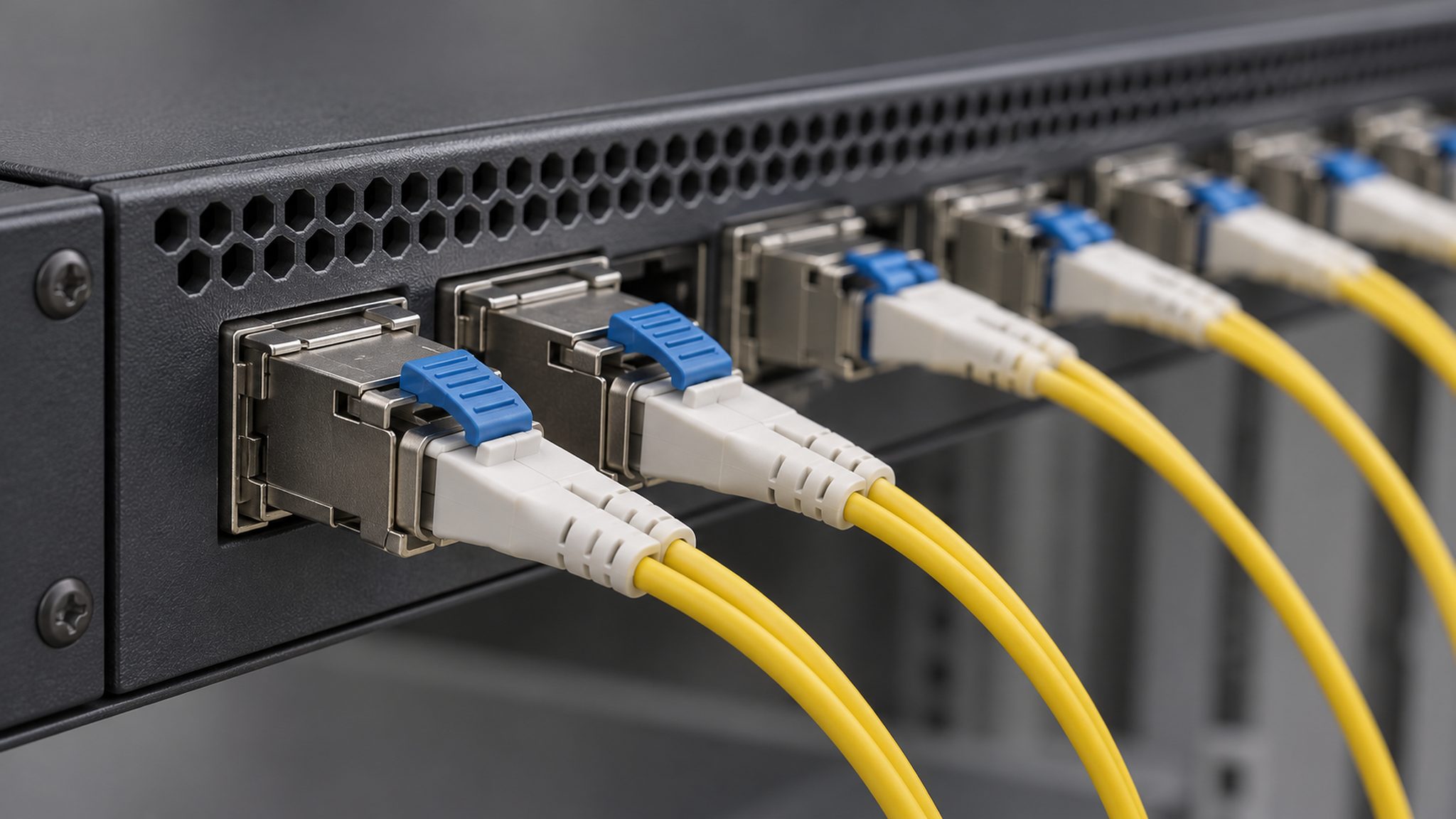
- The operators establish a point of interconnection where their networks exchange traffic. The physical interface at the end of an interconnection link is a port. A network can provide several such interfaces.
- The interconnection seeker needs its link terminated at the provider’s point of interconnection. The provider makes the port available and the seeker pays the applicable charge for that facility.
- The charging relationship runs between service providers. A subscriber reading a mobile bill cannot use the port ceiling to calculate the price of a call without knowing the terms of the retail plan.
- A physical connector helps locate the end of a link. Its appearance alone cannot establish the capacity agreed between operators or the annual charge in their interconnection agreement.
- Section 11(1)(b) of the TRAI Act, 1997 gives the regulator functions covering interconnection terms, technical compatibility and effective interconnection. A working connection depends on both compatible interfaces and agreed commercial terms.
How Do E1 and IP Ports Differ?
The older charging schedule addressed a standard unit of circuit capacity. The amendment adds a way to price interfaces of different packet-network capacities.
- An E1 link carries 2.048 megabits per second. Time-division multiplexing divides transmission time into recurring slots so several channels can share one digital connection.
- An IP network carries traffic in packets. Operators describe port capacity as a transmission rate, expressed in megabits or gigabits per second. That rate indicates how much traffic can pass in a given time.
- Two operators selecting a higher-capacity IP port can exchange more traffic through the interface. The annual ceiling refers to the capacity selected. Actual traffic can vary over the course of the year.
- When an operator continues to use an E1 port, the earlier E1 charging provisions apply. A network with both technologies must identify which interface an agreement covers before choosing the applicable schedule.
How Does an Annual Ceiling Work?
A ceiling sets the highest permissible charge for a specified port capacity and period. Operators retain room to negotiate within that limit.
- For a standard IP port, start with the agreed capacity and the applicable annual ceiling. An offer below that ceiling can be accepted by mutual agreement between the seeker and the provider.
- For a capacity outside the two specified sizes, the parties may agree on another IP-port capacity. They must determine its charge transparently using the same methodology applied to the specified ports.
- The IP-port provisions cover fixed-line, mobile and long-distance services, including international long-distance services. The type of service carried does not create a separate ceiling for the same stated IP-port capacity.
- A regulator examining a charge needs the effective date, interface type, port capacity and billing period. Comparing two invoice totals without these details can make a compliant charge appear excessive.
Way Forward
Document the Interface and the Price
- Record the technology and contracted capacity at each point of interconnection.
- Show how a negotiated charge relates to the applicable annual ceiling.
- Read the price provisions alongside the rules on enforcing interconnection agreements.
Conclusion
- The amendment matters because wholesale port pricing now accommodates a range of packet-network capacities while retaining an identifiable charging schedule for legacy circuit interfaces.
- In a regulatory problem, identify who supplies the port, who pays and what capacity the parties chose. Those facts establish the relevant price comparison before considering the services that use the connection.
UPSC Practice Questions
Prelims MCQ 1
With reference to TRAI’s November 2026 IP-port charge amendment, consider the following statements:
- The prescribed ceiling applies to a specified port capacity for a year.
- Operators may mutually agree to a charge below the ceiling.
- Earlier E1-port charges continue to apply to E1 ports.
How many of the above statements are correct?
(a) Only one (b) Only two (c) All three (d) None
Answer: (c) All three
Explanation:
The amendment sets capacity-specific annual ceilings for IP ports, permits lower negotiated charges and retains existing charges for E1 ports.
Prelims MCQ 2
Who pays the regulated port charge for terminating an interconnection link at the provider’s point of interconnection?
(a) The interconnection seeker (b) Each subscriber receiving a call (c) The telecom regulator (d) The spectrum auction administrator
Answer: (a) The interconnection seeker
Explanation:
The seeker pays the provider for the port facility used to terminate its link.
UPSC Mains Questions
- How can regulation of wholesale interconnection charges influence competition between telecom operators?
- Discuss the challenges of adapting telecom regulation during the transition from circuit-based to packet-based networks.
Source: PIB, Ministry of Communications.
Frequently Asked Questions
When do the new IP-port ceilings take effect?
TRAI issued the final amendment on 9 November 2026 and set 1 January 2027 as its effective date. The release gave operators advance notice of the new charging framework.
What distinguishes an E1 port from an IP port?
E1 is a digital interface with a standard capacity of 2.048 Mbps. An IP port carries packet traffic, with its transmission capacity expressed in Mbps or Gbps.
Can two operators agree on a different IP-port capacity?
Yes. The parties may agree to a capacity outside the two specified sizes and determine the charge transparently using the methodology applied to the standard capacities.
Does a mobile customer pay the annual port ceiling?
The interconnection seeker pays the provider for terminating its network link at the provider’s port. A mobile customer pays the retail charges applicable under the subscriber’s service plan.
Tell Google you want more of this.
Add Anantam IAS as a preferred sourceOne tap, and this site shows up more often in your own Top Stories, AI Overviews and AI Mode. Remove it any time.