Why in news?
PM2.5 in parts of Delhi crossed 150–200 times WHO limits after Deepavali, with data missing from several monitoring stations.
UPSC Relevance
Prelims: AQI, PM2.5/PM10, WHO Air Quality Guidelines, NCAP, CAQM, GRAP, SAFAR, green crackers, Pusa decomposer.
Mains, GS3 – Environmental pollution and degradation, conservation, agriculture (crop residue management).
Air Pollution
Air pollution is the presence of harmful substances in the air – gases, particles and biological matter – at levels that damage human health and the environment. The most dangerous pollutant for health is particulate matter (PM).
- PM10 – particles of 10 micrometres or less; mostly dust, enter the nose and throat.
- PM2.5 – fine particles of 2.5 micrometres or less (about 1/30th the width of a hair); enter deep into lungs and the bloodstream, causing heart and lung disease.
- Other pollutants – nitrogen dioxide (vehicles), sulphur dioxide (coal), carbon monoxide, ground-level ozone, ammonia and lead.
Standards at a glance (µg/m³)
| Pollutant | WHO Guidelines (2021) | Indian NAAQS (2009) |
|---|---|---|
| PM2.5 – 24 hours | 15 | 60 |
| PM2.5 – Annual | 5 | 40 |
| PM10 – 24 hours | 45 | 100 |
| PM10 – Annual | 15 | 60 |
India’s standards are much looser than WHO’s and have not been revised since 2009. This is why Delhi can be ‘moderate’ on the Indian scale while being many times above WHO limits.
National Air Quality Index (AQI)
Launched in 2014, the AQI turns data on eight pollutants (PM10, PM2.5, NO2, SO2, CO, O3, NH3 and Pb) into one number and colour. The CPCB’s daily bulletin at 4 p.m. gives the 24-hour average, which is taken as the day’s AQI.
| AQI range | Category |
|---|---|
| 0–50 | Good |
| 51–100 | Satisfactory |
| 101–200 | Moderate |
| 201–300 | Poor |
| 301–400 | Very poor |
| 401–500 | Severe |
Why Delhi Chokes Every Winter
Natural / meteorological factors
- Temperature inversion – in winter, a layer of warm air sits over cold surface air and traps pollutants close to the ground. The mixing height of the air falls sharply.
- Low wind speed – calm winds stop pollutants from dispersing.
- Wind direction – north-westerly winds after the monsoon carry smoke from stubble burning in Punjab and Haryana.
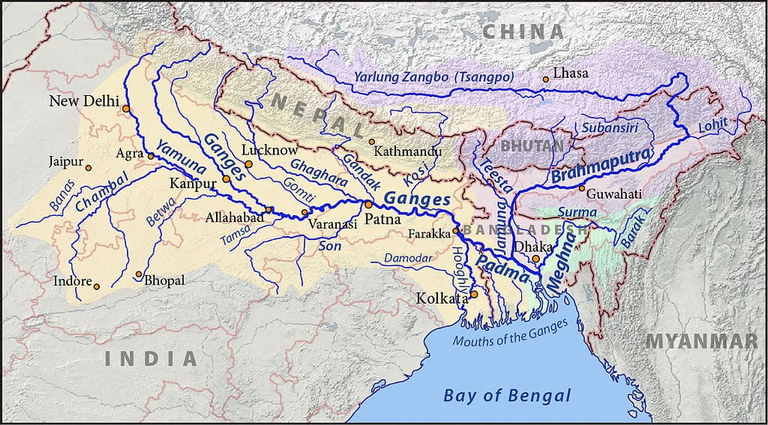
- Landlocked geography – Delhi lies in the Indo-Gangetic Plain, bounded by the Himalayas to the north, so pollution has no easy outlet.
- Fog and moisture – particles mix with moisture to form smog.
Man-made factors
- Vehicles – a major year-round source of PM2.5 and NO2; Delhi has one of the largest vehicle fleets in India.
- Road and construction dust – the IIT Kanpur source apportionment study (2016) found dust and vehicles among the biggest contributors to Delhi’s particulate pollution.
- Stubble burning – farmers burn paddy residue as the window before wheat sowing is short. Its share in Delhi’s PM2.5 varies daily – 5.1% on the day after Deepavali, but much higher on some peak days.
- Firecrackers – release PM, metals and sulphur in a few hours, when weather is already unfavourable.
- Industries and power plants – coal-based units in the NCR and nearby States.
- Biomass and waste burning – burning of garbage, wood and coal for heating and cooking.
Other issues
- Poor enforcement – firecrackers were burst well past the 10 p.m. deadline, and traditional crackers were sold despite the Supreme Court allowing only green crackers in fixed time windows.
- Data gaps – several Continuous Ambient Air Quality Monitoring Stations (CAAQMS) did not report data at the peak hours. Missing peak values make the average look better than the reality.
- Blame game – Delhi and Punjab governments blamed each other over missing data and stubble fires. Air pollution crosses State boundaries, so blame does not solve it – coordinated action does.
- Episodic response – the issue gets attention only in October–November, while the sources work all year.
Impact of Air Pollution
- Health – respiratory diseases, asthma, heart disease, stroke and lung cancer. A Lancet Planetary Health study estimated about 16.7 lakh deaths in India in 2019 due to air pollution.
- Children and elderly – most vulnerable; children breathe faster and their lungs are still developing.
- Economy – lost working days, medical costs, lower productivity and a negative image for investment and tourism.
- Agriculture and environment – stubble burning kills soil microbes and nutrients; ozone reduces crop yields.
- Inequality – the poor, outdoor workers and slum dwellers are most exposed and least protected.
Steps Taken
- BS-VI fuel norms – India leapfrogged from BS-IV to BS-VI in April 2020.
- Green crackers – developed by CSIR-NEERI; about 30% lower emissions; identified through a QR code.
- Crop residue management – subsidised machines like Happy Seeder and Super SMS; IARI’s Pusa decomposer turns stubble into manure; co-firing of biomass pellets in thermal plants.
- Clean energy – PM Ujjwala Yojana (LPG), FAME scheme for EVs, Eastern and Western Peripheral Expressways to divert trucks.
- Delhi measures – odd-even scheme, smog towers, anti-dust campaigns and green war rooms.
Global Good Practices
| City / Country | Practice |
|---|---|
| Beijing (China) | Air Pollution Action Plan (2013) – coal-to-gas shift, closing polluting industries, regional coordination; PM2.5 fell sharply within five years |
| London (UK) | Ultra Low Emission Zone (2019) – daily charge on polluting vehicles |
| Mexico City | ‘Hoy No Circula’ driving restrictions and a regional environmental commission |
| Los Angeles (US) | South Coast Air Quality Management District – single regional authority with strong powers |
Lesson: successful cities treated pollution as a regional, year-round problem with one empowered authority, clear targets and strict enforcement.
Way Forward
- Airshed approach – manage air quality across the whole Indo-Gangetic Plain, not city by city.
- Year-round action – shift from emergency GRAP measures to permanent control of vehicles, dust and industry.
- Transparent data – audit monitoring stations, publish raw data, and use satellites to fill gaps.
- Farmer-friendly solutions – crop diversification away from paddy, MSP support for alternate crops, and a market for stubble (biofuel, pellets, packaging).
- Revise NAAQS – bring Indian standards closer to WHO 2021 guidelines in a phased manner.
- Public transport and EVs – last-mile connectivity, more buses and electric mobility.
- Cooperative federalism – Centre, Delhi, Punjab, Haryana and UP must work together through CAQM instead of blame.
- Behaviour change – awareness on firecrackers, waste burning and the health cost of pollution.
Conclusion: Clean air is part of the right to life under Article 21. Delhi’s winter smog is not a seasonal accident but the result of year-round neglect. Science-based, regional and transparent governance is the only lasting answer.
Practice MCQ
Q1. Consider the following:
- Carbon monoxide
- Ammonia
- Lead
- Methane
- Ozone
How many of the above are included in the National Air Quality Index (AQI) of India?
(a) Only two (b) Only three (c) Only four (d) All five
Answer: (c). The AQI covers eight pollutants: PM10, PM2.5, NO2, SO2, CO, O3, NH3 and Pb. Methane is a greenhouse gas but is not part of the AQI.
Q2. With reference to the Commission for Air Quality Management (CAQM), consider the following statements:
- It is a statutory body for the National Capital Region and adjoining areas.
- It replaced the Environment Pollution (Prevention and Control) Authority (EPCA).
- Its directions are only advisory and not binding on State governments.
Which of the statements given above are correct?
(a) 1 and 2 only (b) 2 and 3 only (c) 1 and 3 only (d) 1, 2 and 3
Answer: (a). Statement 3 is incorrect. Under the CAQM Act, 2021, the Commission’s directions are binding, and non-compliance is punishable.
Mains Practice Question
Q. “Delhi’s winter air pollution is less a seasonal crisis and more a failure of year-round, regional governance.” Discuss the natural and man-made factors behind the problem and suggest an effective framework for clean air in the Indo-Gangetic Plain. (15 Marks, 250 words)
Tell Google you want more of this.
Add Anantam IAS as a preferred sourceOne tap, and this site shows up more often in your own Top Stories, AI Overviews and AI Mode. Remove it any time.