Why in News?
On 2 November, PIB reported an Indian-led study of ULX-8 whose long-term X-ray behaviour favours a stellar-mass black hole undergoing extreme accretion.
- The team used observations from Chandra, XMM-Newton and Swift spanning 2000–2024.
- The source remained highly luminous while its brightness varied over the observing period.
- PIB reports long-term spectral changes, without evidence of dramatic transitions between the accretion states commonly seen in many black-hole binaries.
- The finding connects gravity, radiation and matter inflow in an extreme physical environment.
- A bright source requires an explanation of its accretion conditions, rather than an automatic assumption of an exceptionally massive black hole.
UPSC Relevance
Prelims Relevance
- Ultraluminous X-ray source: a luminous compact-object system outside the central supermassive-black-hole category.
- Accretion: matter falling towards a compact object and releasing energy.
- Eddington limit: a classical gravity–radiation balance benchmark.
- X-ray spectrum: the distribution of detected emission across photon energies.
Mains Relevance
GS Paper 3
- Explain how long-term space observations test models of extreme astrophysical systems.
- Distinguish measured evidence from model-dependent identification of an unseen compact object.
Essay
- Scientific explanations improve when observations test the assumptions behind a familiar limit.
Background and Context
What Makes an X-Ray Source Ultraluminous?
ULX-8 illustrates how matter around a compact object can reveal a system whose central engine cannot be identified from brightness alone.
- Ultraluminous X-ray sources are exceptionally bright emitters in nearby galaxies, considered separately from emission associated with central supermassive black holes. The label describes their observed radiation rather than proving a particular central object.
- A neutron star or black hole can draw material from a companion star. Matter moving inward heats up and releases X-rays, so the detected radiation traces the surrounding accretion flow and its conditions.
- Accretion supplies a physical route from infalling matter to radiated energy. A black-hole interpretation concerns the object driving this process; it does not mean that the observed X-rays escape from inside the black hole.
- ULX-8 lies in the interacting NGC 4490/4485 galaxy system. Its continued high luminosity makes repeated observations useful for investigating how a compact source sustains an extreme flow rather than merely producing one brief flare.
- Brightness and spectral shape provide different information: one describes how strong the signal is, while the other describes its distribution across X-ray energies. Studying both constrains explanations more effectively than treating brightness as sufficient.

What Does the Eddington Limit Mean?
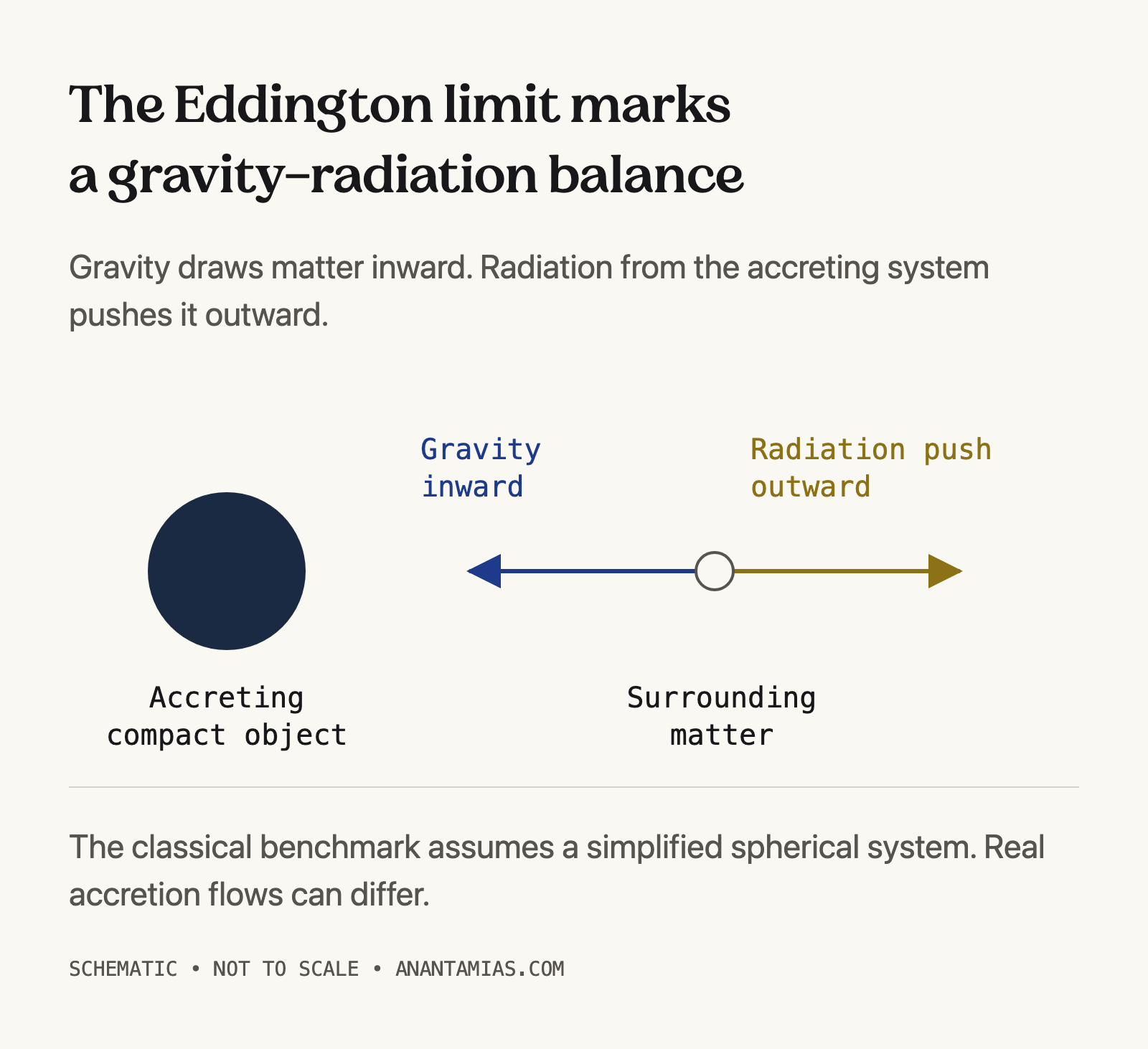
The classical benchmark compares gravity drawing matter inward with radiation exerting an outward push; interpreting an extreme source requires examining that balance.
- Gravity attracts surrounding matter towards the compact object. Radiation produced by the hot inflow can push matter outward, creating competing effects within the same system rather than two unrelated sources of energy.
- The Eddington limit expresses a simplified balance between these effects. It is a benchmark for interpreting an accreting source, rather than a direct measurement of the source’s mass obtained from its brightness alone.
- A source appearing unusually luminous raises questions about the accretion model used to interpret it. The observation calls for testing the model and its assumptions; it does not establish that gravity has ceased operating.
- Extreme accretion can involve powerful gas outflows and changing conditions around the central object. Researchers use observations to investigate those processes instead of assuming that every bright system contains the same kind of compact object.
- The useful comparison is between a classical benchmark and an observed system. A model provides an expectation; the measured spectrum and its evolution determine whether that expectation adequately describes this particular accretion environment.
What the ULX-8 Study Establishes
The reported result favours a physical interpretation, while leaving room for better measurements and closer tests of the accretion model.
- Long-term monitoring showed substantial brightness changes alongside continuing ultraluminous behaviour. This combination matters because a changing signal does not necessarily mean that the source repeatedly entered entirely different accretion states during the observed period.
- The reported spectral evolution supports changing accretion conditions. PIB presents a stellar-mass black hole as the most likely explanation, which should be described as an inference supported by observations rather than a directly measured identity.
- PIB uses both above-limit and near-limit descriptions in its account. The defensible takeaway is extreme accretion; the release does not justify a precise mass, a numerical excess, or an unconditional claim that a limit was violated.
- This question differs from Centaurus X-3 accretion-stream inference: here, persistent luminosity and spectral evolution frame the explanation. Results from one compact system cannot automatically identify the central object in another system.
- Proposed improvements in future observations remain prospective capabilities. As with satellite commissioning, the status of an instrument matters: expected performance should not be represented as evidence already obtained by an operational mission.
Way Forward
Test the Accretion Interpretation
- Extend monitoring to distinguish sustained behaviour from short-lived changes.
- Compare brightness and spectra across observations with their measurement limits stated.
- Use improved observations to test the compact-object interpretation, retaining uncertainty where competing explanations remain.
Conclusion
- ULX-8 connects an observable X-ray signal to an inferred compact engine through an accretion model. Its importance lies in testing how matter and radiation behave under extreme conditions, rather than simply labelling a source unusually bright.
- For an answer, explain the gravity–radiation balance, describe the long-term evidence, and state the inference cautiously. Brightness, mass and accretion behaviour are related questions, but the reported observation does not make them interchangeable quantities.
UPSC Practice Questions
Prelims MCQ 1
With reference to ultraluminous X-ray sources, consider the following statements:
- They may be powered by neutron stars or black holes accreting matter.
- The Eddington limit concerns a classical balance between gravity and radiation.
- High X-ray brightness alone conclusively establishes that the source contains a supermassive black hole.
How many of the above statements are correct?
(a) Only one (b) Only two (c) All three (d) None
Answer: (b) Only two
Explanation:
Statements 1 and 2 are correct. Brightness alone does not uniquely establish the mass or nature of the compact object.
Prelims MCQ 2
Why are repeated measurements of an X-ray source’s spectrum useful?
(a) They automatically reveal the exact mass of any black hole. (b) They eliminate the need for physical models. (c) They help test how accretion conditions evolve over time. (d) They establish that radiation has no effect on infalling matter.
Answer: (c) They help test how accretion conditions evolve over time.
Explanation:
Spectral evolution supplies information about the changing accretion environment. Interpretation still requires physical models and recognition of measurement limits.
UPSC Mains Questions
- Explain the Eddington limit and discuss why an unusually luminous X-ray source requires careful interpretation.
- How does long-term astronomical monitoring help distinguish observation from inference? Illustrate with the reported ULX-8 study.
Source: PIB, Department of Science and Technology.
Frequently Asked Questions
What is ULX-8?
NGC 4490 ULX-8 is an exceptionally luminous X-ray source studied in the NGC 4490/4485 galaxy system. The reported observations favour a stellar-mass black hole undergoing extreme accretion.
What is the Eddington limit?
It is a classical luminosity benchmark based on the balance between gravity attracting matter and radiation pushing it outward. Researchers use it to interpret accreting objects and test the assumptions of their models.
Does high brightness prove a supermassive black hole exists?
No. The observed brightness must be interpreted alongside the spectrum, its changes and the accretion model. Different compact objects and accretion conditions can produce powerful X-ray emission.
What did long-term monitoring contribute?
It revealed substantial brightness changes while ULX-8 remained highly luminous. Spectral changes provided evidence about evolving accretion conditions, helping researchers assess the likely nature of the compact object.
Tell Google you want more of this.
Add Anantam IAS as a preferred sourceOne tap, and this site shows up more often in your own Top Stories, AI Overviews and AI Mode. Remove it any time.