Constitution (131st Amendment) Bill, 2026 | Delimitation Bill, 2026 | Union Territories Laws (Amendment) Bill, 2026
| OUTCOME | The Constitution (131st Amendment) Bill, 2026 was DEFEATED in the Lok Sabha on April 17, 2026 — the first time in 12 years that a constitutional amendment bill brought by the Modi government failed to pass. 298 voted in favour; 230 against. Required: 352 votes (two-thirds of 528 present). The government then withdrew the Delimitation Bill and UT Laws Amendment Bill. |
PART I: Background — The Unfinished Promise
1.1 The Long Road of Women’s Reservation in India
The demand for legislative reservation for women in Parliament is one of the oldest unresolved democratic debates in post-independence India. Bills to reserve one-third of parliamentary seats for women were introduced and lapsed in 1996, 1998, 1999, and 2008 — each time dying due to political disagreement, particularly over whether Other Backward Class (OBC) women should have a sub-quota within the women’s reservation.
| Year | Bill / Development | Outcome |
|---|---|---|
| 1996 | Women’s Reservation Bill introduced in 11th Lok Sabha (Deve Gowda Govt) | Lapsed with dissolution of Lok Sabha |
| 1998 | Reintroduced under Vajpayee government | Lapsed |
| 1999 | Introduced again under Vajpayee | Lapsed |
| 2008 | Introduced in Rajya Sabha (Manmohan Singh Govt); passed in RS in 2010 | Lapsed with 15th Lok Sabha |
| 2023 | Constitution (106th Amendment) Act — Nari Shakti Vandan Adhiniyam — passed unanimously by both Houses | Received Presidential assent; but not notified into force — tied to post-Census delimitation |
| Apr 2026 | 3-Bill package introduced to operationalise 2023 Act | Defeated in Lok Sabha |
1.2 The 2023 Act and Its Structural Delay
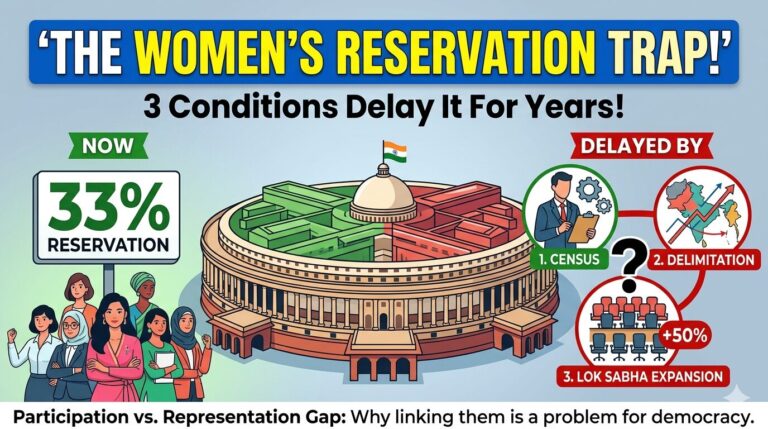
The Constitution (One Hundred and Sixth Amendment) Act, 2023 — known as the Nari Shakti Vandan Adhiniyam — was passed unanimously in September 2023. It amended Article 334A of the Constitution to provide for 33% reservation for women in the Lok Sabha and State Legislative Assemblies (including the Delhi Assembly). However, Section 1(2) of the Act tied its commencement to a separate government notification.
| CRITICAL | The 2023 Act explicitly made women’s reservation operative ONLY after: (i) the next Census is conducted and published, AND (ii) a delimitation exercise is carried out based on that Census. Since the 2021 Census was delayed (to 2026-27) due to COVID-19 and other administrative reasons, the 2023 Act remained a dead letter for three years — passed with fanfare but never implemented. |
On April 16, 2026 — the first day of the special session — the Union government issued a notification under Section 1(2) bringing the 2023 Act formally into force. On the same day, it introduced three new bills in the Lok Sabha to enable implementation of the Act through a revised delimitation framework.
PART II: The Three Bills — Provisions in Detail
2.1 Overview of the Package
The Union government introduced the three bills as a coordinated legislative package on April 16, 2026, during a specially convened session of Parliament. The bills were presented as necessary to operationalise the 2023 women’s reservation law ahead of the 2029 General Elections, by bypassing the requirement to wait for the delayed post-2021 Census and conducting delimitation on the basis of the 2011 Census instead.
| Bill | Introduced by | Core Purpose |
|---|---|---|
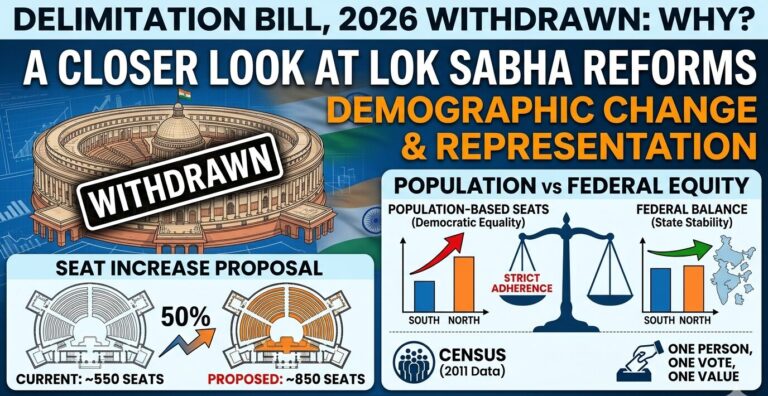
| Constitution (131st Amendment) Bill, 2026 | Home Minister Amit Shah | Expand Lok Sabha to 850 seats; remove Census freeze; enable immediate delimitation; link women’s reservation to this delimitation |
| Delimitation Bill, 2026 | Law Minister Arjun Ram Meghwal | Replace Delimitation Act 2002; constitute new Delimitation Commission to redraw constituencies using 2011 Census data |
| Union Territories Laws (Amendment) Bill, 2026 | Home Minister Amit Shah | Extend same changes to Delhi, Puducherry, and Jammu & Kashmir |
2.2 Constitution (131st Amendment) Bill, 2026 — Detailed Provisions
A. Expansion of Lok Sabha Strength
- Current cap: Article 81 limits Lok Sabha to a maximum of 550 members (530 from States + 20 from UTs)
- Proposed cap: Maximum of 850 members — up to 815 from States and up to 35 from Union Territories
- Practical effect: A near 57% increase in House strength — the largest expansion in India’s parliamentary history. Aligns with the seating capacity of the new Parliament building (888 seats, expandable to 1,272 for joint sittings)
B. Removal of the 1971 Census Freeze on Seat Allocation
This is constitutionally the most consequential change. Since the 84th Constitutional Amendment (2001), Article 81 froze inter-state seat distribution on the basis of the 1971 Census, until the first Census after 2026. This was done to protect states that had successfully controlled population growth from losing parliamentary seats as a consequence.
- The Bill removes this freeze entirely. It allows Parliament to pass a simple law determining (i) when delimitation will be done, and (ii) which Census data will be used.
- Implication: Parliament — i.e., the government of the day — gains the power to decide both the timing of delimitation and the demographic baseline, through a simple majority. This replaces a constitutionally entrenched protection that previously required a two-thirds majority to alter.
C. Amendment of Article 82 — Delimitation No Longer Mandatory After Every Census
Under the existing constitutional scheme, Article 82 mandates that delimitation must occur after every Census. The Bill severs this link — delimitation becomes a discretionary legislative act rather than a constitutional obligation.
D. Amendment of Article 334A — Women’s Reservation Linked to New Delimitation
- The 2023 Act (106th Amendment) had tied women’s reservation to a post-Census delimitation.
- The 131st Amendment Bill rewrites Article 334A to link commencement of women’s reservation to the new delimitation exercise being proposed — i.e., the 2011 Census-based delimitation.
- Government’s stated target: Implement 33% women’s reservation in time for the 2029 Lok Sabha elections.
E. Knock-on Effects on Other Constitutional Provisions
- Rajya Sabha power imbalance: Rajya Sabha remains capped at 250 seats under Article 80, which the Bill does not amend. With Lok Sabha expanding to 850, the LS:RS ratio changes from 2.2:1 to 3.3:1. In a joint sitting (Article 108), a government with 56% of Lok Sabha seats could override even a two-thirds Rajya Sabha majority.
- Council of Ministers size: Article 75 caps Ministers at 15% of Lok Sabha strength. At 850 seats, the permissible Cabinet size rises from 81 to 127 ministers — potentially enabling larger political patronage networks.
- Presidential/VP elections: Expanded Lok Sabha alters the electoral college for President and Vice-President, reducing the relative weight of Rajya Sabha and state assemblies.
2.3 Delimitation Bill, 2026
This Bill operationalises the constitutional changes proposed in the 131st Amendment. It replaces the Delimitation Act, 2002 and constitutes a fresh Delimitation Commission.
- Delimitation Commission: Chaired by a serving or former Supreme Court judge; includes the Chief Election Commissioner or a nominated Election Commissioner as a member.
- Census basis: Uses the ‘latest published Census figures’ — which as of April 2026 means the 2011 Census, since the 2026-27 Census exercise has not yet concluded.
- Allocation of seats: Proportional to population — reverts to ‘one person, one vote, one value’ principle, directly triggering seat shifts between States.
- Reservation determination: Commission also determines SC/ST reserved seats and women’s reserved seats within constituencies.
- Accountability gap: Critics note the Bill provides no formula or allocation mechanism for distributing additional seats across states — leaving a significant policy vacuum for political discretion.
2.4 Union Territories Laws (Amendment) Bill, 2026
This Bill amends three laws — the Government of Union Territories Act 1963, the Government of National Capital Territory of Delhi Act 1991, and the Jammu & Kashmir Reorganisation Act 2019 — to extend the same delimitation and women’s reservation framework to Delhi, Puducherry, and Jammu & Kashmir.
PART III: Arguments in Favour
3.1 The Government’s Position
The ruling National Democratic Alliance, led by the BJP, and Home Minister Amit Shah presented the bills as a historic step for gender justice and democratic modernisation. The government’s core arguments:
Gender Justice — Implementing the Promise
- The 2023 Nari Shakti Vandan Adhiniyam was passed unanimously — there is political consensus on 33% women’s reservation. The 3-bill package is simply the mechanism to implement it.
- India currently has only about 15% women in Lok Sabha — well below the global average of 27% and far behind countries like Rwanda (61%), Iceland (48%), and Sweden (46%).
- The only practical way to operationalise the 2023 Act before the 2029 elections — without waiting for the delayed Census — is the route proposed in these Bills.
Constitutional Principle of One Person, One Vote
- Since 1971, India has not redistributed Lok Sabha seats between States. In 50 years, massive population disparities have emerged — some constituencies in UP have 4x the voters of a constituency in Kerala.
- Amit Shah: ‘For 50 years, from 1976 to 2026, India did not get representation as per the population. This is a constitutional injustice that must be corrected.’
- Proportional representation is a foundational democratic norm. States like UP, Bihar, Rajasthan have been under-represented for decades relative to their populations.
Larger Lok Sabha = Better Democracy
- An 850-seat Lok Sabha would reduce the population-per-constituency ratio, making MPs more accountable to smaller constituents.
- The new Parliament building was built with 888 seats precisely anticipating this expansion. A larger House enables more diverse voices, including more women.
- In absolute terms, every state gains more seats under the expanded House even if proportional shares shift.
Gainers Among Southern States — Counter to ‘South India Loses’ Narrative
- Shah argued: Tamil Nadu would go from 39 to 59 seats under the expansion. Even if its proportional share slightly decreases, it gains 20 seats in absolute terms, of which 20 would be reserved for women.
- South Indians would have more women MPs in absolute numbers under the new scheme than under the status quo.
- North-South divide framing by the opposition was characterised by the government as ‘manufactured’ and ‘misleading’.
Expediting the Frozen Process
- The 2021 Census was delayed by COVID-19. If India waits for the post-2021 Census and then conducts delimitation, women’s reservation cannot practically commence before 2034-2035 — five election cycles away.
- The 2011 Census, though 15 years old, is the latest complete, verified data and is constitutionally valid as ‘latest Census’.
- The government framed delay as the real injustice — not expediting the process.
PART IV: Arguments Against — Opposition Parties & Scholars
4.1 Rahul Gandhi (Congress — Leader of Opposition, Lok Sabha)
| Rahul Gandhi — Leader of Opposition, Lok Sabha |
| “This bill is not a women’s bill. It has nothing to do with the empowerment of women. This is an attempt to change the country’s electoral map, using and hiding behind India’s women.”Called the constitutional amendment an ‘anti-national act’ — one that would strip representation from southern, north-eastern and smaller statesArgued the government was using women’s reservation as a ‘Trojan horse’ to reshape India’s parliamentary geography in the BJP’s political interestNoted that the 2023 Women’s Reservation Act was passed unanimously — the opposition supports it. But these Bills go far beyond that ActCharged that the bills were designed to delay caste-based census demands by creating a diversion — ‘using women to deny OBCs their rights’Offered to pass the original 2023 Act for immediate implementation if the government separated it from the delimitation packageLikened PM Modi to ‘a failed magician’ trying to mislead the public, citing that both Indira Gandhi and Vajpayee had chosen caution over haste on delimitation |
4.2 Other Prominent Opposition Voices
| DMK / Tamil Nadu Block — Penalising Demographic Success |
| “Empowering women is a cause we all support, but using it as a Trojan horse to diminish the voice of the South is an affront to our federal structure.”Tamil Nadu’s seats would decline from 39 to 32 under 2011 Census-based proportional allocation (PRS data). Kerala from 20 to 15.Southern states achieved the Centre’s family planning goals — they are being punished for demographic discipline by losing parliamentary seatsUP, Bihar, Rajasthan — which have higher fertility rates — would gain disproportionately, skewing national policy towards northern demographicsTamil Nadu CM MK Stalin had earlier described any such delimitation as ‘constitutional murder of southern states’ |
| Samajwadi Party / OBC bloc — No Sub-Quota for OBC Women |
| The bills do not carve out a sub-quota for women belonging to OBC communities within the 33% women’s reservation.OBC women constitute the single largest social group excluded from legislative representationThe 2023 Act only reserves within SC/ST categories; OBC women get no guaranteed seatsSP’s Swami Prasad Maurya had termed the 2023 Act ‘flawed’ for this reason — the same flaw is replicated in the 2026 packageOBC demands for political reservation have been pending since the Mandal Commission; bundling delimitation with women’s reservation sidesteps this demand |
| INDIA Bloc — Procedural & Timing Objections |
| The government rushed three transformative bills through a special session without committee scrutiny, consultation with states, or broad public debate.A proper Census (2026-27) is already underway — why use 15-year-old 2011 data when fresh data will be available within a year?No standing committee referral; no consultation with state governments whose representation would be fundamentally alteredThe Bills were introduced on Day 1 of a special session and pushed for vote on Day 2 — insufficient time for democratic deliberation on the largest constitutional restructuring since 1950Bihar CM Nitish Kumar (NDA ally) had earlier questioned the delayed implementation of the 2023 Act — ironically, the 2026 package still defers actual reservation to 2029Kapil Sibal (earlier had sought assurance of implementation by 2029 for the 2023 Act) — now noted the opposition had always supported women’s reservation; the issue was the package around it |
PART V: Scholarly & Constitutional Analysis
5.1 The Federalism Problem — Constitutional Law Scholars
Constitutional Law and Philosophy (academic blog — ‘Reshaping Federalism in the Name of Women’): The blog authored an influential pre-vote analysis arguing that the 131st Amendment is, in its core design, a delimitation bill masquerading as a women’s reservation bill. A close reading of the bill dispels any notion that it is primarily about women’s reservation.
- The Bill’s primary operative provision is the deletion of the proivso in Articles 81 and 82 — the freeze protecting southern states from losing seats due to successful population control. This is the single largest change to Indian parliamentary design in the nation’s history.
- The government’s assurance that ‘southern states will not lose seats’ appears nowhere in the Bill text itself. The constitutional default under Art 81(2) — which the Bill reverts to — mandates proportional seat distribution, which automatically advantages fast-growing northern states.
- Giving Parliament the power to decide WHEN to delimitate and ON WHAT CENSUS DATA — through a simple majority — effectively converts a constitutionally protected process into a government-controlled one. Future ruling coalitions could game electoral boundaries to their advantage.
5.2 PRS Legislative Research — Structural Concerns
PRS Legislative Research, India’s foremost parliamentary research body, documented the following structural issues:
| Concern | Detail |
|---|---|
| Rajya Sabha power erosion | Lok Sabha: RS ratio shifts from 2.2:1 to 3.3:1; government with 56% LS seats can override 2/3rd RS majority in joint sittings under Art 108 |
| Cabinet expansion risk | Art 75 cap rises from 81 to 127 ministers — potentially enabling larger patronage coalitions |
| Presidential election skew | Expanded LS alters electoral college, reducing relative weight of RS and State Assemblies |
| No seat allocation formula | Delimitation Bill provides no formula for distributing seats across states — gap between political assurance and legal architecture |
| Discretionary delimitation | Parliament given power to determine timing + census used — risks political misuse of electoral boundary-drawing |
5.3 The ‘Penalising Demographic Success’ Argument
Academic economists and political scientists — drawing on similar debates in the United States over Congressional reapportionment — have highlighted India’s peculiar dilemma: the Constitution simultaneously mandates ‘one person, one vote’ (requiring proportional representation) and makes implicit promises to states about maintaining their political voice. These two principles are in irreconcilable tension when States have vastly different population growth rates.
| State | Current Seats (1971 basis) | Seats under 2011 Pop. (est.) | Change |
|---|---|---|---|
| Uttar Pradesh | 80 | 89 | ▲ +9 |
| Bihar | 40 | 46 | ▲ +6 |
| Rajasthan | 25 | 30 | ▲ +5 |
| Tamil Nadu | 39 | 32 | ▼ −7 |
| Kerala | 20 | 15 | ▼ −5 |
| Andhra Pradesh | 25 | 22 | ▼ −3 |
| Karnataka | 28 | 27 | ▼ −1 |
| West Bengal | 42 | 41 | ▼ −1 |
Note: These are indicative estimates under unchanged Lok Sabha strength. Even with the proposed expansion to 850 seats, the proportional share of southern states would decline relative to northern states. The absolute seat gain does not compensate for reduced federal bargaining power in the House.
5.4 The OBC Women Question — Social Justice Scholars
Social policy scholars — and parties like the Samajwadi Party and BSP — have consistently argued that a blanket 33% reservation for women, without a sub-quota for OBC women, entrenches elite capture of the reserved seats. Evidence from State Assembly elections shows that women elected from general or upper-caste-dominated parties tend to be from privileged socioeconomic backgrounds.
- The 2023 Act contains SC/ST sub-quotas within the 33% — but no OBC sub-quota
- OBC women are estimated to constitute 40-45% of all Indian women, yet have virtually no guaranteed political representation
- Zoya Hasan (political scientist) and others have argued that women’s reservation without social diversification within the category reproduces existing inequalities
- The 131st Amendment Bill inherits this flaw without addressing it
PART VI: The Defeat — What Happened on April 17, 2026
6.1 The Vote
| Parameter | Numbers |
|---|---|
| Total members present | 528 |
| Votes in favour (Ayes) | 298 |
| Votes against (Noes) | 230 |
| Required for constitutional amendment (2/3 of present & voting) | ~352 |
| Shortfall | ~54 votes |
| Result | BILL DEFEATED |
The Constitution (131st Amendment) Bill required a two-thirds majority of members present and voting under Article 368 of the Constitution — the procedure for constitutional amendments. The NDA did not have this supermajority on its own and required opposition support. The united opposition, led by the INDIA bloc, voted en masse against, denying the government the numbers.
| HISTORIC | This was the first time in 12 years — since the Modi government took office in 2014 — that a constitutional amendment it brought failed to pass Parliament. Prime Minister Modi was present in the House when the Bill fell. |
6.2 Amit Shah’s Response
In his closing speech before the vote, Home Minister Amit Shah made a sharp political attack on the opposition, accusing the Congress and its allies of stalling women’s reservation for the ‘fifth time’. He warned: ‘Be ready to face the wrath of women.’ Shah rejected the opposition’s three concerns — North-South divide, OBC rights, and caste census — as ‘false narratives’. He also challenged the DMK directly with seat arithmetic, arguing Tamil Nadu would gain more women MPs in absolute terms under the expanded House.
6.3 Withdrawal of the Other Two Bills
After the 131st Amendment Bill fell, the government withdrew the Delimitation Bill, 2026 and the Union Territories Laws (Amendment) Bill, 2026 from consideration. Since the constitutional amendment (which was the enabling framework for both bills) had failed, the government acknowledged the other two bills could not proceed independently.
| AFTERMATH | The 2023 Women’s Reservation Act (106th Amendment) remains in force — it was notified into force on April 16, 2026 — but remains unimplementable without census and delimitation. Women’s reservation thus continues to be a constitutional promise without operational effect. The political battle is expected to resume with the next government, or after the 2026-27 Census is completed. |
PART VII: Critical Analysis — What Does This Mean for Indian Democracy?
7.1 Women’s Representation — A Genuine Commitment or Instrument of Politics?
The defeat of the bills leaves India in a peculiar situation: a law reserving one-third of parliamentary seats for women exists in the Constitution, has been notified into force, but has no practical machinery to implement it. Both the government and the opposition claim to support women’s reservation — yet it remains unrealised. The episode reveals the challenge of separating genuine gender equity goals from competitive electoral politics.
7.2 The Federal Bargain — India’s Constitutional Moment
The 1976 and 2001 freezes on seat distribution were exercises in political statesmanship — recognising that strict population-proportionality would destroy the political incentive for states to control population growth and would corrode the voice of smaller, better-governed southern states. The 131st Amendment proposed to undo this bargain through a simple parliamentary majority rather than genuine federal consensus. The defeat may ultimately preserve the constitutional compact between the Union and its southern states.
7.3 Institutional Design — Lowering the Bar for Delimitation
The scholarly critique that the Bill gave Parliament discretionary control over both the timing of delimitation and the census data used is perhaps its deepest structural flaw. Delimitation — the drawing of electoral boundaries — is inherently a process vulnerable to gerrymandering. Constitutionally mandated delimitation after every census, using that census’s data, is a protection against political manipulation. The Bills would have replaced this objective trigger with a subjective, majority-controlled one.
7.4 The Way Forward
- Option A: Wait for 2026-27 Census; conduct delimitation after Census is published; implement 2023 Act as originally designed.
- Option B: Bring a narrower bill that ONLY amends Article 334A to allow women’s reservation without linking it to a new delimitation — i.e., implement 33% on existing constituencies. This would require a two-thirds majority but would not provoke the federal and federalism objections.
- Option C: Political parties voluntarily give 33% of their candidate tickets to women — as many democracies have achieved parity through party-level commitments rather than constitutional mandates.
- Option D: Include OBC sub-quota within women’s reservation to build broader political consensus — this was the demand that has blocked women’s reservation since 1996.
PART VIII: Quick Reference & Exam Revision
8.1 Key Facts at a Glance
| Parameter | Fact |
|---|---|
| Bills introduced | April 16, 2026 (Special Session of Parliament) |
| Bills voted on | April 17, 2026 |
| 131st Amendment — Lok Sabha seats proposed | 543 → 850 (up to 815 States + 35 UTs) |
| Articles amended by 131st Bill | Art. 81, 82, 170, 334A + SC/ST reservation articles |
| Census proposed for delimitation | 2011 Census (not 2021/2026-27) |
| Women’s reservation target | 33% (one-third) — operationalising 106th Amendment Act, 2023 |
| Target implementation year | 2029 Lok Sabha elections |
| Votes in favour / against | 298 / 230 (required 352 — two-thirds majority) |
| Result | DEFEATED — first CAB failure by Modi govt in 12 years |
| Subsequent action | Delimitation Bill 2026 + UT Laws Amendment Bill 2026 WITHDRAWN |
| Tamil Nadu seats — current | 39 (would decline to 32 under proportional 2011 census allocation) |
| Kerala seats — current | 20 (would decline to 15 under proportional 2011 census allocation) |
| Rajya Sabha — unchanged | Still capped at 250 (Article 80 not amended) |
8.2 Constitutional Articles at Centre of Debate
| Article | Subject | Role in Debate |
|---|---|---|
| Art. 81 | Composition of Lok Sabha — seat allocation by state | Proposed to be amended to remove 1971 Census freeze |
| Art. 82 | Readjustment of constituencies after each Census | Proposed to be renamed + made discretionary (Parliament decides) |
| Art. 170 | Composition of State Legislative Assemblies | Consequential amendment to change census basis |
| Art. 334A | Reservation for women in legislatures | Proposed to link to new delimitation; operative after 2011 census delimitation |
| Art. 368 | Procedure for Constitutional Amendment | Required two-thirds majority — the threshold the bill failed to cross |
| Art. 108 | Joint sitting of Parliament | Rajya Sabha powers diminished by proposed LS:RS ratio shift |
| Art. 80 | Composition of Rajya Sabha | Notably NOT amended — creating the institutional power imbalance |
8.3 Timeline — Women’s Reservation in India
| Year | Event |
|---|---|
| 1996 | First Women’s Reservation Bill introduced; lapsed |
| 1998-1999 | Reintroduced twice; both lapsed |
| 2008 | Introduced in RS; passed in 2010; lapsed with 15th Lok Sabha |
| Sep 2023 | Constitution (106th Amendment) Act — Nari Shakti Vandan Adhiniyam — passed unanimously; tied to post-Census delimitation |
| Apr 16, 2026 | 106th Amendment notified into force (Section 1(2) notification); three new bills introduced |
| Apr 17, 2026 | 131st Amendment Bill defeated (298 Ayes, 230 Noes); Delimitation Bill + UT Bill withdrawn |
| 2026-27 (ongoing) | 2026-27 Census underway — expected to provide the data for future delimitation |
| 2029 (targeted) | Government’s stated target for women’s reservation commencement — now in doubt |
Tell Google you want more of this.
Add Anantam IAS as a preferred sourceOne tap, and this site shows up more often in your own Top Stories, AI Overviews and AI Mode. Remove it any time.