
Cyber Kidnapping Cases: Types, Prevention & Laws
Cyber kidnapping doesn’t require anyone to physically grab a person. It’s a crime where offenders use digital deception to make victims — or their families — believe someone is being held against their will. And the financial damage is real: Indian families have paid lakhs to voices on the phone who claimed to be kidnappers, only to find their loved ones were sitting safely in a café the whole time.
For UPSC, this topic sits squarely in GS Paper III under internal security, cyber crime, and challenges to law enforcement.
What Is Cyber Kidnapping?
Cyber kidnapping is a form of virtual extortion where criminals use phone calls, social media, or digital manipulation to convince a victim’s family that their relative has been kidnapped. No physical abduction takes place. The “victim” is often coached, coerced, or simply unaware while the perpetrators extort money from panicked relatives.
The term also covers broader digital crimes where personal data, identity, or digital assets are effectively “held hostage” — but the dominant usage in law enforcement contexts refers to virtual extortion schemes.
How a Typical Scheme Works
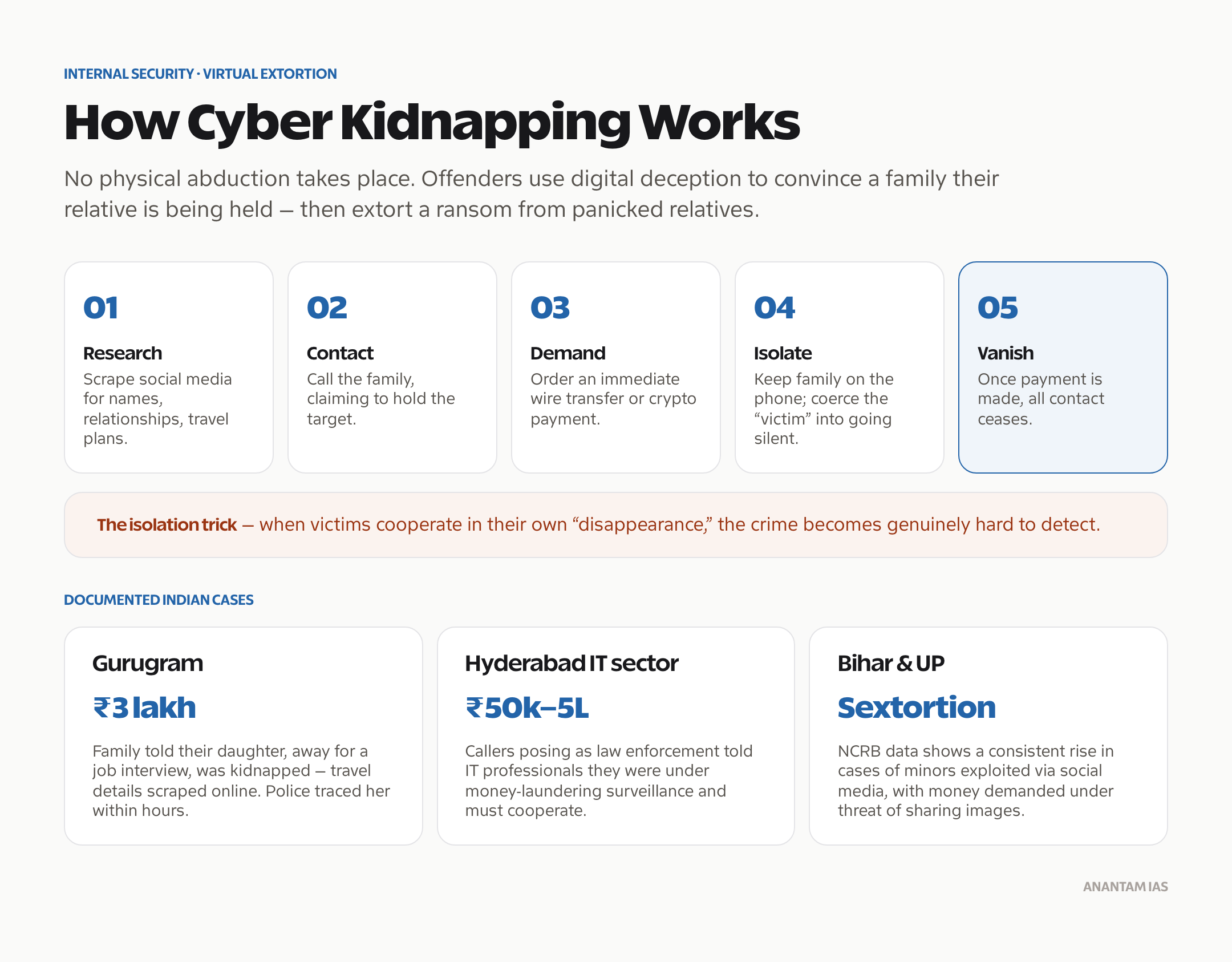
- Criminals research a target on social media to gather personal details (names, relationships, travel plans)
- They contact the family, claiming to hold the target
- They demand immediate wire transfer or cryptocurrency payment
- They instruct the family to stay on the phone and not contact police
- The “victim” is sometimes coerced into isolating themselves (checking into a hotel, going silent on social media) to make the story credible
- Once payment is made, contact ceases
The isolation element is what separates sophisticated cyber kidnapping from simple phone fraud. When victims cooperate in their own “disappearance,” the crime becomes genuinely hard to detect.
Types of Cyber Kidnapping
| Type | Description | Primary Target |
|---|---|---|
| Virtual/Simulated Kidnapping | No physical abduction; family is deceived by phone/digital communication | Families of travellers, students abroad |
| Sextortion-based Kidnapping | Victim coerced using compromising images; threatened with release unless ransom paid | Young adults, professionals |
| Digital Identity Kidnapping | Account takeover or identity theft used to ransom digital assets | Businesses, social media influencers |
| Ransomware Kidnapping | Critical systems or data encrypted until ransom is paid | Hospitals, government agencies, corporations |
| Child Cyber Exploitation | Children lured online, groomed, then virtually held over fabricated or real compromising material | Minors |
| Corporate Data Hostage | Sensitive business data exfiltrated and held for ransom (double extortion) | Enterprises, MSME sector |
Virtual Kidnapping vs Physical Kidnapping
Virtual kidnapping is in many ways harder to prosecute than physical kidnapping. There’s no crime scene, no forensic evidence of restraint, and the “victim” was never in danger. Law enforcement has to prove digital fraud across jurisdictions — often international — where evidence trails go cold fast.
Real Cases of Cyber Kidnapping
The Utah Case (2023) — International Significance for UPSC
In December 2023, a Chinese student studying in Utah, USA, was found hiding in the woods after being coerced by people posing as Chinese government officials. The perpetrators told him his identity had been “compromised” and instructed him to isolate himself, send disturbing photos to his parents, and go silent. His parents paid a ransom. This case drew global attention and is frequently cited in UPSC current affairs contexts because it showed how coordinated Chinese cyber crime syndicates operate internationally.
Indian Cases
Gurugram, 2022: A family in Gurugram received a call claiming their daughter (who was in Bengaluru for a job interview) had been kidnapped. The caller had details of her travel — likely scraped from social media. The family transferred ₹3 lakhs before contacting police, who tracked down the daughter within hours.
Hyderabad IT Sector, 2021: Multiple cases involving IT professionals where callers posed as law enforcement. Victims were told they were under surveillance for money laundering and must cooperate or face arrest. Several paid between ₹50,000 and ₹5 lakhs.
Sextortion Cases, Bihar and UP: NCRB data shows a consistent rise in sextortion cases involving minors being exploited via social media platforms, with perpetrators demanding money under threat of sharing images — a form of digital coercive control.
Legal Framework: IT Act 2000
The Information Technology Act, 2000 is the primary legislation governing cyber crimes in India. It was substantially amended in 2008 (IT Amendment Act, 2008) to add more cyber crime provisions.
Key Sections Relevant to Cyber Kidnapping
| Section | Provision | Punishment |
|---|---|---|
| Section 43 | Unauthorised access to computer systems | Civil penalty up to ₹1 crore |
| Section 66 | Computer-related offences (hacking) | Up to 3 years imprisonment or ₹5 lakh fine |
| Section 66C | Identity theft | Up to 3 years imprisonment and ₹1 lakh fine |
| Section 66D | Cheating by personation using computer resource | Up to 3 years imprisonment and ₹1 lakh fine |
| Section 67 | Publishing obscene material electronically | Up to 3 years and ₹5 lakh fine (first offence) |
| Section 67B | Child pornography and sexual content involving minors | Up to 5 years and ₹10 lakh fine (first offence) |
| Section 72 | Breach of confidentiality and privacy | Up to 2 years or ₹1 lakh fine |
Limitations of the IT Act
The IT Act was designed primarily for the 2000-era internet. It doesn’t adequately address:
- Cryptocurrency-based ransom transactions
- Cross-border cyber crimes involving foreign nationals
- AI-generated deepfake content used in sextortion
- Social media platform liability for enabling predatory behaviour
IPC Provisions for Cyber Kidnapping
The Indian Penal Code (IPC) provisions — now subsumed under the Bharatiya Nyaya Sanhita (BNS), 2023 — apply alongside the IT Act.
| IPC Section (old) | BNS Equivalent | Offence | Relevance to Cyber Kidnapping |
|---|---|---|---|
| Section 383-389 | Sections 308-312 BNS | Extortion | Direct application — demanding money through threats |
| Section 384 | Section 308 BNS | Punishment for extortion | Up to 3 years imprisonment |
| Section 385 | Section 309 BNS | Putting person in fear for extortion | Applies to phone threat calls |
| Section 366A | Section 94 BNS | Procuration of minor girl | Child cyber exploitation |
| Section 507 | Section 351 BNS | Criminal intimidation by anonymous communication | Applies to anonymous cyber threats |
| Section 420 | Section 318 BNS | Cheating | Phone fraud element of virtual kidnapping |
| Section 468 | Section 336 BNS | Forgery for purpose of cheating | Fake digital communication |
The combination of IT Act + BNS provisions allows prosecution on multiple counts — which is important because cyber kidnapping typically involves fraud, extortion, identity misuse, and intimidation simultaneously.
CERT-In: India’s Cyber Emergency Response
The Computer Emergency Response Team — India (CERT-In) operates under the Ministry of Electronics and Information Technology (MeitY). It’s the nodal agency for responding to cyber security incidents.
CERT-In’s Role in Cyber Crime Response
- Issues advisories on emerging threats (including scam call patterns, vishing attacks)
- Coordinates response with state police cyber cells and the National Cyber Crime Reporting Portal (NCRP)
- Works with international CERTs under the Global Forum of Incident Response and Security Teams (FIRST)
- Can direct intermediaries to preserve digital evidence under the IT Act
- Under the CERT-In Directions 2022, all organisations must report cyber incidents within 6 hours of becoming aware
The 2022 CERT-In Directions — Controversy
The April 2022 CERT-In directions mandated:
- Reporting of incidents within 6 hours (stricter than most global norms)
- Mandatory log retention for 180 days
- VPN providers to maintain user data for 5 years
Privacy advocates and tech companies objected to VPN data retention as invasive. Several international VPN providers withdrew their India-based servers rather than comply. This tension between security mandates and privacy rights is a live UPSC debate.
India’s Cyber Security Framework
Institutional Architecture
| Institution | Role |
|---|---|
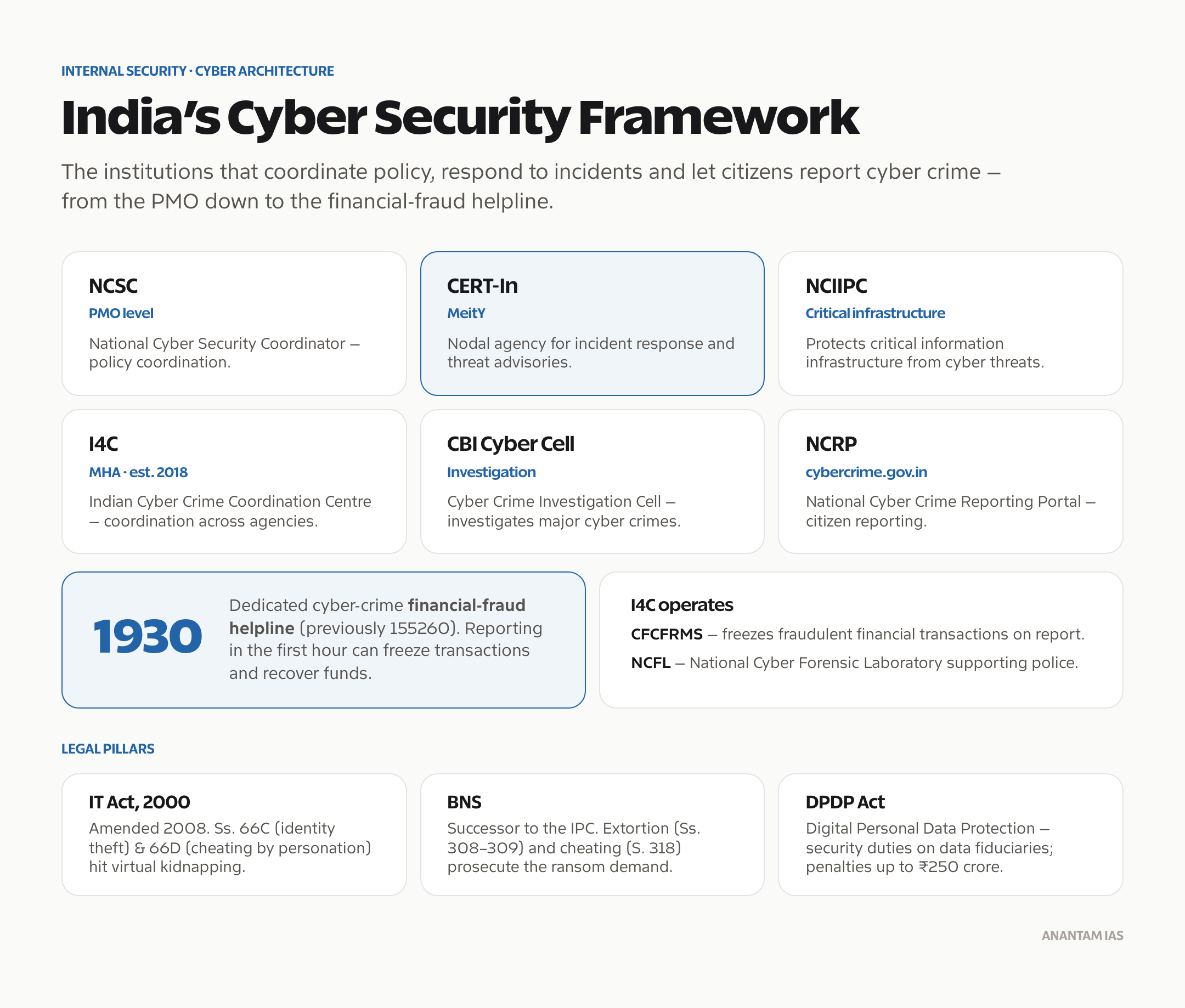
| National Cyber Security Coordinator (NCSC) | Policy coordination at PMO level |
| CERT-In (MeitY) | Incident response, advisories |
| NCIIPC (National Critical Information Infrastructure Protection Centre) | Protects critical infrastructure from cyber threats |
| Cyber Crime Investigation Cell (CBI) | Investigates major cyber crimes |
| National Cyber Crime Reporting Portal (cybercrime.gov.in) | Citizen reporting |
| I4C (Indian Cyber Crime Coordination Centre) | Coordination across agencies |
National Cyber Security Policy 2013
India’s foundational cyber security policy document. Key objectives:
- Build a secure and resilient cyber ecosystem
- Create 24×7 incident response mechanisms
- Develop 500,000 cyber security professionals by 2018 (target not fully met)
- Establish CERT-In as the national agency
A new National Cyber Security Strategy has been in draft for years — its finalization remains a policy gap.
I4C: The Coordination Hub
The Indian Cyber Crime Coordination Centre (I4C), established in 2018 under MHA, coordinates cyber crime response across India. It operates:
- Citizen Financial Cyber Fraud Reporting and Management System (CFCFRMS) — allows immediate reporting of financial fraud to freeze transactions
- National Cyber Forensic Laboratory (NCFL) — forensic support to police
- Coordination with state police cyber cells
The helpline 1930 (previously 155260) is dedicated to cyber crime financial fraud reporting.
Prevention Strategies
For Individuals
- Social media hygiene: Don’t post real-time location updates, travel plans, or detailed daily routines publicly
- Verify before paying: If you receive a kidnapping call, hang up and call the supposed victim directly from a different device
- Emergency code word: Families should establish a secret code word that the kidnapped person would know but a kidnapper wouldn’t
- Report immediately: Call 1930 or file on cybercrime.gov.in — freezing transactions within the first hour can recover funds
- Two-factor authentication: Protects against account takeover used in sextortion schemes
For Organisations
- Regular employee awareness training on social engineering
- Protocol for verifying unusual financial requests
- Incident response plans for ransomware
- Regular data backups (the single most effective ransomware countermeasure)
For Government
- Stronger mutual legal assistance treaties (MLATs) for cross-border cyber crime prosecution
- Fast-track cyber crime courts
- Mandatory cyber crime curriculum in schools
- Greater CERT-In capacity and funding
Data Protection Act 2023 and Cyber Crime
The Digital Personal Data Protection Act, 2023 (DPDPA) creates new obligations relevant to cyber kidnapping and related crimes:
- Data fiduciaries (companies handling personal data) must implement security safeguards
- Breach notification to the Data Protection Board is mandatory
- Penalties up to ₹250 crore for data breaches
- Breaches that enable identity theft or fraud create civil liability
The DPDPA doesn’t directly criminalise cyber fraud, but it creates a regulatory architecture that makes personal data harder to exploit.
Frequently Asked Questions
Q1. What is cyber kidnapping and how is it different from traditional kidnapping?
Cyber kidnapping is a virtual extortion scheme where criminals deceive a victim’s family into believing someone has been kidnapped, without any actual physical abduction. Unlike traditional kidnapping, there’s no crime scene, no physical restraint, and the u0022victimu0022 is often unaware or complicit in their own isolation. The crime relies entirely on psychological manipulation and digital communication. It’s prosecuted under both the IT Act 2000 and IPC/BNS extortion provisions.
Q2. Which sections of the IT Act 2000 apply to cyber kidnapping?
Key sections include Section 66 (computer-related offences), Section 66C (identity theft), Section 66D (cheating by personation), and Section 67B (child sexual exploitation). The IT Act provisions apply alongside IPC/BNS sections on extortion (Section 383-389 IPC / Sections 308-312 BNS) and cheating (Section 420 IPC / Section 318 BNS). The combination allows prosecution on multiple counts.
Q3. What is CERT-In’s role in cyber crime?
CERT-In (Computer Emergency Response Team — India) is the national nodal agency under MeitY for cyber security incident response. It issues threat advisories, coordinates with state police cyber cells and the National Cyber Crime Reporting Portal (cybercrime.gov.in), works with international CERTs, and under the 2022 Directions, mandates incident reporting within 6 hours. It doesn’t investigate individual crimes but supports law enforcement with technical guidance.
Q4. What is the helpline number for reporting cyber crime in India?
The national helpline for cyber crime financial fraud is
1930 (operated by I4C under MHA). For reporting all cyber crimes including kidnapping threats, fraud, and sextortion, the portal is cybercrime.gov.in. Reporting quickly — ideally within the first hour of a financial transaction — can trigger a transaction freeze that may recover funds.nnQ5. How do you prevent cyber kidnapping?
Key prevention measures: maintain strict social media privacy (no real-time location sharing), establish a family code word to verify genuine emergencies, always call the supposed victim directly before transferring any money, use two-factor authentication on all accounts, and report threats immediately to 1930 or cybercrime.gov.in. Organisations should train employees on social engineering and maintain ransomware-resistant data backups.
Tell Google you want more of this.
Add Anantam IAS as a preferred sourceOne tap, and this site shows up more often in your own Top Stories, AI Overviews and AI Mode. Remove it any time.