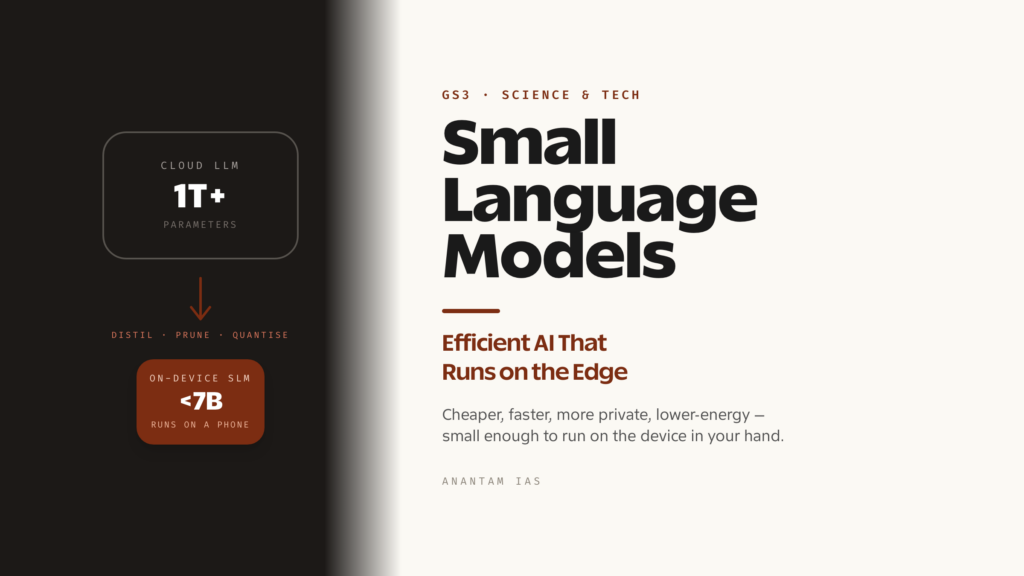
For three years the story of artificial intelligence was a story about size — bigger models, more parameters, larger data centres, the assumption that intelligence scaled with brute force. Then the pendulum started to swing back. In 2025 NVIDIA’s own researchers published a position paper bluntly titled “Small Language Models are the Future of Agentic AI,” arguing that the compact, cheap, narrow model running on a single chip — not the trillion-parameter giant in a hyperscale cloud — is what most real AI work will actually need. Microsoft’s Phi family and Google’s Gemma had already shown that a model small enough to sit on a phone could match systems many times its size on the tasks people care about. The age of the small language model had quietly arrived.
And it matters far beyond Silicon Valley. A small language model, or SLM, is a compact AI language model — typically a few million to a few billion parameters — built to run efficiently on ordinary hardware, often on the device in your hand rather than a distant server. That single design choice changes the economics, the privacy and the reach of AI all at once. For India and the Global South, where data must travel cheaply, work offline, and speak dozens of languages, the SLM is arguably the more important machine. It sits squarely in the GS Paper 3 science-and-technology syllabus, at the meeting point of indigenous innovation, data sovereignty and digital inclusion — and it rewards a candidate who can explain the trade-off in a few sharp sentences.
What a Small Language Model Is and How It Differs from a Frontier LLM
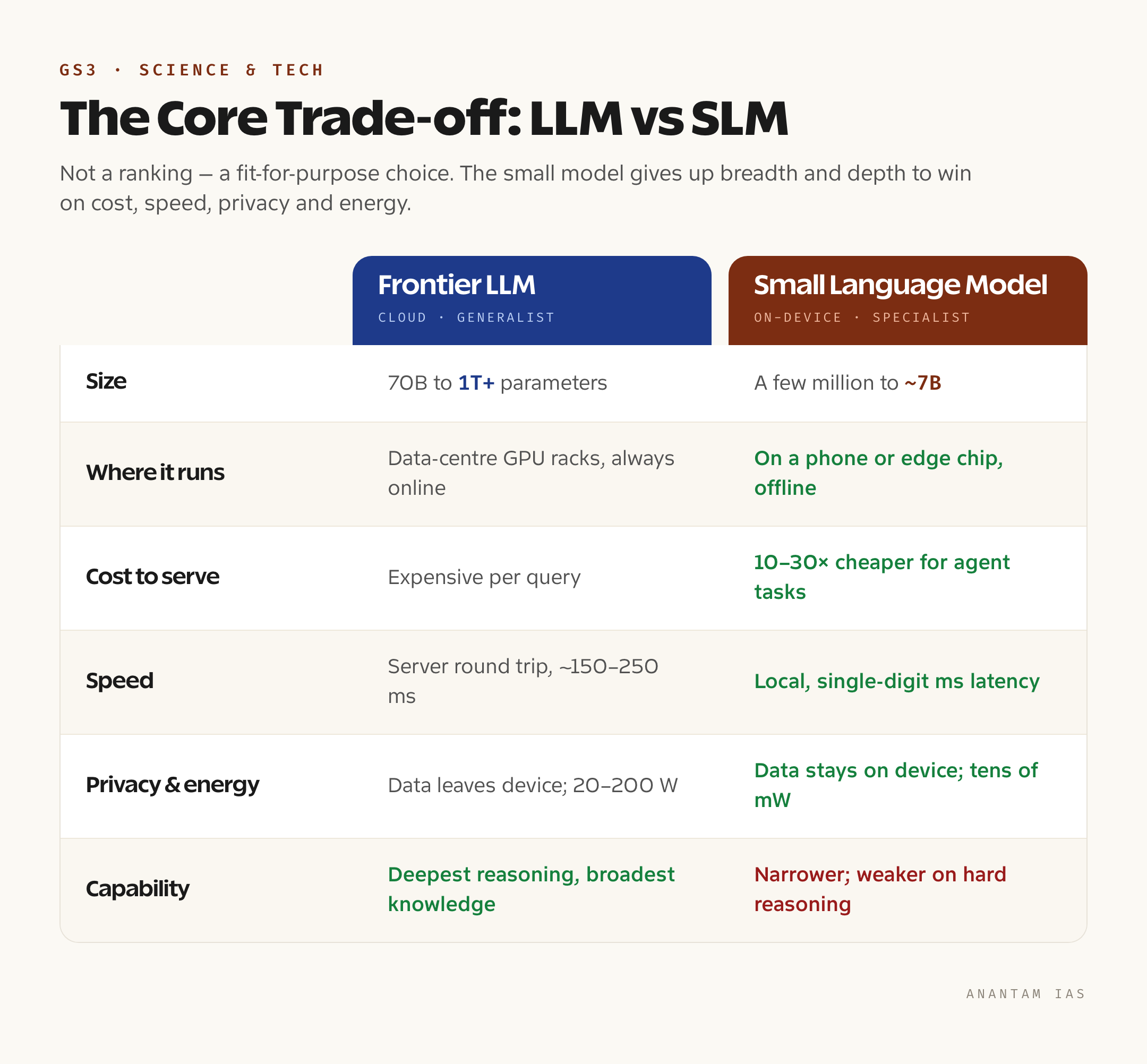
Start with the contrast, because the whole topic lives in it. A large language model — the kind behind the best-known chatbots — is a generalist trained to do almost anything: write code, reason through a puzzle, draft an essay, hold a long conversation. To do that it packs hundreds of billions, sometimes more than a trillion, parameters — the adjustable numbers that store what the model has learned. Running it means racks of expensive accelerator chips in a data centre, a constant internet connection, and a meaningful slice of electricity and water for every answer. It is powerful precisely because it is huge, and huge precisely because it is meant to be everything to everyone.
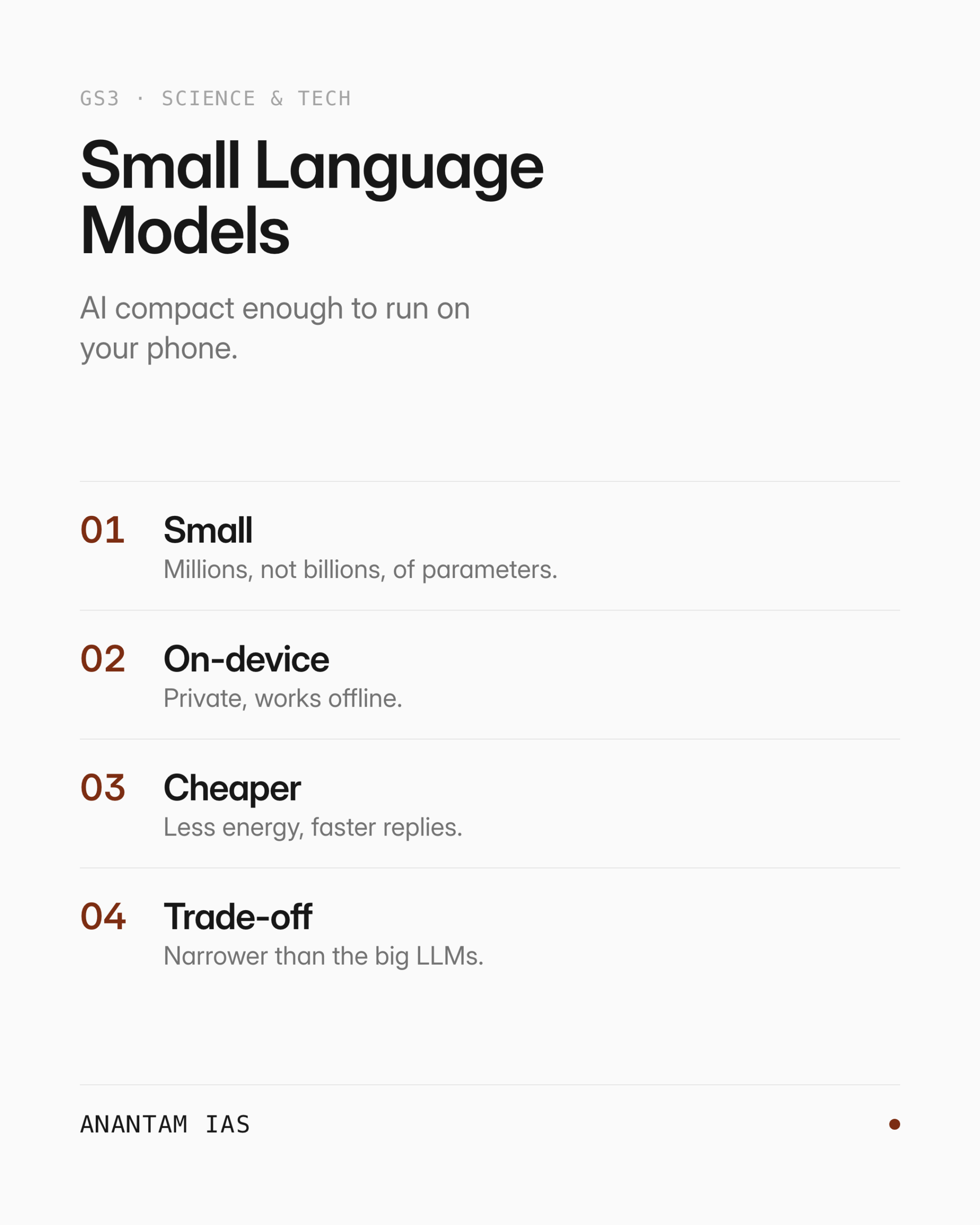
A small language model flips every one of those choices. Where a frontier model might have 70 billion to over a trillion parameters, an SLM typically runs from a few hundred million to roughly 7 billion — small enough that, once compressed, it fits inside the memory of a modern smartphone. As IBM and others define the category, the dividing line is less a hard number than a purpose: an SLM is built to be efficient and specific rather than vast and universal. That brings four concrete advantages that are worth memorising as a chain. It is cheaper to run, because it needs a fraction of the computing power. It is faster, because the answer is computed on the device with no round trip to a server — latency drops from a couple of hundred milliseconds to single digits. It is more private, because your data never leaves your phone. And it sips energy: edge studies report ten- to a-hundred-fold cuts in both latency and power when a task moves from the cloud to a local chip, with tiny on-device models drawing tens of milliwatts against the tens or hundreds of watts a cloud GPU burns.
There is a price for all this, and an honest answer names it. An SLM is narrower and less capable than a frontier model. It cannot match the deepest reasoning, the longest memory of a conversation, or the encyclopaedic breadth of a giant. Ask a 3-billion-parameter model to handle a sprawling, open-ended problem and it will struggle where a frontier model would shine. The art, then, is not to crown one winner but to match the model to the job — a giant for the rare task that genuinely needs raw power, a small model for the thousands of routine, well-defined tasks that do not. That principle of “right-sizing” the model is the single idea an examiner most wants to see.
How Small Language Models Are Built
A small model is not just a big model with bits chopped off at random — making one capable is a craft, and four techniques do most of the work. The first is knowledge distillation, the most important of the set. Here a large, expensive “teacher” model is used to train a small “student” model to imitate its answers, so the student inherits much of the teacher’s skill at a fraction of the size. Microsoft’s Phi series was built this way and, by the company’s own account, retains the bulk of a far larger model’s capability at a small share of its footprint. The student learns not just the right answers but the teacher’s confidence across many possible answers, which is what lets a tiny model punch so far above its weight.
The second technique is quantisation, which shrinks the model’s numbers. A parameter normally stored as a 16- or 32-bit decimal can be squeezed down to a 4- or 8-bit integer with little loss of quality. The effect on memory is dramatic: a 7-billion-parameter model that needs about 14 gigabytes at full precision drops to roughly 3.5 gigabytes when quantised to 4 bits — the difference between “needs a server” and “fits on a phone.” The third is pruning, which deletes the parameters that contribute least, trimming the network the way a gardener thins a hedge; combined with quantisation it can cut a model’s size by ninety per cent or more while keeping it useful for most tasks. The fourth is fine-tuning on high-quality, often domain-specific data — feeding the model a focused, carefully filtered diet rather than the whole messy internet. Phi was trained partly on curated synthetic “textbook-quality” data for exactly this reason, and the broader lesson holds: a small model fed sharp, relevant data can become a genuine expert in one domain even if it knows little outside it.
Where Small Language Models Actually Get Used
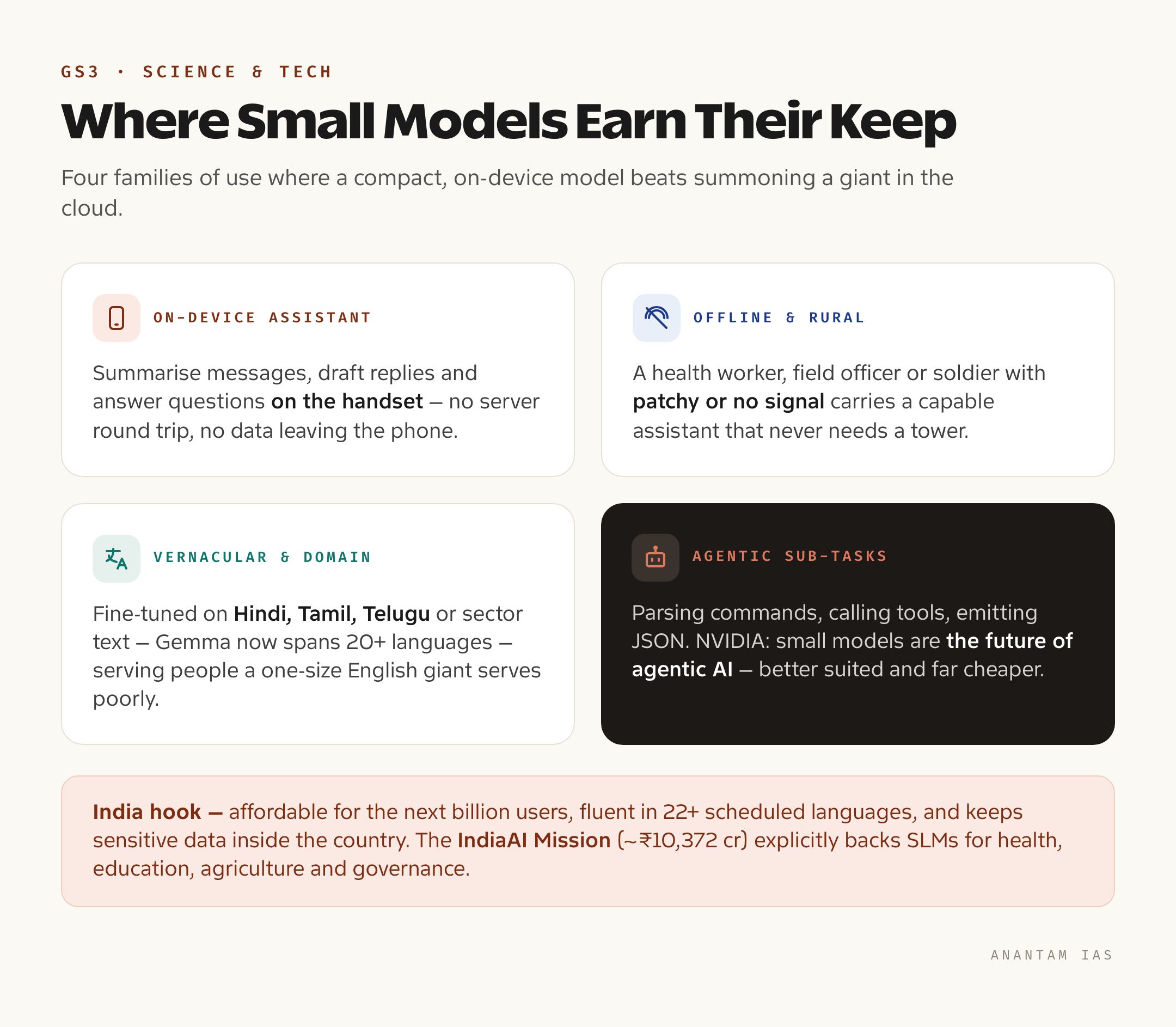
The case for SLMs is strongest where the giant model is overkill, and there are four families of use that recur. The first is the on-device assistant. Because the model runs locally, it can summarise your messages, draft a reply, transcribe a voice note or answer a question with no connection and no data leaving the handset — which is why high-end phones, now shipping with 12 to 16 gigabytes of memory, increasingly bundle a model in the 1-to-3-billion range. The second is offline and low-connectivity work: a health worker in a village with patchy signal, a field officer in a forest, a soldier in a remote post can all carry a capable assistant that never needs a tower. For a country with vast rural stretches, that is not a niche — it is the main event.
The third family is the regional-language and domain-specific model, and this is where the SLM becomes a tool of inclusion. A model fine-tuned on Hindi, Tamil, Telugu or Marathi medical or legal text can serve a population that a one-size-fits-all English giant serves poorly — and Google’s Gemma now supports twenty-plus languages including several Indian ones at production quality. The fourth, and the one driving the most industry excitement, is the agentic sub-task. An AI “agent” that books a ticket or files a form does not need a genius for every step; most of what it does is parse a command, call a tool, or produce a small piece of structured output like a JSON snippet. NVIDIA’s researchers argue that small models are not just adequate but better suited to these errands — and ten to thirty times cheaper to serve — so the future they sketch is a heterogeneous system where cheap SLMs do the routine work and a big model is summoned only when raw intelligence is genuinely needed. If you want to see how those autonomous systems are assembled, the wider picture is in our explainer on agentic AI; for how these language models work under the hood, start with our guide to generative AI and large language models.
Why Small Models Matter for India and the Global South
For India the appeal of the small model is not a passing fashion — it lines up with four deep national interests, and naming them is how this topic earns marks. The first is affordability. Running a frontier model for hundreds of millions of users is ruinously expensive in compute and electricity; a model that runs on the phone someone already owns spreads AI to the next billion users at almost no marginal cost. The second is linguistic reach. India has twenty-two scheduled languages and hundreds more in daily use, and a frontier model trained mostly on English text serves a Bhojpuri or Kannada speaker badly. Small, fine-tuned vernacular models are the practical route to AI that actually speaks the country’s languages — the difference between a tool for the metros and a tool for the whole population.
The third interest is data sovereignty, and it is the one with the sharpest policy edge. When a query runs on a distant foreign server, sensitive data — a citizen’s health record, a farmer’s land detail, a government file — leaves the country and the reach of Indian law. A model that runs on Indian devices or Indian-controlled infrastructure keeps that data at home. It is the same logic that drove India’s data-localisation rules and its Digital Personal Data Protection framework, applied to AI. The fourth is strategic self-reliance: depending on a handful of foreign companies for the intelligence layer of the economy is a vulnerability, and building indigenous models is how India reduces it.
This is exactly where the IndiaAI Mission comes in. Approved by the Union Cabinet in March 2024 with an outlay of about ₹10,372 crore over five years, the mission’s foundation-model pillar explicitly backs not just large multimodal and large language models but small language models tailored to India-specific problems in health, education, agriculture, climate and governance. A January 2025 call for proposals drew more than 500 submissions; companies such as Sarvam AI, Soket AI and Gnani.ai were picked in the first round to build multilingual and voice models, with a second round in September 2025 adding ventures including the IIT-Bombay-led BharatGen consortium, whose Param-1 text model and Shrutam speech system are built for Indian languages. The thread running through all of it is efficiency for inclusion: India’s bet is that the path to AI for 1.4 billion people runs through models small and cheap enough to reach them.
The Limits, and How to Keep Them in View
Small does not mean harmless or magic, and a balanced answer says so. The first limit is capability: a compressed model trades away breadth and depth, so on hard, open-ended reasoning or long, multi-step problems it will lag a frontier system, and shrinking a model too aggressively can degrade its quality in ways that are hard to predict. The second is reliability. Language models of every size can “hallucinate” — produce confident, fluent text that is simply wrong — and research suggests this is an innate feature of how they work rather than a bug to be fully patched out; with a smaller model the risk in a narrow domain can sometimes be managed, but it never vanishes. For high-stakes uses — medical, legal, financial — that means a human must stay in the loop.
The third set of limits is practical and governance-shaped. A model running on millions of personal devices is a larger, messier surface to secure and to update than one model in a controlled data centre. Quality varies sharply with the data a model was fine-tuned on, so a vernacular or domain model is only as good — and only as free of bias — as the carefully curated dataset behind it, which is a real bottleneck for low-resource Indian languages where clean data is scarce. And the same efficiency that makes SLMs democratising also makes powerful AI easy to copy, run privately and misuse, which complicates any attempt to regulate it. None of this is an argument against small models. It is the reason the serious framing is not “small versus large” but a portfolio — small models for reach and routine work, large models for the hardest problems, and clear rules, good data and human oversight binding the two together.
For Your Mains Answer
This is a high-value topic for GS Paper 3, which covers developments in science and technology, indigenisation of technology, and the awareness aspects of IT and emerging tech. It maps onto questions about artificial intelligence, the IndiaAI Mission, data sovereignty, digital inclusion and the bridging of the digital divide. It also offers a fresh, concrete example for Essay themes on technology and society, self-reliance, and equitable development. The skill examiners reward is the one this article models: state the trade-off precisely, ground it in real examples, and always tie the technology back to India’s specific needs.
How to Build the Answer
Open with the definition and the pivot — AI is moving from “bigger is better” toward right-sized models. Then move in a chain: what an SLM is (a few million to a few billion parameters, runs on-device), the four-part trade-off (cheaper, faster, more private, lower energy, but narrower), how they are built (distillation, quantisation, pruning, quality-data fine-tuning), where they are used (on-device, offline, vernacular, agentic sub-tasks), and why India cares (affordability, languages, data sovereignty, self-reliance, the IndiaAI Mission). Close by judging the technology honestly — its limits and the portfolio framing. That arc — define, trade-off, build, use, India, evaluate — fits almost any SLM or edge-AI question.
Common Mistakes to Avoid
Don’t treat “small” as simply “worse” — the point is fitness for purpose, not a ranking. Don’t claim SLMs eliminate hallucination; reliability is a limit for every model size. Don’t forget the India hook — an answer that explains the technology but never reaches data sovereignty, vernacular languages or the IndiaAI Mission leaves marks on the table. And don’t confuse the techniques: distillation transfers knowledge from a teacher, quantisation shrinks the numbers, pruning deletes weak parameters — keep them distinct.
A Compact Answer Spine
SLM = compact language model, ~few million to ~7B parameters, runs on-device → trade-off: cheaper, faster, more private, lower energy, but narrower and less capable → built via distillation + quantisation + pruning + quality-data fine-tuning → examples: Phi, Gemma, small Llama/Mistral → uses: on-device assistants, offline/low-connectivity, vernacular and domain models, agentic sub-tasks (NVIDIA: SLMs are the future of agentic AI) → India: affordability, 22+ languages, data sovereignty, self-reliance, IndiaAI Mission (₹10,372 cr, backs SLMs) → limits: capability gap, hallucination, security and data quality → verdict: a portfolio of small and large, not a single winner.
Diagram or Flowchart Idea
Draw a simple two-column compare — LLM (huge, cloud, generalist, costly) versus SLM (compact, on-device, specialist, cheap) — with arrows on the SLM side for cost, latency, privacy and energy. Beside it, a small fan-out from one “SLM” box to its four use cases (on-device, offline, vernacular, agentic). The two visuals together carry the whole answer at a glance.
A Balanced-Conclusion Line
A line that lands the marks: “Small language models reframe the AI race from raw scale to fitness for purpose — and for a country that must reach 1.4 billion people, in dozens of languages, often offline and under its own laws, the smaller, cheaper, on-device model may be the more transformative machine.”
How to Use Data Without Cramming
You need only a handful of anchors, not a spreadsheet: a few million to ~7 billion parameters (the SLM range), a 4-bit quantised 7B model fitting in about 3.5 GB (why it runs on a phone), ten-to-thirty-times cheaper for agentic tasks (NVIDIA), and ₹10,372 crore over five years for the IndiaAI Mission. Attribute them plainly — “as NVIDIA’s 2025 paper argued,” “under the IndiaAI Mission” — rather than scattering numbers loose.
Frequently Asked Questions
What is a small language model, and how small is “small”?
A small language model, or SLM, is a compact AI language model built to run efficiently on limited hardware — often on a phone or edge device rather than a cloud server. There is no hard cut-off, but SLMs typically run from a few hundred million to around 7 billion parameters, against the tens or hundreds of billions, or more than a trillion, in a frontier large language model. The defining idea is purpose: an SLM is designed to be efficient and specific, not vast and universal.
Why would anyone use a small model when large ones are more capable?
Because most real tasks don’t need a genius. SLMs are cheaper to run, faster (the answer is computed on the device with no server round trip), more private (data never leaves the phone), and far more energy-efficient. For routine, well-defined work — summaries, voice commands, structured outputs for AI agents — a small model is more than enough, and NVIDIA’s researchers argue it is actually better suited and up to ten-to-thirty-times cheaper. The trade-off is that an SLM is narrower and weaker on the hardest reasoning, so the sensible approach is to match the model to the job.
How are small language models built?
Mainly through four techniques. Knowledge distillation trains a small “student” model to imitate a large “teacher,” inheriting much of its skill at a fraction of the size. Quantisation shrinks each parameter to fewer bits, so a 7B model can drop from about 14 GB to roughly 3.5 GB. Pruning deletes the least useful parameters. And fine-tuning on high-quality, often domain-specific data turns a general small model into a focused expert. Microsoft’s Phi family is a well-known example built largely through distillation and curated training data.
Why do small language models matter especially for India?
For four reasons. Affordability — they run on phones people already own, spreading AI to the next billion users cheaply. Language — small, fine-tuned models can serve India’s twenty-plus scheduled languages where an English-first giant serves them poorly. Data sovereignty — on-device or India-hosted models keep sensitive data inside the country and under Indian law. And self-reliance — indigenous models reduce dependence on a few foreign firms. The IndiaAI Mission, with an outlay of about ₹10,372 crore, explicitly backs small language models for India-specific problems in health, education, agriculture and governance.
Practice Questions
Prelims MCQs
- With reference to small language models (SLMs), consider the following statements: 1) They are typically built to run on-device or on edge hardware rather than only in large data centres. 2) They generally contain more parameters than frontier large language models. 3) Knowledge distillation and quantisation are techniques used to create them.
Which of the statements is/are correct?
(a) 1 and 3 only
(b) 2 and 3 only
(c) 1 only
(d) 1, 2 and 3
Answer: (a) SLMs run efficiently on limited hardware and are made via distillation, quantisation and pruning; they contain fewer parameters than frontier LLMs, so statement 2 is wrong. - The technique in which a large “teacher” model is used to train a smaller “student” model to imitate its outputs is known as:
(a) Quantisation
(b) Pruning
(c) Knowledge distillation
(d) Tokenisation
Answer: (c) Knowledge distillation transfers the teacher’s learned behaviour to a smaller student, the method behind models such as Microsoft’s Phi. - “Quantisation,” as applied to language models, primarily refers to:
(a) Deleting the least useful parameters from a network
(b) Reducing the numerical precision of a model’s parameters to cut memory use
(c) Translating a model into multiple languages
(d) Connecting many small models into one large model
Answer: (b) Quantisation lowers the bit-precision of parameters — for example from 16-bit to 4-bit — sharply reducing memory so a model can fit on a phone. - The IndiaAI Mission, which supports the development of indigenous foundation models including small language models, was approved with an outlay of approximately:
(a) ₹1,000 crore over five years
(b) ₹10,372 crore over five years
(c) ₹50,000 crore over ten years
(d) ₹500 crore over three years
Answer: (b) The Union Cabinet approved the IndiaAI Mission in March 2024 with an investment of about ₹10,372 crore over five years. - Which of the following is correctly cited as an advantage of small language models over frontier LLMs for many tasks?
(a) Greater depth of reasoning on open-ended problems
(b) Lower cost, lower latency, better privacy and lower energy use
(c) Complete elimination of hallucination
(d) A larger context window and broader general knowledge
Answer: (b) SLMs win on cost, speed, on-device privacy and energy efficiency; they do not match frontier models on the deepest reasoning, nor do they eliminate hallucination.
Mains Practice Questions
- What are small language models (SLMs), and how do they differ from frontier large language models? Discuss the trade-offs that make them suitable for on-device and edge deployment. (15 marks, 250 words)
- “For India, the small language model may be the more transformative machine than the frontier giant.” Critically examine this statement with reference to affordability, linguistic diversity and data sovereignty. (15 marks, 250 words)
- Examine the role of the IndiaAI Mission in building indigenous AI capability. How does its support for small language models advance the goals of digital inclusion and technological self-reliance? (15 marks, 250 words)
- Explain the principal techniques used to build small language models — distillation, quantisation, pruning and domain fine-tuning. (10 marks, 150 words)
- Small language models are often described as democratising artificial intelligence, yet they carry their own risks. Evaluate the limitations and governance challenges of widespread SLM and edge-AI deployment. (15 marks, 250 words)
Tell Google you want more of this.
Add Anantam IAS as a preferred sourceOne tap, and this site shows up more often in your own Top Stories, AI Overviews and AI Mode. Remove it any time.