Most aspirants do not lose the UPSC exam on the static syllabus. They lose it on current affairs — not because they read too little, but because they read in a way that never connects to anything. Five news apps, three Telegram channels, a stack of monthly magazines, and pages of notes that never get opened again. The reading feels productive and the marks never move.
Current affairs rewards a system, not effort. The aspirants who clear Civil Services treat the newspaper as a tool for understanding the syllabus, not as a daily quiz to memorise. This guide lays out that system — the sources worth trusting, how to take notes that survive to revision, how to tie every news item back to the static syllabus, and an honest answer to the question everyone asks: how much is actually enough.
Why Current Affairs Decides the UPSC Outcome
Current affairs is the one thing that runs through every stage of the exam. In Prelims, a large share of the General Studies Paper I questions are either dynamic current affairs or static topics dressed up in a current-affairs headline — a scheme in the news, a species in the news, a place in the news. The Commission rarely asks a date or a rote fact; it asks whether you understood what happened and why it matters.
In Mains it goes deeper. All four General Studies papers reward candidates who bring a recent example, a committee name, or a data point to a static question. A polity answer on federalism reads very differently when it carries a recent Supreme Court judgment or a Finance Commission recommendation. The Essay paper leans on current debates for its arguments, and the Personality Test is built almost entirely around what you have read and how you think about it. If you have followed the news with judgment, the interview board can tell within two questions.
So current affairs is not a separate subject sitting beside polity and economy. It is the connective tissue that makes the static syllabus feel alive in an answer. Treat it as a bolt-on and it stays shallow. Treat it as the lens through which you read everything else, and the same hours start paying off across all six papers and the interview.
The Sources That Actually Matter
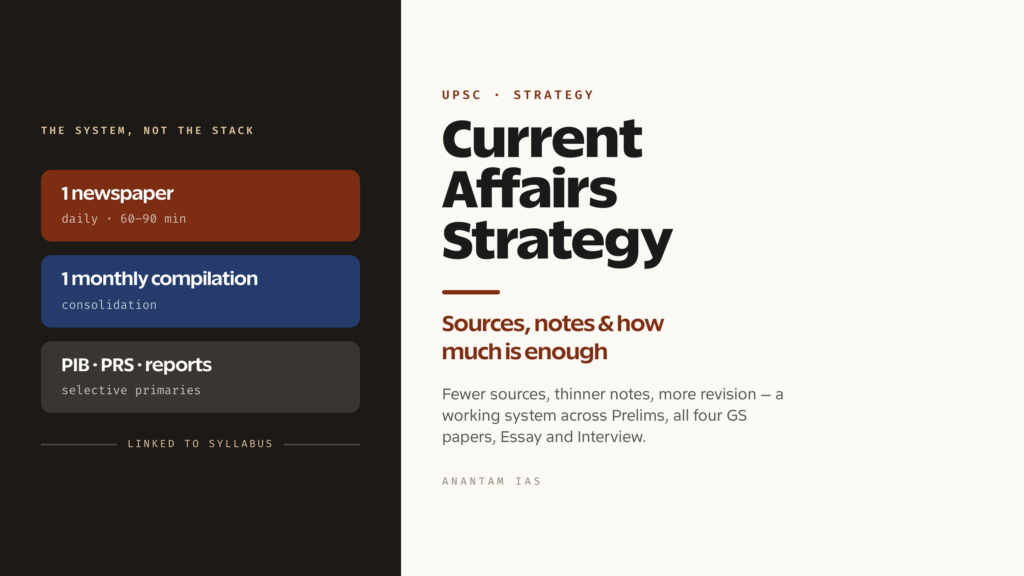
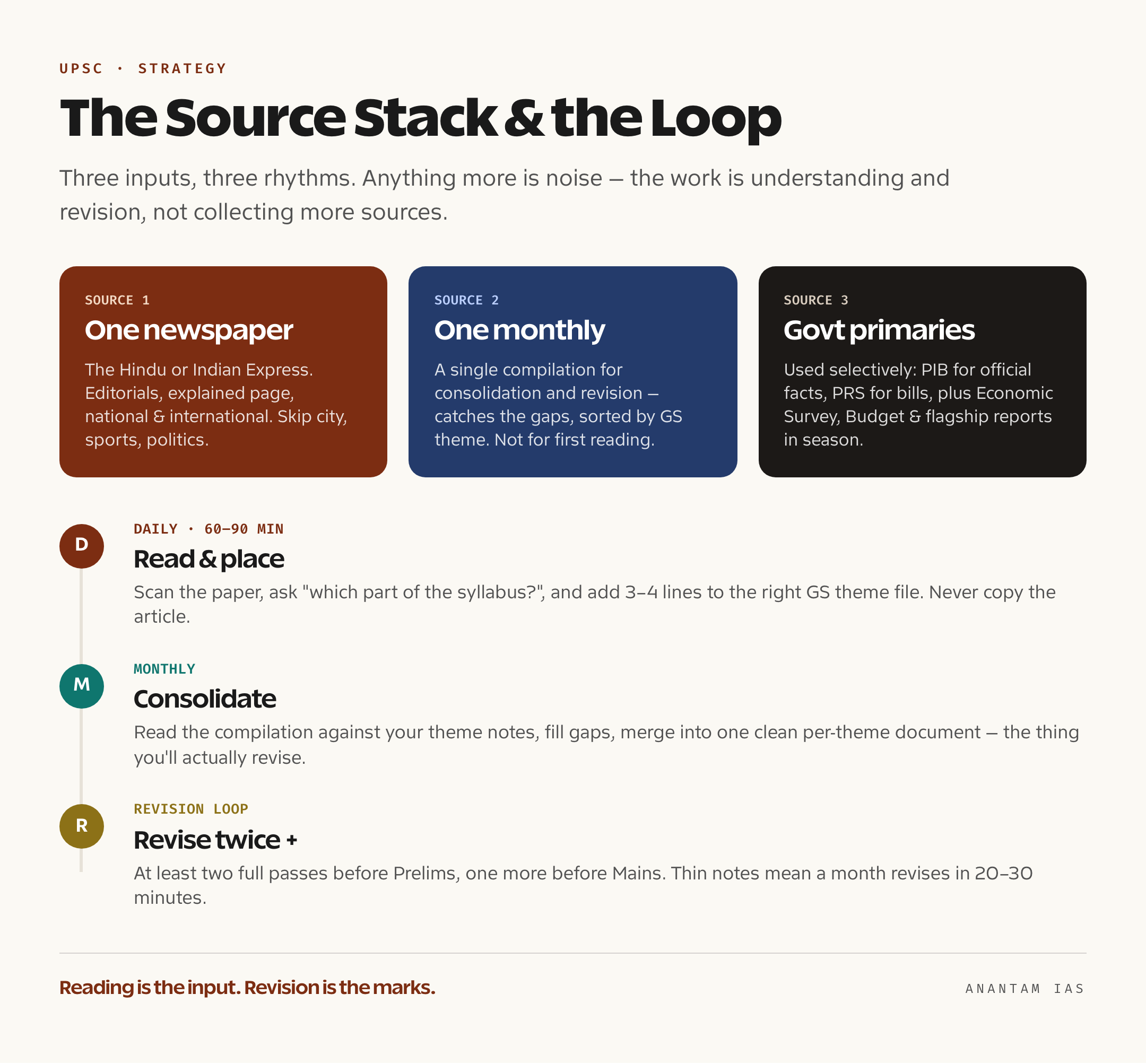
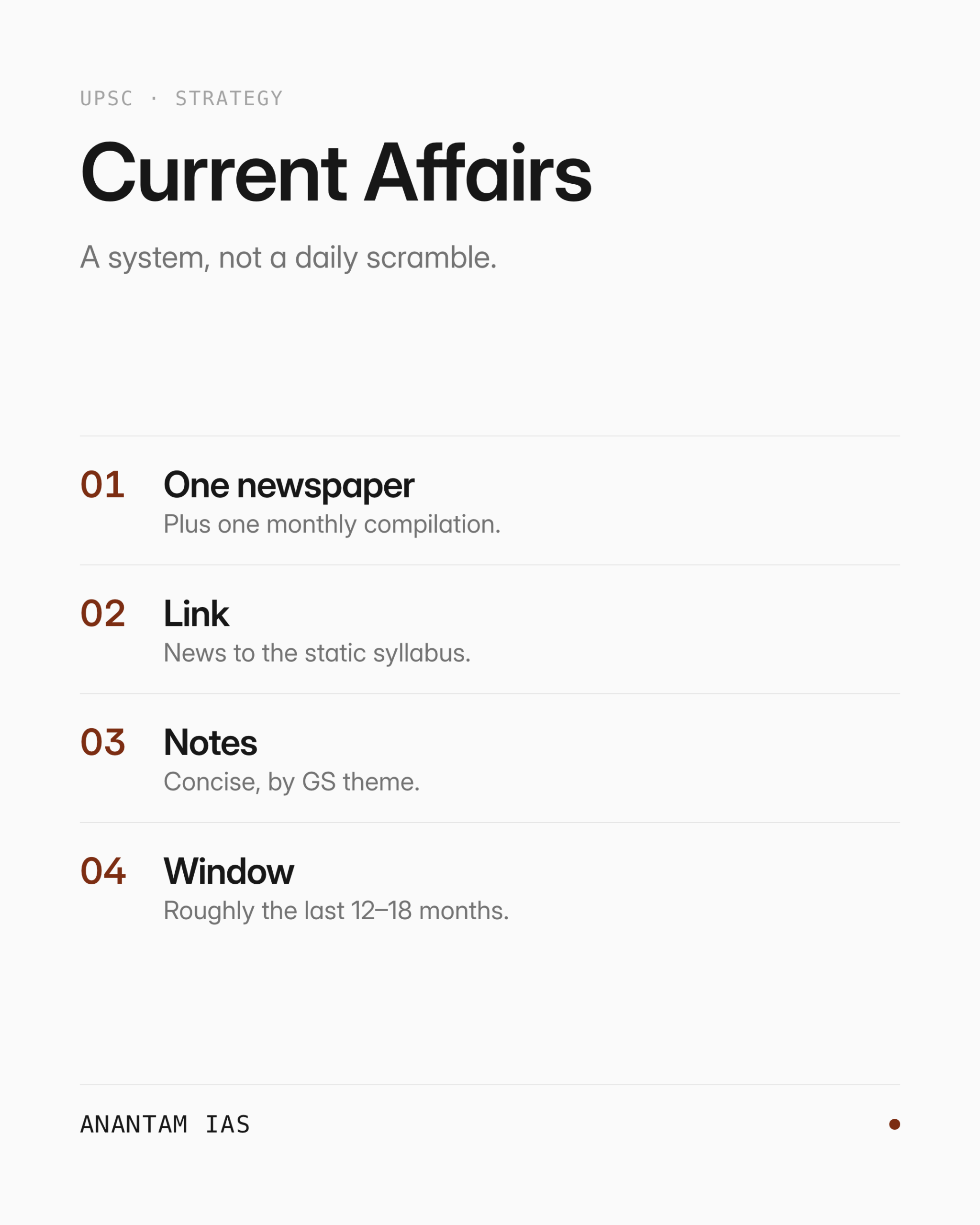
The single biggest mistake in current affairs is source overload, so start by cutting down. You need one good newspaper, one monthly compilation, and a small set of government primary sources. That’s it. Adding a fourth and a fifth source does not add coverage — it adds noise and steals the time you should be spending on understanding and revision.
For the newspaper, pick one of The Hindu or The Indian Express and stay with it for the whole preparation. Both are edited for depth rather than speed, and both run editorial and op-ed pages that model the kind of balanced argument Mains rewards. Read the editorials, the explained or ideas pages, and the national and international sections. Skip the city news, sports, and the routine political slanging match — none of it is testable. If reading the English daily feels slow at first, our walkthrough on how to read The Hindu for UPSC shows which pages to read and which to leave.
For monthly consolidation, one current affairs compilation from a reputed source is enough. It catches anything you missed, organises the month by General Studies theme, and gives you a single document to revise from instead of thirty days of scattered notes. The magazine is for consolidation and revision, not for first reading — the newspaper does the first reading.
The third layer is government primary sources, used selectively. The Press Information Bureau (PIB) carries the official version of scheme launches and government decisions, which is safer than a journalist’s paraphrase for Prelims facts. PRS Legislative Research summarises every bill and key policy in plain language, which is gold for Mains. Add the big annual documents in their season — the Economic Survey, the Union Budget, the flagship reports from NITI Aayog and the relevant ministries. You don’t read these cover to cover; you mine them for data and committee names.
The Daily-to-Monthly Workflow
The system has three rhythms — daily, monthly, and a revision loop — and each one feeds the next. Get the rhythm right and current affairs stops feeling like a flood.
The daily rhythm is the newspaper, and it should take about 60 to 90 minutes, not three hours. A common trap is treating the paper as a reading-comprehension exercise where every word matters. It doesn’t. Scan the front page and national pages for events that touch the syllabus, read the editorials and the explained page properly, and ask one question of every item worth keeping: which part of the GS syllabus does this belong to? If you can’t place it on the syllabus, it probably isn’t worth a note. As your eye trains, the 90 minutes drift down toward an hour.
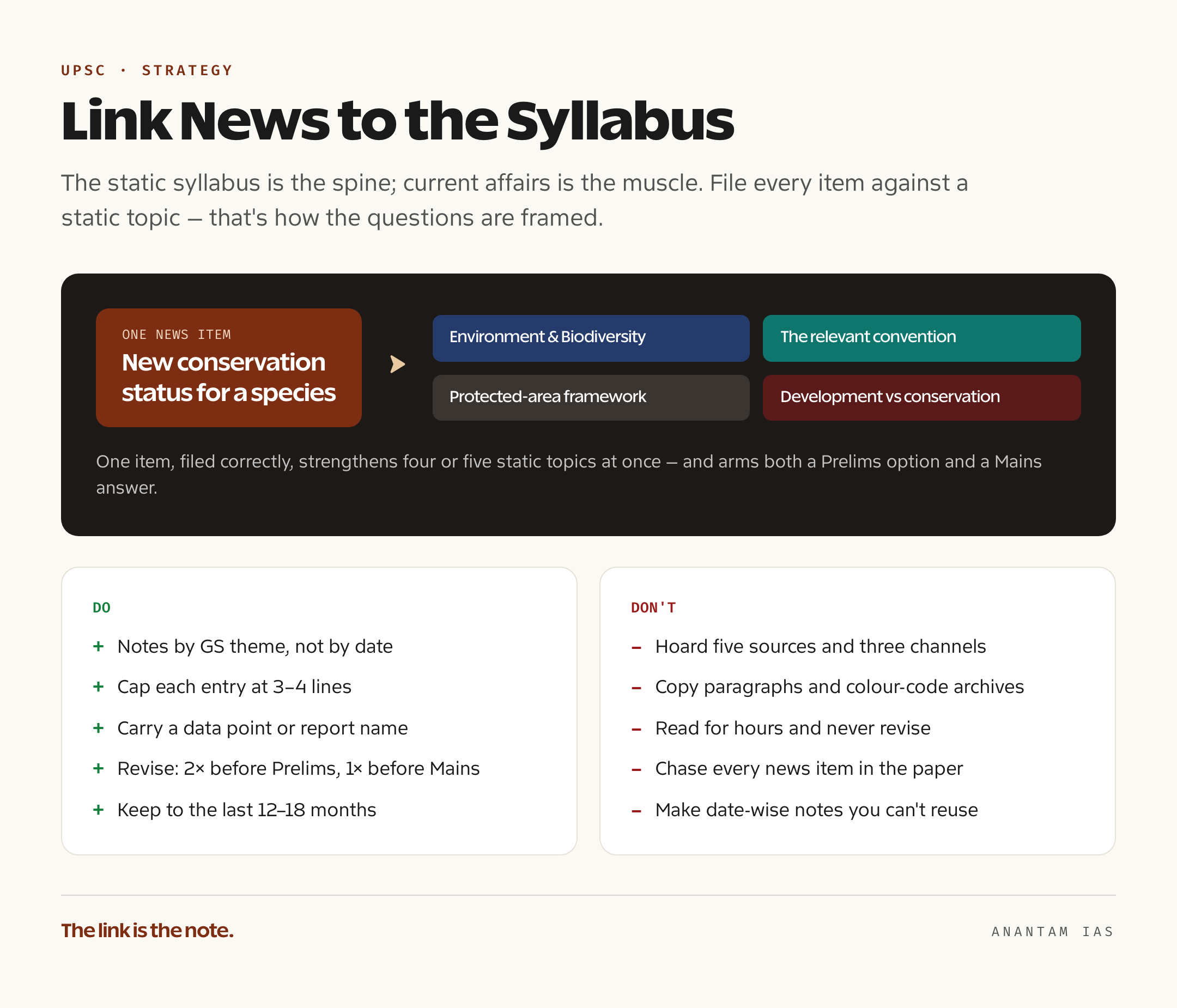
Note-making is where most aspirants go wrong, so keep it deliberately thin. Make notes by GS theme, not by date — a running file or digital page for each topic such as Indian Polity, Economy, Environment, Science and Technology, International Relations, and Schemes. When a relevant item appears, add three or four lines to the right theme: what happened, why it matters, and one fact or figure worth carrying into an answer. Never copy the article. If a note runs longer than four or five lines, you’re transcribing instead of distilling, and you’ll never revise it.
The monthly rhythm is consolidation. At the end of each month, read the monthly compilation against your own theme notes, fill the gaps, and merge everything into one clean per-theme document. This is the document you will actually revise — not the newspaper, not the magazine, your own consolidated theme file. The act of merging is itself a revision, and it tells you honestly what you missed during the daily reading.
The revision loop is the part everyone skips and the part that decides the result. Current affairs notes you make once and never reopen are worth almost nothing in the exam hall. Plan to revise your consolidated theme files at least twice before Prelims and at least once more before Mains. If you’ve kept the notes thin, a full revision of a month takes 20 to 30 minutes, which is exactly the point.
Linking News to the Static Syllabus
Linking is the skill that separates a high scorer from someone who simply reads a lot. The static syllabus is the spine; current affairs is the muscle around it. Every news item should be filed against a static topic, because that is how the Commission frames its questions and how you’ll need to recall the material under pressure.
Take a single example. A news report on a new conservation status for a species is not a fact to memorise on its own — it links to the Environment and Biodiversity portion of the syllabus, to the relevant convention, to the protected-area framework, and to the broader debate on development versus conservation. Filed that way, one news item strengthens four or five static topics at once and gives you ready examples for both a Prelims option and a Mains answer.
Do this consistently and the famous static-versus-dynamic divide disappears. A judgment links to the polity chapter on fundamental rights. A trade move links to the economy chapter on the balance of payments. A summit links to the international-relations section on India and its neighbourhood. The link is the note — once you’ve placed an item correctly, you’ve already done most of the thinking the exam will ask for.
The same habit feeds value-addition for Mains, which is just linking pushed one step further. A good answer carries a recent example, the name of a committee or report, and a number. You collect these almost automatically when you read with the syllabus in mind — a Finance Commission figure here, a NITI Aayog target there, a committee recommendation from a PRS summary. Keep a short running list of such data points and report names by theme, and answer-writing stops being a scramble for evidence. Our guide to UPSC Mains answer writing shows how to weave these into a structured answer without padding.
Common Mistakes and How to Fix Them
The first mistake is hoarding sources. More inputs feel safer and perform worse, because they crowd out the time you need to understand and revise. Fix it by force: one newspaper, one monthly compilation, government primaries when they matter, and nothing else. Mute the rest.
The second is over-noting. Aspirants copy paragraphs, colour-code beautifully, and build archives they never reopen. Notes are for retrieval, not for collection. Cap each entry at three or four lines, write only what you’d want in an answer, and judge a note by whether you’ll revise it — not by how complete it looks.
The third, and the most expensive, is reading without revising. A year of daily reading with no revision loop leaves almost nothing in the exam hall, because current affairs fades fast. Build revision into the calendar from day one: monthly consolidation, then at least two full passes before Prelims and one before Mains. Reading is the input; revision is what converts it into marks.
The fourth is chasing every news item. Not everything in the paper is exam-relevant, and the urge to capture all of it is what makes the reading balloon to three hours. Train the filter — does this touch the syllabus, and would it strengthen an answer? If not, let it go. And keep the window realistic: the exam draws on roughly the last 12 to 18 months, so you’re building a focused, syllabus-linked record of that period, not an encyclopaedia of everything that happened. A steady revision strategy is what holds the whole system together across that window.
Frequently Asked Questions
How much time should I spend on current affairs every day?
About 60 to 90 minutes for the newspaper is the right budget for most aspirants. Beginners may take longer at first, but if it’s consistently crossing two hours, you’re reading non-testable sections or over-noting. Monthly consolidation and revision sit on top of that daily window.
How many months of current affairs does UPSC actually ask?
Roughly the last 12 to 18 months before the exam is the working window. The Commission occasionally reaches back to a major event beyond that, but the bulk of questions come from the year-and-a-half before Prelims, so concentrate your effort there rather than trying to cover several years.
Is a newspaper enough, or do I need coaching current affairs material too?
One newspaper plus one monthly compilation is enough for the vast majority of selected candidates. Coaching material is just a packaged compilation; pick one source for consolidation and don’t stack three. The differentiator is how well you link news to the syllabus and how often you revise, not how many compilations you own.
Should I make current affairs notes by date or by topic?
By topic, always. Date-wise notes are impossible to revise and impossible to use in an answer. Keep a running file per GS theme — polity, economy, environment, and so on — and add each item to its theme. When you revise, you revise a clean topic file, not thirty days of scattered headlines.
Tell Google you want more of this.
Add Anantam IAS as a preferred sourceOne tap, and this site shows up more often in your own Top Stories, AI Overviews and AI Mode. Remove it any time.