Join Anantam IAS Channel on Telegram

Daily Digest · Tuesday

29 July 2025 Current Affairs for UPSC

6 current affairs published on Tuesday, 29 July 2025

29 July 2025 Current Affairs for UPSC — every Why-in-News article AnantamIAS published on Tuesday, 29 July 2025, broken down with Why in News?, the exact GS paper it feeds, sub-topic mapping, MCQ-ready facts and a UPSC-style practice question. 6 articles in total, covering Polity, Economy, Environment, S&T, IR, Geography, History, Society and Internal Security — the same Why-in-News + GS-paper-mapping + practice-question format the Compass uses across every daily digest on the site.

Daily current affairs for UPSC is where new material enters your prep stream. Read this 29 July 2025 digest end-to-end in 25–35 minutes, attempt the practice question at the foot of each article (it's MCQ for some, 10/15-marker for others), then bookmark the entries that fall inside your active revision window. Everything stays cross-linked: tap any subject pill to jump to that subject's hub, or use the table of contents above to skip straight to a specific story.

Use this page three ways. Read sequentially for a one-sitting scan of everything that mattered on 29 July 2025. Download the 29 July 2025 PDF below for offline study or print revision. Or use the July 2025 Current Affairs compilation to see this day in the month's full context. For the previous day's reading, see 28 July 2025 Current Affairs; the next day's is 30 July 2025 Current Affairs.

Why we publish daily current affairs separately from the monthly compilation: daily is learning, monthly is revision. Use the daily page to add fresh material to your notes the day it breaks; come back to the July 2025 compilation 60 days before Prelims when the noise has settled and only the lasting takeaway is worth re-reading.

Women’s Chess World Cup

Open article →Download PDF

Why in news:

Divya Deshmukh, a 19-year-old Indian chess prodigy, made history by winning the Women’s Chess World Cup in Batumi, Georgia, becoming the first Indian woman to ever win this title. She defeated fellow Indian Grandmaster Koneru Humpy in the tie-breakers of the final. This victory makes her the first Indian woman to win the FIDE Women’s World Cup

UPSC CSE Relevance:

UPSC CSE in prelims examination has focused on games. A case in point is a following PYQ.

UPSC Prelims PYQ 2021:

Consider the following statements in respect of the ICC World Test Championship:

1. The finalists were decided by the number of matches they won.
2. New Zealand was ranked ahead of England because it won more matches than England.
Which of the above statements is/are correct?
(a) 1 only
(b) 2 only
(c) Both 1 and 2
(d) Neither 1 nor 2

Divya Major Milestones:

  • She became India’s 88th Grandmaster
  • Only the 4th Indian woman Grandmaster, after Koneru Humpy, D. Harika, and R. Vaishali.
  • Divya’s win is not just a personal milestone but a national moment of pride as no Indian woman had won the World Cup before.

FIDE World Chess Championship:

  • The FIDE governs all international chess competitions and was recognized as a Global Sporting Organization by the International Olympic Committee in 1999.
  • Founded in 1924 in Paris and headquartered in Lausanne, FIDE is now one of the largest National Chess Federations, encompassing 201 countries as affiliate members. 
  • Publishes monthly rankings for the top 100 players, women, juniors, and girls 
  • Publishes rankings for countries based on the average rating of their top 10 players and top 10 female players 
  • Regulates all international chess competitions 
  • Connects national chess federation

About chess:

  • Chess is one of the most ancient, intellectual and cultural games, with a combination of sport, scientific thinking and elements of art.
  • One theory is that an early game similar to chess called Chaturanga originated in Northern Indian Subcontinent during the Gupta period (~ 319 – 543 CE) and spread along the Silk Roads west to Persia.(Source-United Nation)
  • In 900 CE, Abbasid chess masters al-Suli and al-Lajlaj composed works on the techniques and strategy of the game, and by 1000 CE Chess was popular across Europe, and in Russia where it was introduced from the Eurasian Steppe.
  • On 12 December 2019, the General Assembly proclaimed 20 July as World Chess Day to mark the date of the establishment of the International Chess Federation (FIDE) in Paris in 1924.

UPSC Prelims PYQ 2023

Consider the following statements in respect of the 44th Chess Olympiad, 2022:

  1. It was the first time that the Chess Olympiad was held in India.
  2. The official mascot was named ‘Thambi’.
  3. The trophy for the winning team in the open section is the Vera Menchik Cup.
  4. The trophy for the winning team in the women’s section is the Hamilton-Russell Cup.

How many of the statements given above are correct?

(a) Only one
(b) Only two
(c) Only three
(d) All four

Rajendra Chola I

Open article →Download PDF

Why in news:

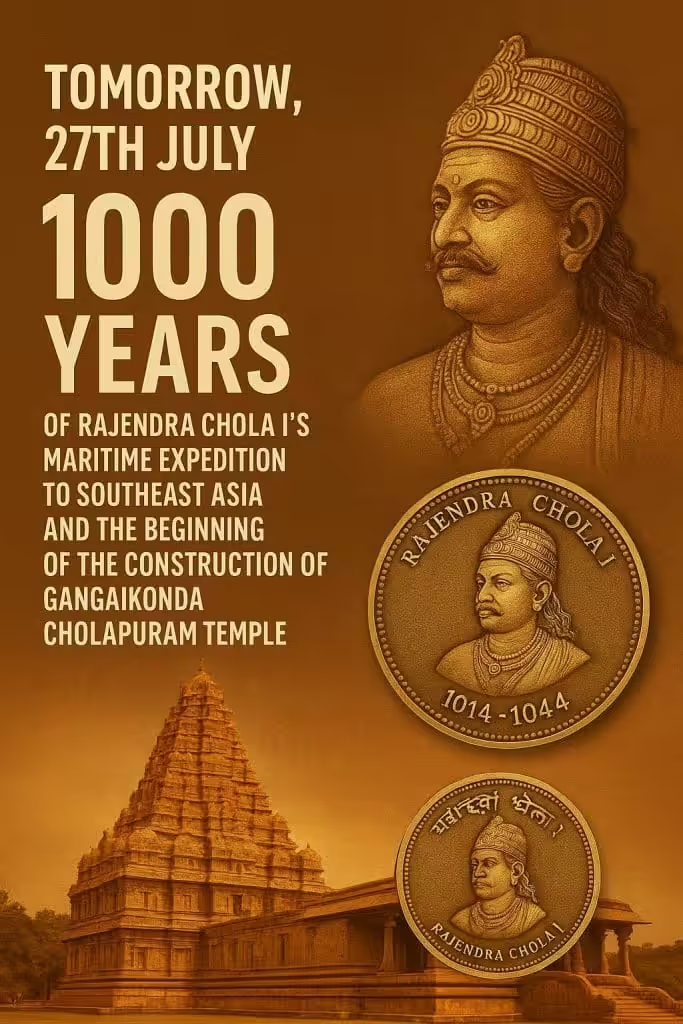
Prime Minister Narendra Modi visited Gangaikonda Cholapuram in Tamil Nadu to attend the Aadi Thiruvizha festival, commemorating the birth anniversary of Rajendra Chola I, one of the greatest emperors of the Chola dynasty. The event also marked 1,000 years since Rajendra Chola’s naval expedition to Southeast Asia and the construction of the Gangaikonda Cholapuram temple, now a UNESCO World Heritage Site.

UPSC CSE Relevance:

UPSC CSE in mains and prelims examination has focused on different dynasties(Chola’s,Pallavas,Chera’s etc.)and features of art and culture in GSI. A case in point is a following PYQ.

UPSC CSE Mains Question 2022

Question: Discuss the main contributions of Gupta period and Chola period to Indian heritage and culture.

About Chola Empire:

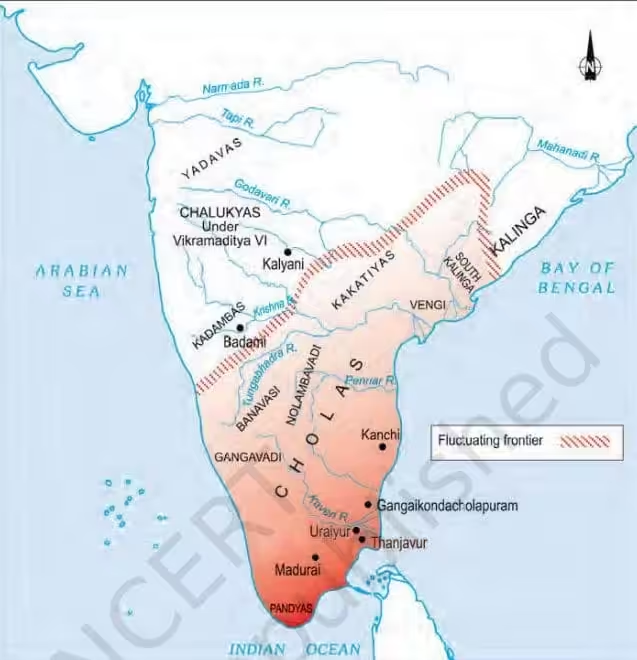
History: Vijayalaya was a key figure from the ancient Chola line based in Uraiyur. In the mid-9th century, he captured the Kaveri delta from the Muttaraiyar. This marked the founding moment of Imperial Chola power. Vijayalaya built the town of Thanjavur (which later became the Chola capital).

  • The Chola Dynasty was founded by Vijayalaya Chola.
  • In the mid-ninth century the family came to dominate the region, building an empire that would last more than four hundred years. Based in the fertile Kaveri River delta in the present-day Indian state of Tamil Nadu, the Chola Dynasty—at its height in the eleventh century—ruled much of south India and as far as Sri Lanka and the Maldive Islands.
  • The greatest Chola rulers were Rajaraja (985-1014) and his son Rajendra I (1014-1044).

Source: NCERT

About Rajendra Chola I:(1014–1044 CE)

  • Rajendra Chola I (1014–1044 CE) was one of the most powerful and visionary rulers in Indian history
  • Under his leadership, the Chola Empire expanded its influence across South and Southeast Asia.
  • He established Gangaikonda Cholapuram as the imperial capital after his victorious campaigns, and the temple he built there served as a beacon of Shaiva devotion, monumental architecture, and administrative prowess for over 250 years.
  • Rajendra’s territories extended to coastal Burma, the Andaman and Nicobar Islands, Lakshadweep, Maldives, conquering the kings of Srivijaya (Sumatra, Java, and Malaya in South East Asia) and the Pegu islands with his fleet of ships.
  • He is particularly famous for his naval expeditions to Southeast Asia and his campaign to the Ganges River in northern India, earning him the title “Gangaikonda Cholan” (the one who conquered the Ganges).

He constructed the grand Gangaikondacholeeswaram Temple, dedicated to Lord Shiva.

  • This temple inscribed as UNESCO World Heritage Sites for their exceptional architecture and cultural significance.

How do Cholas provide a roadmap for Modern India?

  • Naval Prowess and Defense: Modi emphasizes the Cholas’ strong navy, built by Rajaraja Chola and further strengthened by Rajendra Chola, as a model for modern India to enhance its defense forces and maritime capabilities. He links this to current national security initiatives, such as “Operation Sindoor,” to assert India’s strong response to threats.
  • Economic and Strategic Advancements: The Prime Minister points to the Chola era’s economic brilliance, including robust revenue systems, focus on maritime trade, and port development, as an inspiration for India’s goal of becoming a developed nation and a $5 trillion economy. He suggests their global trade and cultural exchange through sea routes with South and South East Asia offer lessons for India’s current foreign policy and outreach.
  • Democratic Traditions: PM Modi has lauded the Chola Empire as the “Mother of Democracy,” citing their village-level electoral practices through the “Kudavolai Amaippu” system, which predated Western concepts like the Magna Carta. This highlights a deep-rooted democratic ethos within India’s historical fabric.
  • Cultural Unity and Heritage: He underscores how Chola rulers “wove India into a thread of cultural unity.” Modi connects this to his government’s initiatives like the Kashi-Tamil Sangamam and Saurashtra-Tamil Sangamam, which aim to revive ancient cultural bonds. He also highlights efforts to repatriate stolen Indian artifacts, including those from Tamil Nadu, as a continuation of preserving India’s rich cultural legacy.
  • Shaivite Tradition and Spiritual Identity: The Prime Minister acknowledges the Cholas’ deep connection with Shaivism and its vital role in shaping India’s cultural and spiritual identity. He highlights the enduring influence of Tamil Shaivite traditions and the contributions of Nayanar saints and construction of temples like Brihadeshvara.
  • Water Management: Modi references Rajendra Chola’s symbolic act of bringing Ganga water to the south, showcasing their foresight in water management by building massive lake Cholagangam and their efforts towards “Ek Bharat, Shreshtha Bharat” (One India, Great India).

Facts for Prelims: (Source-NCERT)

Administration of the Empire:

  • Ur = Settlement of peasants (basic rural unit).
    Multiple villages formed larger administrative units called nadu.
  • Nadu was the real functioning unit of local self-government in Chola times.
  • Muvendavelan = A velan (peasant) who served the three Chola kings.
  • Araiayar = Chief, often a wealthy or influential landowner.

Types of Land:

Land TypeMeaning
VellanvagaiLand owned by non-Brahmana peasant proprietors. Indicates the presence of a prosperous agrarian peasant class.
BrahmadeyaLand gifted to Brahmanas — often tax-free, usually in fertile areas. Enabled Brahmanical influence and Sanskritization.
ShalabhogaLand allocated for the maintenance of schools (likely gurukulas or Vedic institutions). Reflects state support for education.
Devadana / TirunamattukkaniLand gifted to temples, showing the theocratic economy and religious patronage.
PallichchhandamLand donated to Jaina institutions, revealing religious tolerance and Jaina presence in the region.

Justice delayed is justice denied

Open article →Download PDF

Why in News:

The issue of judicial pendency and timely justice is once again in national focus due to the massive backlog of over 5 crore cases across India’s judicial system and the President of India’s recent remarks on the “black coat syndrome” — a metaphor highlighting citizens’ hesitation in approaching the judiciary due to long delays and fear of legal complexities.

UPSC CSE Relevance:

UPSC CSE in mains and prelims examination has focused on Judiciary System and issues arising in judiciary system. A case in point is a following PYQ.

UPSC 2023 mains PYQ:

“Constitutionally guaranteed judicial independence is a prerequisite of democracy.” Comment.

UPSC 2021 mains PYQ:

Discuss the desirability of greater representation to women in the higher judiciary to ensure diversity, equity and inclusiveness.

Current situation of delayed justice:

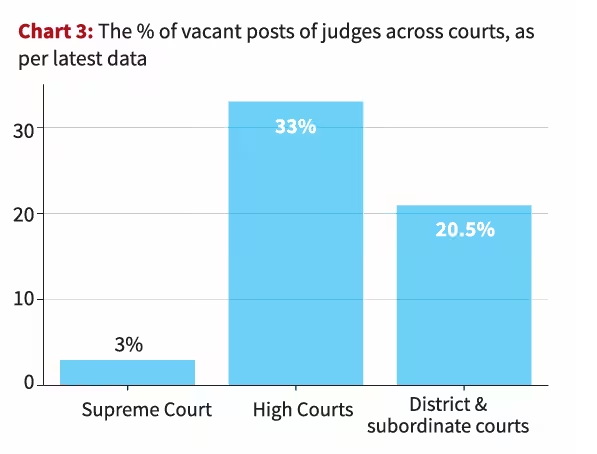
  • Over 86,700 cases are pending in the Supreme Court (SC), over 63.3 lakh cases in High Courts (HCs), and 4.6 crore cases in district and subordinate courts.
  • Added up, the total number of pending cases in India amounts to more than 5 crore

Causes:

  • Inadequate infrastructure and staff in courts like District courts, which handle 90% of total litigation, have only 18 judges per 10 lakh people, against the Law Commission’s 1987 recommendation of 50 judges per 10 lakh.
  • Frequent adjournments and absence of strict timelines for case stages (filings, hearings, witness examination).
  • Poor case management systems — no uniform scheduling or bundling of similar cases.
  • Lack of tracking and monitoring mechanisms.
  • Complexity of civil disputes, especially property and family matters.
  • Inadequate cooperation from key stakeholders (litigants, lawyers, witnesses).
  • All High Courts in the country normally have 210 working days only in a year.

An analysis of the justice delivery timeline in Indian courts:

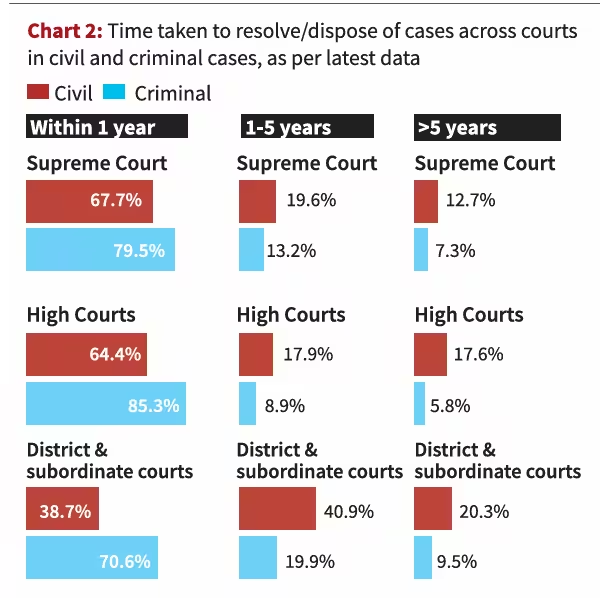
  • Criminal cases, generally considered as offences against the State, are resolved faster than civil ones, such as property, family or contractual disputes at every tier.
  • HC disposes 85.3% criminal cases within a year, followed by the SC at 79.5%, and district courts at 70.6%.
  • The real concern lies in civil litigation at the district level, which handles the bulk of India’s pending cases, where only 38.7% civil cases are resolved with-in a year, and nearly 20% stretch beyond five years.
  • A major systemic cause of judicial delay is the persistent gap between the sanctioned and actual strength of judges across courts
  • India’s judiciary functions at just 79% of its capacity.
  • Out of 26,927 sanctioned posts, 5,665 are vacant, resulting in overwhelming workloads.

Alternative dispute resolution:

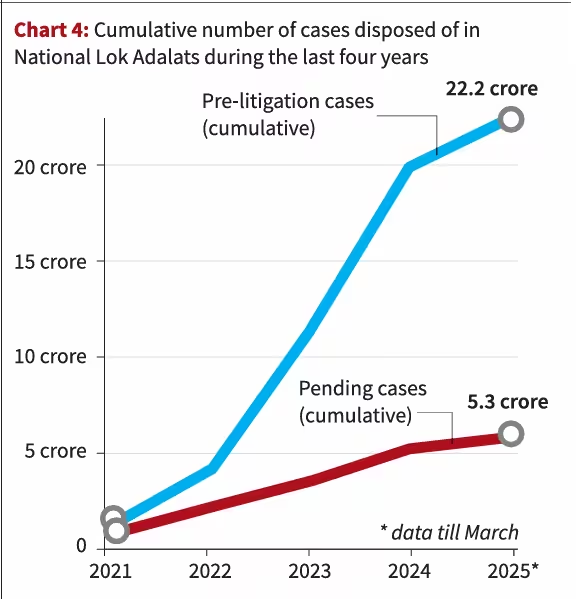
The success of National Lok Adalats, which are organised simultaneously in all taluks, district courts, and HCs on a pre-fixed date, demonstrates this potential, they resolved over 27.5 crore cases, including 22.21 crore pre-litigation and 5.34 crore pending court cases between 2021 to May 2025.

Reform measures Taken to resolve pending cases:

Increasing Judicial Strength:

  • Filling vacant judicial positions and potentially hiring retired judges to handle the backlog of cases are crucial steps.

Modernizing the Judiciary:

  • e-Courts and IT Enablement: Digitizing court records, online case filing, and virtual courts can streamline processes and improve efficiency.

National Judicial Data Grid (NJDG):

  • Expanding the NJDG can improve case tracking and analysis.

Streamlining Case Management:

  • Time-bound disposal of cases: Establishing timelines for case resolution can prevent delays and ensure timely justice.

Financial penalties on frivolous litigation:

  • Discouraging meritless cases can reduce the burden on courts.

Improving Infrastructure:

  • Upgrading court infrastructure, including better facilities for courtrooms and judicial staff, is essential for a conducive environment.

Legal Aid and Access to Justice:

  • Strengthening legal aid services, particularly for marginalized communities, can ensure that everyone has access to justice.

Judicial Outreach and Public Education:

  • Enhancing public awareness about legal processes and rights can reduce unnecessary litigation.

Fast-Track Courts:

  • Setting up fast-track courts to expedite the resolution of specific types of cases, such as those involving women and children, can help reduce pendency.

Legislative Amendments:

  • Reviewing and amending outdated laws can eliminate unnecessary legal complications and streamline procedures.

Timely justice is not merely an administrative challenge but a foundational requirement for a functional democracy. The massive pendency in the Indian judiciary erodes citizens’ confidence in the legal system and restricts access to justice, especially for the marginalized.

Justice hurried is justice burried

The Environment Protection (Management of Contaminated Sites) Rules, 2025

Open article →Download PDF

Why in news:

The Union Environment Ministry has notified new rules under the Environment Protection Act, 1986 that lays out a process to address sites that are chemically contaminated.

UPSC CSE Relevance:

UPSC CSE in mains and prelims examination has focused on environmental issues and laws related to them. A case in point is a following PYQ.

UPSC 2020 mains PYQ:

How does the draft Environment Impact Assessment (EIA) Notification, 2020 differ from the existing EIA Notification, 2006?

Contaminated Sites:

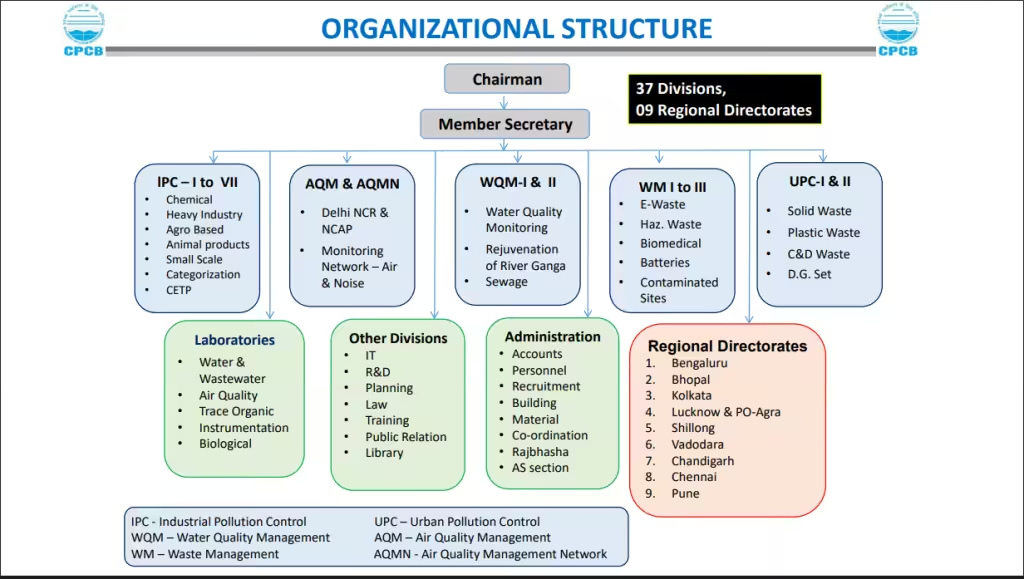
  • According to the Central Pollution Control Board, contaminated sites are those, where hazardous and other waste had been dumped historically.
    • These sites may include landfills, dumps, waste storage and treatment sites, spill sites, and chemical waste handling and storage sites.

Why a problem?

  • Polluters have either shut their operations or the cost of remediation is beyond their capacity. Thus the sites remain a threat to the environment.
  • Remedial operation has commenced only in 7 of the 103 such sites in the country.

RULES:

Identification of contaminated sites:

  1. The local body or District Administration, on its own or on receipt of a complaint from the public, shall identify an area affected with contaminants and list all such areas as suspected contaminated sites in its jurisdiction on a centralized online portal.
    • a) The local body or District Administration shall furnish the list to the State Pollution Control Board or the Pollution Control Committee  periodically on a half-yearly basis.
  2. The State Pollution Control Board or the Pollution Control Committee, or a reference organisation, would examine these sites and provide a preliminary assessment within 90 days of being informed.
  3. Following these, it would have another three months to make a detailed survey and finalise if these sites were indeed “contaminated”.

Remediation and Liabilities:

  • A “reference organisation” – basically a body of experts – would be tasked with specifying a remediation plan.
  • The State Board would also have 90 days to identify the person(s) responsible for the contamination. Those deemed responsible would have to pay for the cost of remediation of the site, else the Centre and the State under a prescribed arrangement would arrange for the costs of clean-up.
  • Any criminal liability, if it is proved that contamination such caused loss of life or damage would be under the provisions of the Bharatiya Nyaya Sanhita (2023),”

Application – These Rules shall not apply to a contaminated site affected by – 

  • solid waste from dump site
  • radioactive waste
  • mining operations 
  • pollution of the sea by oil or oily substance 

About Central Pollution Control Board:

  • Statutory organisation, was constituted in September, 1974 under the Water (Prevention and Control of Pollution) Act, 1974.
  • CPCB was entrusted with the powers and functions under the Air (Prevention and Control of Pollution) Act, 1981.
  • It serves as a field formation and also provides technical services to the Ministry of Environment and Forests of the provisions of the Environment (Protection) Act, 1986.
  • H.Q- New Delhi

New Education Policy – A Critical Appraisal

Open article →Download PDF

Why in news:

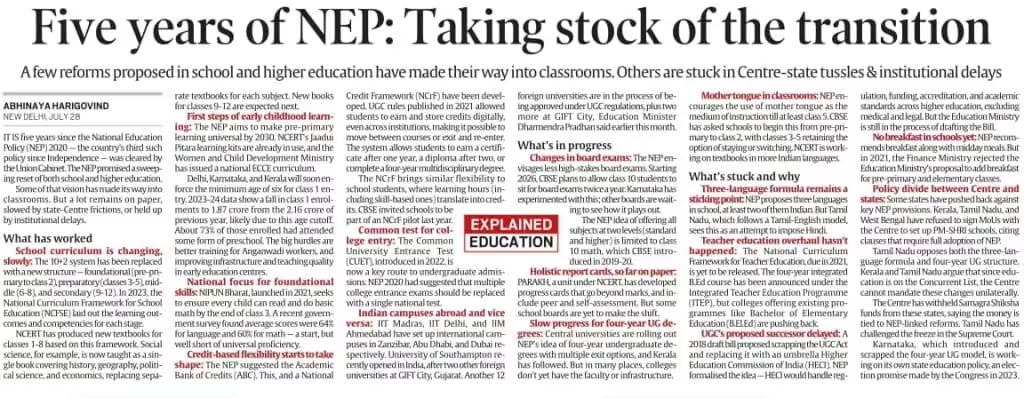
It is five years since the National Education Policy (NEP) 2020 – the country’s third such policy since Independence – was cleared by the Union Cabinet. It promised a sweeping reset of both school and higher education. Some aspects have already been implemented while some others have remained on paper amidst Center State friction and institutional delays.

UPSC CSE Relevance:

UPSC CSE in mains and prelims examination has focused on Government policies and interventions for development in various sectors and Issues relating to development and management of Social Sector/Services relating to Health, Education, Human Resources. As we can see PYQ related to this.

UPSC 2022 mains PYQ:

The Right of Children to Free and Compulsory Education Act, 2009 remains inadequate in promoting incentive-based system for children’s education without generating awareness about the importance of schooling. Analyse

About New Education Policy, 2020:

  • It is the first education policy of the 21st century and replaces the 34-year-old National Policy on Education (NPE), 1986.
  • The new Curricular Structure of  (5+3+3+4) replaces the traditional 10+2 school structure.
  • Aims to increase public investment in education to 6% of GDP (from around 4.43% currently).
  • Holistic and multidisciplinary education with no rigid separation of streams, integration of vocational education and emphasis on 21st-century skills.
  • Promotes multilingualism and mother Tongue by recommending teaching in the home language/mother tongue/local language/regional language until at least Grade 5. Continues with the three-language formula, emphasizing Indian languages.
  • A new National Assessment Centre, PARAKH (Performance Assessment, Review, and Analysis of Knowledge for Holistic Development), to be set up as a standard-setting body.
  • Shift from summative to formative assessment focusing on regular, competency-based assessments that promote learning and development, testing higher-order skills.
  • Focus on teacher education and development by developing National Professional Standards for Teachers (NPST) and 4 year integrated B. ED.
  • Higher education reforms with common entrance exam, multiple Entry/Exit Options, Academic Bank of Credits (ABC) and a Higher Education Commission of India (HECI) as a single overarching umbrella body for higher education, replacing multiple regulatory bodies like UGC and AICTE.
  • Integration of technology by establishing National Educational Technology Forum (NETF) and via digital learning platforms like DIKSHA, SWAYAM, and National Digital Library.
  • Promoting inclusive education  by focusing on Socially and Economically Disadvantaged Groups (SEDGs), including gender identities, socio-cultural identities, and geographical identities.

What has worked?

  • School curriculum is changing : The 10+2 system has been replaced with a new structure – foundational (pre-pri-mary to class 2), preparatory (classes 3-5), middle (6-8), and secondary (9-12).
    • In 2023, the National Curriculum Framework for School Education (NCFSE) laid out the learning outcomes and competencies for each stage.
    • NCERT has produced new textbooks for classes 1-8 based on this framework
    • Primary Education : The NEP aims to make pre-primary learning universal by 2030.
      • NCERT’s Jaadui Pitara learning kits are already in use.
      • the Women and Child Development Ministry has issued a national ECCE curriculum.
    • National focus for foundational skills: NIPUN Bharat, launched in 2021, seeks to ensure every child can read and do basic math by the end of class 3.
      • A recent govern-ment survey found average scores were 64% for language and 60% for math – a start, but well short of universal proficiency
    • Flexibility in Education : Academic Bank of Credits (ABC) for higher education and a National Credit Framework for School education have been developed to exit and enter courses flexibly.
    • Common test for college entry: The Common University Entrance Test (CUET), introduced in 2022, is now a key route to undergraduate admissions and CUET PG fir postgraduate admissions.
    • Indian campuses abroad and vice versa: IIT Madras, IIT Delhi, and IIM Ahmedabad have set up international cam-puses in Zanzibar, Abu Dhabi, and Dubai respectively. University of Southampton recently opened in India, after two other foreign universities at GIFT City, Gujarat.
    • Changes in board exams: The NEP envisages less high-stakes board exams. Starting 2026, CBSE plans to allow class 10 students to sit for board exams twice a year. Karnataka has experimented with this; other boards are waiting to see how it plays out.

    What is stuck ?

    • Holistic report cards, so far on paper : PARAKH, a unit under NCERT, has developed progress cards that go beyond marks, and include peer and self-assessment. But some school boards are yet to make the shift.
    • Slow progress for four-year UG degrees: Central universities are rolling out NEP’s idea of four-year undergraduate degrees with multiple exit options, and Kerala has followed. But in many places, colleges don’t yet have the faculty or infrastructure.
    • The three-language formula was not received well : NEP proposes three languages in school, at least two of them Indian. But Tamil Nadu, which follows a Tamil-English model, sees this as an attempt to impose Hindi. A similar controversy erupted in Maharashtra also recently.
    • Teacher education overhaul hasn’t happened: The National Curriculum Framework for Teacher Education, due in 2021, is yet to be released. The four-year integrated B.Ed course has been announced,  but colleges offering existing programmes like Bachelor of Elementary Education (B.El.Ed) are pushing back.
    • Delay in establishing HECI: A 2018 draft bill proposed scrapping the UGC Act and replacing it with an umbrella Higher Education Commission of India (HECI) but the Education Ministry is still in the process of drafting the Bill.
    • No breakfast in schools yet: NEP recommends breakfast along with midday meals. But in 2021, the Finance Ministry rejected the Education Ministry’s proposal to add breakfast for pre-primary and elementary classes.
    • Policy divide between Centre and states: Some states have pushed back against key NEP provisions. Kerala, Tamil Nadu, and West Bengal have refused to sign MoUs with the Centre to set up PM-SHRI schools, citing clauses that require full adoption of NEP.

    Way Ahead:

    • Structured Inter-State Forums: Revitalize and utilize bodies like the Inter-State Council and NITI Aayog‘s Governing Council for regular, high-level discussions and consensus-building on NEP implementation. These should not be mere consultation platforms but genuine decision-making forums.
    • “One Size Does Not Fit All”: The Centre should provide broad guidelines and a national vision, but allow states the flexibility to adapt implementation strategies to their local contexts, linguistic diversity, and resource availability. This is crucial for successful adoption.
    • Increased and Predictable Funding: The Centre must honor the commitment to increase public investment in education to 6% of GDP, and this funding should be predictable and sufficient for states to plan long-term reforms.
    • Performance-Linked Incentives: Link a portion of central funds to clear, outcome-based performance indicators related to NEP goals, rather than just input-based compliance. This incentivizes states to achieve results.
    • Phased Infrastructure Development: Prioritize essential infrastructure development (e.g., basic amenities, digital labs, libraries) in a phased manner, focusing on areas with the greatest need.
    • Public-Private Partnerships (PPPs): Explore ethical and transparent PPP models for funding infrastructure development and specialized vocational training, ensuring equity and quality.
    • Robust Data Systems: Develop and implement robust, integrated data collection and management systems at national, state, and institutional levels to track progress, identify gaps, and inform policy adjustments.
    • Outcome-Based Monitoring: Shift from mere input-based monitoring to outcome-based evaluation, focusing on actual learning outcomes and skill development.

    Index of Industrial Production

    Open article →Download PDF

    Why in news:

    India’s industrial growth (as measured by the Index of Industrial Production or IIP) slowed down to a 10-month low of 1.5% in June 2025, compared to 1.9% in May 2025. This is a significant economic indicator showing weakness in industrial momentum.

    UPSC CSE Relevance:

    This article is relevant for GS Paper III (Indian Economy) as it highlights trends in industrial growth and sectoral performance under the Index of Industrial Production (IIP). It aids in understanding economic slowdowns, structural issues in key sectors like mining and electricity, and their implications on policy and planning.

    UPSC CSE PYQ 2015:

    In the ‘Index of Eight Core Industries’, which one of the following is given the highest weight?

    A. Steel production

    B. Coal production

    C. Electricity generation

    D. Fertilizer production

    About IIP:

    •  The Central Statistical Organisation (CSO) is responsible for the compilation and publication of the Index of Industrial Production (IIP) since 1950. 
    • It measures the change in industrial production in an economy.
    • Published monthly by the Central Statistics Office (CSO).
    • The base year for this is 2011–12.

    Categorization Of IIP:

    Sectoral based:

      • Mining
      • Manufacturing
      • Electricity.

      Note: Highest weightage-Manufacturing. 

      Use base Classification:

      Note: Highest Weightage-Primary goods

      Primary Goods:- Primary goods are goods that are directly obtained from natural sources. They are primarily used for further processing or direct consumption.

      Examples: Ores and Minerals and Electricity

      Capital goods: Plants, machinery and goods used for further investments. E.g.: Boilers, Air & Gas Compressors, Engines including Internal Combustion and Diesel Engine, Tractors (complete), Transformers, Commercial Vehicles and all machineries like Textile Machinery, Printing Machinery etc.

      Intermediate goods: Any good/ product produced as incomplete product or which goes as input in production for further finishing or forming a part of a product. E.g.: Cotton yarn, Plywood, Steel Tubes/ Pipes, Fasteners, etc.

      Infrastructure/ construction goods: Finished goods which are primarily used in infrastructure industry or construction industry as an input. This category has been created to precisely categorise items which could not be classified under Consumer durables or Intermediate goods. E.g.: paints, cement, cables, bricks and tiles, rail materials, etc.

      Consumer durables: Products directly used by consumers and having a longer durability (more than 2/3 years). E.g.: Pressure Cooker, Air Conditioners, Tyres, Telephone and mobile instruments, TV Sets, Passenger cars, Two-wheelers (motorcycles/ scooters), Jewellery of gold etc.

      Consumer non-durables: Products that are directly used by consumers and can’t be preserved for long periods. E.g.: Soyabean Oil, Full-cream/ Toned/ Skimmed milk, Milk Powder, Maida, Rice, Biscuits/ cookies, Sugar, Tea, Cigarettes, etc.

      Eight Core Industries:

      The Index of Eight Core Industries evaluates the collective and individual performance of selected key industries in terms of production.

      • The eight core industries, in descending order of their weight: Refinery Products (28.04%) > Electricity (19.85%) > Steel (17.92%) > Coal (10.33%) > Crude Oil (8.98%) > Natural Gas (6.88%) > Cement (5.37%) > Fertilizers (2.63%)
      • These eight major industries account for 40.27% of the items included in the Index of Industrial Production (IIP).
      • The index is compiled and published by the Office of the Economic Adviser (OEA) under the Department for Promotion of Industry and Internal Trade (DPIIT), Ministry of Commerce and Industry, Government of India.

      Practice Question:

      Which of the following have the highest and lowest weight among the eight core industries?

      a) Coal, Electricity
      b) Cement, Steel
      c) Refinery Products, Fertilizers
      d) Crude Oil, Natural Gas