Join Anantam IAS Channel on Telegram

Daily Digest · Tuesday

31 March 2026 Current Affairs for UPSC

5 current affairs published on Tuesday, 31 March 2026

31 March 2026 Current Affairs for UPSC — every Why-in-News article AnantamIAS published on Tuesday, 31 March 2026, broken down with Why in News?, the exact GS paper it feeds, sub-topic mapping, MCQ-ready facts and a UPSC-style practice question. 5 articles in total, covering Polity, Economy, Environment, S&T, IR, Geography, History, Society and Internal Security — the same Why-in-News + GS-paper-mapping + practice-question format the Compass uses across every daily digest on the site.

Daily current affairs for UPSC is where new material enters your prep stream. Read this 31 March 2026 digest end-to-end in 25–35 minutes, attempt the practice question at the foot of each article (it's MCQ for some, 10/15-marker for others), then bookmark the entries that fall inside your active revision window. Everything stays cross-linked: tap any subject pill to jump to that subject's hub, or use the table of contents above to skip straight to a specific story.

Use this page three ways. Read sequentially for a one-sitting scan of everything that mattered on 31 March 2026. Download the 31 March 2026 PDF below for offline study or print revision. Or use the March 2026 Current Affairs compilation to see this day in the month's full context. For the previous day's reading, see 30 March 2026 Current Affairs; the next day's is 1 April 2026 Current Affairs.

Why we publish daily current affairs separately from the monthly compilation: daily is learning, monthly is revision. Use the daily page to add fresh material to your notes the day it breaks; come back to the March 2026 compilation 60 days before Prelims when the noise has settled and only the lasting takeaway is worth re-reading.

Artemis II: Lunar Flyby Mission

Open article →Download PDF

Why in News?

  • The final countdown for Artemis II (Lunar Flyby Mission) has begun, with launch scheduled for 1 April 2026. It is NASA’s first crewed mission beyond low Earth orbit in over five decades since the Apollo era. 
UPSC Relevance: (GS-3 Science and Technology: Space Technology)

Prelims: Artemis Mission

What is Artemis Mission?

  • Artemis is a series of missions for Lunar exploration. 
  • Joint Mission: Led by the National Aeronautics and Space Administration (NASA), along with the European Space Agency (ESA), Japan Aerospace Exploration Agency (JAXA), and the Canadian Space Agency (CSA).
  • Aim: To send astronauts to the lunar south pole and eventually establish a permanent presence (base) on the Moon. To use Moon as a launch pad for deep space explorations and human missions to Mars.

Key Missions under Artemis:

  • Artemis 1: Uncrewed test flight of the Orion spacecraft around the Moon (launched in 2022). 
  • Artemis 2: Lunar flyby mission (fly astronauts around the Moon and back without landing); planned in 2026. First crewed mission of the Artemis programme.
  • Artemis 3: Mission to test docking and landing systems in lunar orbit; planned launch in 2027.
  • Artemis 4: Landing crewed mission near the lunar South Pole; planned launch in 2028. It was originally intended to deliver astronauts to the Lunar Gateway (a proposed space station in lunar orbit). However, recent updates (2026) indicate possible changes in mission architecture or reduced emphasis on Lunar Gateway. 

Artemis II Mission:

  • Launch target: April 2026
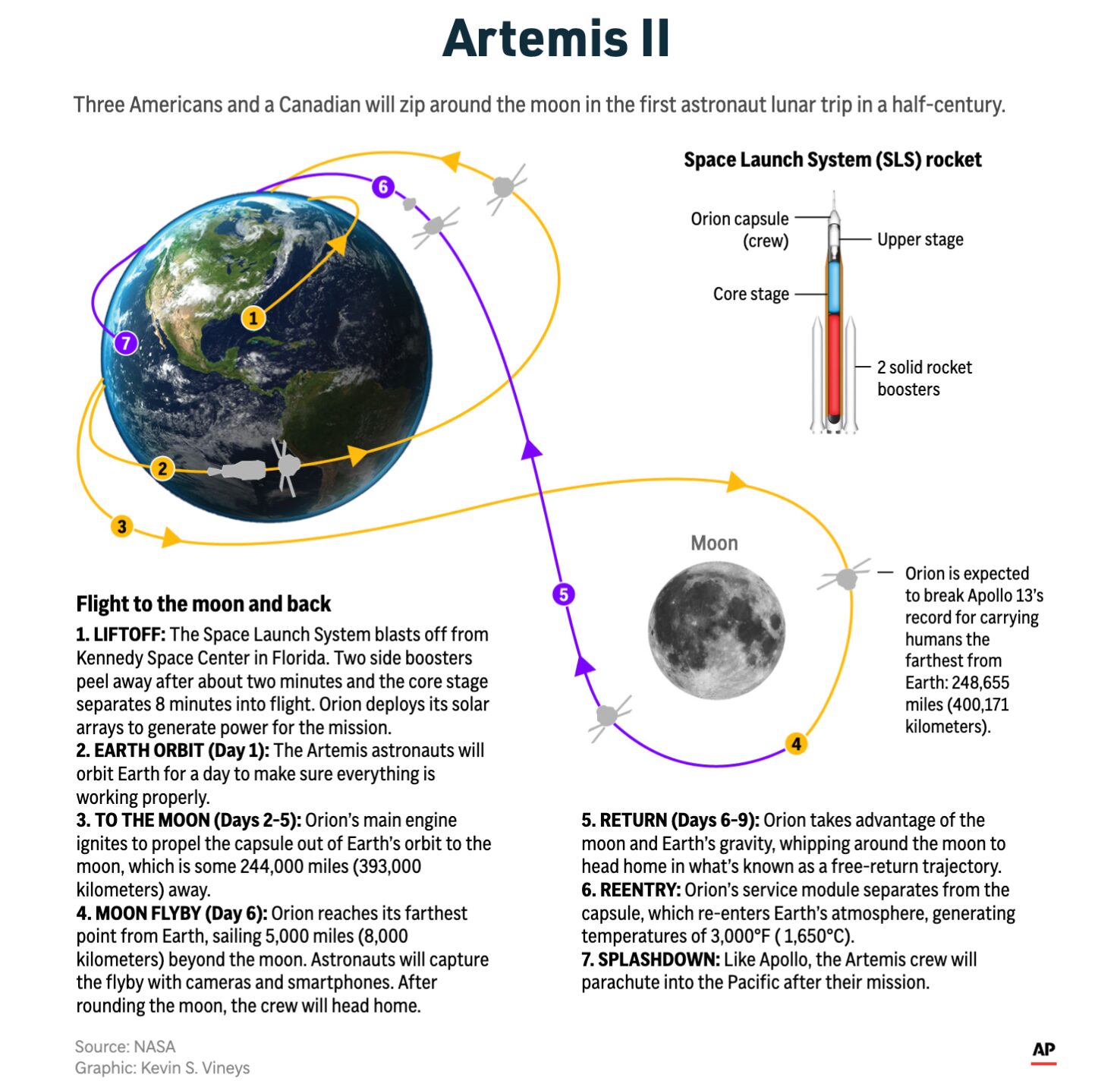
  • A 10-day-long lunar crewed mission where four astronauts will fly around the Moon and return to Earth without landing.
  • Aim: To test and stress Orion’s life-support systems to make sure that it is capable of supporting astronauts to live and work in deep space, and collect valuable flight test data.
  • Lunar free return trajectory: Earth’s gravity will naturally pull the spacecraft back home after flying by the Moon. The spacecraft does not need any propulsion on its return journey. It takes advantage of the Earth-Moon gravity field.
  • It will be the second flight of the Space Launch System (SLS), the first crewed mission of the Orion spacecraft, and the first crewed mission beyond low Earth orbit since Apollo-17 in 1972. 
Artemis II

Practice MCQ:

Q. With reference to the Artemis II mission, consider the following statements:

1. It is the first crewed mission of the Orion spacecraft and the second flight of the Space Launch System (SLS).

2. The mission involves landing astronauts near the lunar South Pole.

3. The spacecraft will follow a free-return trajectory without requiring propulsion for the return journey.

4. It will be the first crewed mission beyond low Earth orbit since Apollo 17 in 1972.

Which of the statements given above are correct?

(a) 1, 3 and 4 only

(b) 1 and 2 only

(c) 2 and 3 only

(d) 1, 2, 3 and 4

Answer: (a)

    UPSC PYQ 2020

    Q. “The experiment will employ a trio of spacecraft flying in formation in the shape of an equilateral triangle that has sides one million kilometres long, with lasers shining between the craft.” The experiment in question refers to:

    (a) Voyager-2

    (b) New Horizons 

    (c)  LISA Pathfinder

    (d)  Evolved LISA

    Answer: (d) 

    S-400 Air Defence System: Strategic Deterrent for India

    Open article →Download PDF

    Why in News?

    India is set to receive the remaining two units of the S-400 air defence system from Russia by 2026. Additionally, the Indian Defence Ministry’s Defence Procurement Council has approved the purchase of five more Russian S-400 long-range air defence systems

    UPSC Relevance: (GS-3 Science and Technology: Defence Technology)

    Prelims & Mains: S-400 Air Defence System

    What is the S-400 Air Defence System?

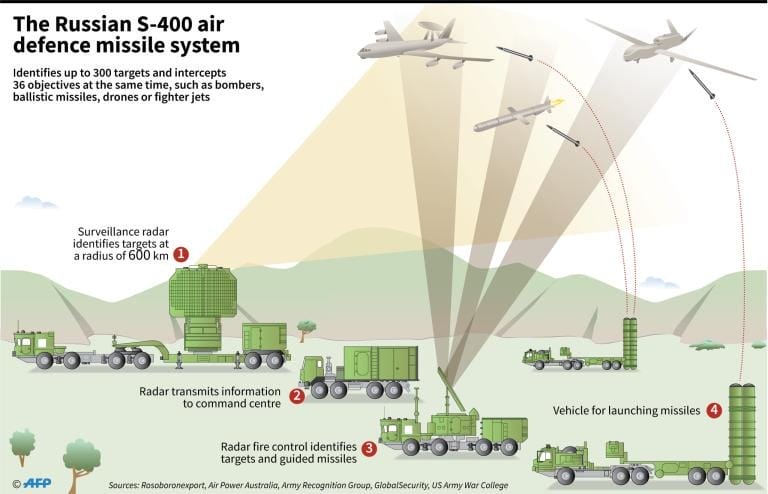
    • S-400 Triumf is considered one of the world’s most advanced air defence systems that can simultaneously track and neutralise a range of incoming objects over very long ranges.
    • Developed by Russia. S-400 is a successor to the S-300 system. 
    • The surface-to-air missile system can provide air interception against:
      • fighter aircraft, stealth aircraft, AWACS aircraft 
      • airborne missile strategic carriers
      • unmanned aerial vehicles 
      • ballistic missiles and cruise missiles
    • The S-400 is fully mobile. Capable of firing four types of missiles to create a layered defence net for up to 40 km, 120 km, 250 km and a maximum range of 400 km.
    • Altitude: It can destroy targets at a height of 10 metres to 30 Kilometres. The different ranges and varying altitudes create a layered air defence net. 
    • Each system has a 3D phased array acquisition radar that can track around 300 targets, a command and control centre, automatic tracking and targeting systems, launchers and support vehicles. 

    India signed a $5.43 billion deal with Russia in 2018 for five squadrons of the S-400 system. Russia has delivered three units- deployed in Pathankot (Punjab), Rajasthan, and Gujarat. The remaining units will be delivered to India by 2026. Despite the fear of sanctions from the US under the Countering America’s Adversaries Through Sanctions Act (CAATSA), India and Russia signed a contract. 

    Why is the S-400 important for India? 

    S-400 has been named ‘Sudarshan Chakra’, inspired by the mythological weapon of Lord Krishna.

    • Proven layered air defence system: The S-400 system has already demonstrated its operational effectiveness. During Operation Sindoor (2025), the deployed systems played a critical role in intercepting and neutralising incoming missiles and drones, significantly bolstering India’s air defence capabilities. 
    • Complements India’s indigenous Ballistic Missile Defence system developed by the Defence Research and Development Organisation (DRDO).
    • Fills gaps in the Indian Air Force (IAF): The S-400 would make up for its falling fighter aircraft squadrons in the medium term. 
    • Strong deterrence: Given its long range, the system can track the movements of Pakistan Air Force aircraft. Enhances India’s strategic deterrence against China. 

    The S-400 can be seamlessly integrated into the country’s existing air defence network, thereby strengthening national security against evolving aerial threats. 

    Practice MCQ:

    Q. Consider the following statements regarding the S-400 air defence system:

    1. It is a long-range surface-to-air missile system developed by Russia.

    2. It can engage aircraft, cruise missiles and ballistic missiles.

    3. It is a submarine-launched missile system.

    Which of the statements given above is/are correct?

    (a) 1 and 2 only

    (b) 2 only

    (c) 1 and 3 only 

    (d) 2 and 3 only 

    Answer: (a)

    UPSC Mains PYQ (2021)

    Q. How is the S-400 air defence system technically superior to any other system presently available in the world? 

    UPSC PYQ 2014

    Q. Which reference to Agni-IV Missile, which of the following statements is/are correct? 

    (1) It is a surface-to-surface missile.

    (2) It is fuelled by liquid propellant only.

    (3) It can deliver one-tonne nuclear warheads about 7500 km away.

    Select the correct answer using the code given below.

    (a) 1 only

    (b) 2 and 3 only

    (c) 1 and 3 only

    (d) 1, 2 and 3

    Answer: (a)

    IOC bans Transgender athletes from Women’s Sports

    Open article →Download PDF

    Why in News?

    • The International Olympic Committee (IOC) has announced a new Policy on the Protection of the Female (Women’s) Category in Olympic Sport.
    UPSC Relevance: (GS-3 Science and Technology: Biology & Biotechnology)

    Prelims: SRY gene; Chromosomes

    What is the new Policy?

    • Eligibility for any female category event at the Olympic Games or any other IOC event (including individual and team sports) is now limited to biological females, determined based on a one‑time SRY gene screening.
      • The eligibility for participation in women’s sporting events will be determined according to sex, and not gender identity or testosterone reduction.
      • This policy will exclude transgender and intersex people from participation in any female category event. 
    • Rationale: As per IOC, it aims to ensure fairness, safety and integrity in elite competition and protection of the female (women’s) category.  
    • The policy is applicable from the LA28 Olympic Games onwards (Los Angeles, the US, 2028).

    What is the SRY gene? 

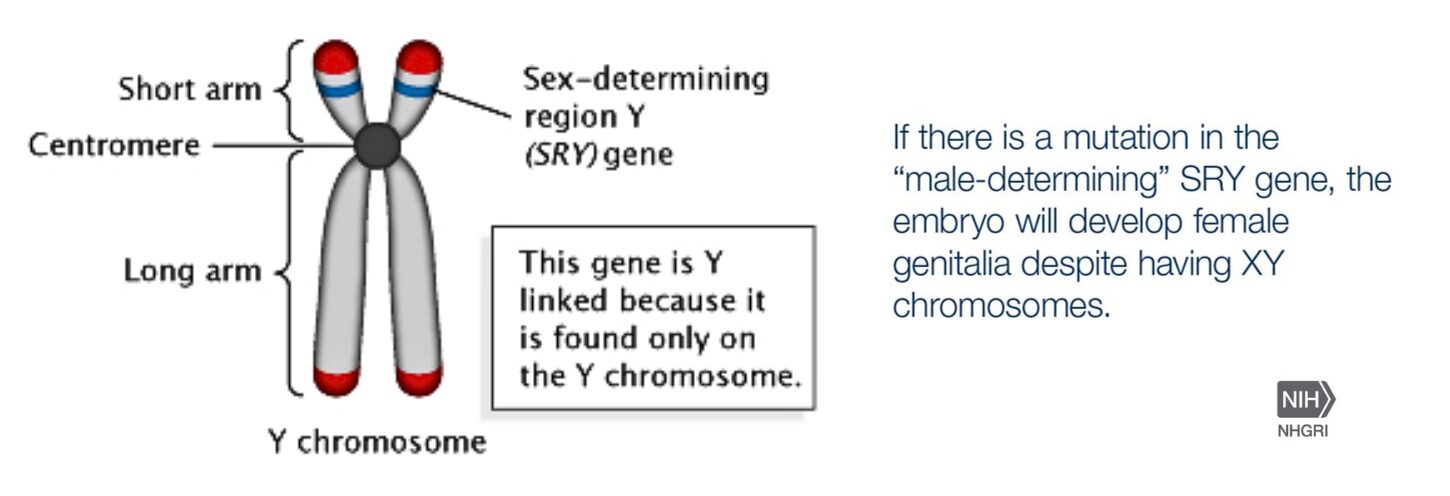
    • SRY stands for Sex-determining Region of the Y chromosome.
    • SRY is a gene located on the Y chromosome. It plays a crucial role in sex determination during early embryonic development.
      • The SRY gene triggers the development of testes in the embryo. The testes produce testosterone and other hormones. These hormones lead to the development of male reproductive organs and male secondary sexual characteristics.
    • Disorder of Sex Development (DSD):
      • Swyer syndrome: A person has XY chromosomes but develops female external reproductive organs. Occurs due to a non-functional SRY gene or related genetic factors. 
    • SRY gene screening: A non-intrusive saliva or buccal smear test is used to detect the presence or absence of the SRY gene located on the Y chromosome. 
    Key Facts (SRY gene):
    Present only on the Y chromosome. 
    Found only in genetic males (XY). 
    Absent in genetic females (XX)

    Sex and Gender

    1. Sex:

    • Sex (male/female/intersex) is the distinction based on reproductive biology. Sex in humans is determined by chromosomes, which carry genes responsible for development.
    • Humans have 23 pairs of chromosomes:
      • 22 pairs are the same in males and females (autosomes)
      • 1 pair is different, called the sex chromosome.
    • Chromosome combination:
      • XX: Female sex organs develop
    • XY: Male sex organs develop

    2. Gender:

    • Gender is a social construct: It is a person’s sense of themselves as a woman, a man or neither/non-binary. 
    • Gender identification can be different from sex. E.g., a transgender woman may have been born with male sex characteristics, but identify as a woman.

    Practice MCQ: 

    Q. With reference to the SRY gene, consider the following statements:

    1. SRY stands for Sex-determining Region of the Y chromosome.

    2. The SRY gene initiates the development of testes in the embryo.

    3. In the absence of SRY gene activity, the embryo typically develops female characteristics.

    Which of the statements given above are correct?

    (a) 1 and 2 only

    (b) 2 and 3 only

    (c) 1 and 3 only

    (d) 1, 2, and 3 

    Answer: (d) 

    UPSC PYQ 2021

    Q. The term ‘ACE2’ is talked about in the context of

    (a) genes introduced in the genetically modified plants

    (b) development of India’s own satellite navigation system

    (c) radio collars for wildlife tracking

    (d) spread of viral diseases

    Answer: (d) 

    CSS Fund Flow & Last-Mile Delivery

    Open article →Download PDF

    Why in News?

    Recently the Parliamentary Standing Committee on Public Grievances, Law and Justice raised concerns about:

    What is the Core Issue?

    India releases welfare money from the Centre to states — but a large chunk sits unused in bank accounts. People don’t get houses built, wages paid, or services delivered — not because money is absent, but because the system of spending it is broken.

    Think of it like this: Water reaches the city’s main tank (fund released), but the pipes to individual homes are blocked (last-mile delivery fails).

    Key Terms

    TermMeaning
    CSS (Centrally Sponsored Schemes)Central govt schemes where both Centre + State share costs (e.g., PMAY, MGNREGS, Jal Jeevan Mission)
    SNA (Single Nodal Agency)One state-level bank account for each CSS, introduced in 2021–22 to consolidate funds
    JIT (Just-In-Time) FundingRelease money only when it’s about to be used — not in advance — to reduce idle cash
    SNA-SPARSHUpgraded system (Jan 2024) that releases Centre + State funds faster and directly to beneficiaries
    PFM (Public Financial Management)The system of planning, releasing, tracking, and auditing government money
    CAGComptroller and Auditor General — India’s top auditor of government accounts

    Background: How Did We Get Here?

    CSS — Scale of the Problem

    • CSS accounts for more than half of all Union-to-State fund transfers
    • That’s roughly 1.5% of GDP every year
    • Yet as of December 2024, ₹1,60,000 crore of welfare money was sitting unspent in bank accounts

    The money was released. The accounts existed. The schemes were active. But nothing moved.

    EVOLUTION OF REFORMS

    Reforms Done So Far to Improve Fund FlowIndia has taken several steps to fix the problem of idle money:

    Year/PeriodReformWhat it did
    2014-15Rationalisation of CSSReduced number of schemes; funds routed through State Consolidated Fund for better legislative oversight
    2021-22Single Nodal Agency (SNA)All funds for one scheme in a state go to one single bank account instead of many accounts
    January 2024SNA-SPARSH (Just-in-Time funding)Upgraded SNA system; releases money directly and faster to beneficiaries or implementing agencies only when needed (like real-time/just-in-time payment)

    SNA-SPARSH integrates:

    • Public Financial Management System (PFMS)
    • State Integrated Financial Management Information System (IFMIS)
    • RBI’s e-Kuber

    Benefits of SNA-SPARSH:

    • Reduces idle funds sitting in banks.
    • Lowers states’ short-term borrowing costs.
    • Improves transparency and budget forecasting.
    • Centre and State shares can be released together.

    Positive impact:

    • In Union Budget 2026-27 context, unutilised funds in revised estimates dropped sharply — from 42% (₹1.6 lakh crore) in 2024-25 to 18% (₹69,000 crore) by December 2025.
    • In states that adopted SNA-SPARSH for PMAY-R (rural housing), idle funds dropped by 85%

    But the Problem Isn’t Fully Solved

    Even though idle funds fell 85% in PMAY-R states, the actual utilisation rate stayed at only 14%.

    Faster fund flow ≠ Faster spending on the ground.

    Also, from Statement 4AA of the Union Budget:

    • 38 out of 50 CSS schemes used less than 50% of allocated funds by December 2025

    The problem has shifted — money is no longer stuck in bank accounts, but scheme-implementing agencies are not claiming and spending it in time.

    Where Exactly is the Blockage? (Last-Mile Friction)

    A CAG Report on PMAY-R in Tamil Nadu identified specific bottlenecks:

    BottleneckWhat it means
    Manual processesPaperwork done by hand instead of digitally — slow and error-prone
    Multiple verification layersToo many approvals needed before money moves
    Wrong bank account mappingBeneficiary bank details entered incorrectly — payment fails
    No defined turnaround timesNo deadline for how fast each step must be completed

    These are procedural and physical problems — not financial ones.

    What is the 16th Finance Commission’s Observation?

    The 16th Finance Commission (currently being constituted for the 2026–31 period) flagged a related issue:

    • Without credible data on spending efficiency, schemes that have outlived their purpose keep running — because there’s no formal mechanism to wind them down.

    This means public money keeps getting allocated to zombie schemes year after year.

    The Way Forward:

    1. Digital Public Financial Management (PFM)

    It means using integrated digital systems to track government funds from allocation to final spending, ensuring transparency and reducing leakages. It helps in better budgeting, monitoring, and timely release of funds.

    2. Observability

    It refers to real-time visibility of where funds are lying and how they are being used, enabling quick identification of delays or inefficiencies in the system.

    3. Rule-Based Workflows

    These are predefined automated processes where approvals and fund releases happen based on set rules, reducing human discretion, delays, and bureaucratic hurdles.

    4. Milestone-Based Payments

    Funds are released in phases only after achieving specific targets (like completion of a house stage), ensuring accountability and preventing misuse of funds.

    5. Real-Time Processing

    It ensures instant fund transfer and transaction updates without waiting for batch processing, thereby speeding up implementation and reducing idle funds.

    6. Fix Last-Mile Governance

    This involves strengthening local administration (district/block level) with better capacity, clear accountability, and simplified procedures to ensure actual delivery of services.

    Conclusion

    India has significantly improved fund flow efficiency through reforms like SNA-SPARSH, but the persistence of low utilisation highlights deeper administrative and procedural bottlenecks at the implementation level. The next phase of reform must focus on last-mile governance by integrating digital public financial management, improving accountability, and ensuring real-time monitoring to translate financial allocations into tangible developmental outcomes.

    Mains Questions

    1. “Despite reforms like SNA and SNA-SPARSH, CSS fund utilisation remains low. Examine the structural reasons and suggest a way forward.”
    2. “Just-in-time funding alone cannot ensure last-mile delivery of welfare schemes. Comment.”
    3. “Critically analyse the role of digital public financial management in improving governance of Centrally Sponsored Schemes.”

    Is Delimitation a Threat to Cooperative Federalism?

    Open article →Download PDF

    Why in News?

    Delimitation is expected after the 2026 Census, as the freeze on Lok Sabha seats (since 1976, extended in 2002) will end. This raises concerns about fair representation and federal balance, especially between high- and low-population growth states.

    UPSC Relevance:

    GS-II: Polity & Governance, Federalism, Democracy, Population Policy.

    What is Delimitation?

    Delimitation means redrawing the boundaries of parliamentary and assembly constituencies, and redistributing the number of seats in Lok Sabha and State Legislatures based on the latest population (Census) data.

    It is done by a Delimitation Commission set up under the Delimitation Commission Act.

    Constitutional Background

    ProvisionWhat it says
    Article 81Lok Sabha seats must be distributed among states so that the ratio of seats to population is roughly equal for all states
    Article 82After every Census, Parliament must readjust constituencies via a Delimitation Act
    84th Constitutional Amendment, 2002Froze the number of Lok Sabha & Assembly seats until the first Census after 2026 — as an incentive for states to control population growth Note: Earlier 42nd Amendment (1976) Froze seats till 2001

    So the next delimitation will happen after Census 2026, results of which are expected by 2028, followed by a new Lok Sabha in 2029.

    What Will Happen After 2026?

    • Census likely in 2026
    • Results by ~2028
    • Delimitation Commission will be formed
    • New seat allocation before 2029 Lok Sabha elections

    Why the North-South Divide is the Core Problem?

    This is the heart of the controversy.

    • Southern states (Tamil Nadu, Kerala, Karnataka, Andhra Pradesh, Telangana) controlled their population growth successfully decades ago.
    • Northern states (Uttar Pradesh, Bihar, Madhya Pradesh, Rajasthan — earlier often called BIMARU states) grew much faster.

    If seats are allocated purely on population, southern states will lose seats (or gain far fewer) compared to northern states, despite having better governance.

    This feels deeply unfair to the south — they are being penalised for good performance.

    The TFR (Total Fertility Rate) Data

    TFR = Average number of children born per woman.
    A TFR of 2.1 = replacement level (population stabilises).

    YearStates at TFR ≤ 2.1
    2005–06 (NFHS-3)9 states: HP, Punjab, Delhi, Goa, AP, Karnataka, Kerala, Tamil Nadu
    2019–21 (NFHS-5)Almost all major states EXCEPT Bihar, UP, Jharkhand, Meghalaya, Manipur

    Whats the Solution? DemPer (Demographic Performance) Principle:

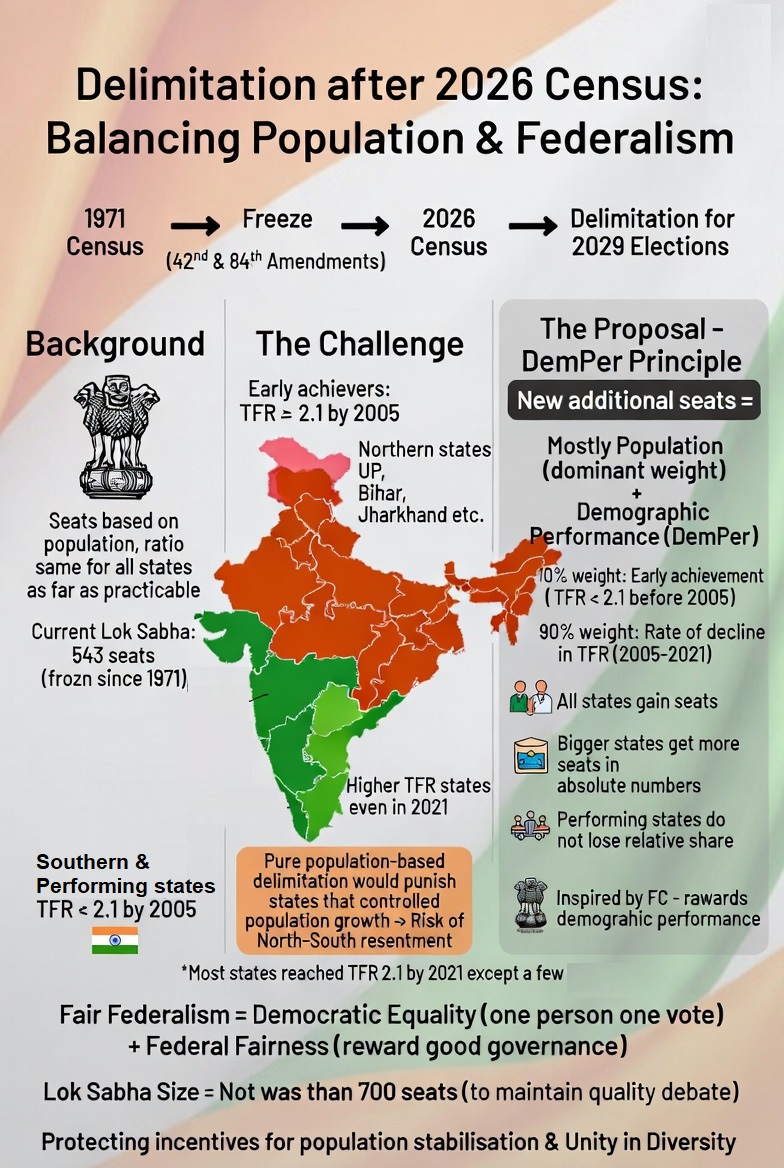
    It is a two-factor model for seat allocation, borrowing logic from the Finance Commission.

    Finance Commission Parallel

    • The Finance Commission already rewards demographic performance — it uses population (50% weight) + demographic performance + other criteria to distribute funds to states. The same logic can apply to delimitation.

    How DemPer Would Work?

    Step 1: Keep the existing 543 seats unchanged — no state loses anything.

    Step 2: For new/additional seats beyond 543, apply both:

    • Population size (dominant factor)
    • Demographic Performance (DemPer)

    Two Components of DemPer

    ComponentWhat it measuresWeightage
    Early AchievementAchieving TFR ≤ 2.1 before 200510%
    Rate of DeclineHow fast TFR fell between 2005–202190%

    The 90% weight on rate of decline is significant — it rewards improvement, not just early achievers. So even states like Bihar or UP that are improving fast get credit.

    What are the Key Outcomes of DemPer Principle?

    • Every state gains seats — no state loses
    • More populous states get more seats in absolute numbers — population principle remains dominant
    • States that controlled population don’t lose their proportional share — federalism protected
    • It incentivises states to keep improving on population management

    What is the Ideal Lok Sabha Size?

    YearIndia’s PopulationAvg. population per seat
    1971~54 crore10–11 lakh per seat
    Now~140 croreMuch larger

    The Lok Sabha should not exceed 700 seats to keep parliamentary debate meaningful and deep. Going beyond that risks making the House unwieldy.

    • Too many MPs → poor debate quality
    • Need balance between representation and efficiency

    It’s Not Just a North-South Issue

    Delimitation fairness is not only a southern states’ concern.

    States like Punjab, Haryana, Himachal Pradesh, and Goa in the north and west also controlled their populations early. So the issue is really about rewarding responsible governance across India, not a regional battle.

    Conclusion:

    Delimitation after 2026 presents a critical challenge of balancing democratic equality with federal fairness. A purely population-based approach risks penalising states that successfully controlled population growth. Incorporating a Demographic Performance-based model, similar to the Finance Commission’s approach, can ensure equitable representation, preserve cooperative federalism, and strengthen the unity of India while maintaining democratic legitimacy.

    Mains Questions

    1. “Delimitation based purely on population undermines cooperative federalism. Critically examine.”
    2. “Should demographic performance be a criterion in delimitation? Analyse with reference to the Finance Commission model.”
    3. “The 84th Constitutional Amendment froze Lok Sabha seats till 2026. What are the implications of the upcoming delimitation for federal balance in India?”