Opens in a new tab
Join Anantam IAS Channel on Telegram

Daily Digest · Friday

2 October 2026 Current Affairs for UPSC

7 current affairs published on Friday, 2 October 2026

2 October 2026 Current Affairs for UPSC — every Why-in-News article AnantamIAS published on Friday, 2 October 2026, broken down with Why in News?, the exact GS paper it feeds, sub-topic mapping, MCQ-ready facts and a UPSC-style practice question. 7 articles in total, covering Polity, Economy, Environment, S&T, IR, Geography, History, Society and Internal Security — the same Why-in-News + GS-paper-mapping + practice-question format the Compass uses across every daily digest on the site.

Daily current affairs for UPSC is where new material enters your prep stream. Read this 2 October 2026 digest end-to-end in 25–35 minutes, attempt the practice question at the foot of each article (it's MCQ for some, 10/15-marker for others), then bookmark the entries that fall inside your active revision window. Everything stays cross-linked: tap any subject pill to jump to that subject's hub, or use the table of contents above to skip straight to a specific story.

Use this page three ways. Read sequentially for a one-sitting scan of everything that mattered on 2 October 2026. Download the 2 October 2026 PDF below for offline study or print revision. Or use the October 2026 Current Affairs compilation to see this day in the month's full context. For the previous day's reading, see 1 October 2026 Current Affairs; the next day's is 3 October 2026 Current Affairs.

Why we publish daily current affairs separately from the monthly compilation: daily is learning, monthly is revision. Use the daily page to add fresh material to your notes the day it breaks; come back to the October 2026 compilation 60 days before Prelims when the noise has settled and only the lasting takeaway is worth re-reading.

BharatNet Ring Topology: Keeping Rural Connections Working

Open article →Download PDF

Why in News?

On 1 October 2026, an agreement for Maharashtra’s Amended BharatNet Programme included a planned upgrade from linear to ring topology to improve rural network resilience.

  • The State-led model will be implemented through MahaNet Digital Infrastructure Limited, with the Maharashtra government, Digital Bharat Nidhi, BSNL and MahaIT participating in the agreement.
  • The planned linear-to-ring upgrade concerns existing Phase I Gram Panchayat connections; the agreement also covers network expansion and on-demand village connectivity.
  • The release announces an implementation agreement, not a completed upgrade or measured improvement in service availability.
  • Coverage asks whether a location is connected; resilience asks whether the connection can keep working when a component fails.
  • Rural schools, health centres and public-service offices need usable connectivity, including working local links, power and timely fault repair.

UPSC Relevance

Prelims Relevance

  • Linear and ring network topology
  • Route redundancy and protection switching
  • Backbone connectivity versus last-mile access
  • Digital Bharat Nidhi under the Department of Telecommunications

Mains Relevance

GS Paper 3

  • Infrastructure resilience and rural broadband service quality
  • Maintenance and last-mile economics in digital inclusion

GS Paper 2

  • Coordination between Union institutions, state agencies and service operators

Essay

  • Digital inclusion depends on the reliability of access, not connection counts alone.

Background and Context

How a ring provides an alternate path

Topology describes how network points are connected. A ring adds a potential route around a failed link, but equipment must use it correctly.

  • In a simple linear chain, a village downstream of a broken fibre segment can lose its route to the upstream network. The fault affects more than just the settlement beside the cut.
  • A ring closes the chain into a loop. Between connected points, traffic can potentially travel around either side, providing an alternate route when one segment becomes unavailable and the rest remains operational.
  • Protection switching or routing mechanisms must detect failure and direct traffic along the surviving path. Drawing a loop on a network map does not itself make the equipment deliver uninterrupted service.
  • The ITU’s Ethernet ring protection standard illustrates this distinction between physical topology and protection mechanisms. It is explanatory context, not evidence that Maharashtra’s agreement specifies that particular protocol.
  • Multiple cuts can isolate part of a ring. A shared power failure or failed essential network point can also interrupt service; alternate fibre paths do not remove every possible source of outage.
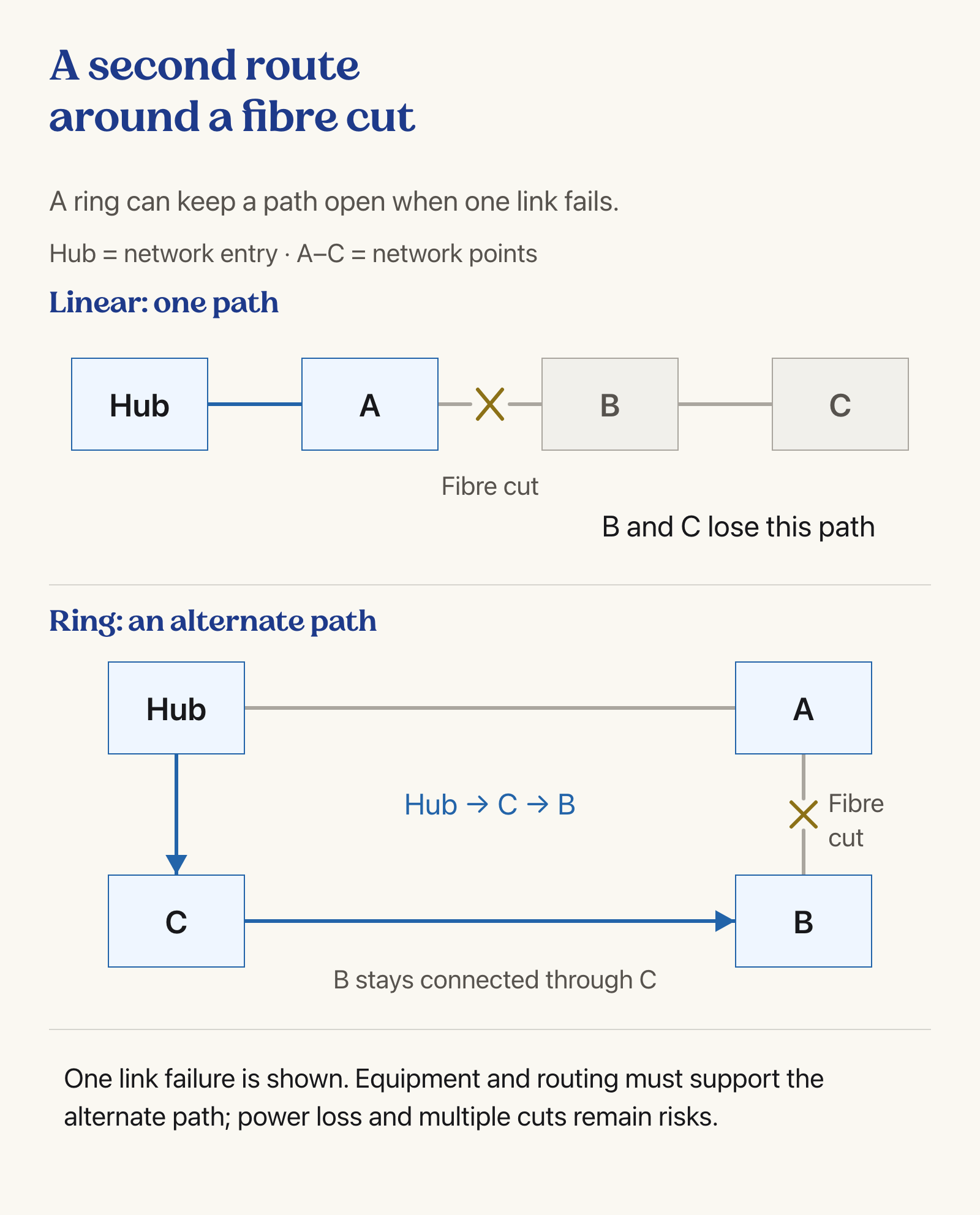
Linear and ring fibre networks after a break between A and B; the ring retains an alternate path through C
A ring provides an alternate path after one link failure when equipment and routing support it. This schematic is not the Maharashtra network design.

What the BharatNet upgrade would change

The agreement links an infrastructure design change with rural service expansion. Its results will depend on construction, commissioning and continuing operation.

  • BharatNet is intended to strengthen rural broadband infrastructure. In Maharashtra, the announced programme combines upgrading existing links with coverage expansion, rather than treating every location as a completely new network build.
  • Digital Bharat Nidhi, under the Department of Telecommunications, supports telecommunications access in underserved areas. This public-service role matters where the commercial return alone may not justify investment in dependable rural connectivity.
  • Optical fibre carries signals between network points, while associated equipment connects and manages those links. Installing cable is only one part of making an operational connection available to public facilities or households.
  • The last mile connects the local network to the actual user. A resilient upstream route cannot compensate for a disconnected school, an unavailable household connection or faulty equipment at the user’s premises.
  • The release describes on-demand village connectivity and expected home connections. These are implementation intentions; they should not be reported as evidence that every household already receives reliable or affordable broadband service.

How to judge whether connectivity becomes reliable

A useful assessment follows the user’s service from the main network to the premises and checks how faults are handled.

  • Route diversity should be assessed physically. Two apparent alternatives sharing a vulnerable trench or crossing can fail together, so a network diagram alone cannot establish protection against a real excavation or flood.
  • Availability measures whether service works over time; cable length measures construction. Tracking outages and restoration time helps distinguish an installed asset from a connection that students or health workers can actually use.
  • Power backup and equipment maintenance support the fibre network. Where local electronics stop functioning, a surviving cable route cannot by itself keep the affected access point available for users who depend on it.
  • Operational responsibility needs clear allocation across participating institutions and service providers. Fault reporting, repair access and escalation should connect rather than leave a village waiting while agencies dispute which segment has failed.
  • Affordability and adoption remain separate tests of inclusion. A technically resilient network may still be underused if local service is costly or suitable connections are unavailable; resilience improves supply without automatically ensuring effective use.

Way Forward

Test service continuity before counting success

  • Run controlled fault tests before acceptance to check that alternate routing works under the planned equipment configuration and that essential services can recover.
  • Monitor uptime and repair time alongside construction progress, with a clear service contact for schools, health centres and local public offices.
  • Check shared vulnerabilities, including trenches, power and local equipment, and prioritise repairs that reduce recurring service interruptions.
  • Assess last-mile availability and affordability separately from backbone completion so infrastructure expansion translates into usable connections.

Conclusion

  • Ring topology strengthens rural connectivity by making an alternate path possible after a link failure. Its value depends on working protection mechanisms, operational equipment and timely maintenance, not merely the shape of the network.
  • Use the Maharashtra agreement to explain the difference between coverage and service reliability. The upgrade is planned; judging its success requires evidence that connected users can continue accessing services during ordinary faults.

UPSC Practice Questions

Prelims MCQ 1

With reference to ring topology in a fibre network, consider the following statements:

  1. It can provide an alternate path around a failed segment.
  2. A ring eliminates all risks from multiple fibre cuts and power failures.
  3. Equipment and protection or routing mechanisms must support use of the alternate path.

How many of the above statements are correct?

(a) Only one (b) Only two (c) All three (d) None

Answer: (b) Only two

Explanation:

Statements 1 and 3 are correct. A ring provides route redundancy but cannot eliminate all multi-fault, power or equipment failures.

Prelims MCQ 2

Which observation best demonstrates a gap between backbone coverage and usable last-mile access?

(a) A village network point is connected, but its school lacks a working local connection. (b) Traffic uses an alternate route after a fibre cut. (c) Equipment detects a failed network segment. (d) A cable loop connects several network points.

Answer: (a) A village network point is connected, but its school lacks a working local connection.

Explanation:

Backbone connectivity does not automatically provide an operational connection at every user premises. The school’s local connection is a distinct service requirement.

UPSC Mains Questions

  1. Explain how ring topology can strengthen rural broadband resilience. Why does it not guarantee uninterrupted service?
  2. Discuss how public investment in rural fibre networks should be evaluated beyond coverage and construction targets.

Sources: PIB, Ministry of Communications and International Telecommunication Union.

Frequently Asked Questions

What is ring topology?

Ring topology connects network points in a loop. It can provide an alternate path around a failed segment when the remaining network, equipment and protection mechanisms support that path.

Has Maharashtra completed this BharatNet upgrade?

No. The 1 October release announces an implementation agreement covering a planned linear-to-ring upgrade and other expansion work. It does not establish that the upgrade is completed or its benefits measured.

Does ring topology prevent every outage?

No. Multiple fibre cuts, shared power failures, equipment faults or common physical vulnerabilities can still disrupt service. A ring provides a form of redundancy, not immunity from all failures.

How is the last mile different from the backbone?

The backbone carries connectivity between network points. The last mile reaches the actual user premises. A school or household needs a working local connection even when the upstream network is available.

Why is Digital Bharat Nidhi relevant?

Digital Bharat Nidhi, under the Department of Telecommunications, supports access in underserved areas. It participates in the Maharashtra agreement, connecting public investment with the objective of improving rural telecommunications infrastructure.


CAPEX Survey: Separating Investment Intentions From Actual Spending

Open article →Download PDF

Why in News?

MoSPI announced on 1 October that the CAPEX 2026 survey is collecting private corporate investment information during October–December 2026.

  • The National Statistics Office is surveying selected large private corporate enterprises; the announcement does not contain results from the ongoing round.
  • The questionnaire covers past expenditure, provisional spending for the current financial year and intentions for the forthcoming year.
  • Coverage includes asset groups, industries, investment objectives and financing sources, allowing spending plans to be examined beyond a single aggregate.
  • A company announcing a factory expansion signals intention; evidence of expenditure is needed before treating that announcement as investment already undertaken.
  • Forward-looking information helps assess the investment pipeline, while later actual figures test whether the expected spending materialised.

UPSC Relevance

Prelims Relevance

  • NSO and MoSPI
  • Capital expenditure versus recurring expenditure
  • Actual, provisional and intended CAPEX
  • Panel comparisons and realisation ratio
  • Selected private corporate coverage

Mains Relevance

GS Paper 3

  • Interpreting private investment intentions without equating them with realised capital formation
  • Using survey evidence to identify financing and implementation constraints

Essay

  • Why economic expectations require evidence of implementation

Background and Context

Three stages of investment information

An investment plan, an interim spending estimate and a completed expenditure figure answer different questions about the same business decision.

  • Capital expenditure concerns assets used beyond routine operations, such as machinery or plant expansion. Its economic significance lies in the productive capacity it can create, replace or improve over time.
  • Investment intentions describe planned future spending. A proposal to acquire machinery remains a plan until expenditure occurs; changing demand, financing conditions or implementation difficulties can alter its eventual size and timing.
  • Provisional expenditure is an interim account of the current financial year. Read it with its reference period and estimate status, because subsequent reporting can revise the amount before a final comparison becomes possible.
  • Actual expenditure records spending already incurred for the specified period. It offers firmer evidence of implementation than intentions, but spending alone does not establish that every asset is commissioned or fully productive.
  • For example, a planned machine purchase, an interim expenditure report and later actual spending describe successive information stages. This illustrative sequence explains the categories; it is not a finding about a surveyed company.

What a realisation ratio can tell us

The useful comparison asks whether earlier plans became spending, using matching enterprises and periods rather than unrelated headline totals.

  • A realisation ratio compares actual expenditure with the corresponding earlier investment intention. Its interpretation depends on matching the reference period and comparison base; otherwise, a seemingly precise ratio can answer the wrong question.
  • The ministry cites a 96.3% realisation ratio for actual 2024–25 expenditure from the earlier CAPEX 2025 exercise. This is historical panel evidence, not an outcome of the ongoing CAPEX 2026 survey.
  • At the aggregate level, that historical figure suggests spending broadly matched intentions. It does not establish that every enterprise fulfilled its plan, since one company’s additional spending can offset another company’s shortfall.
  • A fixed panel follows the same enterprises across periods, improving comparability. If different sets of firms enter successive totals, an apparent spending change may partly reflect changed coverage rather than changed investment behaviour.
  • Even a strong aggregate realisation ratio cannot establish why investment occurred. Claims about a policy’s effectiveness require additional evidence that separates its influence from demand, financing costs and other changes affecting corporate decisions.

Coverage determines the limits of the headline

The survey offers a view of selected large private companies, not a complete account of capital formation across India.

  • The survey frame draws on active MCA-registered enterprises, applying eligibility and turnover criteria. It does not automatically include every business, household investment or public-sector project when reporting private corporate expenditure and intentions.
  • A survey frame identifies eligible units; responses then provide investment information. The Statistical Business Register explainer covers the separate question of identifying businesses, rather than measuring whether their investment plans materialise.
  • Investment information complements production statistics but answers a different question. The Annual Survey of Industries explainer examines factory output and value added; CAPEX intentions concern prospective spending, not output already produced.
  • The questionnaire includes capacity expansion and upgrading, green energy, robotics and financing sources. These categories help distinguish investment purposes, but their inclusion does not itself prove rising spending or successful technological adoption.
  • Reliable interpretation requires complete, timely responses and validation. MoSPI states that identifiable enterprise-level information will not be disseminated; published aggregates can inform policy without exposing an individual company’s commercially sensitive investment plans.

Way Forward

Track execution alongside expectations

  • Publish estimate status and reference periods prominently so readers can distinguish future intentions from provisional and actual expenditure.
  • Compare a consistent enterprise panel and explain coverage changes before interpreting movement in aggregate investment figures.
  • Use subsequent spending reports to examine implementation gaps; investigate financing or execution constraints instead of assuming every unfulfilled intention reflects weak demand.

Conclusion

  • The CAPEX survey helps connect business expectations with later spending. Its value comes from preserving the distinction between what firms plan, provisionally report and actually undertake.
  • In an investment answer, establish the reference period, estimate status and coverage before using a headline. Treat corporate intentions as evidence about the pipeline, with realisation requiring subsequent verification.

UPSC Practice Questions

Prelims MCQ 1

With reference to the CAPEX 2026 survey, consider the following statements:

  1. It collects information on past expenditure and future investment intentions.
  2. It covers all public and private investment undertaken in India.
  3. Its frame uses information on active enterprises registered with the Ministry of Corporate Affairs.

How many of the above statements are correct?

(a) Only one (b) Only two (c) All three (d) None

Answer: (b) Only two

Explanation:

Statements 1 and 3 are correct. Coverage is selected large private corporate enterprises subject to eligibility criteria, not the entire economy.

Prelims MCQ 2

A high aggregate realisation ratio for a corporate investment panel most directly indicates which of the following?

(a) Every company completed all planned projects (b) Actual expenditure broadly matched corresponding investment intentions in aggregate (c) All installed assets operated at full capacity (d) A specific policy caused the investment

Answer: (b) Actual expenditure broadly matched corresponding investment intentions in aggregate

Explanation:

The ratio compares expenditure and corresponding intentions. It does not establish firm-level completion, capacity utilisation or policy causality.

UPSC Mains Questions

  1. How can forward-looking corporate investment surveys improve economic policymaking? Explain the limitations of treating investment intentions as realised spending.
  2. Discuss the role of consistent panels and realisation ratios in assessing private investment. Why must aggregate results be interpreted cautiously?

Source: PIB, Ministry of Statistics and Programme Implementation.

Frequently Asked Questions

What is the CAPEX 2026 survey?

It is an NSO survey of selected large private corporate enterprises, conducted during October–December 2026. It collects past expenditure, current provisional spending and future investment intentions, alongside information on assets, objectives and financing.

Are CAPEX 2026 results already available?

The 1 October announcement concerns the ongoing survey. Historical CAPEX 2025 findings cited in that release must not be presented as results of the new CAPEX 2026 round.

What does the realisation ratio measure?

It compares actual expenditure with corresponding earlier investment intentions. A ratio close to full realisation indicates aggregate alignment, but does not establish that every firm completed its projects or that assets are fully operational.

Does the survey measure all investment in India?

No. It covers selected large private corporate enterprises drawn from an MCA-based frame. Its results should not be treated as comprehensive measures of household, public-sector and all other investment.

Why are provisional expenditure and investment intentions different?

Provisional expenditure concerns the current financial year’s interim spending estimate. Investment intentions concern proposed future spending. Both need clear reference periods, and neither should be silently relabelled as final actual expenditure.

Divyangjan FASTags: Longer Validity With Defined Eligibility

Open article →Download PDF

Why in News?

Revised Divyangjan FASTag guidelines take effect on 2 October 2026, replacing annual renewal with longer validity for eligible vehicles.

  • Recorded disability of 70–100% gives eligible exempted FASTags five-year validity.
  • Recorded disability of 40% to less than 70% gives eligible exempted FASTags three-year validity.
  • Vehicle eligibility covers specially designed and constructed vehicles for persons with physical disabilities, and vehicles registered under ownership type “Divyangjan”.
  • Renewal remains conditional on continued eligibility and compliance with the applicable National Highways Fee Rules.
  • Administrative burden can restrict access even when a concession exists: repeated applications cost time, travel and assistance.
  • Longer validity addresses renewal frequency; it does not establish universal toll exemption for every vehicle used by a person with a disability.

UPSC Relevance

Prelims Relevance

  • Exempted FASTag versus ordinary toll payment
  • Qualifying vehicle categories
  • Disability Certificate and Unique Disability Identity Card
  • Validity linked to recorded disability
  • Conditional renewal under National Highways Fee Rules

Mains Relevance

GS Paper 2

  • Disability inclusion and access to public services
  • Administrative burden and exclusion in targeted concessions

GS Paper 3

  • Inclusive design of transport infrastructure and toll administration

Essay

  • A right becomes usable when its administrative process is accessible.

Background and Context

Vehicle eligibility and recorded disability are separate checks

The concession requires an eligible vehicle and valid supporting records; personal circumstances alone should not be treated as proof of every condition.

  • Specially designed and constructed vehicles form one stated category. The relevant connection is their design for use by persons with physical disabilities, rather than an assumption about every passenger.
  • Registration under ownership type “Divyangjan” is the other stated category. This matters because the announcement expressly recognizes a registration route alongside the specially designed vehicle route.
  • Supporting records include a valid Disability Certificate, Unique Disability Identity Card or other applicable records. The recorded disability percentage determines the validity period described in the announcement.
  • Eligibility is not visible from a photograph, wheelchair or driver alone. A plain-looking vehicle cannot be classified as eligible or ineligible without checking the applicable registration and records.
  • Exam trap: “Every vehicle driven by a person with a disability receives exemption” is too broad. It removes the vehicle categories and documentation conditions from the stated framework.

Longer validity changes the renewal cycle

The principal administrative change is the interval between renewals, replacing the earlier annual requirement with differentiated periods.

  • The higher disability band receives the longer validity period, while the other stated band receives a shorter multi-year period. Both are changes to the duration of the exempted FASTag.
  • Reduced repetition can save applicants repeated document submission and follow-up. This is the policy logic of longer validity, rather than a measured outcome already demonstrated by the announcement.
  • Expiry still matters: a multi-year tag is not a permanent exemption. The release expressly permits subsequent renewal subject to continued eligibility and compliance with the applicable rules.
  • Scope discipline: the release specifies two disability bands. It does not provide enough information to invent an additional validity period or a new decision rule for lower percentages.
  • Implementation detail remains limited: the release does not spell out the treatment of every existing tag. Do not infer automatic extension or a universal fresh-application requirement from this summary.

Why procedure is part of disability inclusion

A targeted concession has practical value when eligible users can establish entitlement and keep it active without disproportionate effort.

  • Compliance costs include time spent understanding requirements, arranging documents and following up. For a person needing assistance, the same administrative step can impose an additional coordination burden.
  • Uniform administration is an explicit aim of the revision. Consistent interpretation can reduce uncertainty, but a stated objective should not be mistaken for evidence that every operational difficulty has disappeared.
  • Clear communication should distinguish vehicle eligibility, disability evidence and validity. Combining these into a vague message about “free travel” risks misleading applicants about the concession’s conditions.
  • Digital processing can simplify repeated transactions, but inaccessible interfaces or unclear rejection reasons can create new obstacles. These are implementation risks to assess, not reported findings from this announcement.
  • Evaluate delivery through applicant effort, processing delays and correction of errors. Counting issued tags alone would not show whether eligible users can navigate the process and resolve problems.

Way Forward

Make the revised process usable

  • Publish clear guidance separating vehicle categories, acceptable records, validity and renewal conditions, with examples that avoid promising blanket exemption.
  • Provide assisted access and accessible application interfaces so the change does not shift procedural work onto applicants or their caregivers.
  • Explain adverse decisions and provide a workable correction channel for record mismatches; monitor avoidable repeat submissions and delays.

Conclusion

  • The reform reduces renewal frequency for eligible exempted FASTags while retaining documentary and vehicle-related conditions. Its value lies in making an existing concession easier to maintain.
  • For a governance answer, connect inclusion with administrative design: fewer repeated steps, clear eligibility and usable remedies must operate together for a concession to translate into reliable access.

UPSC Practice Questions

Prelims MCQ 1

With reference to the revised Divyangjan FASTag guidelines, consider the following statements:

  1. Validity is linked to the disability percentage recorded in valid supporting records.
  2. Renewal after expiry is unconditional.
  3. Vehicles registered under ownership type “Divyangjan” are among the stated eligible categories.

How many of the above statements are correct?

(a) Only one (b) Only two (c) All three (d) None

Answer: (b) Only two

Explanation:

Statements 1 and 3 are correct. Renewal remains subject to continued eligibility and compliance with the applicable National Highways Fee Rules.

Prelims MCQ 2

Which administrative change is central to the revised guidelines effective from 2 October 2026?

(a) Permanent exemption without documentary checks (b) Exemption for every vehicle carrying a person with a disability (c) Replacement of annual renewal with differentiated multi-year validity (d) Abolition of vehicle eligibility requirements

Answer: (c) Replacement of annual renewal with differentiated multi-year validity

Explanation:

The earlier annual renewal requirement is replaced by five-year and three-year validity for the respective stated disability bands. Eligibility requirements continue.

UPSC Mains Questions

  1. How can reducing administrative burden improve access to disability-related concessions? Discuss with reference to revised exempted FASTag validity.
  2. Targeted transport concessions require both clear eligibility and accessible procedures. Examine the implementation choices needed to balance these objectives.

Source: PIB, Ministry of Road Transport and Highways.

Frequently Asked Questions

What changed in Divyangjan FASTag validity?

The revised guidelines replace annual renewal with five-year validity for the higher stated disability band and three-year validity for the other stated band. Vehicle eligibility and valid supporting records remain necessary.

Does every vehicle used by a person with a disability qualify?

No blanket entitlement is stated. The announcement identifies specially designed and constructed vehicles for persons with physical disabilities, as well as vehicles registered under ownership type “Divyangjan”, subject to applicable requirements.

Which records determine the validity period?

The announcement refers to the disability percentage recorded in a valid Disability Certificate, Unique Disability Identity Card or other applicable records. This documentary basis should be distinguished from the separate vehicle eligibility conditions.

Is renewal automatic after the validity period?

Renewal is conditional on continued eligibility and compliance with the applicable National Highways Fee Rules. The announcement does not establish an unconditional lifetime exemption or explain the treatment of every existing tag.

GOBARdhan: Connecting Biogas Plants With Assured Markets

Open article →Download PDF

Why in News?

The Ministry of Petroleum and Natural Gas launched the integrated GOBARdhan Central Sector Scheme for compressed biogas on 1 October 2026, according to PIB.

  • The framework combines offtake assurance, pricing, capital assistance, pipelines, credit guarantees and ecosystem support.
  • The CBG procurement obligation for CGD entities is 3% in FY 2026–27, 4% in FY 2027–28 and 5% thereafter for CNG transport and domestic PNG.
  • An administered price of ₹2,110 per MMBtu seeks to improve revenue visibility for producers.
  • A plant needs both reliable feedstock and paying customers; machinery subsidies alone cannot establish a functioning waste-to-energy business.
  • The policy connects rural waste management with domestic energy production, while leaving important operational and environmental risks to be managed.

UPSC Relevance

Prelims Relevance

  • Compressed biogas (CBG)
  • City Gas Distribution (CGD)
  • CBG Obligation: procurement responsibility rests with CGD entities
  • Central Sector Scheme; Ministry of Petroleum and Natural Gas
  • Offtake assurance versus credit guarantee

Mains Relevance

GS Paper 3

  • Market design for renewable gas and circular agriculture
  • Infrastructure and finance constraints in waste-to-energy projects

GS Paper 2

  • Coordination between a central scheme and state-level implementation

Essay

  • Turning waste into a resource requires functioning institutions and markets.

Background and Context

The material and value chain

Compressed biogas connects organic resources to an energy market, but the useful product must reach a buyer.

  • Crop residue, cattle dung and other organic resources are inputs identified in the release. Their economic value depends on collection and transport arrangements, rather than merely their presence in a district.
  • Farmers, cooperatives, gaushalas and local enterprises can participate in aggregation, transportation and processing. These are potential business opportunities; the launch announcement does not establish that participants already receive additional income.
  • Organic manure is another output identified alongside domestic gas. Its processing and sale matter because a plant needs a workable destination for this output as well as a gas customer.
  • Feedstock assurance connects the agricultural and energy sides of the project. A proposed plant must assess accessible supplies, competing uses and collection costs before treating locally available waste as a dependable input.

How procurement and pricing reduce market uncertainty

The framework addresses two separate commercial questions: who buys the gas, and how predictable is the selling price?

  • Offtake means purchase of a producer’s output. Mapping plants to identified CGD geographical areas or CBG clusters is intended to give production a dependable route into the gas market.
  • The procurement obligation rests with CGD entities. It applies to the specified transport CNG and domestic PNG segments; it should not be described as a universal obligation covering every natural-gas use.
  • Administered pricing improves revenue visibility by specifying the selling-price framework. It does not determine a plant’s profit, which also depends on operating costs, output, transport arrangements and timely payment.
  • Demand assurance and physical connectivity solve different problems. Identifying a buyer cannot by itself move gas from a plant, while constructing a connection cannot by itself guarantee commercially viable production.

Why capital, pipelines and credit are separate interventions

The remaining support instruments address investment barriers that a procurement obligation alone cannot remove.

  • Capital assistance for eligible greenfield projects covers plant machinery, feedstock aggregation and manure-processing or value-addition equipment. Eligibility matters: the announcement is not an unconditional subsidy promise to every existing or proposed operator.
  • Pipeline infrastructure support distinguishes cluster connections to trunk networks from standalone plant connections to CGD networks. This recognises different gas-evacuation needs, rather than assuming every project can use an identical delivery arrangement.
  • Credit guarantees cover eligible MSME-based projects, subject to limits. They share specified default exposure with lenders; they do not cancel the borrower’s repayment responsibility or make the underlying enterprise risk-free.
  • The Ecosystem Challenge Fund supports technology, capacity building, feedstock assessment, aggregation and manure value addition. These supporting services can address constraints that remain even after equipment finance becomes available.

Implementation is the real test

The scheme announcement describes a policy framework; operating results must be assessed separately.

  • State governments have roles in feedstock assessments, suitable land banks, approvals and infrastructure support. A single central nodal ministry still requires coordination with local institutions and project-level conditions.
  • Projected jobs, emissions reductions and foreign-exchange savings are expected benefits in the release. They must not be reported as measured achievements resulting from the newly launched integrated scheme.
  • Operating performance is a better implementation test than announcements alone. Track actual gas output and sales, reliable input supplies and manure offtake when assessing whether support translates into viable plants.
  • Risk allocation remains central: producers need workable supply and delivery arrangements, buyers need reliable output, and lenders need credible cash flows. Public support reduces selected risks without eliminating all of them.

Way Forward

Test the complete project chain

  • Require local feedstock and transport assessments before sizing projects; align plant capacity with supplies that can actually be collected.
  • Coordinate buyer mapping and pipeline readiness with commissioning, so installed capacity has a practical route to market.
  • Track gas sales and manure offtake alongside finance disbursed; distinguish operating outcomes from projected scheme benefits.

Conclusion

  • GOBARdhan is a market-design intervention as well as an energy scheme: it connects procurement, pricing, infrastructure and finance around the same production chain.
  • For a Mains answer, explain which bottleneck each instrument addresses, then assess the operational conditions required to turn policy assurance into sustained production.

UPSC Practice Questions

Prelims MCQ 1

With reference to the integrated GOBARdhan framework, consider the following statements:

  1. The CBG procurement obligation rests with City Gas Distribution entities.
  2. The prescribed obligation covers the CNG transport and domestic PNG segments.
  3. Credit guarantee support eliminates all commercial risks faced by a CBG producer.

How many of the above statements are correct?

(a) Only one (b) Only two (c) All three (d) None

Answer: (b) Only two

Explanation:

The first two statements describe the announced procurement framework. Credit guarantees cover specified eligible default exposure within limits; they do not eliminate operational or commercial risks.

Prelims MCQ 2

Which intervention most directly addresses the physical movement of gas from a CBG plant to a distribution network?

(a) Administered pricing (b) Credit guarantee support (c) Pipeline infrastructure development (d) Capacity-building assistance

Answer: (c) Pipeline infrastructure development

Explanation:

Pipeline support addresses gas evacuation and network connectivity. Pricing, guarantees and training address different commercial or institutional constraints.

UPSC Mains Questions

  1. Explain how combining procurement obligations, administered pricing and pipeline support can improve the viability of compressed biogas projects.
  2. Assess the role of feedstock assurance and organic-manure markets in translating waste-to-energy schemes into sustained rural economic benefits.

Source: PIB.

Frequently Asked Questions

What changed with the GOBARdhan launch?

The October launch brought offtake assurance, pricing, capital assistance, pipeline development, credit guarantees and ecosystem support into an integrated framework for the compressed biogas sector under the Ministry of Petroleum and Natural Gas.

Who must procure CBG under the obligation?

The procurement obligation rests with City Gas Distribution entities for the CNG transport and domestic PNG segments. It should not be interpreted as a purchase obligation applying to every category of natural-gas consumption.

Does an assured market make a biogas plant risk-free?

No. Offtake arrangements reduce market uncertainty, but feedstock availability, operating costs, reliable production, connectivity and payment performance still matter. Credit guarantees also operate within eligibility conditions and limits rather than eliminating all risk.

Why does manure matter in a gas scheme?

Organic manure is an associated output with its own processing and sales requirements. Developing its market strengthens the connection between agriculture and energy and helps address a constraint identified in the official release.

Are the announced economic benefits already achieved?

No. The release describes expected benefits and production ambitions. Evaluating the newly launched framework requires subsequent evidence of operating plants, actual gas sales and outcomes, rather than treating forecasts as completed achievements.

Grain Fumigation Trials: Testing Alternatives to Repeated Chemical Use

Open article →Download PDF

Why in News?

ICAR and FCI signed an agreement on 30 September 2026 to research alternative grain fumigation technologies for wheat and rice, according to a PIB release published on 1 October.

  • ICAR-CIPHET, Ludhiana, will implement the research with support from the Department of Food & Public Distribution.
  • The planned trials cover nitrogen in metal silos, carbon dioxide with phosphine in bag storage, and carbon dioxide under hermetic covers.
  • A two-year initial pilot is to be followed by a one-year multi-location phase for region-specific procedures.
  • These are proposed research trials; the announcement does not establish successful commercial replacement of existing treatments.
  • Storage protection connects agricultural production with the availability of usable grain for distribution.
  • A new treatment must address pest control, worker exposure and operational feasibility together; changing the gas alone cannot demonstrate success.

UPSC Relevance

Prelims Relevance

  • ICAR-CIPHET and its role in post-harvest research
  • FCI and foodgrain storage
  • Fumigation and storage pest resistance
  • Nitrogen, carbon dioxide and phosphine trial configurations
  • Hermetic containment and multi-location validation

Mains Relevance

GS Paper 3

  • Post-harvest technology and food security
  • Scientific validation of alternatives to repeated chemical pest control

GS Paper 2

  • Research-agency and public-storage coordination

Essay

  • Food security depends on protecting what has already been produced.

Background and Context

Why repeated treatment becomes a storage problem

The research responds to the limits of repeatedly applying existing pest-control methods across grain reserves.

  • According to the release, grain protection has relied heavily on aluminium phosphide and malathion. The proposed research concerns alternatives to this established pattern of chemical pest management.
  • Pest resistance means a treatment can become less effective against the target pest population. Repeating a familiar intervention is not the same as demonstrating that it still works.
  • The release associates repeated chemical use with additional fumigation cycles and rising operational costs. That makes treatment performance an economic question as well as a scientific one.
  • Occupational exposure, ecological impacts and fumigant residues are stated concerns. The announcement identifies problems for investigation; it does not prove that any proposed alternative eliminates every concern.
  • For food-security analysis, connect post-harvest protection with usable stocks. Procurement and storage capacity alone are incomplete measures if pest management cannot reliably preserve the grain being held.

Three trials address different storage configurations

The trial designs pair particular gases with particular storage arrangements; they are not interchangeable versions of one completed technology.

  • The nitrogen trial concerns storage pests in wheat held in metal silos. Its intended application is a bulk-storage arrangement, rather than the bag-storage designs described separately.
  • The carbon dioxide–phosphine combination concerns wheat and rice stored in bags at FCI and Central Warehousing Corporation warehouses. This proposed combination still includes phosphine; it is not chemical-free storage.
  • The carbon dioxide trial under hermetic covers also concerns wheat and rice in bags. Here the enclosing cover is an explicit part of the planned treatment arrangement.
  • The durable distinction is gas, grain and containment. Comparing a nitrogen silo trial directly with a bag trial without accounting for the storage arrangement would obscure what is being tested.
  • The stated aim is commercial standardization, but an aim is not a validated result. The release provides trial plans, not comparative findings proving which design performs best.

Why containment belongs in the explanation

A storage treatment is a system involving the enclosure and its operating conditions, not simply the name of a gas.

  • Hermetic describes an airtight enclosure. In the announced bag-storage trial, the cover matters because retaining the intended atmosphere is part of the proposed treatment configuration.
  • Enclosure integrity should be assessed alongside pest outcomes. A promising treatment under controlled conditions does not by itself establish reliable performance in every working warehouse or silo.
  • Worker protection remains a separate evaluation requirement. The use of nitrogen or carbon dioxide cannot be treated as a blanket assurance that handling the system is harmless.
  • Grain quality should also remain visible in evaluation. Pest suppression alone is an incomplete adoption criterion if storage operations cannot preserve the usefulness of the wheat or rice.
  • An exam answer should separate intended mechanism from demonstrated performance. Explain the storage configuration, then identify the evidence needed before drawing conclusions about safety, cost or scalability.

From a pilot to region-specific procedures

The planned second phase addresses the challenge of moving from an initial study to diverse operating environments.

  • The initial pilot is intended to investigate the proposed technologies. Its position at the start of the programme matters: research preparation should not be reported as a completed rollout.
  • The subsequent multi-location trial is planned across varied agro-climatic zones. This adds a different test: whether findings remain useful beyond the conditions of the initial study.
  • Region-specific standard operating procedures are an intended output. The release does not provide completed procedures, so their effectiveness and readiness for adoption cannot yet be assessed.
  • The institutional pairing joins ICAR research capacity with FCI storage needs. Its practical value will depend on whether the research produces evidence usable by storage operators.

Way Forward

Make adoption depend on comparable evidence

  • Publish trial methods and comparative outcomes, distinguishing pest suppression, grain quality, exposure concerns and operating costs.
  • Evaluate containment and repeatability under working storage conditions before treating pilot findings as a basis for wider adoption.
  • Develop validated operating procedures and worker training from trial evidence; an announcement should not substitute for safe implementation requirements.

Conclusion

  • Alternative grain fumigation is a research response to the limits of repeated chemical pest control. The key lesson is to evaluate the storage system alongside the treatment.
  • Use this case to connect post-harvest science and food security, while keeping planned trials, demonstrated results and commercial adoption clearly separate.

UPSC Practice Questions

Prelims MCQ 1

With reference to the announced ICAR–FCI grain-storage trials, consider the following statements:

  1. Nitrogen is proposed for wheat stored in metal silos.
  2. The carbon dioxide–phosphine trial excludes phosphine from pest management.
  3. Carbon dioxide is also proposed for grain bags enclosed in hermetic covers.

How many of the above statements are correct?

(a) Only one (b) Only two (c) All three (d) None

Answer: (b) Only two

Explanation:

Statements 1 and 3 match the announced configurations. Statement 2 is incorrect because the combination explicitly includes phosphine.

Prelims MCQ 2

What is the stated purpose of the planned multi-location phase after the initial grain-fumigation pilot?

(a) To establish region-specific standard operating procedures (b) To certify that every gas treatment is harmless (c) To replace all bag storage with metal silos (d) To announce completed nationwide commercial adoption

Answer: (a) To establish region-specific standard operating procedures

Explanation:

The release proposes multi-location trials across varied agro-climatic zones to develop region-specific procedures. It does not announce a completed nationwide replacement.

UPSC Mains Questions

  1. Why must alternative grain-fumigation technologies be evaluated as storage systems rather than only as chemical substitutes? Discuss.
  2. Explain how post-harvest research can strengthen food security. What evidence should guide the transition from pilot trials to commercial adoption?

Source: PIB, Ministry of Agriculture & Farmers Welfare.

Frequently Asked Questions

What did ICAR and FCI announce?

They signed an agreement to research alternative fumigation technologies for storage pests in wheat and rice. The announcement describes planned trials and later multi-location validation, rather than completed commercial adoption.

Which storage arrangements will be tested?

The announcement separates nitrogen treatment in wheat silos, carbon dioxide with phosphine for bagged wheat and rice, and carbon dioxide for grain bags enclosed in hermetic covers.

Does alternative fumigation mean chemical-free storage?

No. One announced trial explicitly combines carbon dioxide with phosphine. The alternatives should be assessed for effectiveness, exposure, residues and feasibility, rather than described collectively as chemical-free or harmless.

Why are multi-location trials planned?

The planned second phase will test the technologies across varied agro-climatic zones and support region-specific operating procedures. Results from an initial pilot do not automatically demonstrate suitability everywhere.

Offshore Mineral Auctions: Exploration Before Commercial Extraction

Open article →Download PDF

Why in News?

The Ministry of Mines launched offshore mineral auctions on 1 October 2026 for composite licences covering two Andaman Sea blocks.

  • Sewell Rise-01 and West Sewell Ridge-01 together cover over 1,632 square kilometres in the Andaman Sea.
  • The blocks contain polymetallic nodules and crusts hosting cobalt, nickel, manganese, copper and rare earth elements, according to the ministry.
  • The announcement begins an auction process; it does not announce an operating mine or commercial mineral production.
  • Mineral security depends on usable supplies reaching manufacturers, so geological potential must be assessed alongside extraction and processing capability.
  • Offshore governance must address environmental uncertainty while deciding how exploration can improve knowledge of potentially valuable resources.

UPSC Relevance

Prelims Relevance

  • Composite licence: exploration licence-cum-production lease.
  • Sewell Rise-01 and West Sewell Ridge-01: Andaman Sea.
  • Polymetallic nodules and crusts: mineral-bearing seabed deposits.
  • International Seabed Authority: mineral activities beyond national jurisdiction.

Mains Relevance

GS Paper 3

  • Mineral security and the gap between resource discovery and industrial supply.
  • Marine environmental safeguards under conditions of scientific uncertainty.

GS Paper 2

  • Domestic resource regulation and the limits of international seabed jurisdiction.

Essay

  • Scientific frontiers require institutions capable of managing uncertainty.

Background and Context

What is being auctioned?

The immediate policy decision concerns access to explore mineral-bearing areas, while the commercial value of those resources still requires investigation.

  • A composite licence is an exploration licence-cum-production lease. The Ministry of Mines uses this definition to describe a linked legal route covering investigation and prospective mineral production.
  • The auction launch invites competitive participation. It does not establish that a bidder has already secured operating rights, begun extraction or demonstrated that the deposits can support profitable production.
  • Sewell Rise-01 lies in the southern part of Sewell Rise; West Sewell Ridge-01 is off Great Nicobar Island. Both blocks belong to the Andaman Sea auction announced by the ministry.
  • The mineral forms include nodules and crusts. Describing the offer only as a nodule auction would omit part of the resource covered by the official announcement.
  • The list of hosted minerals indicates potential uses in manufacturing and energy technologies. It does not establish recoverable quantities, processing yields or the eventual commercial output of either block.

How exploration differs from production

Exploration reduces uncertainty about a resource; production requires a workable route for extracting and supplying it.

  • Exploration asks where mineralisation occurs, how it varies and what further testing is necessary. An area offered for investigation should not be treated as an already proven source of industrial supply.
  • Resource appraisal needs more than an impressive area figure. Mineral concentration, distribution and accessibility determine whether a deposit is worth investigating further and what technical challenges an operator would face.
  • Extraction feasibility concerns whether material can be recovered reliably in marine conditions. Equipment performance and operational cost matter because a mineral’s presence alone says little about affordable recovery.
  • Processing feasibility is a separate question: recovered material must yield usable products. An auction cannot, by itself, demonstrate that every listed mineral can be separated economically for manufacturers.
  • The ministry’s licensing explanation states that applicable approvals are required before execution of operating rights. Selection through an auction does not erase other legal requirements.

Which authority governs the seabed?

The jurisdictional boundary matters because domestic offshore auctions and international seabed contracts belong to different regulatory settings.

  • These auctions follow India’s offshore mineral legislation and auction rules, according to the ministry. Their legal basis should be read from the domestic framework identified in the official notification.
  • The International Seabed Authority regulates mineral activities in the Area: the seabed, ocean floor and subsoil beyond national jurisdiction. It is not the licensing authority named in this auction.
  • The term offshore does not automatically mean beyond national jurisdiction. A question about marine resources must establish the relevant location and legal regime before assigning regulatory responsibility.
  • A licence establishes a legal entitlement subject to the governing framework; it does not settle all scientific questions. Legal permission and evidence about environmental effects answer different questions.
  • For an answer on institutional coordination, distinguish auction administration, scientific appraisal and environmental oversight. Combining them into one approval obscures the separate judgments involved in responsible resource development.

Why environmental evidence must come early

An exploration frontier also creates a knowledge problem: decision-makers need evidence about the marine system before assessing possible disturbance.

  • Baseline studies should document habitats and environmental conditions before disturbance. Without a reference condition, later monitoring cannot reliably distinguish project effects from existing patterns or natural variation.
  • Sediment disturbance is a relevant concern for nodule collection. International Seabed Authority technical work identifies near-bottom sediment plumes among potential impacts; this does not establish the impact of these particular blocks.
  • Site-specific assessment matters because findings from another ocean area cannot simply determine local outcomes. Environmental claims should identify the studied location, activity and limits of the available evidence.
  • Monitoring design should identify measurable changes and decision points before operations expand. Collecting data is useful only if adverse findings can influence the next operational decision.
  • Mineral-security benefits should be evaluated alongside ecological costs and alternative supply measures. Treating strategic importance as proof of environmental acceptability avoids the very trade-off public policy must examine.

Way Forward

Tie progress to evidence

  • Publish geological and environmental baselines sufficient for independent scrutiny while protecting legitimately confidential information.
  • Evaluate extraction and processing feasibility separately before making claims about dependable domestic mineral supply.
  • Set monitoring thresholds and review points that can change operational decisions when new environmental evidence emerges.

Conclusion

  • Composite licensing creates a route from exploration towards production; it is not evidence that commercially viable extraction has begun.
  • The policy test is whether mineral security improves through credible geological appraisal, workable processing and enforceable environmental safeguards, with domestic and international jurisdictions kept distinct.

UPSC Practice Questions

Prelims MCQ 1

With reference to the Andaman Sea offshore mineral auctions launched in October 2026, consider the following statements:

  1. The blocks cover polymetallic nodules and crusts.
  2. A composite licence is described as an exploration licence-cum-production lease.
  3. The auction announcement establishes that commercial extraction has already begun.

How many of the above statements are correct?

(a) Only one (b) Only two (c) All three (d) None

Answer: (b) Only two

Explanation:

The first two statements are correct. An auction launch does not establish that commercial production has begun.

Prelims MCQ 2

The International Seabed Authority’s mineral-resource mandate applies to which of the following?

(a) Every mineral deposit within coastal states (b) Only riverbeds flowing into international waters (c) The seabed, ocean floor and subsoil beyond national jurisdiction (d) All offshore blocks auctioned by India’s Ministry of Mines

Answer: (c) The seabed, ocean floor and subsoil beyond national jurisdiction

Explanation:

The ISA’s mandate concerns the international seabed Area. Domestic offshore mineral auctions must be distinguished from that jurisdiction.

UPSC Mains Questions

  1. Explain why offshore mineral auctions cannot be equated with assured mineral security. Discuss the role of exploration, processing and environmental appraisal. (150 words)
  2. How should India balance strategic mineral needs with scientific uncertainty in offshore resource development? Suggest an evidence-based regulatory approach. (250 words)

Sources: PIB, Ministry of Mines and PIB, Ministry of Mines: Sea Sand Mining Tender.

Frequently Asked Questions

What is a composite licence for offshore minerals?

It is an exploration licence-cum-production lease. The expression links exploration and prospective production within a legal framework; it does not mean that extraction begins immediately when an auction is announced.

Which Andaman Sea blocks are in the latest auction?

The Ministry of Mines announced Sewell Rise-01 and West Sewell Ridge-01. Together they cover over 1,632 square kilometres and contain polymetallic nodules and crusts, according to the official release.

Does this auction mean offshore mining has started?

No. The announcement launches the auction process. Commercial extraction requires further legal and operational steps; the news release does not establish an operating mine or commercially viable mineral production.

Is this an International Seabed Authority auction?

No. The ministry identifies India’s offshore mineral legislation and auction rules as the governing framework. The International Seabed Authority’s mineral mandate concerns seabed areas beyond national jurisdiction.

Why is mineral occurrence different from mineral security?

Mineral security requires usable material to reach industry reliably. Finding mineral-bearing deposits leaves questions about recovery, processing, cost, environmental effects and dependable supply that an auction announcement alone cannot answer.

Sugar Stock Rules: Controlling Both Quantity and Holding Time

Open article →Download PDF

Why in News?

On 1 October 2026, the Union government announced revised sugar stock limits for dealers, combining a quantity ceiling with a shorter holding period during the festive season.

  • The revised restrictions apply from 15 October to 30 November 2026; they are not yet in force on this article’s publication date.
  • Dealers must not retain sugar for more than 15 days from receipt or hold more than 1,000 quintals under the general ceiling.
  • The quantity ceiling is 2,000 quintals for Kolkata and its extended metropolitan areas and Assam, reflecting regional supply requirements.
  • A quantity ceiling controls the size of inventory; a holding period controls how long particular stock stays with a dealer.
  • The policy seeks faster market circulation, but its effectiveness also depends on transport, replenishment and enforcement that distinguishes normal distribution from hoarding.

UPSC Relevance

Prelims Relevance

  • Quantity ceilings versus holding periods
  • Receipt date as the holding-period reference
  • Regional stock-limit exceptions
  • Dealer inventory versus bulk-consumer requirements
  • Ex-mill prices versus retail prices

Mains Relevance

GS Paper 3

  • Food-price stabilisation through inventory regulation
  • Supply-chain logistics and consumer-price transmission

GS Paper 2

  • Proportionate enforcement and geographically differentiated regulation

Essay

  • Fair markets require both competition and dependable supply.

Background and Context

Two controls on the same stock

The measure addresses both the amount stored and the time stock spends outside active circulation.

  • A quantity ceiling caps inventory at a point in time. It can restrict large accumulations, but by itself does not establish how quickly a smaller stock must reach the market.
  • A holding-period limit follows elapsed time from receipt. A dealer remaining below the quantity ceiling must still comply with the duration rule; these are separate tests rather than alternative ways to qualify.
  • The intended mechanism is faster turnover: mills supply dealers, who move sugar onward towards consumers. Restricting accumulation seeks to discourage withholding in anticipation of higher prices and improve continuous availability in the market.
  • This is a distribution intervention, not additional production. Moving existing sugar sooner can ease a circulation bottleneck, but cannot by itself replace a harvest shortfall or repair a disrupted transport route.
  • Compliance needs attention to receipt dates as well as quantities. An inspection showing modest inventory cannot alone demonstrate that every consignment has remained within its permitted holding period since arrival at the dealer.

Why the eastern exception matters

A larger permitted stock can support reliable replenishment where supply journeys and distribution responsibilities are more demanding.

  • The release explains that Kolkata draws sugar from producing states and supplies eastern markets, including the North-East. Its intermediary role helps explain why a uniform national quantity ceiling may create uneven pressures.
  • For Assam, the government cites geographical constraints, transport logistics and consumer interests. The exception recognises regional distribution conditions; it is not a claim that inventory discipline becomes irrelevant in these areas.
  • The stated exception changes the quantity allowance. The release does not announce a separate longer holding period for these regions, so the higher ceiling should not be read as unrestricted storage duration.
  • Stocks serve a legitimate buffer function between deliveries. The policy trade-off is to deter artificial scarcity while leaving enough operational inventory for dependable supply, especially when transport schedules are irregular or delayed.
  • An enforcement approach should examine local replenishment conditions alongside stock records. Otherwise, treating every warehouse accumulation as speculative could penalise necessary distribution activity without demonstrating that supplies are being deliberately withheld from buyers.

Separate the new rule from earlier measures

The regulated actor, effective date and type of restriction determine what has changed.

  • Earlier sugar-stock relaxation coverage concerned imported stocks and bulk-consumer requirements. Today’s dealer restrictions address a different operational question: how much stock may remain in the distribution chain and for how long.
  • Do not assume this announcement cancels every earlier provision. Applying a rule requires identifying the covered actor and relevant conditions; a dealer’s resale inventory and a bulk consumer’s production requirements are different categories.
  • The announcement date and effective date differ. Preparation can begin beforehand, but the new restrictions should not be described as already operating on 2 October or used to assess compliance before their commencement.
  • The release also reports earlier price declines. Those observations cannot establish that a rule taking effect later caused the fall; assessing an intervention needs a credible timeline and consideration of other supply developments.
  • Ex-mill prices are upstream prices, while households pay retail prices. Transport costs, existing inventories and trading margins affect transmission, so lower mill prices do not guarantee an immediate matching reduction at every shop.

Way Forward

Measure circulation and availability together

  • Check receipt and dispatch records alongside stock quantities so enforcement can assess both dimensions of compliance.
  • Monitor local shortages and replenishment delays to identify whether restrictions are disrupting legitimate distribution.
  • Compare retail availability and prices after implementation, while accounting for crushing-season supply and other market changes.

Conclusion

  • Stock size and stock age are distinct policy levers: together, they seek to keep sugar moving through the distribution chain rather than merely limiting warehouse totals.
  • A strong answer should balance anti-hoarding enforcement with legitimate logistics needs, and distinguish intended price benefits from outcomes established after the measure takes effect.

UPSC Practice Questions

Prelims MCQ 1

With reference to the sugar dealer norms announced on 1 October 2026, consider the following statements:

  1. The holding period is counted from receipt of stock.
  2. The higher quantity ceiling applies to all of West Bengal.
  3. The revised restrictions take effect on 15 October 2026.

How many of the above statements are correct?

(a) Only one (b) Only two (c) All three (d) None

Answer: (b) Only two

Explanation:

Statements 1 and 3 are correct. The higher ceiling covers Kolkata and its extended metropolitan areas, and Assam; the release does not extend it to all West Bengal.

Prelims MCQ 2

Which best explains the difference between a stock quantity ceiling and a holding-period limit?

(a) Both regulate only consumer purchases. (b) A quantity ceiling automatically guarantees rapid dispatch. (c) One limits inventory size, while the other limits elapsed holding time. (d) A holding-period limit directly increases crop production.

Answer: (c) One limits inventory size, while the other limits elapsed holding time.

Explanation:

A dealer can satisfy one test and fail the other. These controls influence distribution and turnover, without directly producing more sugar.

UPSC Mains Questions

  1. Explain how quantity ceilings and holding-period limits can influence food supply chains. Discuss their limitations as price-stabilisation instruments. (150 words)
  2. Why might geographically differentiated inventory norms improve food-market regulation? Discuss with reference to sugar distribution. (150 words)

Source: PIB, Ministry of Consumer Affairs, Food & Public Distribution.

Frequently Asked Questions

When do the revised sugar dealer rules apply?

The restrictions announced on 1 October apply from 15 October to 30 November 2026. On 2 October, they are announced measures awaiting commencement, rather than restrictions already in force.

What are the quantity and duration limits?

The general quantity ceiling is 1,000 quintals, with a 15-day holding period counted from receipt. Kolkata and its extended metropolitan areas, and Assam, have a higher quantity ceiling of 2,000 quintals.

Why is a holding-period rule different from a stock ceiling?

A stock ceiling restricts the amount held at a particular time. A holding-period rule restricts how long stock remains with a dealer. Staying below the quantity ceiling does not automatically satisfy the duration requirement.

Does the announcement prove that the new rule reduced prices?

No. The release describes price declines occurring before the revised restrictions take effect. Establishing their impact requires later evidence and consideration of other influences on supply, distribution and retail prices.