Opens in a new tab
Join Anantam IAS Channel on Telegram

Daily Digest · Thursday

1 October 2026 Current Affairs for UPSC

8 current affairs published on Thursday, 1 October 2026

1 October 2026 Current Affairs for UPSC — every Why-in-News article AnantamIAS published on Thursday, 1 October 2026, broken down with Why in News?, the exact GS paper it feeds, sub-topic mapping, MCQ-ready facts and a UPSC-style practice question. 8 articles in total, covering Polity, Economy, Environment, S&T, IR, Geography, History, Society and Internal Security — the same Why-in-News + GS-paper-mapping + practice-question format the Compass uses across every daily digest on the site.

Daily current affairs for UPSC is where new material enters your prep stream. Read this 1 October 2026 digest end-to-end in 25–35 minutes, attempt the practice question at the foot of each article (it's MCQ for some, 10/15-marker for others), then bookmark the entries that fall inside your active revision window. Everything stays cross-linked: tap any subject pill to jump to that subject's hub, or use the table of contents above to skip straight to a specific story.

Use this page three ways. Read sequentially for a one-sitting scan of everything that mattered on 1 October 2026. Download the 1 October 2026 PDF below for offline study or print revision. Or use the October 2026 Current Affairs compilation to see this day in the month's full context. For the previous day's reading, see 30 September 2026 Current Affairs.

Why we publish daily current affairs separately from the monthly compilation: daily is learning, monthly is revision. Use the daily page to add fresh material to your notes the day it breaks; come back to the October 2026 compilation 60 days before Prelims when the noise has settled and only the lasting takeaway is worth re-reading.

Annual Survey of Industries: Reading Factory Value Addition

Open article →Download PDF

Why in News?

The Ministry of Statistics and Programme Implementation released the Annual Survey of Industries 2024-25 results on 30 September 2026, reporting higher factory value addition and employment.

  • Gross Value Added increased by 9.59% over the previous year; the release presents these monetary estimates at current prices.
  • Estimated persons engaged reached 2.10 crore, an increase of 7.19% over the previous year.
  • The reference period was April 2024 to March 2025; it describes that accounting year, rather than factory conditions in September 2026.
  • Factory accounts connect production with inputs, employment and capital, helping explain how industrial expansion translates into value addition.
  • Measurement choices matter: higher sales value, more people engaged and faster physical production answer different economic questions.

UPSC Relevance

Prelims Relevance

  • ASI: establishment-based annual industrial statistics.
  • GVA: output less intermediate inputs.
  • NVA: GVA less depreciation.
  • Persons engaged: a broader category than workers.
  • Current-price growth: includes price effects.

Mains Relevance

GS Paper 3

  • Interpret manufacturing growth using value addition, employment and capital together.
  • Explain why industrial statistics require consistent coverage, prices and reference periods.

Essay

  • What we measure shapes our understanding of economic progress.

Background and Context

The factory is the accounting unit

ASI examines production establishments, allowing their recorded inputs, output, capital and employment to be read together.

  • Establishment-based reporting centres on the factory rather than the corporate group. A company with several plants can produce different goods across locations, so company-wide totals may hide useful industrial differences.
  • Consolidated returns are permitted for qualifying establishments under common ownership in the same state and industry group. The establishment approach should not be interpreted as an absolute ban on combined reporting.
  • Coverage matters: registered factories form the core of ASI, with additional specified categories. Its employment estimate is not a count of everybody working in manufacturing, including every unregistered household production unit.
  • Recorded accounts anchor this survey. The release also cautions that its results are estimates from a sample survey; detailed figures should be interpreted with attention to reliability rather than treated as exact counts.
  • A Statistical Business Register helps identify units for surveys. ASI accounts answer a different question: what the covered establishments produced, consumed and contributed during their reporting period.

Value addition is not the same as sales

The central relationship is simple: gross value added equals the value of output minus intermediate inputs consumed.

  • Intermediate inputs include materials and fuel used in production. A factory transforms these into output; subtracting their value isolates the additional value generated within the establishment during the accounting period.
  • Double counting explains the subtraction. Counting the full value of a purchased component again inside the finished product would repeatedly count production already recorded elsewhere in the chain, obscuring each establishment’s contribution.
  • GVA is not profit. The value created must also support labour compensation and other claims; calling the full amount a return to the owner would confuse production accounting with business earnings.
  • Gross versus net concerns depreciation: subtracting the recorded consumption of fixed capital from GVA gives net value added. The distinction recognises that machines wear out while helping the factory produce goods.
  • Current prices combine quantity and price changes. Higher output prices can lift measured value without an equivalent increase in physical production; interpreting real growth needs suitable price adjustment, not merely the nominal percentage.

Read employment and production measures together

An employment headline becomes useful only after identifying who is counted and which production measure accompanies it.

  • Workers include people engaged in manufacturing processes and associated activities, directly or through contractors. This production-related category should not be casually substituted for the broader total of everyone engaged by an establishment.
  • Employees include workers and other paid personnel, such as administrative and supervisory staff. Persons engaged additionally include working proprietors and qualifying unpaid family or cooperative members participating in the factory’s work.
  • Rising employment and value addition can coexist, but their aggregate growth does not reveal job security or pay distribution. Establishing job quality requires evidence on compensation, employment arrangements and working conditions.
  • GVA per person engaged relates value addition to labour input. At current prices it remains sensitive to prices and industry mix; a higher ratio alone cannot prove improved physical efficiency at each factory.
  • The monthly IIP tracks production volume, while ASI provides annual structural accounts. Comparing their growth rates directly overlooks differences in coverage, timing and valuation, even when both describe industrial activity.

Way Forward

Match each policy claim to its measure

  • Use price-adjusted evidence before attributing nominal value-added growth entirely to higher physical production.
  • Compare employment and compensation across consistent categories before claiming that industrial expansion improved job quality.
  • Combine annual accounts with timely production indicators, while stating their different reference periods and coverage.

Conclusion

  • ASI is most useful as a connected account of industrial production, inputs and employment. Its value lies in explaining the contribution of covered establishments, rather than turning a growth headline into a verdict on all manufacturing.
  • For an economic assessment, separate output from value addition, gross from net, current prices from real change, and workers from persons engaged. These distinctions make the same headline more informative without adding a long statistical table.

UPSC Practice Questions

Prelims MCQ 1

With reference to industrial production accounts, consider the following statements:

  1. Gross value added is obtained by subtracting intermediate inputs from output.
  2. Net value added is obtained by subtracting depreciation from gross value added.
  3. Growth at current prices necessarily equals growth in physical production.

How many of the above statements are correct?

(a) Only one (b) Only two (c) All three (d) None

Answer: (b) Only two

Explanation:

The first two statements describe the accounting relationships. Current-price growth includes price effects and need not equal physical production growth.

Prelims MCQ 2

Which statement best describes total persons engaged in ASI?

(a) It covers only directly employed production workers. (b) It covers only paid administrative employees. (c) It includes employees and qualifying working proprietors and unpaid members. (d) It counts every manufacturing worker in India.

Answer: (c) It includes employees and qualifying working proprietors and unpaid members.

Explanation:

Persons engaged is broader than workers and paid employees, but remains bounded by ASI coverage.

UPSC Mains Questions

  1. Explain why gross value added offers a different assessment of manufacturing performance from the total value of output.
  2. How should employment categories and price effects be considered while interpreting the Annual Survey of Industries?

Sources: PIB, Ministry of Statistics and Programme Implementation and MoSPI: Annual Survey of Industries concepts.

Frequently Asked Questions

What does the Annual Survey of Industries measure?

ASI provides annual information on the structure and performance of covered industrial establishments, including inputs, output, value added, employment and capital. It uses an establishment approach rather than treating each corporate group as one unit.

Is GVA the same as factory profit?

No. GVA subtracts intermediate inputs from output and measures value created in production. It also supports labour compensation and other claims, so it cannot be treated as the owner’s profit.

Does higher nominal GVA prove higher production volume?

No. Current-price GVA reflects prices as well as quantities. Assessing real production change requires suitable price adjustment and attention to coverage, rather than interpreting the nominal growth rate as a volume measure.

Are workers and persons engaged interchangeable?

No. Persons engaged includes employees beyond production workers and qualifying working proprietors and unpaid members. A statement about workers should use that specific category rather than the wider employment total.

How does ASI differ from IIP?

ASI provides detailed annual establishment accounts, including value addition and employment. IIP tracks production volume at a higher frequency. Different coverage, reference periods and valuation mean their growth rates should not be directly equated.


CAFE Norms: Fleet Averages and the Path to Lower Fuel Use

Open article →Download PDF

Why in News?

The Ministry of Power notified new Corporate Average Fuel Economy (CAFE) norms on 30 September, setting a future framework for reducing passenger-vehicle fuel consumption.

  • The norms take effect on 1 April 2027 and apply through 31 March 2032; notification does not mean immediate implementation.
  • Coverage includes new passenger vehicles manufactured or imported for sale in India.
  • The fuel-consumption benchmark falls from 3.996 litres/100 km to 3.3273 litres/100 km across the period, a reduction of about 16.7%.
  • Lower fuel consumption can support energy security, while manufacturers need time to change vehicle designs and their product mix.
  • A fleet-average framework combines a common regulatory objective with flexibility over the technologies manufacturers deploy.

UPSC Relevance

Prelims Relevance

  • CAFE: Corporate Average Fuel Economy.
  • Ministry of Power: notifying authority for the new framework.
  • Fleet-average obligations differ from identical limits for every vehicle.
  • Carbon Neutrality Factor: recognition of renewable and low-carbon fuels.
  • MIDC and WLTP: vehicle test procedures used for reporting.

Mains Relevance

GS Paper 3

  • Energy efficiency, transport fuel demand and technology-neutral environmental regulation.
  • Balancing credible compliance with flexibility for automobile manufacturers.

GS Paper 2

  • Regulatory design, transparent reporting and the distinction between notification and commencement.

Essay

  • Environmental regulation works best when incentives remain tied to measurable outcomes.

Background and Context

What does a fleet-average target regulate?

CAFE evaluates the manufacturer’s vehicle portfolio, so the central question is how the fleet performs under the prescribed framework.

  • Fleet-average compliance is different from requiring every model to achieve the same fuel-consumption figure. A manufacturer can sell different vehicle types while remaining responsible for its prescribed overall performance.
  • The published benchmark should not be read as a universal mileage promise to every buyer. Manufacturer targets remain weight-sensitive, and the revised target line changes requirements across lighter and heavier vehicles.
  • A lower litres-per-distance figure means less fuel is consumed for the same distance. This helps students interpret the announced direction of tightening without confusing fuel consumption with distance travelled per litre.
  • The revised framework gives relatively softer targets to lighter vehicles and greater efficiency requirements to heavier vehicles. Its policy purpose is to account for fleet characteristics while strengthening the overall ambition.
  • Notification and commencement are separate stages: the replacement framework has been announced, but existing norms continue until the transition date. An answer should describe the new rules as notified rather than already operating.

How technology choice and credits affect compliance

The framework tightens the objective while permitting several routes towards it, instead of prescribing one powertrain for all manufacturers.

  • The Carbon Neutrality Factor recognises renewable and low-carbon fuels, including ethanol-blended petrol, biofuels and compressed biogas. It adds a fleet-performance pathway alongside vehicle-efficiency improvements and electrification under the new framework.
  • Super credits recognise specified advanced vehicle categories in fleet-average calculations, including battery electric, range-extended electric, plug-in hybrid, strong hybrid and flex-fuel vehicles. These are regulatory incentives for their deployment, not consumer mileage guarantees.
  • Approved fuel-conservation technologies also receive recognition. Solar-reflective paints, advanced glazing and efficient air-conditioning illustrate how reducing ancillary energy demand can complement changes to the propulsion system in passenger vehicles.
  • Manufacturers may meet obligations through specified compliance blocks. Better-than-target performance can generate credits, with permitted carry-forward provisions helping manufacturers manage changes in their product portfolios and technology adoption over the transition.
  • A manufacturer facing a compliance gap may use permitted credit exchange or trading, or the buyout mechanism administered by the Bureau of Energy Efficiency. These pathways operate within the framework’s conditions, not unrestricted exemptions.

What should be measured beyond formal compliance?

A credible assessment separates regulatory accounting, tested vehicle performance and fuel actually used in transport; these answer different questions.

  • Reporting under both MIDC and WLTP supports a gradual move towards globally harmonised testing. Consistent test procedures matter because comparisons require a defined measurement basis, rather than manufacturers choosing incompatible conditions.
  • Credits and physical savings should be distinguished in evaluation. A compliant fleet does not by itself reveal how much fuel drivers saved; assessment should examine the technologies deployed and the performance evidence behind recognition.
  • Vehicle efficiency and transport demand are different policy concerns. More efficient cars address fuel used for travel, while public transport and demand management address the amount and pattern of private-vehicle travel.
  • Fuel economy and crash protection answer different regulatory questions. The separate vehicle crash-testing framework helps explain why evidence of efficiency should never be treated as evidence of occupant safety.
  • Cleaner-fuel claims need their own evidence about production and use. The lifecycle questions around LNG traction offer a useful comparison: changing a fuel is not the complete assessment of its environmental consequences.

Way Forward

Make compliance transparent and outcomes measurable

  • Publish clear target and credit reporting so fleet performance and the contribution of each compliance pathway can be understood.
  • Maintain reliable testing and verification, particularly when recognising technologies or fuels through regulatory adjustments.
  • Evaluate actual fuel savings alongside compliance, and coordinate vehicle-efficiency policy with public transport and cleaner energy supply.

Conclusion

  • The notified CAFE framework combines progressively tighter fuel-consumption targets with multiple compliance pathways. Its immediate significance is regulatory certainty for the coming transition, rather than proof that the promised savings have already occurred.
  • For Mains, judge flexibility by its results: technology choice can ease transition, but clear testing, credit transparency and evidence of real fuel savings determine whether compliance advances the underlying energy-security objective.

UPSC Practice Questions

Prelims MCQ 1

With reference to the newly notified CAFE framework, consider the following statements:

  1. It applies to new passenger vehicles manufactured or imported for sale in India.
  2. It came into effect immediately on 30 September 2026.
  3. It provides fleet-average compliance pathways involving recognised technologies and credits.

How many of the above statements are correct?

(a) Only one (b) Only two (c) All three (d) None

Answer: (b) Only two

Explanation:

Statements 1 and 3 are correct. The new norms take effect on 1 April 2027, so notification and commencement must be distinguished.

Prelims MCQ 2

Which interpretation of a fleet-average fuel-economy framework is most appropriate?

(a) Every individual vehicle must achieve an identical mileage figure. (b) A manufacturer’s prescribed overall fleet performance is assessed under the applicable rules. (c) It measures only the crash protection offered by passenger vehicles. (d) It removes the need for vehicle testing.

Answer: (b) A manufacturer’s prescribed overall fleet performance is assessed under the applicable rules.

Explanation:

Fleet-average compliance concerns the manufacturer’s portfolio under the framework. It does not establish identical individual-vehicle mileage, crash performance or exemption from testing.

UPSC Mains Questions

  1. How can fleet-average fuel-economy standards combine environmental ambition with technological flexibility? Discuss the safeguards needed for credible compliance.
  2. Distinguish regulatory compliance from actual transport-energy savings. Explain why vehicle-efficiency policy requires complementary measures.

Source: PIB, Ministry of Power.

Frequently Asked Questions

Have the new CAFE norms already taken effect?

No. The Ministry of Power notified them on 30 September 2026, but they take effect on 1 April 2027 and apply through 31 March 2032.

Does every car have to meet the same fuel-consumption figure?

No. CAFE assesses prescribed fleet-average performance, and the framework remains weight-sensitive. The published benchmark should not be treated as an identical mileage requirement or guarantee for every individual car.

What is the Carbon Neutrality Factor?

It recognises renewable and low-carbon fuels within the new CAFE framework. The official explanation includes ethanol-blended petrol, biofuels and compressed biogas as an additional pathway alongside efficiency improvements and electrification.

What are super credits under CAFE?

They are volume derogation factors for specified advanced vehicle categories in fleet-average calculations. Their purpose is to encourage deployment of these technologies; they do not state the real-world mileage of individual vehicles.

Why are MIDC and WLTP mentioned?

The framework requires reporting under both test procedures to facilitate a gradual transition towards globally harmonised vehicle testing. A defined testing basis helps make performance reporting more consistent and comparable.

CHIME Hydrogen Mapping: Reading Cosmic Expansion

Open article →Download PDF

Why in News?

On 30 September 2026, PIB reported CHIME’s standalone detection of distant hydrogen emission, with Raman Research Institute participation, advancing a method for studying cosmic expansion.

  • The signal comes from when the universe was about five billion years old; this is cosmic age, not a five-billion-year lookback time.
  • CHIME identified the faint hydrogen signal using its own data, without requiring another telescope’s galaxy survey for this detection.
  • The result strengthens hydrogen intensity mapping; it does not directly detect dark energy or settle competing explanations of accelerated expansion.
  • Neutral hydrogen provides a tracer of matter beyond individually identified bright galaxies, helping researchers study cosmic structure statistically.
  • Signal extraction is central: a plausible sky map becomes scientific evidence only after contamination and instrument effects are tested.

UPSC Relevance

Prelims Relevance

  • CHIME: a radio interferometer in Canada.
  • Neutral atomic hydrogen and its 21-centimetre radio emission.
  • Cosmological redshift: wavelength increases as the universe expands.
  • Intensity mapping: aggregate emission rather than separately catalogued galaxies.
  • Raman Research Institute: Indian participation in the collaboration.

Mains Relevance

GS Paper 3

  • How new observational tools test cosmological models.
  • Research infrastructure, international collaboration and reliable data analysis.

Essay

  • Scientific progress often depends on learning to distinguish a weak signal from a convincing error.

Background and Context

What the CHIME telescope measures

CHIME collects radio signals across broad areas of sky; its measurement is the combined brightness of hydrogen rather than a photograph of individual atoms.

  • CHIME stands for Canadian Hydrogen Intensity Mapping Experiment. Its fixed, curved reflectors resemble long troughs, with receivers along their focal lines; they do not rotate to follow a selected object across the sky.
  • As Earth rotates, different sky regions pass overhead. Combining receiver signals makes this an interferometer, allowing astronomers to distinguish directions while repeatedly surveying the same accessible sky with a stationary physical structure.
  • Neutral atomic hydrogen has an electron bound to a proton. Its characteristic radio emission has a rest wavelength of 21 centimetres; expansion stretches that radiation before it reaches the telescope on Earth.
  • Intensity mapping records aggregate emission within sky and frequency cells. It retains information about large-scale structure without requiring every contributing galaxy to be separately identified, measured and entered into an optical survey catalogue.
  • Indian participation through Raman Research Institute connects instrument interpretation with international research. The wider question of access to specialised equipment is discussed in shared public research infrastructure, although I-STEM does not operate CHIME.

From hydrogen emission to a three-dimensional map

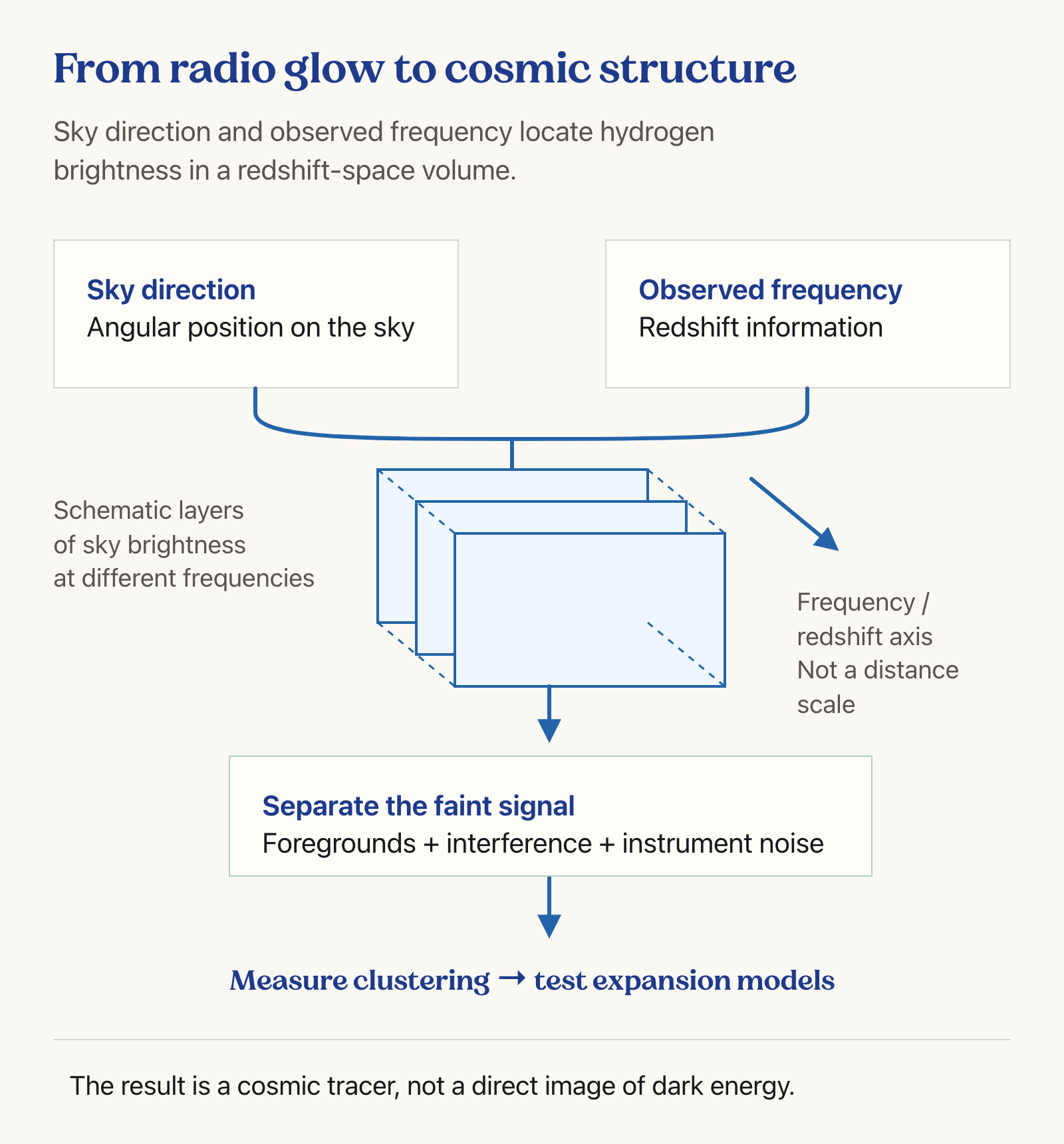
Sky direction supplies angular position, while the observed frequency supplies redshift information: together they organise hydrogen emission into a three-dimensional view.

  • Angular position tells researchers where a signal appears on the sky. On its own, this is a projected view: radiation arriving from the same direction can originate at different depths along that sightline.
  • Observed frequency adds the missing separation. Comparing it with hydrogen’s known emitted frequency gives redshift; for cosmological emission, a lower observed frequency corresponds to greater stretching during the radiation’s journey through expanding space.
  • Frequency slices separate emission by redshift. Combining these slices with angular maps produces a volume of brightness fluctuations; converting redshift into physical distance requires a cosmological model, rather than simple direct ranging.
  • Clustering describes how emission varies across this volume. Its statistical patterns trace underlying matter structure, giving researchers a way to compare predictions about the universe with observations gathered through a different measurement technique.
  • Expansion tests compare clustering patterns across redshifts. Characteristic scales, including baryon acoustic oscillations, can act as cosmological rulers; detecting hydrogen emission is a step toward these measurements, not proof that every ruler is measured.
Schematic of sky-direction and frequency inputs forming hydrogen brightness layers before foreground separation and expansion-model tests.
Schematic: sky direction and observed frequency build a radio-brightness volume; foreground separation allows clustering analysis. This is not measured data.

Why foreground removal determines the claim

A telescope detects everything entering its receivers; the scientific task is to establish which part of that mixture belongs to distant hydrogen.

  • Foreground emission from nearer astronomical sources can overwhelm the desired signal. Human radio transmissions and the instrument’s own response add further contamination, so a strong recorded signal is not automatically a strong cosmological detection.
  • Calibration characterises receiver behaviour before researchers interpret sky brightness. Differences across time, direction or frequency can otherwise resemble celestial structure; cleaning must also be checked for accidentally removing the weak hydrogen component being sought.
  • Cross-correlation previously compared CHIME data with independent galaxy surveys to recover shared structure. The new standalone result establishes detection using CHIME observations themselves, while independent comparisons remain valuable checks on the interpretation of those measurements.
  • Dark energy names the unknown explanation associated with accelerated expansion. Hydrogen supplies observable matter structure for testing cosmological models; its detection neither photographs dark energy nor identifies a new particle responsible for cosmic acceleration.
  • Cosmic mapping asks how matter is distributed across large volumes. By contrast, black-hole jet heating concerns energy transfer around galaxies; studying gas in both cases does not make the physical questions interchangeable.

Way Forward

Improve the measurement before widening the claim

  • Test foreground cleaning against simulated signal recovery and independent observations to distinguish real structure from analysis artefacts.
  • Expand the analysed observations while checking instrument stability; more data are useful only when measurement errors remain controlled.
  • Report detection, parameter constraints and theoretical interpretation separately so scientific communication does not turn a new observational capability into a settled explanation.

Conclusion

  • CHIME hydrogen mapping links an atomic radio signal to cosmic structure through sky position, observed frequency and statistical analysis. The standalone detection strengthens that observational chain without directly revealing the physical nature of dark energy.
  • The durable distinction is between what is measured and what is inferred: hydrogen brightness is observed, while expansion history is investigated through calibrated maps and cosmological models that must survive further tests.

UPSC Practice Questions

Prelims MCQ 1

With reference to hydrogen intensity mapping, consider the following statements:

  1. It can measure combined radio emission without individually identifying every contributing galaxy.
  2. Cosmological expansion stretches the wavelength of hydrogen emission.
  3. Detecting hydrogen emission directly identifies the physical nature of dark energy.

How many of the above statements are correct?

(a) Only one (b) Only two (c) All three (d) None

Answer: (b) Only two

Explanation:

The first two statements are correct. Hydrogen maps help test expansion models; they do not directly identify dark energy.

Prelims MCQ 2

Why is frequency information useful alongside angular position in hydrogen intensity mapping?

(a) It eliminates all instrument noise automatically. (b) It identifies the chemical composition of every galaxy. (c) It supplies redshift information that separates emission along the line of sight. (d) It proves that foreground emission is absent.

Answer: (c) It supplies redshift information that separates emission along the line of sight.

Explanation:

The known emitted hydrogen frequency and its observed value give redshift information. Foreground removal and calibration are still required.

UPSC Mains Questions

  1. Explain how hydrogen intensity mapping can contribute to studies of cosmic expansion. What observational challenges limit the interpretation?
  2. Distinguish scientific detection from theoretical explanation, using CHIME’s standalone hydrogen detection as an example.

Sources: PIB, Ministry of Science and Technology and National Research Council Canada.

Frequently Asked Questions

What is CHIME?

CHIME is the Canadian Hydrogen Intensity Mapping Experiment, a fixed radio telescope in Canada. It combines signals from its receivers to survey the sky as Earth rotates and study astronomical radio emission.

How does hydrogen intensity mapping work?

It measures combined hydrogen radio brightness across sky directions and observed frequencies. Frequency provides redshift information, allowing researchers to study structure in three dimensions without separately identifying every contributing galaxy.

Did CHIME discover dark energy?

No. The reported achievement is a standalone detection of distant hydrogen emission. Hydrogen maps can support tests of cosmic expansion and dark-energy models, but they do not directly establish what dark energy is.

Does five billion years refer to the signal’s travel time?

No. The report refers to the age of the universe when the emission originated. Cosmic age at emission and lookback time describe different intervals and should not be used interchangeably.

Why must researchers remove foregrounds?

Closer astronomical radio sources can be much brighter than distant hydrogen. Researchers must distinguish that contamination, terrestrial interference and instrument effects from the weak signal before interpreting a map as cosmological evidence.

Adaptive Traffic Signals: From Fixed Timings to Live Coordination

Open article →Download PDF

Why in News?

On 30 September 2026, the Cabinet Committee on Economic Affairs approved Delhi’s Intelligent Traffic Management System, including adaptive traffic signals and performance-dependent implementation phases.

  • The approved project covers 42 traffic corridors through three phases; approval does not establish that the proposed system is already operational.
  • Delhi Police will implement the project through a competitively selected Master System Integrator, with C-DAC providing technical support as Project Management Consultant.
  • Each subsequent phase depends on evaluation against prescribed testing, commissioning, acceptance and performance parameters; smoother journeys remain an expected benefit.
  • Adaptive control seeks better use of existing road space by responding to observed conditions rather than relying only on scheduled signal timings.
  • Public value depends on measurable journey improvements, maintained equipment and safe crossings, not simply the number of cameras or connected junctions.

UPSC Relevance

Prelims Relevance

  • Adaptive Traffic Control System: timings respond to current traffic demand.
  • Fixed-time control: predefined signal timings rather than continuous demand-based adjustment.
  • Corridor coordination: linked timing decisions across successive junctions.
  • C-DAC: technical scrutiny, monitoring, validation and acceptance support for Delhi ITMS.

Mains Relevance

GS Paper 2

  • Performance-based procurement and accountable urban service delivery.
  • Data safeguards and accessible remedies in automated enforcement.

GS Paper 3

  • Feedback control and efficient use of transport infrastructure.

Essay

  • Technology earns public trust through outcomes people can verify.

Background and Context

What changes when a junction becomes adaptive?

Adaptive traffic signals change the relationship between road conditions and signal decisions; they do not remove the physical limits of the intersection.

  • Fixed-time plans allocate signal periods in advance, potentially using different schedules across the day. When actual demand departs from that schedule, a lightly used approach can receive time that congested approaches need.
  • Adaptive control uses fresh traffic observations to revise timings. Its defining feature is the link between observed demand and subsequent control decisions, rather than simply installing electronic signal heads or surveillance cameras.
  • Corridor coordination considers successive junctions together. Releasing traffic rapidly at one intersection can merely move the queue downstream if the receiving junction cannot accommodate those vehicles, leaving the wider journey unimproved.
  • Road capacity remains constrained by junction geometry, obstructions and competing movements. Better timing can reduce avoidable waiting, but cannot guarantee unrestricted flow when demand persistently exceeds the space available to carry vehicles.
  • Approval versus delivery is the central news distinction: Delhi has an approved implementation project. Announced expectations of smoother traffic are prospective benefits, not measured results from an already completed citywide deployment.

The observe-adjust-measure feedback loop

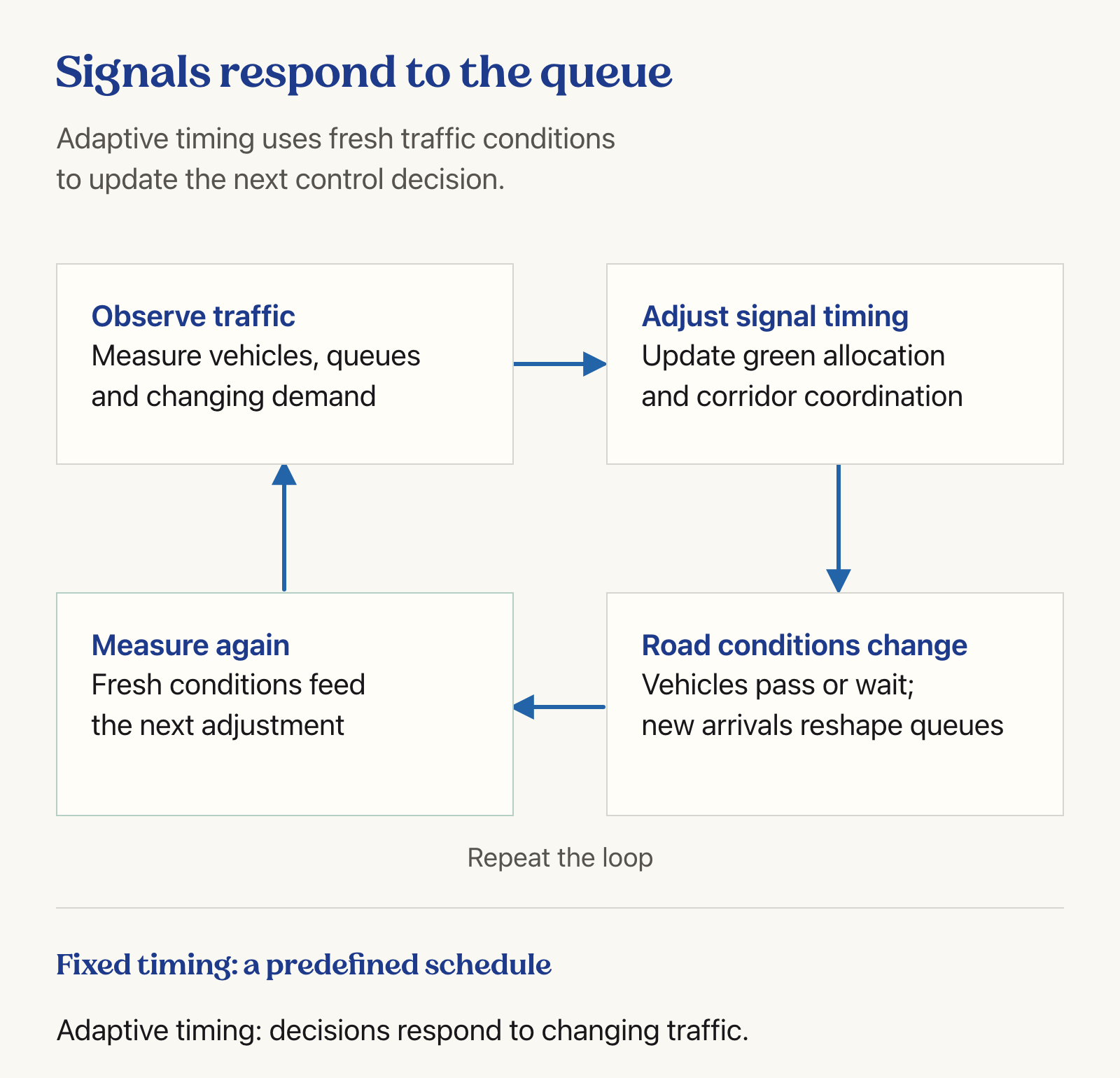
The general mechanism is a repeating feedback loop; the announcement does not identify a particular algorithm or publish detailed operating thresholds.

  • Observe demand: traffic sensors collect information about approaching vehicles and road conditions. This provides the changing input for control decisions; a scheduled plan alone cannot reveal whether the present queue differs from expectations.
  • Evaluate and adjust: control software assesses conditions against its operating objectives and modifies signal timing. The Federal Highway Administration describes this sequence without implying that every adaptive system uses the same algorithm.
  • Measure again: fresh observations show what happened after the adjustment. Those observations inform later decisions, completing the feedback loop; the system should respond to changing conditions rather than assume its earlier decision remains suitable.
  • Coordinate the corridor: linked signals need to account for traffic arriving from upstream junctions. Giving a single approach more green time is not automatically useful if it sends vehicles towards an already blocked exit.
  • Maintain dependable inputs: dirty, failed or poorly positioned sensors can weaken decisions. As with reliable sensor measurement, collecting data and obtaining trustworthy information are different tasks requiring technical checks and ongoing maintenance.
Clockwise feedback loop linking traffic observation, signal adjustment, changing road conditions and fresh measurements.
Adaptive control repeatedly observes traffic, adjusts timings and measures the changed conditions.

Why later phases must earn expansion

Performance gates create an opportunity to test whether installed equipment produces a useful service before the project expands across more corridors.

  • Implementation gates link each subsequent Delhi phase to evaluation of its predecessor. Testing that equipment switches on is only part of acceptance; the announcement also explicitly requires assessment against prescribed performance parameters.
  • Institutional roles separate implementation by Delhi Police from technical support through C-DAC. The latter’s stated responsibilities include scrutiny, monitoring, validation and acceptance during implementation and operation, rather than merely supplying a general endorsement.
  • Evaluation design should compare similar traffic periods and record changes in demand or road works. This is an analytical recommendation: the approval release does not disclose the detailed method or numerical acceptance thresholds.
  • Outcome measures should examine delays, queue spillback and journey reliability alongside safe pedestrian movement. The distinction between infrastructure completion and usable access also appears in evaluating rural road outcomes.
  • Data governance deserves separate scrutiny because automated enforcement can identify vehicles. Purpose limits, restricted access, retention rules and error appeals are recommended safeguards here, not claims about detailed protections notified with this approval.

Way Forward

Make expansion conditional on service evidence

  • Publish intelligible acceptance results for each phase, including reliability and unresolved failures, before expanding deployment.
  • Require maintenance and fallback arrangements so defective inputs or communication failures do not leave traffic management dependent on unreliable automated decisions.
  • Assess pedestrian and public-transport needs alongside vehicle flow; a shorter car queue alone is an incomplete measure of urban mobility.
  • Specify data access controls and error review for enforcement, distinguishing recommended safeguards from protections actually adopted in binding project arrangements.

Conclusion

  • Adaptive signalling is a feedback-based allocation of limited junction capacity, not a promise to eliminate congestion. Delhi’s approval makes performance validation especially important because expansion is explicitly tied to preceding-phase assessment.
  • In an urban-governance answer, connect observations, control decisions and measured outcomes. Judge procurement by the dependable service delivered to road users, with maintenance and accountability treated as operating requirements rather than later additions.

UPSC Practice Questions

Prelims MCQ 1

With reference to adaptive traffic control, consider the following statements:

  1. It uses current traffic observations to inform signal-timing adjustments.
  2. Corridor coordination concerns only one isolated junction.
  3. Delhi ITMS expansion to subsequent phases depends on evaluation of the preceding phase.

How many of the above statements are correct?

(a) Only one (b) Only two (c) All three (d) None

Answer: (b) Only two

Explanation:

Statements 1 and 3 are correct. Corridor coordination links decisions across successive junctions, so statement 2 is incorrect.

Prelims MCQ 2

Which observation most directly demonstrates the need for corridor-level signal coordination?

(a) Every traffic signal has an electronic display. (b) Faster release at one junction enlarges the queue at the next. (c) A city installs additional administrative computers. (d) A control room receives a new project name.

Answer: (b) Faster release at one junction enlarges the queue at the next.

Explanation:

A junction can improve its own throughput while transferring congestion downstream. Coordination evaluates the linked corridor rather than an isolated signal.

UPSC Mains Questions

  1. Explain how adaptive traffic signals use feedback to manage urban road demand. Why does corridor coordination matter?
  2. How can performance-gated procurement improve accountability in intelligent traffic management projects? Discuss measurement, maintenance and data safeguards.

Sources: PIB, Cabinet Committee on Economic Affairs and US Federal Highway Administration.

Frequently Asked Questions

Is Delhi’s approved ITMS already fully operational?

The announcement approves implementation and describes phased delivery. It does not establish that the full system is operating or that projected reductions in traffic delays have already been achieved.

How do adaptive signals differ from fixed-time signals?

Fixed-time signals follow predefined timings. Adaptive systems use current traffic observations to assess conditions and revise timings, repeating the process as demand changes rather than relying entirely on a predetermined schedule.

Does adaptive signalling guarantee congestion-free roads?

No. It can improve the allocation of available signal time, but junction geometry, blocked exits and demand beyond road capacity can still produce congestion even when signal control works properly.

What does C-DAC do in the Delhi project?

C-DAC will provide technical support as Project Management Consultant. Its announced functions include technical scrutiny, monitoring, validation and acceptance during implementation and the operation and maintenance period of the project.

Green Energy Corridor III: Connecting Transmission and Storage

Open article →Download PDF

Why in News?

On 30 September 2026, the Union Cabinet approved Green Energy Corridor Phase III, combining intra-state transmission expansion with battery energy storage for renewable integration.

  • The approved transmission component is intended to enable evacuation of up to 135 GW of renewable energy.
  • The scheme provides for 50 GWh of battery storage at generator sites or other locations important for grid flexibility.
  • These are approved provisions, not evidence that the transmission assets and batteries have already been commissioned.
  • Renewable generation is useful only when the network can carry it and electricity is available when consumers need it.
  • The scheme connects infrastructure planning with the operational task of balancing variable generation and changing demand.

UPSC Relevance

Prelims Relevance

  • Intra-state transmission and renewable power evacuation
  • Battery Energy Storage Systems and grid flexibility
  • GW as power versus GWh as energy
  • Tariff Based Competitive Bidding and cost-plus implementation
  • State Transmission Utilities

Mains Relevance

GS Paper 3

  • Renewable integration, electricity infrastructure and energy security
  • Coordinating generation, transmission and storage investments

GS Paper 2

  • Centre-state coordination in infrastructure delivery

Essay

  • Infrastructure creates value when its complementary systems work together.

Background and Context

Transmission addresses the location of electricity

A transmission corridor connects renewable generation to the wider electricity system; its value depends on what happens at both ends.

  • Power evacuation means carrying electricity away from generating stations into the network. A renewable plant may be ready to generate while its connecting line or substation remains the constraint on usable supply.
  • Intra-state transmission strengthens the network within a state or Union Territory. In this scheme, the focus is enabling renewable integration and evacuation within those territories, rather than treating every corridor as an interstate link.
  • Congestion arises when the network cannot carry all desired power flows within operating limits. Adding generation alone does not remove that bottleneck; suitable lines, substations and network strengthening must accompany the plant.
  • Curtailment means reducing generation that could otherwise be produced. Where inadequate evacuation is the cause, transmission reinforcement can improve use of renewable resources, but its location and commissioning sequence matter as much as capacity.
  • Demand connections complete the chain from renewable resources to productive use. The Kandla e-methanol proposal illustrates why renewable electricity supply must be considered alongside the industrial process that will consume it.

Storage addresses when electricity is needed

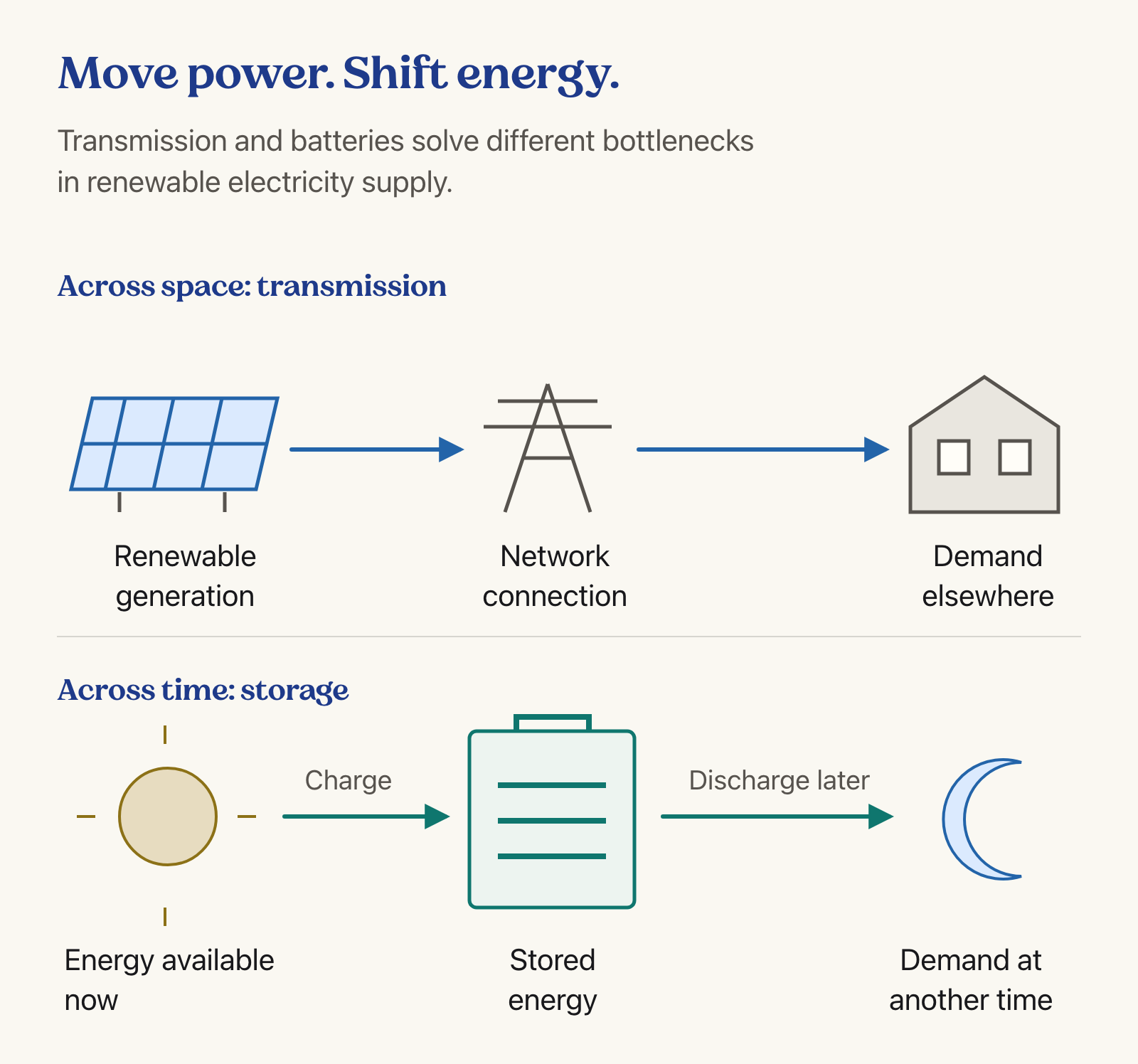
Batteries add a time dimension: they can absorb electricity at one moment and supply it later, subject to their operating limits.

  • Battery storage charges when electricity is available and discharges when required. The Cabinet release identifies intermittency, congestion, curtailment and non-solar-hour demand among the problems this component is intended to address through grid flexibility.
  • Location changes the service a battery can provide. Storage near a generator may absorb output before an export bottleneck; storage nearer demand may support local supply, depending on available connections and operating arrangements.
  • GW measures power, the rate at which electricity is produced or delivered. GWh measures energy, an amount accumulated over time; comparing these units requires knowing which equipment each figure actually describes in the system.
  • Storage duration requires the usable energy capacity and discharge power of the same storage system. Dividing the scheme’s battery-energy figure by its renewable-evacuation figure would mix different assets and produce a misleading duration.
  • Flexibility is complementary: batteries do not create renewable energy or replace all network expansion. Their contribution depends on charging opportunities, available stored energy, conversion losses and the power they can deliver when needed.
Diagram comparing renewable generation, transmission and demand with battery charging and later delivery.
Transmission carries electricity between locations; batteries retain energy for later use.

Approval must become coordinated delivery

The implementation model separates new transmission projects from upgrades, while delivery still requires coordination across assets and institutions.

  • Greenfield transmission projects under the scheme will use Tariff Based Competitive Bidding. Transmission Service Providers will participate through a Build-Own-Operate-Maintain model, linking project delivery with continuing responsibility for the asset’s operation and maintenance.
  • Brownfield upgrades and network strengthening will follow a cost-plus basis. This distinction concerns the implementation route; it does not mean existing networks need less careful scrutiny of costs, performance or the chosen technical solution.
  • State Transmission Utilities are the overall implementing agencies. Effective delivery requires their plans to match renewable-project readiness, connection requirements and storage siting, so one completed asset is not stranded while another remains unfinished.
  • Financial assistance is intended to offset intra-state transmission charges and support affordable power. This is the policy rationale; an approval announcement alone cannot establish the eventual tariff paid by a particular electricity consumer.
  • Outcome assessment should distinguish installed assets from useful services. As with measuring road connectivity outcomes, the question is whether infrastructure improves access and performance, rather than whether construction expenditure has simply occurred.

Way Forward

Plan and measure the complete electricity chain

  • Sequence generation, transmission and storage against shared commissioning milestones, with responsibility for each connection clearly assigned.
  • Choose battery locations and operating arrangements around a defined network or demand problem, rather than aggregate storage capacity alone.
  • Track renewable curtailment, availability during demand peaks and network congestion before and after commissioning to assess actual service improvements.

Conclusion

  • Transmission moves electricity across space; storage shifts its availability across time. Renewable integration needs both functions where the system’s bottlenecks demand them, alongside operational coordination and appropriate connections.
  • Use GEC-III to explain complementary infrastructure in a Mains answer: begin with the bottleneck, identify the suitable intervention, and assess delivered electricity services separately from approved capacity or construction.

UPSC Practice Questions

Prelims MCQ 1

With reference to Green Energy Corridor Phase III, consider the following statements:

  1. It combines intra-state transmission development with battery energy storage provisions.
  2. GWh expresses energy capacity, whereas GW expresses power.
  3. The renewable-evacuation capacity can be used as the battery discharge rating to calculate storage duration.

How many of the above statements are correct?

(a) Only one (b) Only two (c) All three (d) None

Answer: (b) Only two

Explanation:

Statements 1 and 2 are correct. Storage duration needs the energy capacity and discharge power of the same battery system; renewable evacuation capacity is not its discharge rating.

Prelims MCQ 2

Which implementation distinction is stated for the transmission component of GEC-III?

(a) All projects use cost-plus implementation (b) Brownfield projects use competitive bidding while greenfield projects use cost-plus implementation (c) Greenfield projects use tariff-based competitive bidding while brownfield upgrades use cost-plus implementation (d) State Transmission Utilities have no implementing role

Answer: (c) Greenfield projects use tariff-based competitive bidding while brownfield upgrades use cost-plus implementation

Explanation:

The Cabinet release specifies competitive bidding for greenfield transmission and cost-plus implementation for brownfield upgrades and network strengthening. State Transmission Utilities are the overall implementing agencies.

UPSC Mains Questions

  1. Transmission and storage address different constraints in renewable energy integration. Explain with reference to Green Energy Corridor Phase III. (150 words)
  2. How should policymakers evaluate whether renewable-energy infrastructure delivers reliable electricity services? Discuss coordination and outcome measurement. (250 words)

Source: PIB, Union Cabinet.

Frequently Asked Questions

What is Green Energy Corridor Phase III?

It is a Cabinet-approved scheme combining intra-state transmission development with battery energy storage. Its purpose is to support renewable power evacuation, grid integration and flexibility; approval does not mean all assets are operational.

How do transmission and batteries differ?

Transmission carries electricity between locations. Batteries absorb electrical energy and supply it later. These functions can complement each other, but a battery cannot automatically remove every network bottleneck or replace transmission expansion.

Why should GW and GWh not be confused?

GW measures the rate of electricity delivery or generation. GWh measures an amount of energy. Storage duration requires the energy and discharge-power ratings of the same storage system, not figures from unrelated assets.

Who will implement the transmission component?

State Transmission Utilities are the overall implementing agencies. Greenfield transmission projects will use tariff-based competitive bidding, while brownfield upgrades and network strengthening will follow a cost-plus basis under the approved scheme.

National Coastal Mission 2.0: Coordinating Coastal Resilience

Open article →Download PDF

Why in News?

The Environment Ministry launched National Coastal Mission 2.0 implementation guidelines on 30 September 2026 to coordinate coastal resilience, conservation and sustainable development.

  • NCM 2.0 is a Central Sector Scheme involving coastal States, Union Territories and other stakeholders.
  • The guidelines cover vulnerability assessment, ecosystem restoration, pollution management, biodiversity conservation and spatial planning.
  • The release stresses convergence with ongoing schemes, clearer institutional responsibilities, monitoring and accountability.
  • The announcement concerns a guideline launch; it does not establish that proposed activities have already delivered results.
  • Coastal resilience requires decisions about ecosystems, settlements and economic activity to work together in the same landscape.
  • Integrated planning matters because agencies can otherwise pursue individually useful projects whose combined effects undermine coastal protection.

UPSC Relevance

Prelims Relevance

  • National Coastal Mission 2.0: Central Sector Scheme.
  • Nodal ministry: Environment, Forest and Climate Change.
  • Spatial planning: considering the location and interaction of different coastal uses.
  • Mangroves: nursery habitats and natural coastal protection.
  • Guidelines, implementation activities and measured outcomes are distinct stages.

Mains Relevance

GS Paper 3

  • Ecosystem-based coastal resilience and competing land-use pressures.
  • Outcome measurement in environmental programmes.

GS Paper 2

  • Centre-State coordination and accountability across departments.

Essay

  • Development works better when public institutions account for ecological connections.

Background and Context

What integrated coastal planning should connect

The mission brings related coastal tasks into a common implementation framework; the practical challenge is making decisions reinforce one another.

  • Vulnerability assessment should identify the places, ecosystems and livelihoods facing risk before selecting interventions. A useful planning question is who remains exposed after a proposed project, rather than simply where construction is possible.
  • Spatial planning asks how activities fit within a shared coastal area. As an illustrative choice, planners should consider whether access infrastructure conflicts with a restoration site before approving separate work programmes.
  • Convergence means linking ongoing government efforts rather than treating each scheme as a self-contained project. Departments should compare locations, schedules and responsibilities so that one investment does not frustrate another nearby.
  • Stakeholder participation is part of the announced approach. Its practical value should come from identifying local resource uses and implementation constraints before decisions, with responses recorded rather than consultation measured only through attendance.
  • The same planning principle appears in urban river management: administrative boundaries need not match environmental connections. Coastal planning should examine linked pressures instead of assuming each project site functions independently.

Why coastal ecosystems belong in development decisions

Mangroves illustrate why ecosystem restoration, biodiversity and community resilience cannot be evaluated as unrelated spending categories.

  • UNEP identifies mangroves as natural coastal defences that reduce erosion and attenuate waves. This makes ecosystem condition relevant to protection decisions, alongside the infrastructure and preparedness measures appropriate to each particular location.
  • Mangroves also provide nursery habitat for fish and crustaceans. Their value extends beyond the trees visible above water; a coastal assessment should consider how habitat protection relates to nearby resource-dependent livelihoods.
  • Restoration should be evaluated through ecological function, not merely planting activity. For a proposed intervention, planners should explain the intended habitat benefit and how monitoring will determine whether that benefit persists over time.
  • Pollution management is another mission priority. As an implementation recommendation, restoration plans should identify and address continuing pressures at the site; creating an asset while ignoring its surrounding conditions risks undermining the investment.
  • Blue economy objectives in the release connect coastal development with resilience and sustainability. An answer should examine whether economic activity maintains the ecosystem functions supporting it, rather than equating coastal investment with sustainable development.

How to judge implementation without overstating the launch

The guidelines announce an enabling framework. Evidence of delivery must come from subsequent implementation and monitoring.

  • The release promises clearer institutional responsibilities. A useful implementation test is whether each planned action has an identified responsible authority, coordination partners and a route for resolving delays involving more than one department.
  • Monitoring should separate activity from outcome. Completing a restoration contract demonstrates work undertaken; demonstrating improved habitat condition requires a baseline, relevant observations and an assessment of whether the change can be sustained.
  • Accountability also requires clarity about unfinished work. Reviews should identify the reason for delay, the institution responsible for correction and the consequences for linked activities instead of reporting only aggregate expenditure or completed tasks.
  • The announcement of a streamlined implementation framework does not establish a new exemption from environmental regulation. Do not infer changes to Coastal Regulation Zone requirements or project-clearance obligations from this press release alone.
  • For an exam answer, distinguish coordination design from proven performance. Compare this with conservation management evaluation, where identifying management arrangements and assessing ecological results are related but different analytical tasks.

Way Forward

Make coordination and results visible

  • Publish site-level responsibilities and interdepartmental dependencies so that monitoring can locate bottlenecks.
  • Set baselines for the intended ecological or resilience outcomes before starting interventions.
  • Record community concerns, decisions taken and unresolved issues alongside physical progress.
  • Assess ecosystem condition and maintenance needs after works are completed.

Conclusion

  • NCM 2.0 offers a framework for connecting coastal conservation and development across institutions. Its significance lies in coordinated choices about places and ecosystems; success still requires evidence from implementation.
  • Use the mission to explain why coastal resilience needs both ecological understanding and administrative accountability. Judge whether interventions work together and sustain useful outcomes, rather than treating the launch itself as proof of protection.

UPSC Practice Questions

Prelims MCQ 1

With reference to National Coastal Mission 2.0, consider the following statements:

  1. It is described as a Central Sector Scheme.
  2. Its announced priorities include spatial planning and ecosystem restoration.
  3. The launch release establishes that coastal projects are exempt from environmental-clearance requirements.

How many of the above statements are correct?

(a) Only one (b) Only two (c) All three (d) None

Answer: (b) Only two

Explanation:

The official release supports the first two statements. A streamlined implementation framework does not establish the exemption claimed in the third.

Prelims MCQ 2

Which observation best distinguishes an ecological outcome from a project activity?

(a) A restoration contract has been awarded. (b) A coordination meeting has been held. (c) Habitat condition has improved against a documented baseline. (d) Funds have been transferred to an implementing agency.

Answer: (c) Habitat condition has improved against a documented baseline.

Explanation:

Habitat improvement measures a change in ecosystem condition. The other observations describe administrative or implementation activities.

UPSC Mains Questions

  1. Explain how integrated coastal planning can reconcile ecosystem conservation and economic activity. Discuss the institutional requirements for implementation.
  2. Why should environmental programmes distinguish outputs from outcomes? Illustrate with coastal restoration and resilience planning.

Sources: PIB, Ministry of Environment, Forest and Climate Change and UNEP: Mangroves in the spotlight.

Frequently Asked Questions

What was launched under National Coastal Mission 2.0?

The Environment Ministry launched implementation guidelines on 30 September 2026. The release describes a framework for coordinated coastal resilience and sustainable development, with clearer responsibilities, monitoring and accountability.

What does spatial planning mean for coastal areas?

Spatial planning considers where different activities occur and how they interact. For coastal management, it helps decision-makers examine whether development, conservation and other uses support or conflict with one another.

Why are mangroves relevant to coastal resilience?

Mangroves provide nursery habitats and natural coastal protection. UNEP describes their role in reducing erosion and attenuating waves, making ecosystem condition relevant to both conservation and the wellbeing of coastal communities.

Do these guidelines prove that coastal protection has improved?

No. A guideline launch establishes an implementation framework. Demonstrating improved protection or ecosystem condition requires subsequent work, suitable baseline information and monitoring evidence; administrative activity alone does not establish ecological outcomes.

One Health Laboratories: Minimum Standards and Biosafety

Open article →Download PDF

Why in News?

India released a Minimum Standard Requirements document for BSL-3/4 laboratories at the Scientific Steering Committee on One Health meeting on 30 September 2026.

  • The Advisory and Review Committee on BSL-3/4 laboratories developed the document released at the meeting.
  • PIB said the document would shortly enter the public domain; the announcement does not disclose its detailed technical clauses.
  • The meeting emphasised institutional ownership, follow-through and use of existing capacities across human, animal and environmental health.
  • The One Health Dashboard remains under development; progress reviewed at the meeting should not be confused with a completed nationwide launch.
  • A laboratory network needs safe operating capacity as well as testing equipment: scientific capability creates public value only when its risks are controlled.
  • The central question is how minimum standards and case-specific risk assessment can support dependable containment across institutions with different resources.

UPSC Relevance

Prelims Relevance

  • BSL: biosafety level
  • Minimum Standard Requirements for BSL-3/4 laboratories
  • WHO’s evidence- and risk-based biosafety approach
  • Biological safety cabinets as primary containment devices
  • One Health: human, animal and environmental health

Mains Relevance

GS Paper 2

  • Public-health infrastructure, accountable institutions and laboratory governance.

GS Paper 3

  • Scientific risk management and safe biological research.

Essay

  • Scientific capacity and responsibility must develop together.

Background and Context

Containment is a system, not a laboratory label

Laboratory biosafety concerns preventing unintended exposure to biological agents and their accidental release; equipment is only one part of that task.

  • A biological safety cabinet is a primary containment device at the work area. Its presence does not, by itself, establish that an entire facility meets a particular biosafety standard.
  • WHO treats laboratory design and maintenance, protective equipment, waste management and programme management as connected subjects. Safe work depends on how these elements operate together, rather than how impressive one installation appears.
  • Decontamination and waste management extend the safety question beyond the immediate experiment. An assessment must consider what happens to material after work ends, not only how staff handle it during testing.
  • Maintenance matters because a safeguard must continue functioning throughout use. Buying equipment is a discrete event; keeping its protective function dependable is a recurring responsibility within a laboratory’s safety programme.
  • BSL-3 and BSL-4 are biosafety-level designations, not certificates of scientific quality. The current announcement concerns minimum requirements for those laboratories; it does not certify every facility or report universal compliance.

Risk assessment determines the protective response

WHO’s manual provides general background for understanding biosafety; its principles should not be presented as undisclosed clauses of India’s new document.

  • The WHO manual calls for thorough, evidence-based and transparent risk assessment. Safety measures should match the actual risk of work with biological agents on a case-by-case basis, rather than follow assumptions alone.
  • Hazard describes the potential for harm; risk assessment examines that potential in the circumstances of the proposed activity. Naming an organism is a starting point, not a complete account of laboratory risk.
  • WHO says assessment should occur before activities begin and inform risk controls. The logical sequence is to understand the work and its risks before deciding which safeguards are appropriate for it.
  • A risk-based approach is not permission to remove safeguards merely to save money. WHO links efficient resource use with sustainable biosafety and access to laboratory services without compromising protection.
  • Safe research access and containment should be evaluated together. As with shared research equipment, wider availability creates practical value only when institutions can support the conditions required for responsible use.

What minimum requirements can establish

Common requirements can create a reference for institutions, but their scope and implementation must be read from the actual document.

  • The confirmed development is release of the MSR document at the meeting, with public dissemination promised shortly. The announcement does not provide a clause-by-clause account or establish an enforcement timetable.
  • A document’s release, its public availability and its legally binding effect are different questions. Do not infer compulsory deadlines, penalties, certification procedures or specific engineering requirements from the press announcement alone.
  • Implementation requires a link between written expectations and actual practice. In a policy answer, examine institutional responsibility, operating resources and verification rather than treating publication of a standard as proof of safer laboratories.
  • A credible safety culture makes deviations visible and supports correction. The wider governance lesson resembles learning from near misses: systems need evidence about failures before those failures become serious harm.
  • The useful One Health connection is shared preparedness across sectors. Laboratories serving different health domains need dependable safeguards; a dashboard can organise information but cannot substitute for the physical and organisational controls supporting safe work.

Way Forward

Make requirements assessable in practice

  • Publish the complete MSR document with clear scope, institutional responsibilities and the basis for assessing conformity.
  • Support risk assessment and staff competence alongside equipment procurement, maintenance and waste-management capacity.
  • Evaluate implementation evidence against stated requirements; distinguish planned upgrades, completed installations and sustained safe operation.

Conclusion

  • Laboratory biosafety depends on a functioning system of assessment, containment and management. A facility’s label or equipment list cannot answer every question about safe operation.
  • For an exam answer, connect minimum requirements with institutional capacity and verification. Keep the confirmed Indian announcement separate from WHO background and from recommendations about future implementation.

UPSC Practice Questions

Prelims MCQ 1

With reference to laboratory biosafety, consider the following statements:

  1. WHO recommends risk assessment before laboratory activities are undertaken.
  2. The presence of a biological safety cabinet alone establishes an entire laboratory’s conformity with a biosafety standard.
  3. WHO’s risk-based approach seeks appropriate safeguards without compromising safety.

How many of the above statements are correct?

(a) Only one (b) Only two (c) All three (d) None

Answer: (b) Only two

Explanation:

Statements 1 and 3 are correct. A cabinet is a primary containment device; whole-laboratory safety also involves design, maintenance, procedures and management.

Prelims MCQ 2

Which conclusion is supported by the September 2026 announcement on Minimum Standard Requirements for BSL-3/4 laboratories?

(a) Every such laboratory has already received certification. (b) The One Health Dashboard has completed nationwide deployment. (c) The MSR document was released, with public dissemination to follow. (d) WHO’s manual has automatically become an Indian statutory rule.

Answer: (c) The MSR document was released, with public dissemination to follow.

Explanation:

PIB confirms release of the document and says it will shortly be available publicly. It does not establish the other claims.

UPSC Mains Questions

  1. How can minimum laboratory requirements and risk-based assessment together strengthen India’s public-health preparedness?
  2. Why is equipment procurement insufficient for laboratory biosafety? Discuss the institutional responsibilities needed for dependable containment.

Sources: PIB, Office of the Principal Scientific Adviser and WHO Laboratory biosafety manual, fourth edition: background.

Frequently Asked Questions

What are the new Minimum Standard Requirements about?

The document concerns BSL-3/4 laboratories and was released at the One Health steering committee meeting. PIB said public dissemination would follow; its detailed technical clauses were not provided in that announcement.

What does risk-based laboratory biosafety mean?

It means assessing the actual risks of proposed work before choosing controls. WHO recommends evidence-based, transparent assessment so that protective measures fit the activity and local circumstances without compromising safety.

Does a biological safety cabinet make a laboratory compliant?

A cabinet provides primary containment at the work area, but it is only one component. Whole-facility safety also involves design, maintenance, protective equipment, waste management and a functioning biosafety programme.

Is the MSR document already a binding statutory rule?

The cited announcement confirms release of a document, not its statutory effect. Its legal basis, detailed requirements and implementation arrangements must be established from the published document and any applicable official instruments.

Petroleum Amendment Draft: Civil Penalties and Safety Offences

Open article →Download PDF

Why in News?

The Ministry of Petroleum and Natural Gas released the draft Petroleum (Amendment) Bill, 2026 on 30 September for public consultation, proposing separate civil and criminal enforcement routes.

  • Comments may be submitted until 30 October 2026; the ministry says it will examine the inputs received.
  • The draft concerns penalties and procedure under the Petroleum Act, 1934; it is not an enacted amendment.
  • Its central proposal combines civil adjudication of license breaches with specific offences covering unauthorized activity, fraud and damage.
  • Fuel-handling safety requires enforceable duties even when routine regulatory breaches move away from criminal prosecution.
  • The consultation stage matters: as with draft product-naming rules, a proposed requirement must not be described as an operative obligation.

UPSC Relevance

Prelims Relevance

  • Draft legislation versus enacted and commenced law.
  • Petroleum Act: import, transport, storage, production, refining and blending.
  • Civil adjudication versus prosecution of specified offences.
  • Natural justice and reasoned administrative decisions.
  • Gazette notification of critical petroleum infrastructure.

Mains Relevance

GS Paper 2

  • Designing proportionate enforcement with procedural safeguards.
  • Pre-legislative consultation and administrative accountability.

GS Paper 3

  • Industrial safety and protection of petroleum infrastructure.

Essay

  • Simpler regulation depends on credible enforcement.

Background and Context

What conduct would follow which route?

The proposal changes how different violations are treated, making the nature of the conduct central to the enforcement response.

  • The Petroleum Act covers handling activities including storage, transport, refining and blending. This draft concerns their enforcement framework; it should not be confused with amendments to the separate upstream oilfields law governing resource development.
  • A license-condition breach would enter civil adjudication. This does not remove the requirement to obtain a license: conducting an activity that legally requires one without obtaining it would remain a distinct proposed criminal offence.
  • Fraudulent licensing would be separately punishable. The draft distinguishes securing permission through dishonesty or misrepresentation from breaching conditions after permission is granted, rather than treating both as an undifferentiated failure to comply.
  • Intentional or knowing damage, petroleum pilferage and endangering safety appear in a specific offence provision. The relevant conduct and mental element matter; an accidental equipment failure should not automatically be labelled this offence.
  • The draft separately addresses obstruction of inspection and failure to report an accident when required. Decriminalizing license breaches does not mean inspectors lose access to facilities or operators lose their accident-reporting responsibilities.

How would civil adjudication work?

An administrative inquiry would establish the breach and support corrective orders, while the licensing authority retains its separate decision-making role.

  • The Central Government would authorize an adjudicating person or authority through a Gazette notification. The proposed role is to determine license-condition breaches and conduct inquiries, rather than send every such matter directly for criminal trial.
  • The inquiry must follow natural justice and record reasons for its actions. This makes the proposed civil route an evidence-based procedure, not an automatic fine triggered solely by an allegation against an operator.
  • The officer would have specified civil-court powers, including summoning witnesses, examining them on oath and requiring documents. These powers help test disputed compliance evidence; they do not convert the officer into a criminal court.
  • After inquiry, a written order could direct corrective action, impose a civil penalty, or do both. Proposed maximum penalties are ₹2.5 crore for a first breach and ₹5 crore for a subsequent breach.
  • The officer could recommend suspension, revocation or curtailed license duration to the licensing authority. A recommendation is distinct from that authority’s decision; unpaid civil penalties could also be recovered as arrears of land revenue.

Why civil penalties do not erase safety liability

The essential safeguard is that changing the enforcement route for one breach does not extinguish other legal consequences of harmful conduct.

  • If a license breach endangers public safety or causes grievous hurt or death, the draft expressly allows civil proceedings alongside proceedings under other applicable law. A civil payment would not buy immunity for the harm.
  • A separate provision preserves other liabilities in addition to civil penalties. In an answer, distinguish the regulatory breach, the resulting harm and the applicable legal proceedings instead of assuming that one penalty settles every issue.
  • The Centre could notify facilities or areas as critical petroleum infrastructure, with a specific offence for damaging them. The draft supplies a notification mechanism; it does not itself classify every fuel-storage site as critical.
  • Proportionality requires matching enforcement to the established conduct while retaining safety duties. The civil route can address compliance failures, but deterrence also depends on inspections, reliable evidence and actual correction of unsafe operating conditions.
  • The consultation document is the proposal being discussed, not current amended law. Its explanatory note helps explain policy intent, but expressly disclaims legal interpretation; detailed claims should be checked against the actual draft clauses.

Way Forward

Make the enforcement boundary clear

  • Publish clear classification guidance separating license breaches, unauthorized operations and safety offences, with examples that prevent inconsistent treatment.
  • Specify workable inquiry procedures and reasoned orders; procedural fairness also matters in criminal-process safeguards, although the legal settings differ.
  • Connect corrective directions with follow-up inspections so collecting a penalty does not become a substitute for fixing unsafe conditions.

Conclusion

  • The draft’s central mechanism is differentiated enforcement: civil inquiry for license breaches, specified offences for other conduct and preservation of additional liabilities. Its value depends on maintaining these boundaries in both drafting and implementation.
  • For an answer on regulatory reform, connect proportionate sanctions with evidence, reasoned decisions and verified correction. Describe this framework as a proposal under consultation, never as a safety regime already brought into force.

UPSC Practice Questions

Prelims MCQ 1

With reference to the draft Petroleum (Amendment) Bill, 2026, consider the following statements:

  1. It proposes an administrative inquiry for breaches of license conditions.
  2. Its proposed civil penalties would extinguish liabilities under every other law.
  3. It proposes Gazette notification of critical petroleum infrastructure.

How many of the above statements are correct?

(a) Only one (b) Only two (c) All three (d) None

Answer: (b) Only two

Explanation:

Statements 1 and 3 reflect the draft. Statement 2 is incorrect: other liabilities are expressly preserved.

Prelims MCQ 2

Which distinction best captures the proposed petroleum enforcement framework?

(a) All petroleum activities become license-free. (b) Civil adjudication replaces every criminal offence. (c) License breaches and operating without a required license receive different enforcement treatment. (d) Consultation automatically brings the amendment into force.

Answer: (c) License breaches and operating without a required license receive different enforcement treatment.

Explanation:

The draft proposes civil adjudication for license-condition breaches while separately criminalizing activity conducted without a required license. It remains a consultation draft.

UPSC Mains Questions

  1. How can civil adjudication of regulatory breaches improve compliance without weakening industrial safety? Discuss with reference to the draft petroleum amendments.
  2. Explain why decriminalization of regulatory breaches must be accompanied by procedural safeguards and preservation of liability for harmful conduct.

Sources: PIB, Ministry of Petroleum and Natural Gas and Ministry of Petroleum and Natural Gas: draft Bill.

Frequently Asked Questions

Has the Petroleum Amendment Bill become law?

No. The ministry released a consultation draft on 30 September 2026 and invited comments until 30 October. Release for consultation does not mean that Parliament has enacted it or that its provisions operate.

What is the proposed civil enforcement mechanism?

An authorized adjudicating officer would inquire into license-condition breaches, follow natural justice and issue reasoned decisions. Orders could require corrective action, impose civil penalties or combine both responses.

Would paying a civil penalty remove other liability?

No. The draft preserves other liabilities and expressly allows additional proceedings where a license breach endangers public safety or causes grievous hurt or death. Civil adjudication would not create blanket immunity.

Does the proposal remove petroleum licensing?

No. It distinguishes breaching license conditions from undertaking an activity without obtaining a legally required license. The latter would be a separately specified offence under the proposed framework.

How would critical petroleum infrastructure be identified?

The draft would empower the Central Government to identify infrastructure or areas through a Gazette notification. The proposal does not automatically label every petroleum facility as critical infrastructure.