Opens in a new tab
Join Anantam IAS Channel on Telegram

Daily Digest · Monday

19 October 2026 Current Affairs for UPSC

7 current affairs published on Monday, 19 October 2026

19 October 2026 Current Affairs for UPSC — every Why-in-News article AnantamIAS published on Monday, 19 October 2026, broken down with Why in News?, the exact GS paper it feeds, sub-topic mapping, MCQ-ready facts and a UPSC-style practice question. 7 articles in total, covering Polity, Economy, Environment, S&T, IR, Geography, History, Society and Internal Security — the same Why-in-News + GS-paper-mapping + practice-question format the Compass uses across every daily digest on the site.

Daily current affairs for UPSC is where new material enters your prep stream. Read this 19 October 2026 digest end-to-end in 25–35 minutes, attempt the practice question at the foot of each article (it's MCQ for some, 10/15-marker for others), then bookmark the entries that fall inside your active revision window. Everything stays cross-linked: tap any subject pill to jump to that subject's hub, or use the table of contents above to skip straight to a specific story.

Use this page three ways. Read sequentially for a one-sitting scan of everything that mattered on 19 October 2026. Download the 19 October 2026 PDF below for offline study or print revision. Or use the October 2026 Current Affairs compilation to see this day in the month's full context. For the previous day's reading, see 18 October 2026 Current Affairs; the next day's is 20 October 2026 Current Affairs.

Why we publish daily current affairs separately from the monthly compilation: daily is learning, monthly is revision. Use the daily page to add fresh material to your notes the day it breaks; come back to the October 2026 compilation 60 days before Prelims when the noise has settled and only the lasting takeaway is worth re-reading.

Online Child Safety: Detection, Reporting and Access Rights

Open article →Download PDF

Why in News?

The Supreme Court’s October 15 judgment on online child safety, reported by The Hindu on October 18, directed a coordinated detection and reporting framework while protecting children’s internet access.

  • The Union must create a National Hash and URL List Database for detecting and removing child sexual exploitation and abuse material, or CSEAM.
  • Database entries require final independent assessment by at least three trained human analysts; software may assist preliminary screening.
  • Platforms must distinguish verified database matches from material detected through their own review, with different removal and reporting routes.
  • These are judicial directions requiring implementation; the judgment does not establish that the database or all prescribed procedures are already operational.
  • Repeated circulation can prolong harm even after an original upload disappears; coordination across platforms addresses that continuing exposure.
  • The governance question is how to combine rapid removal, accountable decisions and access rights without treating children themselves as the problem.

UPSC Relevance

Prelims Relevance

  • Perceptual hash: identifier based on content characteristics, used to recognise matching material.
  • URL listing: identification of locations hosting verified material.
  • Known origin: material matching a verified national database entry.
  • Unknown origin: detected material outside that verified matching route.
  • Reporting authorities: Special Juvenile Police Unit, local police and/or the cyber-crime portal under the applicable POCSO reporting framework.

Mains Relevance

GS Paper 2

  • Child rights, proportionate regulation and accessible grievance redressal.
  • Accountability of private intermediaries and implementation of judicial directions.

GS Paper 3

  • Technology-assisted detection, human verification and cybercrime reporting.

Essay

  • Digital inclusion requires both access and protection.

Background and Context

Why child protection must preserve access

The judgment treats children as rights-holders whose learning and participation must remain possible while harmful material and responsible actors face effective intervention.

  • Internet access supports learning, expression and social connection, including for children in remote areas or with special needs. The Court rejects an approach that excludes children because platforms have failed to protect them.
  • CSEAM means child sexual exploitation and abuse material. Its continuing circulation can repeat the injury to a child; removing one upload is insufficient when copies remain available elsewhere or are repeatedly shared again.
  • Platform responsibility extends beyond visibly explicit files. Review must consider captions, keywords, links and promoted tools together, because apparently ordinary advertisements can direct users towards exploitative material hosted outside the original platform.
  • The Supreme Court judgment calls for proportionate safeguards and implementation measures. A direction to create a national system does not prove completed deployment, universal platform adoption or successful prevention of every harmful upload.
  • As with internet suspension safeguards, reasoned and reviewable restrictions matter. Here, the immediate object is particular harmful content and accountable platform action, while children retain legitimate opportunities to learn and communicate online.

How verified entries change the removal route

The central distinction is whether harmful material has already passed the national database’s verification process or still requires assessment through the ordinary route.

  • Entry verification may begin with specialised software, but at least three trained human analysts must independently determine whether material constitutes CSEAM. This assessment comes before its identifiers enter the shared national detection system.
  • Database contents must be confined to the perceptual hash identifier and/or URL of confirmed material, entered through encrypted channels. The database is not a repository for storing the underlying abusive images or videos.
  • A known-origin match requires the intermediary to disable and remove matching content immediately without awaiting further verification at its end. Earlier human assessment of the database entry enables this faster action across participating platforms.
  • Unknown-origin removal must follow proper verification and due diligence under the IT Rules. The intermediary must promptly report it to proper authorities and the database body, which separately assesses eligibility for a new entry.
  • Reporting differs by route: unknown-origin removals have specified two-hour reporting triggers; known matches require weekly consolidated reports to the database authority. Paragraph 316 separately preserves reporting under POCSO’s framework for removed or disabled CSEAM.
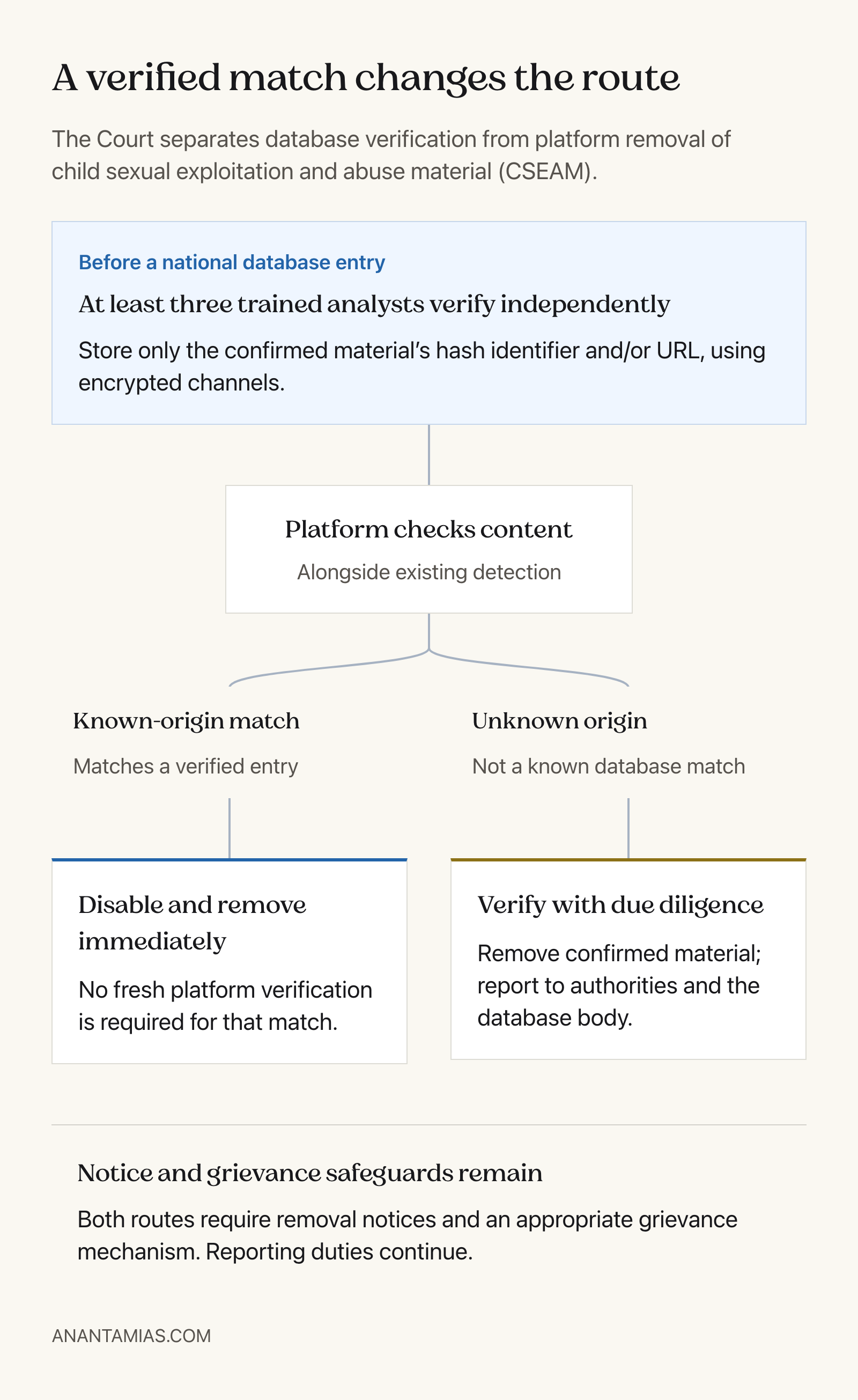
Diagram distinguishing human verification of national database entries, immediate removal of known CSEAM matches and due diligence for unknown-origin material
The Court’s directed framework separates verified database matches from unknown-origin review; the diagram does not imply completed implementation.

Speed needs an accountable correction mechanism

Shared detection can accelerate protection, but classification mistakes require notices, appropriate appeals and records that identify who made each consequential decision.

  • Removal notices must state whether action followed a platform’s own detection or a database match. This identifies the decision-making route and helps affected users understand which authority can examine a challenge to removal.
  • Appeal routes differ accordingly: platform-detected removal follows the IT Rules’ grievance mechanism and subsequent appellate route; database-match removal is challenged before the designated database authority under a grievance mechanism the Union must establish.
  • Human accountability also applies to complaints: automated tools may assist preliminary screening, but a trained grievance officer must decide the outcome. Recorded findings and a digital signature make responsibility traceable instead of anonymous.
  • Accessible reporting connects detection with access to justice in cybercrime. A clear complaint category, identifiable officers and reasoned responses help users seek protection without needing specialist technical knowledge or navigating an opaque platform interface.
  • Hash matching complements ordinary detection rather than replacing it. A database can recognise verified entries, but unfamiliar material still needs scrutiny; absence of a match cannot itself establish that content is lawful or harmless.

Way Forward

Make the safeguards operational and auditable

  • Specify independent verification and correction procedures before expanding shared database use, including secure entry controls and responsibility for erroneous classifications.
  • Publish clear reporting instructions distinguishing unknown-origin deadlines, consolidated known-match reporting and the continuing duties towards proper authorities.
  • Evaluate complaint handling and correction outcomes alongside removal speed; an impressive removal count alone cannot establish accurate classification or effective victim protection.

Conclusion

  • Online child safety requires coordinated detection without sacrificing children’s participation. The judgment connects verified shared identifiers, platform duties and reporting to authorities, while retaining human responsibility for consequential classification decisions.
  • For governance answers, distinguish rapid action on a verified match from assessment of unfamiliar material. Protection becomes more credible when removal is paired with clear notices, an appropriate appeal route and demonstrable implementation.

UPSC Practice Questions

Prelims MCQ 1

With reference to the proposed National Hash and URL List Database, consider the following statements:

  1. Its entries must be confined to hash identifiers and/or URLs of confirmed CSEAM.
  2. Final verification before an entry requires at least three trained human analysts.
  3. Every database match requires fresh human verification by the intermediary before removal.

How many of the above statements are correct?

(a) Only one (b) Only two (c) All three (d) None

Answer: (b) Only two

Explanation:

Statements 1 and 2 are correct. A match against a verified entry must be disabled and removed immediately without awaiting further verification by the intermediary.

Prelims MCQ 2

Which statement best explains the role of hash matching in the judgment?

(a) It replaces all ordinary detection and reporting duties. (b) Absence of a match proves that material is lawful. (c) It supports recognition of verified material alongside existing detection processes. (d) It requires storing abusive videos in the national identifier database.

Answer: (c) It supports recognition of verified material alongside existing detection processes.

Explanation:

The judgment expressly requires database matching alongside ordinary detection. Unknown-origin material still needs due diligence, reporting and assessment; the database stores identifiers and/or URLs.

UPSC Mains Questions

  1. How can technology-assisted content moderation protect children while preserving access rights and procedural fairness? Discuss with reference to the Supreme Court’s directions.
  2. Distinguish the governance requirements for verified database matches and previously unidentified harmful content. Explain why human oversight and reporting duties remain necessary.

Sources: Supreme Court of India judgment and The Hindu.

Frequently Asked Questions

Did the Supreme Court ban children from using the internet?

No. The Court treated children as entitled to internet access and protection. It directed attention towards harmful material, responsible actors and proportionate safeguards rather than excluding children from legitimate online participation.

What will the national database contain?

Its entries must contain only hash identifiers and/or URLs of confirmed material, submitted through encrypted channels. Final classification before entry requires independent determination by at least three trained human analysts.

How does a known match differ from unknown-origin material?

A verified database match requires immediate removal without further platform verification. Unknown-origin removal requires proper due diligence and reporting; the database authority separately assesses whether its identifiers should become a new entry.

Is the national database already operational?

The judgment directs the Union to create the database and establish associated procedures. The sources reviewed establish these directions, not completed national deployment or universal adoption by intermediaries.


CISF Functional Sectors: Matching Security to Infrastructure

Open article →Download PDF

Why in News?

The Hindu reported on 18 October 2026 that the Central Industrial Security Force will reorganise its supervisory structure from 1 November to strengthen specialised security management at critical infrastructure.

  • The Ministry of Home Affairs has approved the revised arrangements; their announced commencement date is still ahead.
  • Supervision will align more closely with functional sectors, including power, petroleum and natural gas, and ports.
  • The stated aims include sector-specific expertise, more uniform security practices and closer coordination with installation managements.
  • Critical infrastructure supports services whose disruption can affect households, production and wider public safety.
  • A shared security organisation needs specialised supervision because installations have different processes, hazards and operating environments.

UPSC Relevance

Prelims Relevance

  • CISF: Central Industrial Security Force.
  • Ministry of Home Affairs approval of the reported reorganisation.
  • Geographical supervision versus functional supervision.
  • Announced commencement: 1 November 2026.
  • Power, petroleum and natural gas, and ports as distinct functional domains.

Mains Relevance

GS Paper 3

  • Critical-infrastructure protection through sector-specific expertise.
  • Continuity of essential services and coordination during emergencies.

GS Paper 2

  • Administrative specialisation, accountability and inter-agency coordination.

Essay

  • Institutional capacity depends on matching expertise to public responsibilities.

Background and Context

From Geographical to Functional Supervision

The reform changes how supervisory responsibility is organised, rather than making every installation follow an identical security model regardless of its purpose.

  • Under geographical supervision, installations in the same broad region are supervised together. This makes location the organising principle, even when the establishments perform different functions and face different operational risks.
  • Under functional supervision, the type of establishment becomes the main organising principle. Supervisors can build familiarity with recurring sector requirements and share relevant lessons among comparable installations across different geographical locations.
  • The announcement describes an extension of an existing approach: aviation and establishments associated with atomic energy and space already had functional arrangements. It should not be presented as the first instance of specialised CISF supervision.
  • Uniformity here means comparable standards within a relevant sector, not identical arrangements everywhere. A port and a power installation need consistent accountability, but their daily activities and interfaces with other agencies differ substantially.
  • The reported change concerns operational and administrative supervision. It does not establish that a new statute has conferred additional arrest or investigative powers; organisational restructuring and legal authority are separate questions for an examination answer.

Why the Installation Type Matters

Sector expertise is useful when it connects protection of an establishment with its operating processes, surrounding communities and essential-service responsibilities.

  • A power installation combines electrical infrastructure with the need for dependable supply. Security coordination must recognise operational continuity and the consequences of interruptions, while technical operators remain responsible for running their equipment safely.
  • A port brings together ships, cargo movements and multiple public and private actors. Security arrangements must work across these interfaces; port governance coordination illustrates why institutional responsibilities must be clear.
  • Petroleum and natural gas facilities handle combustible materials, so protection and emergency planning must account for industrial hazards. This does not mean security personnel replace plant engineers, operators or specialist emergency services.
  • The distinction between security and industrial safety matters: deliberate interference and accidental equipment failures have different causes. Their consequences may overlap, requiring information exchange and coordinated response without blurring professional responsibilities.
  • A shared supervisory framework can support relevant training and exchanges between similar installations. Its value lies in applying lessons appropriately, rather than copying arrangements without considering each site’s operating conditions and local context.

Specialisation Still Needs Local Coordination

A functional chain can deepen expertise, but it must remain connected to the agencies and managers who understand the installation’s immediate environment.

  • Installation management knows production processes, maintenance requirements and operational constraints. Supervisory expertise becomes useful when these inputs inform preparedness, instead of security decisions being made separately from the realities of the protected establishment.
  • Local coordination remains necessary because emergencies unfold in particular places. Functional supervisors need working relationships with relevant civil authorities and responders; grouping similar establishments does not remove the importance of local knowledge and communication.
  • Clear accountability should identify who communicates a concern, who coordinates the response and who reviews shortcomings. A more specialised organisational chart cannot by itself guarantee that information reaches the responsible decision-maker in time.
  • Technology can improve awareness but still requires interpretation and maintenance. As gas-sensor reliability shows, an instrument reading depends on context; equipment purchases alone cannot substitute for trained judgement and dependable institutional procedures.
  • Implementation evidence will matter after commencement: relevant training, clearer coordination and lessons from preparedness reviews can indicate progress. The announcement establishes a planned arrangement, not proof that these operational improvements have already occurred.

Way Forward

Make Supervisory Expertise Usable

  • Build sector-relevant training around the operating environment and responsibilities of protected installations.
  • Clarify coordination responsibilities between functional supervisors, site management and relevant local authorities.
  • Use preparedness reviews to identify communication gaps and adapt lessons to each installation.

Conclusion

  • Functional specialisation matches supervisory expertise to the kind of infrastructure being protected. Its success depends on preserving coordination with technical operators and local institutions while keeping responsibility clear.
  • For a governance answer, distinguish the announced structural change from its eventual results: sector-based organisation may improve capacity, but safer and more dependable operations require effective implementation and review.

UPSC Practice Questions

Prelims MCQ 1

With reference to the announced CISF reorganisation, consider the following statements:

  1. The revised arrangements are scheduled to commence on 1 November 2026.
  2. Functional supervision groups responsibilities around the type of establishment.
  3. The announcement proves that new statutory arrest powers have been conferred on CISF.

How many of the above statements are correct?

(a) Only one (b) Only two (c) All three (d) None

Answer: (b) Only two

Explanation:

The first two statements reflect the reported arrangements. An administrative reorganisation does not by itself confer new statutory arrest powers.

Prelims MCQ 2

Which best explains the rationale for functional supervision of critical infrastructure?

(a) Elimination of all local coordination (b) Replacement of technical plant operators by security personnel (c) Matching supervisory expertise to sector-specific requirements (d) Applying identical procedures to every type of installation

Answer: (c) Matching supervisory expertise to sector-specific requirements

Explanation:

Different sectors have distinct operating processes and hazards. Functional supervision seeks relevant expertise while retaining coordination with operators and other authorities.

UPSC Mains Questions

  1. Explain how functional specialisation can improve the protection of critical infrastructure. What coordination challenges must be addressed? (150 words)
  2. Distinguish organisational restructuring from improved institutional capacity, using the announced CISF supervisory reforms as an example. (250 words)

Source: The Hindu National.

Frequently Asked Questions

When will the CISF reorganisation take effect?

According to The Hindu’s report of the CISF statement, the approved arrangements are scheduled to take effect on 1 November 2026. The October announcement should not be described as completed implementation.

What is functional supervision?

Functional supervision organises oversight around the type of establishment, such as power infrastructure or ports. It aims to develop relevant sector expertise and consistent practices among installations with comparable operating requirements.

Does specialisation remove the need for local coordination?

No. Installations still operate in particular local environments. Functional supervisors must coordinate with installation managers and relevant local authorities so that specialised knowledge informs practical preparedness and response responsibilities.

Does the reorganisation grant new legal powers?

The reported organisational change does not establish a grant of new statutory powers. An answer should distinguish how supervision is arranged from the legal authority under which security personnel act.

COP17 Biodiversity Review: Testing Targets Against Implementation

Open article →Download PDF

Why in News?

Ahead of COP17 opening in Yerevan on 19 October, the CBD’s 18 October release highlighted the State of Biodiversity Action report, launched on 15 October, and gaps between national commitments and implementation.

  • The report will inform the first global review of collective progress under the Kunming-Montreal Global Biodiversity Framework.
  • Nearly 90 per cent of CBD Parties have established national biodiversity targets, but fewer than half of national targets assessed by Parties are on track.
  • The framework contains 23 global targets; national targets may address a topic without covering its full ambition.
  • COP17 review outcomes were still pending at the opening of the meeting; the report itself does not establish newly adopted decisions.
  • Biodiversity loss affects food production, water security and livelihoods, making implementation a development issue across government.
  • Target adoption shows policy engagement; it cannot establish whether ecosystems have recovered or destructive pressures have declined.

UPSC Relevance

Prelims Relevance

  • Convention on Biological Diversity and its Conference of the Parties.
  • Kunming-Montreal Global Biodiversity Framework.
  • National biodiversity strategies and action plans: NBSAPs.
  • National reports and collective global review.
  • Harmful incentives and biodiversity finance.

Mains Relevance

GS Paper 3

  • Mainstreaming biodiversity into agriculture, infrastructure and financial decisions.
  • Measuring conservation outcomes rather than counting policy commitments.

GS Paper 2

  • International environmental cooperation and nationally implemented commitments.

Essay

  • Public accountability requires evidence that commitments change outcomes.

Background and Context

What the Review Measures

The review connects global ambition with national implementation, but each document in that chain answers a different question about progress.

  • National targets describe intended results. Their existence demonstrates commitment, but the report warns that covering a global target’s theme does not necessarily cover its full scope or level of ambition.
  • NBSAPs organise national biodiversity strategies and actions. A useful plan connects intended results with responsibilities and implementation choices; its publication alone cannot demonstrate that those actions have been funded or carried out.
  • National reports provide evidence for assessing progress. They must be read alongside information on methods, coverage and implementation constraints because reporting activity and ecological improvement are different stages of the accountability chain.
  • The global review examines collective progress under the framework. It helps identify shared weaknesses and opportunities for cooperation; it is not a claim that every country faces identical pressures or implementation barriers.
  • The finding that fewer than half of assessed national targets are on track concerns Parties’ assessments. It does not mean fewer than half of species have recovered, or measure individual animal populations directly.

Why Environment Ministries Cannot Deliver Alone

The report locates major implementation gaps in decisions about production, incentives, investment and consumption that extend well beyond conservation agencies.

  • Land-use decisions can undermine conservation when farming, infrastructure and settlement policies increase habitat pressure. Integrating biodiversity into sectoral planning makes these trade-offs visible before projects and budgets lock in damaging development choices.
  • Harmful incentives can reward activities that degrade nature. Adding a conservation grant while retaining damaging subsidies leaves contradictory signals; the report identifies weaker commitments to reducing harmful subsidies than to promoting positive incentives.
  • Biodiversity finance must support implementation rather than merely announce intentions. Conservation, restoration and sustainable use require resources, while developing countries also need technical support and capacity to translate national plans into workable action.
  • Business disclosure can expose impacts on biodiversity and dependence on ecosystem services. Disclosure contributes useful information, but its publication cannot substitute for changes in investment, sourcing or production that reduce harmful pressures.
  • Local communities contribute stewardship and traditional knowledge. Participation must extend into implementation and benefit distribution; the related benefit-sharing discussion illustrates why deciding who benefits is itself an important governance question.

How to Judge Implementation Credibly

A strong assessment separates administrative delivery from environmental results and asks whether evidence supports the claim being made about each target.

  • Administrative outputs include adopted plans or completed reports. Environmental outcomes concern changes in pressures and ecosystems; counting the former alone can make implementation appear successful even when the underlying biodiversity problem remains unresolved.
  • Monitoring needs usable data and knowledge, both highlighted as gaps in the report. An assessment should explain what was measured and what remains unknown instead of treating missing information as evidence of success.
  • Responsibility should follow the driver of loss. For example, invasive-species prevention requires attention to entry pathways and coordination, illustrating why a biodiversity target needs action by agencies beyond those managing protected habitats.
  • Collective review can guide cooperation and stronger implementation. The launch material does not establish new international enforcement powers or automatic penalties, so an exam answer should not invent these mechanisms from the review process.
  • India’s policy challenge can be framed as coordination across sectoral decisions, financing and evidence. This is an application of the report’s diagnosis, not a claim that it issued a separate India-specific performance verdict.

Way Forward

Make Targets Traceable to Decisions

  • Assign sectoral responsibilities and link biodiversity actions to actual budgets, including scrutiny of incentives that continue to damage ecosystems.
  • Publish monitoring methods and evidence gaps so reported progress can be distinguished from plans, expenditure and administrative completion.
  • Use international cooperation to address finance, technical capacity and knowledge gaps, with meaningful participation by Indigenous peoples and local communities.

Conclusion

  • COP17’s central test is whether collective review helps turn national commitments into implementation. The report provides a diagnosis for that discussion; it should not be presented as evidence that governments have already resolved the identified gaps.
  • For a Mains answer, connect sectoral incentives, finance and accountability: explain who must act, what must change and which evidence would show results, rather than equating the number of targets with successful biodiversity conservation.

UPSC Practice Questions

Prelims MCQ 1

With reference to the global biodiversity review, consider the following statements:

  1. National biodiversity targets express intended results.
  2. Submission of a national report by itself proves ecosystem recovery.
  3. The State of Biodiversity Action report will inform the first global review under the Kunming-Montreal framework.

How many of the above statements are correct?

(a) Only one (b) Only two (c) All three (d) None

Answer: (b) Only two

Explanation:

Statements 1 and 3 are correct. Reports provide evidence for assessment; submission alone does not demonstrate ecosystem recovery.

Prelims MCQ 2

The report’s finding that fewer than half of assessed targets are on track refers to which of the following?

(a) The share of individual animals recovered worldwide (b) National biodiversity targets assessed by Parties (c) The proportion of countries expelled from the CBD (d) The share of businesses legally prohibited from operating

Answer: (b) National biodiversity targets assessed by Parties

Explanation:

The finding concerns assessed national targets. It is not a direct species-recovery indicator or an enforcement sanction.

UPSC Mains Questions

  1. Why is biodiversity conservation a whole-of-government responsibility? Discuss with reference to harmful incentives, finance and accountability.
  2. Distinguish biodiversity commitments, implementation outputs and ecological outcomes. How can collective review improve the credibility of national action?

Sources: Convention on Biological Diversity and CBD Global Review.

Frequently Asked Questions

What is the COP17 biodiversity review?

It is the first global review of collective progress under the Kunming-Montreal Global Biodiversity Framework. The State of Biodiversity Action report will inform discussions on implementation gaps and ways to accelerate action.

Are national targets the same as NBSAPs?

No. National targets state intended results, while national biodiversity strategies and action plans organise the approach to achieving them. Neither the adoption of targets nor publication of a plan alone proves ecological improvement.

Does the report measure the proportion of species recovered?

The cited on-track finding concerns national targets assessed by Parties. It should not be interpreted as the proportion of species recovered, individual animals protected or ecosystems restored across the world.

Why does the report emphasise harmful subsidies?

Economic incentives can encourage activities that damage biodiversity. Promoting beneficial incentives without addressing harmful ones can leave contradictory policy signals, weakening conservation efforts even when separate environmental programmes receive support.

Had COP17 already adopted review decisions on 19 October?

The meeting was opening on 19 October. The report’s launch and its findings should be distinguished from subsequent negotiations and decisions; the cited release describes review outcomes as still to come.

Highway Arbitration: Claims, Evidence and Contractual Accountability

Open article →Download PDF

Why in News?

On 16 October 2026, the Road Transport Ministry reported a SAROD tribunal award substantially favouring NHAI in the Chittorgarh–Udaipur highway concession dispute.

  • The ministry said the tribunal rejected the concessionaire’s COVID-linked prolongation claim while allowing some other claims and a conditional refund.
  • NHAI counterclaims concerned dropped project work, highway maintenance failures and unauthorised toll collection, according to the ministry’s account.
  • The dispute arose from a concession agreement with Uchit Expressway Private Limited for six-laning the Chittorgarh–Udaipur section in Rajasthan.
  • Public infrastructure contracts must distribute risks clearly while keeping both the authority and private operator accountable for their agreed obligations.
  • Claim rejection, an award of compensation and actual receipt of money are different outcomes; a headline about public funds cannot establish all three.

UPSC Relevance

Prelims Relevance

  • NHAI: National Highways Authority of India.
  • SAROD: Society for Affordable Redressal of Disputes.
  • Concession agreement: contractual framework allocating project rights and obligations.
  • Counterclaim: a responding party’s own claim against the claimant.
  • Prolongation cost: additional cost claimed because project execution continued beyond the anticipated period.

Mains Relevance

GS Paper 3

  • Risk allocation and dispute resolution in infrastructure partnerships.
  • Maintenance performance and public accountability in highway concessions.

GS Paper 2

  • Evidence, institutional capacity and responsible presentation of administrative outcomes.

Essay

  • Public value depends on enforceable obligations, not announcements alone.

Background and Context

What the Reported Award Establishes

The ministry’s account describes a mixed contractual outcome, with some relief to each side, rather than complete rejection of the private party’s case.

  • SAROD arbitration provided the institutional setting for a tribunal to examine claims and counterclaims under this concession agreement. The news concerns resolution of a particular infrastructure dispute, rather than the creation of a general policy.
  • According to the ministry, the tribunal rejected prolongation costs linked to COVID-19. This reports an outcome for the claim presented; it does not reveal every contractual provision or evidentiary finding supporting that outcome.
  • The concessionaire also received allowed claims and a conditional refund, the ministry stated. These qualifications matter because a headline describing a victory for NHAI can otherwise obscure the reciprocal character of the award.
  • The reported counterclaims covered dropped work, maintenance failures and unauthorised toll collection. Each category concerns a different contractual obligation, so none should be treated simply as a penalty for raising an unsuccessful claim.
  • The ministry’s release summarises the outcome rather than reproducing the full award. It does not establish the complete reasoning, subsequent challenge status or whether any awarded money has actually been received.

How Contractual Risk and Evidence Interact

For exam analysis, distinguish the occurrence of a disruptive event from contractual entitlement and proof of the amount claimed.

  • Risk allocation asks which party bears a specified project risk under the agreement. A disruption may be real without automatically shifting every associated expense to the authority; the applicable contractual terms remain central.
  • Entitlement and quantification answer different questions: whether compensation is payable, and how much is supported. Demonstrating that work lasted longer does not, by itself, explain which additional costs another party must bear.
  • Causation connects the claimed loss to the event relied upon. A sound claim separates consequences of that event from unrelated delays or ordinary operating costs, rather than attributing every project difficulty to one disruption.
  • Contemporaneous records, such as progress reports, correspondence and cost documentation, help reconstruct what happened. This is a practical contract-management lesson; the ministry’s summary does not identify the precise evidence relied upon by this tribunal.
  • Reciprocal accountability means examining the operator’s obligations alongside its compensation demands. Maintaining the road and collecting toll only when authorised protect road users as well as the financial position of the public authority.

What Cannot Be Inferred From the Headline

The useful comparison is between a case-specific contractual award and a general rule governing all infrastructure disputes.

  • A case-specific award is not evidence of a nationwide prohibition on pandemic compensation. Other disputes may involve different contractual language, events and proof; this reported outcome alone cannot establish how those claims should be decided.
  • A rejected claim is different from cash recovered by NHAI. The first denies a requested payment; the second requires an actual receipt. Combining headline amounts into a net recovery would blur these distinct concepts.
  • A conditional refund must remain conditional when summarised. Without the award’s terms and subsequent implementation record, the note cannot assume that the refund was immediately payable or that its conditions have already been satisfied.
  • Public accountability requires reporting both favourable and unfavourable parts of an outcome. A reliable administrative account should distinguish claims rejected, claims allowed and counterclaims awarded, while avoiding unsupported conclusions about final financial settlement.
  • Dispute resolution should inform better contract administration during the project, not only litigation after disagreement. Clear records and timely performance monitoring make responsibilities easier to assess while keeping the road’s service obligations visible.

Way Forward

Strengthen the Contract Record

  • Preserve dated progress and maintenance records so project teams can distinguish disruption, responsibility and demonstrable cost when a dispute arises.
  • Track scope changes and toll authorisation through clear written decisions and operational checks, linking the contract record to actual delivery.
  • Report award implementation separately from the award itself, identifying conditional relief and confirmed receipts without presenting uncollected sums as recovered money.

Conclusion

  • Contractual accountability combines clear allocation of risk with evidence of performance and loss. The reported highway award illustrates why both an operator’s claims and the authority’s counterclaims deserve examination.
  • Use this case to explain evidence-led infrastructure governance, while preserving its limits: a ministry summary is not the full award, a rejected claim is not recovered cash, and one outcome is not a universal rule.

UPSC Practice Questions

Prelims MCQ 1

With reference to the reported Chittorgarh–Udaipur highway arbitration, consider the following statements:

  1. The ministry reported both rejection of some concessionaire claims and allowance of other relief.
  2. NHAI’s reported counterclaims included highway maintenance failures.
  3. The reported rejection of a COVID-linked claim establishes a nationwide prohibition on all pandemic compensation.

How many of the above statements are correct?

(a) Only one (b) Only two (c) All three (d) None

Answer: (b) Only two

Explanation:

Statements 1 and 2 match the ministry’s account. Statement 3 wrongly converts a case-specific reported outcome into a universal rule.

Prelims MCQ 2

Which distinction is most important when assessing a ministry announcement about an arbitration award?

(a) All rejected claims represent cash received by the government. (b) An award necessarily proves that every conditional payment has been made. (c) Claims rejected, counterclaims awarded and money actually received are distinct. (d) A counterclaim is always a penalty for initiating arbitration.

Answer: (c) Claims rejected, counterclaims awarded and money actually received are distinct.

Explanation:

Claim rejection, an award in favour of a responding party and actual collection describe different stages or outcomes. None should be substituted for another.

UPSC Mains Questions

  1. Explain how risk allocation and documentary evidence influence accountability in public infrastructure contracts. Use a highway concession dispute to illustrate your answer.
  2. Why should governments distinguish claims rejected, counterclaims awarded and actual recoveries when reporting dispute-resolution outcomes? Discuss.

Source: PIB, Ministry of Road Transport and Highways.

Frequently Asked Questions

What is SAROD?

SAROD stands for Society for Affordable Redressal of Disputes. The ministry reported that a tribunal under SAROD examined claims and counterclaims arising from the Chittorgarh–Udaipur highway concession agreement.

Did the concessionaire receive no relief?

No. According to the ministry, some concessionaire claims were allowed and a conditional refund was granted, even though the tribunal substantially upheld NHAI’s position and rejected the COVID-linked prolongation claim.

Does this award rule out all COVID-related compensation?

No such general conclusion follows from the reported outcome. The ministry described a particular contractual dispute. The full award would be needed to assess its reasoning, and other contracts may differ.

Why is an award different from money recovered?

An award records the tribunal’s determination, while recovery concerns actual receipt of money. Conditional relief and implementation must be tracked separately, so announced amounts cannot automatically be described as cash recovered.

PacGuard Fisheries Surveillance: Turning Signals Into Enforcement

Open article →Download PDF

Why in News?

An FFA release reproduced by PINA on 18 October reported the PacGuard surveillance trial during Operation KURUKURU, conducted from 5–16 October, ahead of its planned November launch.

  • The Regional Fisheries Surveillance Centre in Honiara coordinated intelligence and patrol support across participating Pacific jurisdictions.
  • The operation recorded over 27,000 satellite detections; this measures observations, not a count of unique fishing vessels or offences.
  • FFA reported 82 boardings and inspections and one vessel apprehension; these are enforcement activities, not a published tally of convictions.
  • Illegal, unreported and unregulated fishing threatens fisheries resources that support Pacific livelihoods, food security and national economies.
  • Regional information sharing helps countries concentrate limited patrol capacity on activities requiring closer examination.

UPSC Relevance

Prelims Relevance

  • PacGuard: Pacific Guardian Surveillance System, trialled before its planned official launch.
  • FFA: Pacific Islands Forum Fisheries Agency.
  • RFSC: Regional Fisheries Surveillance Centre at Honiara, Solomon Islands.
  • Pacific QUAD partners: Australia, France, New Zealand and the United States.
  • Vessel of interest: a surveillance priority, not a finding of guilt.

Mains Relevance

GS Paper 3

  • Maritime domain awareness and fisheries resource protection.
  • Evidence standards and the limits of technology-led enforcement.

GS Paper 2

  • Regional cooperation with national ownership of enforcement.

Essay

  • Better information improves governance only when institutions can act on it fairly.

Background and Context

What the PacGuard Trial Actually Tested

The development concerns operational intelligence: combining dispersed observations so national agencies can decide where a closer inspection would be useful and legally appropriate.

  • PacGuard is the Pacific Guardian Surveillance System; the release describes a trial during KURUKURU, with its official launch scheduled for November, so trial use must not be presented as completed formal rollout.
  • Regional coordination brought fisheries, maritime, law-enforcement and defence personnel together at the RFSC; analysts combined information while participating countries supplied patrol capacity and retained responsibility for responses within their respective maritime jurisdictions.
  • Multiple information sources supported vessel monitoring and risk assessment across exclusive economic zones and adjacent high seas; the important advance is their coordinated use, rather than any single sensor acting as an enforcement authority.
  • Pacific QUAD in this operation means Australia, France, New Zealand and the United States; it must not be confused with the India-inclusive Quad, despite the similar label and the presence of overlapping partners.
  • Institutional distinctions matter: FFA coordinated surveillance, while the release separately referred to WCPFC processes; neither this operation nor the PacGuard trial creates a single regional authority replacing national fisheries enforcement and legal decision-making.

From a Satellite Signal to a Fisheries Case

A useful way to understand surveillance is as an evidence chain, with each stage answering a different question before the next action can follow.

  • Sensing first produces observations of maritime activity; repeated observations can concern the same vessel, and a sensor signal alone cannot establish the vessel’s legal identity, fishing authorisation, catch or compliance with applicable rules.
  • Intelligence fusion combines available information to identify high-risk activity and possible violations; this turns scattered signals into a reasoned surveillance priority, while leaving uncertainty that officers must investigate rather than assume away.
  • Targeting directs vessels and aircraft towards locations needing closer scrutiny; like matching maritime sensors to operating conditions, choosing a suitable capability matters as much as acquiring more observations of the same area.
  • Inspection provides the closer examination that remote signals cannot supply; at-sea and dockside checks can help national officers assess suspected non-compliance, but the release does not describe the evidence obtained in individual cases.
  • Legal action follows assessment under the applicable framework and competent authority; an apprehension records an enforcement step, while guilt and penalties require their own lawful determination rather than inference from an operational announcement.

How to Judge Surveillance Results Without Overclaiming

The central comparison is between collecting many observations and producing reliable compliance outcomes; a successful system needs both useful coverage and defensible follow-through.

  • Activity measures such as detections and boardings show what surveillance teams did; they do not directly measure illegal catch prevented, fish stocks recovered or cases successfully resolved, none of which the release establishes.
  • Vessels of interest warrant attention because intelligence suggests possible risk; treating that label as proof would collapse the distinction between suspicion and evidence, potentially misrepresenting lawful operators before the relevant facts are examined.
  • National ownership links regional intelligence to accountable decisions; information sharing is valuable precisely because countries can act on useful leads, not because a shared technical platform automatically acquires authority to punish vessel operators.
  • Jurisdiction still determines what action is available; the earlier SIOFA fisheries-governance note supplies legal context, while this case concerns the practical conversion of observations into targeted investigation rather than another treaty-accession development.
  • Transferable lesson for India: connect surveillance investments with trained analysts, inspection capacity and usable evidence; this is an analytical lesson from the Pacific operation, not a claim that India participates in PacGuard or KURUKURU.

Way Forward

Measure the Whole Evidence Chain

  • Track follow-through from intelligence leads to completed inspections and lawful case outcomes, while keeping operational activity totals separate from measures of deterrence.
  • Preserve provenance so officers can explain how information was collected, assessed and connected to a suspected violation.
  • Train national teams to question uncertain signals and document inspection findings before escalating cases; coordination should improve the quality of decisions as well as their speed.

Conclusion

  • PacGuard’s trial illustrates how regional surveillance can support focused national action, but the evidence chain remains essential: observation identifies a question, inspection investigates it, and lawful proceedings determine the consequence.
  • For an answer on maritime governance, evaluate the connection between sensors, analysts, patrols and competent authorities; more detections alone cannot demonstrate either more illegal fishing or more successful enforcement.

UPSC Practice Questions

Prelims MCQ 1

With reference to the reported PacGuard trial, consider the following statements:

  1. It was used during Operation KURUKURU before its scheduled official launch.
  2. Every satellite detection represented a different vessel engaged in illegal fishing.
  3. Regional intelligence supported targeted responses by national authorities.

How many of the above statements are correct?

(a) Only one (b) Only two (c) All three (d) None

Answer: (b) Only two

Explanation:

Statements 1 and 3 are correct. Detections are observations and do not establish unique vessel identities or illegal conduct.

Prelims MCQ 2

Which countries were identified as Pacific QUAD partners supporting Operation KURUKURU?

(a) India, Japan, Australia and the United States (b) France, India, New Zealand and Japan (c) Australia, France, New Zealand and the United States (d) Australia, Japan, Fiji and the United States

Answer: (c) Australia, France, New Zealand and the United States

Explanation:

The FFA release names these four Pacific QUAD partners. This grouping is distinct from the India-inclusive Quad.

UPSC Mains Questions

  1. Satellite surveillance improves maritime governance only when observations become usable evidence. Discuss with reference to fisheries enforcement. (150 words)
  2. How can regional intelligence sharing strengthen fisheries compliance while preserving national ownership and procedural safeguards? (250 words)

Source: FFA release reproduced by PINA.

Frequently Asked Questions

What is PacGuard?

PacGuard is the Pacific Guardian Surveillance System. FFA reported its trial during Operation KURUKURU, using maritime monitoring and remote-sensing information to support intelligence and targeted national surveillance before a planned November launch.

Do satellite detections prove illegal fishing?

No. A detection is an observation and can repeat an earlier sighting of the same vessel. Analysts and national officers must examine the relevant facts before any suspected violation can be established.

What did Operation KURUKURU do?

The operation coordinated satellite surveillance, intelligence analysis, maritime patrols and aerial support. It helped participating Pacific countries identify activities needing inspection and pursue appropriate enforcement responses within their relevant legal frameworks.

Does a vessel apprehension mean conviction?

No. Apprehension is an enforcement action, while conviction or another legal finding requires a separate determination. The release reported one apprehension without establishing a resulting conviction or final penalty.

Is the Pacific QUAD the same as the India-inclusive Quad?

No. The Pacific QUAD partners named in this operation are Australia, France, New Zealand and the United States. The India-inclusive Quad instead comprises India, Australia, Japan and the United States.

Professional Course Fees: Predictability Through Timely Regulation

Open article →Download PDF

Why in News?

The Hindu reported on 18 October that the Supreme Court’s 14 October judgment required professional course fees to be notified before admission, with midstream changes confined to exceptional unforeseen expenditure.

  • The case concerned self-financing professional colleges in West Bengal and a revised fee schedule introduced after students had already joined their courses.
  • The Court affirmed the High Court’s final directions on the disputed revised fees, but rejected its reasoning based on retrospectivity and estoppel.
  • The judgment emphasised continuing fee fixation committees, timely cost assessment and judicial review of their institutional functioning.
  • Families need predictable liabilities when choosing a professional course, arranging education loans and committing savings for several academic years.
  • Institutions need legitimate cost recovery to maintain teaching and infrastructure; delayed regulation can harm students and colleges simultaneously.

UPSC Relevance

Prelims Relevance

  • Fee fixation committees and their public regulatory function.
  • AICTE fee regulations and advance disclosure of course fees.
  • Ordinary fee certainty versus exceptional unforeseen expenditure.
  • Judicial review of the functioning of regulatory institutions.
  • Distinction between a court’s final outcome and its legal reasoning.

Mains Relevance

GS Paper 2

  • Regulatory capacity, administrative timeliness and access to professional education.
  • Balancing student protection with the financial sustainability of private educational institutions.

Essay

  • Certainty in public administration as a condition for meaningful individual choice.

Background and Context

Why Fee Certainty Matters After Admission

Professional education involves a continuing financial commitment, so the timing of a fee decision can matter as much as the amount charged.

  • Advance disclosure lets a student compare courses against the family’s available resources before accepting a seat. Once admission is complete, switching institutions may involve academic disruption, lost time and additional expense.
  • Course-wide certainty means knowing the financial liability at entry, as far as reasonably possible. It does not require every semester’s instalment to be identical, provided the applicable schedule is determined and disclosed beforehand.
  • Private institutional sustainability is also a legitimate interest recognised by the Court. Laboratories, libraries, teaching staff and maintenance require recurring resources; a viable regulatory framework must consider these costs when determining permissible fees.
  • Delayed revision can shift unrecovered costs towards future batches or weaken educational quality. The judgment connects student protection with periodic cost assessment, rather than treating every proposal for a higher fee as inherently improper.
  • Access to education includes the ability to continue after enrolment. As the discussion of enrolment and completion shows, admission alone cannot establish whether students can sustain participation throughout their studies.

How Timely Fee Regulation Should Work

The Court’s central institutional response is to complete cost assessment and fee notification before the admission process creates commitments for students and colleges.

  • Fee fixation committees should function as continuing institutions with expertise and institutional memory. Their task is to assess legitimate expenditure systematically, not merely respond when a dispute about a fee demand reaches court.
  • Evidence-based assessment draws on audited recurring expenditure and projected requirements under the applicable regulations. This links permitted fees to the costs of efficient education and prevents unsupported demands from replacing a reasoned regulatory determination.
  • Foreseeable increases should be assessed when the course fee is determined. Faculty remuneration, infrastructure, technology, maintenance and statutory requirements need advance consideration, so ordinary planning failures do not become grounds for repeated midstream adjustments.
  • Timely notification requires both committee recommendations and decisions by competent authorities. A completed technical assessment gives families little practical certainty if the government issues the operative fee decision only after admissions have concluded.
  • Judicial review includes examining whether committees function with efficiency, expertise and integrity. This institutional focus complements professional education oversight: sound standards depend on regulators that can actually carry out their assigned responsibilities.

The Exception and the Legal Distinction

The ruling protects predictable course fees without declaring that every conceivable adjustment is prohibited or adopting all the High Court’s legal reasoning.

  • Exceptional adjustment may address genuinely unforeseen expenditure arising from extraordinary economic conditions, statutory changes or comparable circumstances. The judgment allows a narrowly defined mechanism; it does not confer unrestricted discretion on colleges to increase charges.
  • Ordinary planning remains the baseline. A regulator cannot treat exceptional revision as a substitute for anticipating costs and deciding on time; otherwise the exception would undermine the certainty that advance fee determination should provide.
  • The case outcome and the reasons supporting it must be distinguished. The Supreme Court affirmed the High Court’s final directions concerning the disputed fee schedule while supplying independent reasons centred on certainty and institutional efficiency.
  • Estoppel and retrospectivity were not accepted as the supporting rationale. The Court rejected the High Court’s approach based on the admission brochure and its conclusion that applying the revised structure imposed a retrospective obligation.
  • The examination takeaway is a balanced regulatory principle, not an absolute fee freeze. Read the official judgment as requiring advance certainty, legitimate cost assessment and a confined route for genuinely exceptional changes.

Way Forward

Make the Admission Calendar the Regulatory Deadline

  • Require cost submissions and decisions early enough for notified course fees to be available before students choose their institutions.
  • Maintain continuing committee capacity through relevant expertise, reliable financial records and periodic assessment of institutional expenditure.
  • Define exceptional revision narrowly and require demonstrable unforeseen costs, preventing routine administrative delays from becoming a justification for midstream demands.

Conclusion

  • Fee certainty is an outcome of competent regulation: students can plan their commitments, institutions can recover legitimate costs, and regulators can prevent avoidable disputes by completing the required assessment before admissions begin.
  • For an answer on education governance, connect affordability with administrative timing and institutional capacity. Explain the exceptional-cost safeguard separately, and distinguish the Supreme Court’s reasoning from the High Court conclusions it affirmed.

UPSC Practice Questions

Prelims MCQ 1

With reference to the Supreme Court’s ruling on professional course fees, consider the following statements:

  1. Students should ordinarily know their course fee liability before admission.
  2. Every unforeseen expenditure is prohibited from consideration during the course.
  3. Fee fixation committees perform an important public function subject to judicial review.

How many of the above statements are correct?

(a) Only one (b) Only two (c) All three (d) None

Answer: (b) Only two

Explanation:

Statements 1 and 3 are correct. The Court allows a narrowly defined exception for genuinely unforeseen expenditure; it did not impose an absolute prohibition.

Prelims MCQ 2

Which approach best reflects the Court’s reasoning on professional course fee regulation?

(a) Allow colleges unrestricted midstream revision after government approval (b) Freeze all professional education fees permanently (c) Determine course liabilities before admission through timely regulation, with narrow exceptional adjustments (d) Replace expert fee committees with individual contractual negotiations

Answer: (c) Determine course liabilities before admission through timely regulation, with narrow exceptional adjustments

Explanation:

The ruling balances student certainty and legitimate institutional costs through efficient fee determination, while preserving a limited exceptional adjustment mechanism.

UPSC Mains Questions

  1. How can timely fee regulation reconcile access to professional education with the financial sustainability of self-financing institutions?
  2. Explain why judicial review of a regulator’s institutional functioning can be as important as review of an individual regulatory decision.

Sources: Supreme Court of India and The Hindu.

Frequently Asked Questions

Did the Supreme Court ban every midstream fee increase?

No. The ordinary rule is advance certainty about course fees. A narrowly defined mechanism may accommodate exceptional unforeseen expenditure, including extraordinary economic conditions or statutory changes that could not reasonably have been anticipated.

Why must fees be determined before admission?

Advance determination allows students and families to compare options, arrange finance and understand their commitments. Timely assessment also helps institutions recover legitimate costs without shifting the consequences of regulatory delay onto enrolled students.

What role do fee fixation committees perform?

They assess the expenditure relevant to professional education and recommend appropriate fees under the applicable framework. The Court emphasised continuing institutional capacity, expertise and timely functioning, with their performance subject to judicial review.

Did the Supreme Court accept all the High Court’s reasoning?

No. It affirmed the final directions on the disputed fees for independent reasons, but rejected the High Court’s reasoning based on retrospectivity and the application of equity and estoppel through the admission brochure.

Pulses Research: From Project Appraisal to Field Application

Open article →Download PDF

Why in News?

Responding on 18 October, the Agriculture Ministry said it was expediting pending pulses research approvals, Indian Express reported on 19 October.

  • The ministry expected eligible, committee-recommended projects to be sanctioned by the end of October; this was an expectation, not confirmation of completed approvals.
  • The Cabinet Secretariat had flagged delays in research approvals under the Mission for Aatmanirbharta in Pulses and sought completion of the approval process.
  • The ministry described screening and technical appraisal of proposals, including scientific merit, farmer benefits, field application and duplication with existing research.
  • Research governance determines whether a mission’s stated priorities become funded scientific work with a credible route to farmers.
  • A mission can progress in other activities while its research component remains pending; aggregate crop performance does not establish that unfinished projects delivered results.

UPSC Relevance

Prelims Relevance

  • Mission for Aatmanirbharta in Pulses: agricultural research and farmer-oriented applications.
  • Scientific appraisal: assessment of merit, relevance and feasibility.
  • Duplication screening: checking overlap with existing research.
  • Project sanction: administrative approval, distinct from research completion.
  • Field application: practical use of research under farming conditions.

Mains Relevance

GS Paper 3

  • Link agricultural research priorities to seed availability, nutritional quality and post-harvest management.
  • Assess why expenditure approvals cannot substitute for demonstrated agricultural outcomes.

GS Paper 2

  • Balance timely administrative decisions with independent technical scrutiny and transparent monitoring.

Essay

  • Public investment creates value when institutions connect scientific knowledge with practical use.

Background and Context

What Project Appraisal Is Supposed to Decide

The ministry’s account places scientific screening before sanction, making the approval delay a question about how research priorities become implementable projects.

  • Priority alignment asks whether a proposal addresses a problem identified by the pulses mission. An interesting laboratory question alone is insufficient if its intended contribution to farming remains unclear or poorly explained.
  • Scientific merit concerns the quality of the research question and proposed approach. Appraisal should establish whether the work can produce credible knowledge before administrators commit public resources to the proposed investigation.
  • Duplication screening checks overlap with existing research. Its purpose is to identify avoidable repetition; justified confirmation or adaptation to different farming conditions should be distinguished from simply funding the same unanswered proposal again.
  • Expert review brings researchers before the National-level Research and Development Committee. The ministry described participation by scientists, ICAR officials and mission personnel, connecting technical assessment with the mission’s stated agricultural priorities and objectives.
  • Sanction authorises an eligible project to proceed; it does not certify a successful discovery. Shortlisting, presentation, recommendation and approval are different stages, so their status must remain distinct in public reporting about progress.

Connecting Research Priorities With Farmer Use

The mission’s research priorities concern useful agricultural traits and management problems; the governance challenge is to connect each investigation with a plausible application.

  • Climate-resilient seeds are a stated priority, alongside their commercial availability. Research on resilience must connect with a practical supply pathway; a promising scientific result cannot benefit farmers who cannot obtain suitable planting material.
  • Protein content makes nutritional quality a research concern alongside productivity. These objectives ask different questions: the amount of crop harvested and its nutritional characteristics should not be treated as interchangeable measures of success.
  • Post-harvest storage extends the research agenda beyond cultivation. Studying how harvested pulses are handled and conserved addresses a different point in the production chain from developing a crop variety for use by farmers.
  • Field application asks how a result might work outside the research setting. Proposals should identify intended users and conditions of use, rather than assuming that a technically promising finding will automatically become practical advice.
  • Farmer benefits must be specified before approval and examined after implementation. An appraisal can assess a credible pathway to benefit; it cannot turn an expected improvement into evidence that such improvement has already occurred.

Reading Progress Claims Without Confusing Stages

The reported delay concerns research approvals, while the ministry also cited wider crop progress; those statements describe different parts of the policy chain.

  • Administrative progress can be measured through decisions on proposals and reasons for pending cases. This helps locate a bottleneck, but the number cleared does not by itself establish the quality or usefulness of research.
  • Research progress requires evidence from work undertaken after approval. Reports should distinguish completion of an activity from a finding that changes agricultural practice, especially where the original proposal promised benefits under particular farming conditions.
  • Production changes cannot be attributed to projects that have not yet been sanctioned. Crop outcomes have several influences, and a mission-wide improvement does not demonstrate the contribution of its still-pending research component.
  • Faster decisions and careful appraisal need not conflict. Clear criteria, documented requests for revision and stated decision dates can reduce avoidable waiting while retaining the scientific review needed before projects receive public support.
  • Accountability follows the entire chain: a justified question, an approved project, credible findings and practical use. Monitoring only the first administrative milestone risks losing sight of whether the intended farming problem was actually addressed.

Way Forward

Track Decisions and Intended Applications

  • Publish stage-specific progress and reasons for delay, separating pending appraisal, recommended projects and completed sanctions.
  • Require proposals to identify intended users and application pathways, alongside the scientific question and criteria for assessing results.
  • Evaluate research contribution independently from mission-wide crop statistics, and report uncertainty where benefits have not yet been demonstrated.

Conclusion

  • Pulses research governance is a chain from a justified scientific question to practical agricultural use. Approval is necessary, but its public value depends on the credibility and usefulness of the work that follows.
  • In a Mains answer, distinguish administrative timeliness from demonstrated outcomes: faster sanction should preserve merit review, while claims of farmer benefit must be supported by evidence from completed and applied research.

UPSC Practice Questions

Prelims MCQ 1

With reference to agricultural research appraisal, consider the following statements:

  1. Project sanction establishes that the promised yield gains have already occurred.
  2. Duplication screening examines overlap with existing research.
  3. Potential field application can be assessed before project approval.

How many of the above statements are correct?

(a) Only one (b) Only two (c) All three (d) None

Answer: (b) Only two

Explanation:

Statements 2 and 3 are correct. Sanction permits a project to proceed; it does not demonstrate that its intended agricultural benefits have already occurred.

Prelims MCQ 2

Which provides the strongest basis for assessing the contribution of a newly approved agricultural research project?

(a) The size of the entire mission budget (b) A production increase before the project was sanctioned (c) Evidence connecting completed research and its application with the intended benefit (d) The number of institutions that submitted proposals

Answer: (c) Evidence connecting completed research and its application with the intended benefit

Explanation:

Research contribution requires evidence from the project and its application. Aggregate budgets, submissions or earlier crop changes do not establish its effect.

UPSC Mains Questions

  1. Why must agricultural research appraisal assess both scientific merit and potential field application? Discuss with reference to pulses research.
  2. Explain how stage-specific monitoring can improve accountability in mission-based agricultural research without weakening technical scrutiny.

Source: Indian Express India.

Frequently Asked Questions

Have the pending pulses research projects been approved?

The ministry said on 18 October that eligible projects recommended by the committee were expected to be sanctioned by the end of October. The reported statement did not confirm that those approvals had occurred.

What does the appraisal examine?

According to the ministry’s response reported by Indian Express, appraisal examines scientific merit, relevance, potential field application, expected farmer benefits and duplication with existing research. These are criteria for judging proposals before sanction.

Why does duplication screening matter?

It helps identify avoidable overlap with work already underway. Sound screening should distinguish redundant proposals from justified research that confirms a result or adapts it to different agricultural conditions and intended users.

Does rising pulse production prove research success?

A production increase does not establish the contribution of a particular research project. Benefits cannot be attributed to unfinished or unsanctioned work; assessing research contribution requires evidence connecting its findings and application with outcomes.