Opens in a new tab
Join Anantam IAS Channel on Telegram

Daily Digest · Sunday

18 October 2026 Current Affairs for UPSC

7 current affairs published on Sunday, 18 October 2026

18 October 2026 Current Affairs for UPSC — every Why-in-News article AnantamIAS published on Sunday, 18 October 2026, broken down with Why in News?, the exact GS paper it feeds, sub-topic mapping, MCQ-ready facts and a UPSC-style practice question. 7 articles in total, covering Polity, Economy, Environment, S&T, IR, Geography, History, Society and Internal Security — the same Why-in-News + GS-paper-mapping + practice-question format the Compass uses across every daily digest on the site.

Daily current affairs for UPSC is where new material enters your prep stream. Read this 18 October 2026 digest end-to-end in 25–35 minutes, attempt the practice question at the foot of each article (it's MCQ for some, 10/15-marker for others), then bookmark the entries that fall inside your active revision window. Everything stays cross-linked: tap any subject pill to jump to that subject's hub, or use the table of contents above to skip straight to a specific story.

Use this page three ways. Read sequentially for a one-sitting scan of everything that mattered on 18 October 2026. Download the 18 October 2026 PDF below for offline study or print revision. Or use the October 2026 Current Affairs compilation to see this day in the month's full context. For the previous day's reading, see 17 October 2026 Current Affairs; the next day's is 19 October 2026 Current Affairs.

Why we publish daily current affairs separately from the monthly compilation: daily is learning, monthly is revision. Use the daily page to add fresh material to your notes the day it breaks; come back to the October 2026 compilation 60 days before Prelims when the noise has settled and only the lasting takeaway is worth re-reading.

CERN Foundation Model: Reconstructing Particle Collisions

Open article →Download PDF

Why in News?

CERN and Mistral announced a statement of intent on 15 October 2026 to develop foundation models for science, initially focused on collider physics.

  • The proposed Large Physics Model would be pretrained on billions of simulated proton-proton collisions at the Large Hadron Collider.
  • Intended tasks include collision reconstruction, particle identification, unexpected-signal detection and evaluation of future detector designs.
  • The announcement establishes an ambition and partnership intent; it does not report a completed model, validated deployment or new particle discovery.
  • Scientific AI must handle measurement uncertainty as well as computational scale: a convincing prediction is not automatically a reliable physical result.
  • The development connects research infrastructure with reusable AI capabilities, while keeping experimental evidence central to scientific conclusions.

UPSC Relevance

Prelims Relevance

  • CERN: European laboratory for particle physics.
  • Large Hadron Collider: particle accelerator used for proton-proton collisions.
  • Reconstruction: converting detector signals into particles and other analysis objects.
  • Foundation model: pretrained model intended to support multiple downstream tasks.
  • Simulation-to-data differences: a source of uncertainty requiring validation.

Mains Relevance

GS Paper 3

  • Applications and limitations of artificial intelligence in fundamental science.
  • Scientific infrastructure, computing capacity and reproducible research.

Essay

  • Scientific progress depends on both powerful tools and disciplined doubt.

Background and Context

What Collision Reconstruction Actually Does

A detector records signals; physicists must infer what produced them before testing an explanation of the collision.

  • Particle collisions create outgoing particles whose interactions with detector components produce measurable signals. These measurements are the starting material for analysis, rather than a ready-made account of everything that happened inside the collision.
  • Reconstruction turns detector signals into particles and other objects used for physics analysis. It connects measurements to an interpretable event, allowing researchers to investigate the physical processes consistent with the recorded evidence.
  • CERN describes the existing approach as a chain of specialised algorithms. Each stage contributes to interpreting detector information, so overall performance depends on how these stages work together, not just one isolated calculation.
  • Machine learning already contributes to specialised reconstruction tasks. The proposal builds on that experience by exploring learning across the reconstruction chain, rather than introducing artificial intelligence into particle physics for the first time.
  • Reconstructed objects remain inferences from measurements, not direct photographs of a collision. Researchers must assess how reconstruction choices affect the physical quantities they study before using those quantities to support a scientific claim.

How Training Differs From Using the Model

The key distinction is between learning from simulated collisions and interpreting detector measurements during scientific analysis.

  • Simulated collisions are computer-generated examples based on physical and detector models. They provide a controlled learning environment, but their usefulness depends on how well their assumptions represent the experimental conditions being studied.
  • During pretraining, the proposed model would learn reusable patterns from many simulated proton-proton collisions. CERN intends this shared foundation to support several scientific tasks, rather than training an entirely separate model for every purpose.
  • During inference, a trained model applies what it has learned to an input and produces task-relevant outputs. In reconstruction, the scientific question concerns interpreting detector information, not generating a plausible written answer about physics.
  • The central comparison is specialised pipelines versus a shared foundation model. A reusable model could connect related tasks, but the announcement does not establish that it already outperforms established reconstruction methods on experimental data.
  • CERN lists unexpected-signal detection and detector-design evaluation among intended applications. These are separate scientific uses of shared learning; the announcement does not specify a final architecture or demonstrate that every intended capability works.
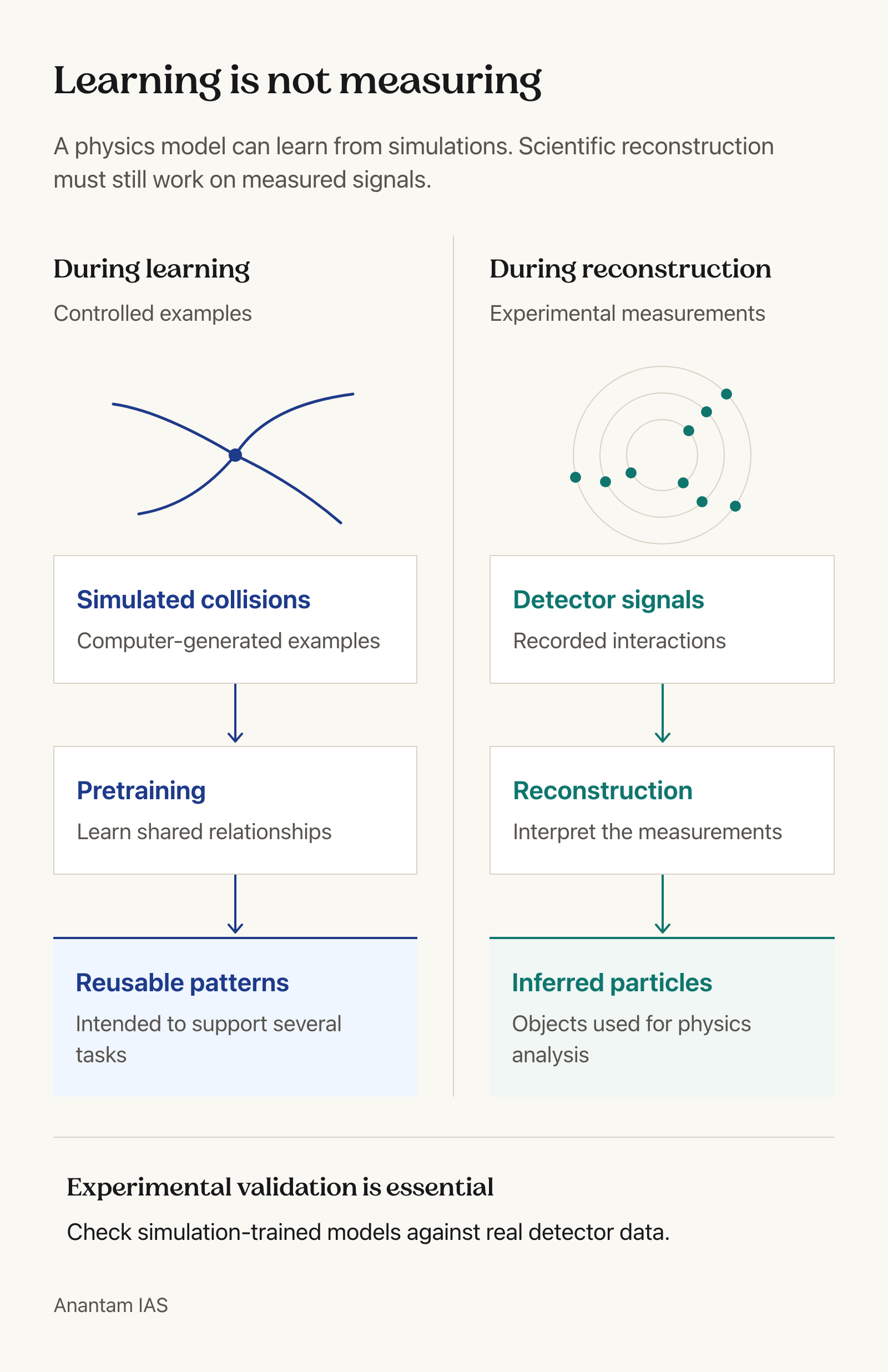
Two conceptual paths compare simulated collision pretraining with reconstruction from measured detector signals
Simulations provide learning examples; detector signals provide measured evidence for reconstruction. The paths show conceptual roles, not a proposed model architecture.

Why Scientific Validation Cannot Be Skipped

The proposal is promising because of its possible reach, but the quality of its scientific conclusions will require evidence.

  • Domain shift occurs when the data encountered in use differ from the training examples. Differences between simulated and measured detector responses can affect predictions, making agreement with real experimental data a necessary validation question.
  • Uncertainty assessment asks how sensitive a result is to measurement limitations and modelling assumptions. An efficient model remains scientifically useful only if researchers can evaluate whether these limitations change the conclusions drawn from its outputs.
  • An unexpected signal is a reason for investigation, not proof of a new particle. Detector effects, modelling weaknesses and known physical processes must be examined before an anomaly can support a discovery claim.
  • Independent checks should compare model outputs with established methods and appropriate experimental evidence. Such evaluation helps distinguish better scientific performance from apparent gains that arise because an evaluation resembles the model’s training examples too closely.
  • The CERN announcement is a statement of intent, not a performance report. Its training plans and application goals should be read as proposed work, with deployment readiness and scientific benefits still to be demonstrated.

Way Forward

Make Performance Scientifically Auditable

  • Evaluate reconstruction accuracy and uncertainty against established methods before using model outputs to support new physics claims.
  • Document training assumptions and simulation limitations, so researchers can identify conditions in which outputs need additional scrutiny.
  • Test task-specific reliability: successful particle identification does not by itself establish reliable anomaly detection or detector-design evaluation.

Conclusion

  • The proposed Large Physics Model illustrates how reusable AI could support scientific analysis across related tasks. Its importance lies in the research approach, while its eventual value depends on demonstrated performance with experimental evidence.
  • For an answer on AI in science, connect computational capability with uncertainty, reproducibility and independent validation. A model can help identify a promising question; the scientific method must still establish whether its answer is trustworthy.

UPSC Practice Questions

Prelims MCQ 1

With reference to the proposed CERN Large Physics Model, consider the following statements:

  1. It is intended to be pretrained on simulated proton-proton collisions.
  2. Collision reconstruction converts detector signals into objects used for physics analysis.
  3. An unexpected signal identified by an AI model automatically establishes a new particle discovery.

How many of the above statements are correct?

(a) Only one (b) Only two (c) All three (d) None

Answer: (b) Only two

Explanation:

Statements 1 and 2 are correct. An unexpected signal requires investigation and independent scientific validation; it does not automatically demonstrate a new particle.

Prelims MCQ 2

Why must a collider model trained on simulations be validated against experimental data?

(a) Simulations and detector measurements are necessarily identical (b) The model can eliminate all measurement uncertainty (c) Differences between simulated and real conditions may affect its outputs (d) Pretraining proves every intended downstream task works

Answer: (c) Differences between simulated and real conditions may affect its outputs

Explanation:

Simulation-to-data differences can create domain shift. Experimental validation is needed to evaluate performance and uncertainty under the conditions where the model will be used.

UPSC Mains Questions

  1. Explain how foundation models could support particle-collision reconstruction. Why does their use strengthen the need for scientific validation? (150 words)
  2. Discuss the opportunities and limitations of artificial intelligence in fundamental science, with reference to simulation, uncertainty and reproducibility. (250 words)

Source: CERN.

Frequently Asked Questions

What have CERN and Mistral announced?

They have signed a statement of intent for a strategic partnership on foundation models for science. The initial ambition is a Large Physics Model for collider physics; a completed operational model was not announced.

What is collision reconstruction?

Collision reconstruction converts signals recorded by a particle detector into particles and other objects used for physics analysis. It helps researchers infer what happened in a collision from the measurements available.

Will the model be trained on actual collisions?

CERN describes pretraining on simulated proton-proton collisions. Simulated examples are generated using models; experimental detector data remain essential for assessing whether the trained system works reliably in real scientific analysis.

Can an AI anomaly establish a particle discovery?

No. An anomaly is an unexpected result that requires investigation. Researchers must assess detector effects, modelling limitations and known physical explanations before concluding that the evidence supports a new particle.

Is this a chatbot for physics?

The announced ambition is a scientific foundation model supporting tasks such as reconstruction and particle identification. Its purpose concerns collider data analysis, rather than conversational answers, and no final model architecture has been specified.

Climate Services: Turning Projections Into Sector Decisions

Open article →Download PDF

Why in News?

The Indian Institute of Tropical Meteorology hosted the first Climate Science into Services for India Forum stakeholder consultation in Pune on 17 October 2026, according to the Ministry of Earth Sciences.

  • The CSSIF consultation brought research institutions, operational agencies and sector users together to identify practical climate information needs.
  • Technical discussions examined weather and climate products, models, datasets and the need for a national Climate Services Information System.
  • The PIB release describes the beginning of sustained engagement; it does not announce an operational national system or binding sectoral decisions.
  • A climate dataset becomes useful only when a decision-maker can interpret it at the relevant location, time horizon and level of confidence.
  • The challenge is institutional as well as scientific: service providers and users must agree what information can change a real decision.

UPSC Relevance

Prelims Relevance

  • CSSIF: Climate Science into Services for India Forum.
  • IITM, Pune: institution under the Ministry of Earth Sciences.
  • Climate prediction versus scenario-dependent climate projection.
  • CSIS: climate data, monitoring, prediction, projection and user-targeted information.

Mains Relevance

GS Paper 3

  • Applying climate science to adaptation and sector planning.
  • Communicating uncertainty without preventing timely decisions.

GS Paper 2

  • Co-production of public services through sustained institutional coordination.

Essay

  • Useful knowledge depends on the questions society asks of science.

Background and Context

What Makes Climate Information a Service?

A climate service connects scientific information with a specific decision, rather than ending when a dataset becomes available online.

  • User needs define the starting question: what decision is pending, who will make it, and when can action still change the outcome? These questions determine the information a provider should prepare.
  • Co-production means researchers and users develop the service together. Users explain operating constraints and decision thresholds; scientists clarify available evidence and limits, reducing the mismatch between technically sound products and practical requirements.
  • Sector translation adds context to climate variables. For example, a water manager needs rainfall information interpreted alongside storage conditions and demand; rainfall alone cannot specify a responsible allocation decision for the season.
  • Access and interpretation are part of service quality. A scientifically valid product may remain unused if its language, delivery channel or timing does not fit the institution expected to act on it.
  • The WMO climate-services framework places user engagement alongside observations, research and information systems. This makes feedback an ongoing responsibility, rather than a single consultation held after experts finish designing a product.

Match the Product to the Decision Horizon

Weather forecasts, seasonal outlooks and climate projections answer different questions; choosing the wrong timescale can make precise-looking information misleading.

  • A weather forecast describes expected atmospheric conditions over a relatively short horizon. It can support near-term scheduling, but it cannot directly establish the climatic conditions that infrastructure will face throughout its lifetime.
  • A seasonal outlook assesses likely climate conditions over an upcoming season, often probabilistically. It can inform preparedness or resource planning without specifying the weather on every individual day within that season.
  • A long-term projection explores how climate may evolve under specified assumptions, including future emissions. It is conditional evidence for planning, rather than a promise that one exact future will inevitably occur.
  • Decision lifetime helps select the product: a short operational choice and a long-lived investment require different information. Combining horizons is useful when planners clearly explain what each product can and cannot support.
  • Spatial scale matters alongside time. Regional information may guide a broad planning choice, while local design requires further analysis; a finer-looking map does not automatically provide reliable evidence at every individual site.

Use Uncertainty to Improve Decisions

The service should explain the strength and limits of evidence so users can compare options without treating a single estimate as certainty.

  • Uncertainty can arise from natural variability, model limitations and different future assumptions. Communicating these distinctions helps users understand why an estimate may change and which decisions remain sensible across several plausible outcomes.
  • Probability expresses a range of possible outcomes, not a guarantee. Users need help interpreting that range in relation to consequences, because the same forecast can justify different actions in different operating settings.
  • Validation asks whether a prediction method performs usefully against observations. A service should disclose relevant performance limits, rather than assuming that greater computational complexity automatically produces dependable guidance for a particular sector.
  • Feedback should ask whether information arrived before the decision, was understood and influenced action. These practical checks complement scientific evaluation and reveal whether the service needs a different format, timing or variable.
  • CSSIF’s present status is consultative: stakeholders identified needs and discussed translation into services. The announcement supports an institutional direction, but does not establish that proposed services are already operating or delivering measured benefits.

Way Forward

Build Around Testable User Decisions

  • Define a decision use case for each pilot: responsible institution, action window, required variable and consequences of an incorrect interpretation.
  • Publish performance and uncertainty guidance with each product, explaining appropriate uses and decisions the evidence cannot support.
  • Maintain a feedback cycle with sector users and document changes made after practical use; evaluate whether the service improves decisions.

Conclusion

  • Climate services bridge scientific evidence and sector choices through suitable timescales, interpretation and sustained user participation. The value lies in better decisions, not simply in producing more datasets or more detailed maps.
  • The CSSIF consultation provides a starting point for this relationship. In an answer, distinguish consultation from operational delivery and explain how transparent uncertainty can support responsible planning rather than justify either certainty or inaction.

UPSC Practice Questions

Prelims MCQ 1

With reference to the first CSSIF stakeholder consultation, consider the following statements:

  1. It was hosted by IITM, Pune, under the Ministry of Earth Sciences.
  2. It discussed the need for a Climate Services Information System for the nation.
  3. Its announcement established that a national CSIS had become operational.

How many of the above statements are correct?

(a) Only one (b) Only two (c) All three (d) None

Answer: (b) Only two

Explanation:

The PIB release confirms the host and discussion of a national CSIS. It describes consultation and sustained engagement, not the launch of an operational national system.

Prelims MCQ 2

Which statement best describes a long-term climate projection?

(a) A guaranteed forecast of daily weather for every future year (b) A conditional assessment of future climate under specified assumptions (c) An observation of atmospheric conditions already measured (d) A seasonal forecast that eliminates natural variability

Answer: (b) A conditional assessment of future climate under specified assumptions

Explanation:

Climate projections depend on specified assumptions, including emissions pathways. They support planning across plausible futures and do not promise exact daily weather.

UPSC Mains Questions

  1. Explain how co-production with sector users can improve the usefulness of climate services in India.
  2. Distinguish weather forecasts, seasonal outlooks and long-term climate projections. How should uncertainty affect their use in public investment decisions?

Sources: PIB, Ministry of Earth Sciences and World Meteorological Organization.

Frequently Asked Questions

What is CSSIF?

CSSIF stands for Climate Science into Services for India Forum. Its first stakeholder consultation, hosted by IITM in Pune, examined how climate research can support practical information needs across different sectors.

Did the consultation launch a national CSIS?

The PIB announcement discusses the need for a national Climate Services Information System and the beginning of sustained engagement. It does not state that an operational national CSIS was launched.

Why do climate services need users to participate?

Users identify the decision, timing and operating constraints. Scientists explain suitable information and its limits. Working together helps ensure that an accurate dataset becomes understandable and useful in a real decision.

Is a climate projection the same as a weather forecast?

A weather forecast concerns expected atmospheric conditions over a shorter horizon. A long-term climate projection assesses possible future climate under specified assumptions, making it conditional planning evidence rather than an exact daily forecast.

El Niño and Forest Stress: Why Local Rainfall Still Matters

Open article →Download PDF

Why in News?

The Hindu reported on October 18 that experts warned of possible forest and wildlife stress in Kerala if dry conditions associated with the reported developing El Niño intensify.

  • Expert warning: The report describes possible earlier drying of forest streams and waterholes, changes in wildlife movement and greater fire risk if dry conditions persist.
  • Conditional assessment: Researchers stressed that local rainfall, temperature and the duration of dry spells would determine the ecological impact.
  • Seasonal safeguard: The amount and distribution of northeast monsoon rainfall could influence water availability; the report does not establish observed forest damage caused by El Niño.
  • Climate risk reaches wildlife through habitat processes: water availability, plant growth and seasonal food supplies, rather than through a single ocean indicator alone.
  • Local monitoring matters because neighbouring forests can experience different stress depending on soils, elevation, forest type and rainfall distribution.

UPSC Relevance

Prelims Relevance

  • El Niño as the warm phase of the El Niño–Southern Oscillation.
  • Forest phenology: seasonal timing of flowering, fruiting, leaf shedding and growth.
  • Soil moisture as a link between rainfall and plant water availability.
  • Drought tolerance and differences in species response.
  • Distinction between heightened fire risk and an observed fire occurrence.

Mains Relevance

GS Paper 3

  • Climate variability, forest regeneration and biodiversity conservation.
  • Water stress, wildlife movement and management of forest-fringe encounters.

GS Paper 1

  • Regional rainfall variation and the limits of broad climatic associations.

Essay

  • Visible ecological stability can conceal declining resilience.

Background and Context

From Ocean Conditions to Local Water Stress

An ocean-scale climate signal becomes a forest problem through local weather and the availability of water to plants and animals.

  • El Niño is the warm phase of the tropical Pacific ocean–atmosphere cycle called ENSO. Its influence on atmospheric circulation can alter rainfall patterns, but it does not determine every forest’s seasonal conditions.
  • Local rainfall provides the immediate link to forest water availability. Experts quoted by The Hindu emphasised rainfall distribution and dry-spell duration, rather than treating the reported ocean conditions as sufficient proof of drought.
  • Soil moisture supports roots between rainfall events. When prolonged dry spells reduce this store, plants can experience water stress even before the canopy shows an obvious loss of leaves or widespread visible damage.
  • Forest streams and waterholes may dry earlier if dry conditions intensify. That is a conditional ecological pathway in the report, requiring observations of local water sources before declaring that it has occurred.
  • Scattered heavy showers do not necessarily replenish water sources across a wider forest landscape. Their spatial coverage matters: a downpour at one site cannot establish adequate water availability throughout neighbouring habitats or catchments.

How Water Stress Changes Forest Phenology

Forest phenology connects seasonal plant events with the timing of resources available to animals and the renewal of vegetation.

  • Phenology means the seasonal timing of flowering, fruiting, leaf shedding and growth. Rainfall and temperature help shape these cycles; a change in timing differs from a simple reduction in total forest area.
  • Seasonal food availability can change when flowering or fruiting shifts. Animals dependent on those resources may face altered feeding opportunities, linking plant responses to habitat quality even where the forest canopy remains present.
  • Regeneration is another concern because persistent water stress can restrict the establishment and growth of young vegetation. A forest may retain mature trees while its capacity to replace them gradually becomes less secure.
  • Drought tolerance varies among species, so identical dry conditions need not produce identical outcomes. The report warns that prolonged drought could disadvantage vulnerable trees and eventually favour species better able to withstand water shortages.
  • Visible canopy cover is an incomplete measure of forest health. Researchers distinguish a forest’s outward appearance from its physiological condition, making repeated observations of growth, seasonal events and regeneration important for identifying emerging stress.

Wildlife Risk Requires Field Evidence

The same dry spell can create several risks, but each requires separate evidence before an ecological impact can be attributed.

  • Wildlife movement may change when familiar water sources fail. Animals seeking alternatives could approach forest fringes and human-dominated areas, increasing encounters; the report presents this as a possibility rather than a measured statewide outcome.
  • Heat and water shortage could affect animal physiology and behaviour. Experts explicitly said that field observations were needed to establish such effects, so a climatic warning cannot substitute for evidence about particular wildlife populations.
  • Fire risk can rise as hot, dry conditions persist, but risk is different from an actual fire. A count of incidents alone cannot demonstrate that El Niño caused a particular fire or seasonal pattern.
  • Forest type, elevation and soils influence exposure and sensitivity. Managers should assess individual landscapes instead of assuming that every forest in Kerala will experience the same degree, timing or combination of ecological stress.
  • Historical phenology records provide a useful comparison with current observations. Researchers can examine whether seasonal plant events differ during El Niño years, while checking local rainfall and temperature before drawing conclusions about the observed association.

Way Forward

Track the Ecological Links

  • Monitor streams, waterholes and soil moisture alongside rainfall and temperature, prioritising locations where persistent drying is observed.
  • Maintain repeated flowering, fruiting and regeneration records so managers can distinguish seasonal variation from sustained ecological deterioration.
  • Prepare fire prevention earlier where local conditions justify it; base timing on actual dryness and risk assessments.
  • Track wildlife movement near forest fringes and coordinate local responses when water shortages increase encounters.

Conclusion

  • El Niño is a risk signal, not a local ecological verdict. Forest impacts depend on rainfall, soil water, species characteristics and the persistence of stress, which must be assessed together.
  • Follow the mechanism in an answer: climate variability can change water availability, plant seasonal cycles and wildlife resources. Keep projected risks separate from observed damage and demonstrated causes.

UPSC Practice Questions

Prelims MCQ 1

With reference to forest phenology, consider the following statements:

  1. It includes the seasonal timing of flowering and fruiting.
  2. An apparently intact canopy necessarily proves that trees are free from physiological water stress.
  3. Rainfall and temperature can influence seasonal plant events.

How many of the above statements are correct?

(a) Only one (b) Only two (c) All three (d) None

Answer: (b) Only two

Explanation:

Statements 1 and 3 are correct. Phenology concerns seasonal biological events, while an intact-looking canopy can conceal physiological stress.

Prelims MCQ 2

Which observation would most directly help assess the proposed link between dry conditions and altered wildlife movement?

(a) A national annual forest-cover total alone (b) The number of forest departments in the country (c) Repeated local records of water-source availability and animal movement (d) An ocean-temperature indicator without local observations

Answer: (c) Repeated local records of water-source availability and animal movement

Explanation:

Paired local observations examine the proposed ecological pathway. Broad indicators alone cannot establish how water availability affects wildlife in a particular landscape.

UPSC Mains Questions

  1. Explain how prolonged dry spells can affect forest phenology and regeneration. Why can canopy appearance provide an incomplete assessment of forest health?
  2. An El Niño warning does not establish local ecological damage. Discuss the evidence needed to assess risks to forest water availability, wildlife movement and fire occurrence.

Source: The Hindu.

Frequently Asked Questions

What is forest phenology?

Forest phenology is the seasonal timing of events such as flowering, fruiting, leaf shedding and growth. These events respond to environmental conditions and influence when food and other habitat resources become available.

Does El Niño prove that a particular forest will suffer drought?

No. El Niño can influence atmospheric circulation and rainfall patterns, but local outcomes depend on rainfall distribution, temperature, dry-spell duration and landscape conditions. Forest-level impacts need observations rather than inference from an ocean indicator alone.

Can a green-looking forest still experience water stress?

Yes. The report notes that forests can retain their overall canopy appearance while physiological health declines. Monitoring soil moisture, growth and regeneration can reveal problems that a visual assessment of canopy cover misses.

Why can forest water shortages increase human–wildlife encounters?

If familiar streams or waterholes dry early, animals may seek water closer to forest fringes and settlements. This is a possible response, not an automatic outcome; movement and water-source observations are needed locally.

Infant Nutrition Draft: Restricting Added Sugars by Age

Open article →Download PDF

Why in News?

On 17 October 2026, the Health Ministry announced an FSSAI draft proposing to prohibit added sucrose and fructose in food products intended for infants up to six months.

  • The draft amendment was published in the Gazette on 16 October; it has not yet become a final amended standard.
  • The proposed restriction concerns addition of sucrose and fructose, not removal of every carbohydrate from infant nutrition products.
  • The consultation allows 60 days for objections and suggestions from public availability of the Gazette copies; FSSAI will consider representations before finalisation.
  • Product formulation shapes exposure before a caregiver chooses a product; standards can address this upstream responsibility.
  • Age-specific regulation requires precise communication: the wider infant-food framework and the particular proposed restriction have different age coverage.

UPSC Relevance

Prelims Relevance

  • FSSAI and infant nutrition standards
  • Sucrose and fructose versus other carbohydrate sources
  • Draft notification versus final regulation
  • Age scope of the proposed restriction
  • Exclusive breastfeeding and complementary feeding

Mains Relevance

GS Paper 2

  • Preventive nutrition through product standards and public consultation
  • Child health policy combining feeding support with safe-product regulation

Essay

  • Protecting early childhood requires supportive institutions as well as informed choices.

Background and Context

What the Draft Would Change

The proposal narrows the permitted formulation of products for early infancy within an existing, broader regulatory framework.

  • The Foods for Infant Nutrition Regulations, 2020 cover nutritional composition, quality and safety across product categories intended for children from birth up to 24 months, according to the Health Ministry release.
  • The proposed six-month restriction has a narrower scope than that overall framework: its wording targets products intended for infants up to six months, rather than every product covered by the regulations.
  • The existing provisions prefer lactose and glucose polymers as carbohydrate sources; sucrose or fructose may currently be added when required as carbohydrate sources, subject to prescribed limits described by the ministry.
  • The amendment would remove that permission to add sucrose and fructose for the specified early-infancy products. It does not announce a prohibition on carbohydrates generally, nor a ban on infant formula itself.
  • The key comparison is between conditional permission under existing provisions and non-addition for the proposed age group. This distinction concerns permitted ingredients, rather than a claim that young infants do not need carbohydrate nutrition.

Why Product Standards and Feeding Support Coexist

A formulation rule addresses manufacturers, while feeding recommendations address nutritional needs and the support available to families.

  • The ministry presents the proposal as a preventive nutrition measure intended to limit unnecessary early exposure to added sugars. This is a policy objective, not evidence that the amendment has already improved health outcomes.
  • WHO and UNICEF recommend exclusive breastfeeding during the first six months. Supporting that recommendation involves health services and practical assistance, rather than treating infant nutrition solely as an individual consumer responsibility.
  • WHO explains that complementary foods become necessary around six months as nutritional needs increase, alongside continued breastfeeding. This describes a feeding transition; it does not extend the draft ingredient restriction to all later foods.
  • Safe-product standards and breastfeeding support address different responsibilities and can operate together. Where families use substitutes, the proposed rule concerns their formulation; it should not become a basis for judging caregivers or withholding support.
  • WHO identifies counselling, maternity support and appropriate health services as practical measures enabling feeding recommendations. A narrower ingredient amendment cannot substitute for these services, safe food handling or attention to a child’s overall nutritional needs.

How to Read a Draft Standard Correctly

The legal status, exact wording and consultation process matter as much as the public-health intention.

  • The Health Ministry announcement describes a draft amendment inviting representations. Gazette publication of a proposal is not, by itself, evidence that the proposed ingredient restriction is already the final applicable standard.
  • The consultation period runs from the date Gazette copies become publicly available. Avoid calculating a definitive closing date from the press release alone, because the stated trigger is public availability, not the announcement date.
  • FSSAI will consider objections and suggestions before finalisation. Consultation gives stakeholders an opportunity to question wording and evidence; the existence of that opportunity does not imply that every suggested change will be accepted.
  • For examination purposes, separate three questions: which ingredients, which age group and whether the measure is final. A statement expanding the proposal to all sugars or all products up to 24 months changes its meaning.
  • For governance analysis, distinguish intended benefits from demonstrated results. Evaluating a final rule would require evidence about compliance and nutrition outcomes; neither an announcement nor a manufacturer’s reformulation claim establishes that impact automatically.

Way Forward

Make the Final Standard Clear and Workable

  • Use consultation responses to clarify affected product categories and ingredient wording without blurring the intended age-specific protection.
  • If finalised, communicate implementation requirements clearly to manufacturers and inspectors, while distinguishing the new obligation from existing nutritional and safety standards.
  • Pair product regulation with accessible feeding counselling and family support; public communication should explain the proposal without alarming or blaming caregivers.

Conclusion

  • The draft illustrates age-specific preventive regulation: a focused restriction on added ingredients within a wider nutritional framework. Its proposed status and limited scope are essential to an accurate answer.
  • A strong policy assessment links manufacturer responsibility with supportive health services, then asks how a final standard would be implemented and evaluated. An ingredient rule alone cannot resolve every cause of poor infant nutrition.

UPSC Practice Questions

Prelims MCQ 1

With reference to the announced FSSAI draft on infant nutrition, consider the following statements:

  1. It proposes prohibiting added sucrose and fructose in products intended for infants up to six months.
  2. It proposes prohibiting every carbohydrate in all products intended for children up to 24 months.
  3. It invites public representations before finalisation.

How many of the above statements are correct?

(a) Only one (b) Only two (c) All three (d) None

Answer: (b) Only two

Explanation:

Statements 1 and 3 are correct. The proposal targets addition of sucrose and fructose for a specific age group, not all carbohydrates or every product in the broader framework.

Prelims MCQ 2

Which statement best distinguishes product regulation from infant-feeding guidance?

(a) Product standards make feeding counselling unnecessary. (b) Breastfeeding recommendations imply a ban on all infant formula. (c) Product standards govern formulation, while feeding guidance also addresses age-appropriate practices and family support. (d) A draft product amendment automatically replaces all existing feeding recommendations.

Answer: (c) Product standards govern formulation, while feeding guidance also addresses age-appropriate practices and family support.

Explanation:

The FSSAI proposal addresses ingredients in specified products. WHO guidance also covers breastfeeding support, complementary feeding and appropriate services; these are complementary policy responsibilities.

UPSC Mains Questions

  1. Explain how age-specific food standards can contribute to preventive child-health policy. Discuss why legal scope and implementation matter.
  2. How can regulation of infant nutrition products coexist with breastfeeding promotion and support for caregivers? Discuss.

Sources: PIB, Ministry of Health and Family Welfare and WHO infant and young child feeding.

Frequently Asked Questions

Has FSSAI already imposed the new restriction?

The ministry announced a draft amendment inviting objections and suggestions. It states that FSSAI will consider representations before finalisation; the announcement does not establish a final amended standard.

Does the proposal ban all sugars in infant foods?

It specifically targets the addition of sucrose and fructose in products intended for infants up to six months. It should not be described as a ban on all carbohydrates or all infant foods.

Why does the note mention both six and 24 months?

The existing infant nutrition framework covers categories intended for children from birth up to 24 months. The proposed restriction on added sucrose and fructose applies to products intended for infants up to six months.

Does this proposal prohibit infant formula?

The announced proposal concerns formulation of specified infant nutrition products, not a prohibition on infant formula. Product safety requirements and practical support for families remain relevant alongside recommendations promoting breastfeeding.

How does complementary feeding differ from exclusive breastfeeding?

WHO recommends exclusive breastfeeding for the first six months, followed by appropriate complementary foods alongside continued breastfeeding. Complementary feeding addresses increasing nutritional needs; it is distinct from the proposed product ingredient restriction.

Ebola Contact Monitoring: Detecting Illness Before Wider Spread

Open article →Download PDF

Why in News?

WHO reported on 16 October that Kenya detected two additional Bundibugyo Ebola cases among family contacts already under quarantine, illustrating how daily monitoring can shorten the interval between illness and isolation.

  • Kenya confirmed its second and third cases on 14 and 16 October; both patients were close family members of the first case.
  • The first case had travelled from the Democratic Republic of the Congo; the WHO update recorded three confirmed cases, including one death.
  • Kenya’s Ministry of Health reported no evidence of community transmission at that update; this was a surveillance assessment, not proof that undetected infection was impossible.
  • WHO reported no licensed vaccine or specific treatment for Bundibugyo Ebola at the time, while trials were under way in the Democratic Republic of the Congo.
  • Finding a case among known contacts can indicate that monitoring is working; rising confirmed numbers do not automatically demonstrate wider uncontrolled transmission.
  • Response design follows disease biology: transmission routes and the timing of infectiousness determine which observation and separation measures can interrupt spread.

UPSC Relevance

Prelims Relevance

  • Contact tracing: identifying and following people with relevant exposure to a case.
  • Quarantine: separating exposed contacts who are not yet ill; exposure does not itself confirm infection.
  • Isolation: separating symptomatic or infected people to reduce opportunities for transmission.
  • Bundibugyo Ebola: countermeasure availability must be checked for the specific virus involved.
  • Transmission: direct contact with infected blood or body fluids, or objects contaminated by them; not airborne spread.

Mains Relevance

GS Paper 2

  • Public-health preparedness through contact follow-up, laboratory confirmation and timely access to designated care.
  • Accountable risk communication that distinguishes known transmission links from uncertainty.

GS Paper 3

  • Using pathogen-specific evidence to select outbreak-control tools and evaluate biomedical claims.

Essay

  • Public trust grows when institutions explain both what surveillance establishes and what remains uncertain.

Background and Context

Exposure, Symptoms and the Opportunity to Interrupt Spread

The Kenya update connects a biological fact with an operational response: detecting symptoms early can limit the time available for further exposure.

  • Ebola transmission involves direct contact with blood or body fluids from someone sick with, or deceased from, the disease, or contaminated objects; WHO states that it does not spread through the air.
  • Exposure is not a diagnosis: a person listed as a contact may never become ill, but a documented opportunity for exposure justifies follow-up rather than assuming that apparent health settles their status.
  • WHO explains that people with Ebola do not transmit it before symptoms; monitoring known contacts can help teams recognise the transition to illness and arrange isolation before additional close contact occurs.
  • Early symptoms are nonspecific, overlapping with malaria and other common illnesses; recognising an exposure history alongside fever or other symptoms supports investigation, while symptoms alone cannot establish which disease is present.
  • Bleeding is not a necessary early signal: WHO describes it as less common and usually later in illness, so waiting for this dramatic feature would misunderstand the purpose of early symptom monitoring.

How Contact Monitoring Connects Quarantine With Isolation

Quarantine and isolation address different stages of risk; the Kenya cases show why a response needs a reliable connection between them rather than interchangeable labels.

  • Contact tracing identifies people with relevant exposure, including family members, care providers and travel contacts; its practical value comes from linking those people to follow-up rather than merely producing a completed list.
  • Quarantine concerns exposed contacts before they are ill, reducing opportunities for later exposure while monitoring continues; it does not mean that everyone separated has a confirmed infection or will eventually develop disease.
  • Daily symptom and temperature checks were conducted through a 21-day observation period, reflecting the longest reported interval from exposure to illness; one symptom-free check cannot substitute for completing the appropriate monitoring period.
  • Isolation becomes relevant when illness appears: the two family contacts were transferred into designated treatment arrangements after early detection, connecting surveillance to care while limiting opportunities for their infection to reach others.
  • New cases within quarantine remain possible until monitoring ends; detecting such cases does not by itself mean quarantine failed, because its immediate purpose includes finding illness early and reducing onward exposure.

What the Update Establishes and What It Does Not

Interpret the findings through confirmed links and the specific virus involved; neither reassuring surveillance language nor a familiar disease name removes the need for qualification.

  • Both additional cases were linked to the imported case, supporting an identifiable transmission chain in the reported investigation; this is different from finding infections with no established connection to a known source.
  • No evidence of community transmission was the Kenyan ministry’s assessment at the update; it describes what investigations had established, not a guarantee that surveillance could detect every infection immediately or without gaps.
  • Bundibugyo-specific evidence matters: the reported absence of a licensed vaccine or specific treatment applies to this virus, so the availability of countermeasures for other Ebola viruses cannot automatically settle response options here.
  • Supportive care remains important even without a licensed specific treatment; WHO reported care in designated units and emphasised that early supportive care improves survival prospects, without suggesting that every patient’s outcome is predictable.
  • Layered response capacity links monitoring with laboratory testing, trained staff, infection prevention and communication; a thermometer or contact list alone cannot provide the diagnosis, safe care and follow-up that containment requires in practice.

Way Forward

Make Every Follow-Up Actionable

  • Close the monitoring-to-care gap: ensure contact teams can rapidly communicate emerging symptoms to laboratory and treatment services through a clear referral pathway.
  • Explain restrictions accurately: distinguish exposure from confirmed infection and tell affected families what observation involves, reducing stigma that could discourage cooperation.
  • Report uncertainty explicitly: publish whether new cases have known links, whether contacts remain under follow-up and the date of the surveillance assessment.

Conclusion

  • Contact monitoring works through timing: it connects known exposure to repeated observation and prompt isolation when illness appears, reducing opportunities for onward transmission while helping patients reach designated care earlier.
  • The exam lesson is disciplined inference: known links explain the reported cluster, surveillance language has limits, and countermeasure claims must match the virus involved rather than the broad label of Ebola.

UPSC Practice Questions

Prelims MCQ 1

With reference to the Ebola response described by WHO in Kenya, consider the following statements:

  1. Quarantine of a contact establishes that the person has a confirmed infection.
  2. Ebola can spread through direct contact with contaminated objects.
  3. Detection of illness among quarantined contacts can demonstrate effective monitoring.

How many of the above statements are correct?

(a) Only one (b) Only two (c) All three (d) None

Answer: (b) Only two

Explanation:

Statements 2 and 3 are correct. Quarantine addresses exposure and risk; it does not itself confirm infection. Monitoring aims to identify illness early among contacts.

Prelims MCQ 2

Which interpretation best reflects the Kenyan Ministry of Health’s statement that there was no evidence of community transmission at the update?

(a) Every possible infection had been conclusively excluded. (b) Further cases among quarantined contacts were impossible. (c) Investigations had not established community transmission at that point. (d) All Ebola vaccines could be used against Bundibugyo Ebola.

Answer: (c) Investigations had not established community transmission at that point.

Explanation:

The statement is a time-specific surveillance assessment. It does not guarantee zero undetected infection or determine the suitability of a vaccine for a particular Ebola virus.

UPSC Mains Questions

  1. Explain how contact tracing, quarantine and isolation perform different but connected functions in controlling an Ebola outbreak.
  2. Why must public-health authorities qualify reassuring surveillance assessments and distinguish virus-specific countermeasures? Discuss with reference to Kenya’s Ebola response.

Source: WHO Regional Office for Africa.

Frequently Asked Questions

What is the difference between quarantine and isolation?

Quarantine concerns people with relevant exposure who are not yet ill. Isolation separates symptomatic or infected people to limit transmission. Contact monitoring helps response teams recognise when a person needs assessment and isolation.

Why are Ebola contacts monitored for 21 days?

WHO’s Kenya update describes 21 days as the longest interval before illness can appear after exposure. Repeated checks across that period help detect emerging symptoms; a single symptom-free observation does not complete monitoring.

Does a new case in quarantine mean containment failed?

Not necessarily. A contact may develop illness from an earlier exposure while under observation. Early detection within quarantine can show that monitoring is functioning and reduce opportunities for further transmission.

Does Bundibugyo Ebola have a licensed vaccine?

The WHO update reported no licensed vaccine or specific treatment for Bundibugyo Ebola at that time, with trials under way. Claims about vaccines for other Ebola viruses should not be transferred automatically to Bundibugyo.

What does no evidence of community transmission mean?

It describes the findings available to the Kenyan Ministry of Health at the update. The reported additional cases had known links; the statement does not prove that every possible undetected infection has been excluded.

Tea Residue Limits: Separating Compliance From Dietary Exposure

Open article →Download PDF

Why in News?

The Health Ministry reported on 17 October that FSSAI had published draft pesticide residue limits for tea, inviting stakeholder comments before finalisation.

  • The 16 October draft proposes tea limits of 20 mg/kg for acetamiprid and 50 mg/kg for imidacloprid.
  • These are proposed maximum residue limits, not newly finalised legal standards; the ministry describes their application as subject to finalisation.
  • The proposal concerns measurable residues in a commodity; it does not prescribe a safe daily quantity of tea for an individual.
  • Food regulation must connect farm pest control, laboratory measurement and consumer exposure without treating any one measure as a complete safety assessment.
  • Public consultation allows the scientific basis, practical compliance requirements and enforcement implications of proposed standards to be examined before finalisation.

UPSC Relevance

Prelims Relevance

  • Maximum residue limit: concentration in a food commodity.
  • Acceptable daily intake: lifetime daily exposure expressed per kilogram of body weight.
  • FSSAI: Indian food standards authority.
  • Codex Alimentarius Commission and Joint FAO/WHO Meeting on Pesticide Residues.
  • Good agricultural practice and supervised residue trials.

Mains Relevance

GS Paper 2

  • Evidence-based food standards and transparent consultation.
  • Coordination between regulators, laboratories and food businesses.

GS Paper 3

  • Crop protection, residue monitoring and agricultural supply-chain compliance.

Essay

  • Trust in regulation depends on explaining what a safety benchmark can and cannot establish.

Background and Context

What a Residue Limit Measures

A residue limit gives the laboratory a commodity-specific compliance benchmark; understanding its unit prevents a common confusion about consumer safety.

  • A maximum residue limit is a concentration expressed in milligrams of pesticide residue per kilogram of the food commodity. The kilogram refers to the tested food, not the body weight of its consumer.
  • The Health Ministry release identifies acetamiprid and imidacloprid in tea as the subjects of the draft. It does not turn the proposed benchmarks into final obligations merely by announcing them publicly.
  • A pesticide residue can include specified conversion products, metabolites and impurities of toxicological significance. Measuring only the original chemical may not answer the regulatory question if the relevant residue definition includes other substances.
  • Good agricultural practice concerns nationally authorised uses under conditions necessary for effective pest control, while leaving the smallest practicable residue. It is a disciplined use framework, rather than permission to apply pesticides without constraints.
  • A laboratory finding and the applicable final standard must be read together when deciding compliance. A proposed concentration cannot replace the standard legally governing a consignment while consultation and finalisation are still pending.

How Concentration Becomes Dietary Exposure

Consumer risk assessment asks how much chemical a person takes in, not merely how much residue appears in a sample.

  • The Codex glossary defines acceptable daily intake as daily intake over a lifetime without appreciable health risk, on the evidence available at evaluation. Its reference unit is chemical mass per kilogram of body weight.
  • Concentration and intake answer different questions: exposure depends on residue levels and the amount consumed. Expressing that intake relative to body weight makes it comparable with the corresponding toxicological benchmark used in assessment.
  • Dietary assessment must consider relevant food consumption and residue information across the diet. Reading a commodity limit alone cannot establish total intake of that pesticide or show how much exposure comes from other foods.
  • For tea, the tested commodity and consumed beverage must not be casually treated as identical. Any numerical estimate of exposure from brewed tea needs supported preparation and residue-transfer assumptions, rather than an invented conversion.
  • Codex MRLs combine toxicological assessment with residue evidence from supervised trials and authorised uses. Dietary residue estimates are compared with the ADI; the standard is intended to connect practical crop protection with consumer protection.

What Makes Compliance Evidence Credible

The useful distinction is between a measurable limit and the wider evidence needed to interpret it responsibly in food regulation.

  • National pesticide-use averages describe agriculture at an aggregate scale. They cannot establish residue concentrations in a particular tea batch or substitute for dietary assessment of consumers with different consumption patterns and body weights.
  • A foreign residue limit can inform regulatory comparison, but a lower numerical limit alone does not prove a complete safety case. The commodity, residue definition, authorised practices and exposure assessment also need examination.
  • Analytical capability matters because a standard must be measurable with acceptable certainty. Codex defines the limit of determination through reliable identification and quantification in a specified commodity using a regulatory method of analysis.
  • Sampling and traceability should connect a tested lot to its producer and handling history. As a governance measure, this makes an adverse result useful for targeted investigation instead of leaving responsibility across the supply chain unclear.
  • Exceeding an applicable MRL raises a compliance problem; the number alone does not diagnose poisoning in a consumer. Assessing health implications requires exposure information, while enforcement still addresses the failure to meet the standard.

Way Forward

Make the Evidence Auditable

  • Publish the residue-trial and exposure rationale supporting the proposed limits so consultation can test assumptions rather than debate isolated numbers.
  • Align sampling, validated laboratory methods and lot traceability so growers and enforcement authorities can identify where compliance fails.
  • Explain the distinction between draft standards, final limits and dietary risk in public communication; avoid national averages as reassurance about individual products.

Conclusion

  • Tea residue regulation links a measurable commodity standard with evidence about authorised agricultural use and dietary exposure. Its credibility rests on explaining that connection, not presenting a single concentration as a universal guarantee.
  • For a governance answer, distinguish consultation from final law and compliance from exposure assessment. Strong enforcement needs dependable testing, traceable consignments and transparent reasoning about how the proposed standard protects consumers.

UPSC Practice Questions

Prelims MCQ 1

With reference to pesticide residue assessment, consider the following statements:

  1. An MRL expresses concentration in a food commodity.
  2. The ADI is expressed relative to the body weight of the consumer.
  3. Low national pesticide use proves that every food consignment meets its applicable residue limit.

How many of the above statements are correct?

(a) Only one (b) Only two (c) All three (d) None

Answer: (b) Only two

Explanation:

Statements 1 and 2 are correct. Aggregate pesticide use cannot establish residue concentrations or compliance in an individual consignment.

Prelims MCQ 2

Which evidence best connects a commodity residue limit with assessment of long-term dietary exposure?

(a) The number of countries registering a pesticide (b) The national average quantity of pesticide applied per hectare (c) Dietary residue estimates compared with the acceptable daily intake (d) The retail price of the commodity

Answer: (c) Dietary residue estimates compared with the acceptable daily intake

Explanation:

Codex links dietary residue estimates with the ADI. The comparison incorporates intake and body weight rather than relying on commodity concentration alone.

UPSC Mains Questions

  1. Explain how maximum residue limits and dietary exposure assessment perform different but connected roles in food safety regulation.
  2. What institutional and technical conditions are necessary for effective enforcement of pesticide residue standards in agricultural supply chains?

Sources: PIB, Ministry of Health and Family Welfare and Codex Alimentarius glossary.

Frequently Asked Questions

Are the announced tea limits already final law?

No. The Health Ministry describes them as proposed limits in draft amendment regulations. Their finalisation is still required; an announcement of a draft must not be reported as a newly operative final standard.

What is the difference between an MRL and the ADI?

An MRL concerns residue concentration in a food commodity. The ADI concerns daily chemical intake over a lifetime without appreciable health risk, expressed relative to the consumer’s body weight.

Does a lower national pesticide-use average prove that tea is safe?

No. A national average does not measure residue in a specific batch or the intake of an individual consumer. Product testing and dietary exposure assessment address those different questions.

Can the proposed tea limit be converted directly into exposure from a cup?

No. Such an estimate needs the amount consumed and supported assumptions about preparation and residue transfer into the beverage. A commodity concentration alone does not provide those inputs for a credible numerical calculation.

Lead Mitigation Draft: Linking Source Control With Health Surveillance

Open article →Download PDF

Why in News?

WHO held a Member State consultation on 16 October 2026 on its existing draft Global Action Plan on Lead Mitigation, seeking feedback before further governing-body consideration.

  • The draft plan covers exposure reduction, evidence, health-system capacity and coordination; these are proposed action areas, not newly binding international obligations.
  • The consultation materials envisage 2027 consideration through WHO governing bodies; consultation does not establish that the plan has already been adopted.
  • The hosted briefing explains the consultation process rather than constituting final WHO policy; the official draft page corroborates the substantive framework.
  • Preventable exposure links public health with product regulation, industrial emissions and waste management, making lead a useful case for examining environmental governance.
  • Testing and source control answer different questions: who has been exposed, and which products or activities must change to prevent further harm.

UPSC Relevance

Prelims Relevance

  • Lead is a toxic metal that affects multiple organ systems.
  • Ingestion and inhalation are important exposure routes.
  • Blood lead measurement assesses human exposure.
  • Lead can accumulate in bones and teeth.
  • A draft action plan is distinct from an adopted international instrument.

Mains Relevance

GS Paper 2

  • Health-system surveillance, prevention and equitable access to testing.
  • International consultation and the distinction between proposed policy and adopted commitments.

GS Paper 3

  • Industrial pollution, safe waste recycling and accountability across regulators.

Essay

  • Prevention requires institutions to act before damage becomes visible.

Background and Context

How Lead Exposure Reaches People

Lead prevention begins with identifying the physical route from a contaminated source to a person, rather than treating illness as an isolated event.

  • Lead-acid batteries are a major use of lead; unsafe recycling can contaminate nearby air, soil and dust, connecting occupational risks inside a facility with exposure among surrounding communities, including children.
  • Inhalation occurs when lead-containing particles enter the air during activities such as smelting or recycling; people can also ingest contaminated dust, soil, food or water without deliberately handling the metal themselves.
  • Young children are especially vulnerable because developing nervous systems can suffer lasting injury, while frequent hand-to-mouth behaviour increases contact with contaminated dust or paint; the absence of obvious symptoms does not establish safety.
  • Accumulation makes exposure more than a short-lived event: lead distributes to organs and can remain in bones and teeth; during pregnancy, stored lead can enter the blood and expose the developing fetus.
  • The WHO health fact sheet states that no safe blood lead concentration is known; this supports preventing exposure rather than assuming that symptom-free populations face no risk from continuing contamination.

Environmental Monitoring and Blood Surveillance

Two evidence streams are needed: measurements of contamination identify possible sources, while measurements in people reveal exposure that requires a health response.

  • Environmental monitoring examines sources and pathways such as industrial releases, contaminated sites or water; it helps regulators locate hazards and assess controls, but does not directly measure a particular person’s absorbed exposure.
  • Blood lead surveillance measures exposure in people and identifies populations at risk; laboratory capacity and quality assurance matter because unreliable results can undermine decisions about follow-up, source investigation and prevention priorities.
  • Linked investigation connects elevated exposure with plausible environmental or occupational sources; a blood result alone does not identify which product, workplace or neighbourhood source caused it, so health findings need contextual investigation.
  • Repeated monitoring can help assess whether interventions reduce exposure over time; governance should track both compliance at sources and exposure among people, since completed inspections alone cannot demonstrate that health risks have fallen.
  • Health-system readiness includes reliable diagnostics, referral pathways, trained staff and incident response; it complements pollution prevention by addressing exposed people, while source controls reduce the possibility of continued or repeated exposure afterward.

Why Responsibility Must Cross Sectors

The draft’s central governance challenge is assigning responsibility across the institutions that control products, workplaces, waste and health services throughout the exposure chain.

  • Product controls can address lead in paint and other non-essential uses through standards, safer formulation and enforcement; a rule on paper needs market surveillance to establish whether products actually comply before reaching consumers.
  • Waste regulation must cover collection, transport, recycling and disposal of lead-containing material; controlling only the final disposal site leaves opportunities for unsafe handling and pollution earlier in the chain, including community exposure.
  • Worker protection links labour and environmental responsibilities: occupational exposure and contamination carried home can connect workplaces with households; prevention must consider both workers and family members rather than stopping at the factory boundary.
  • Interministerial coordination brings health, environment, labour, industry and customs into a shared programme; clear roles are needed so a detected health problem leads to action by the authority responsible for its source.
  • Accountability requires named institutions, monitoring and compliance reporting; the draft offers a framework for coordinated action, while country-level implementation still depends on enforceable measures, technical capacity and cooperation among the responsible agencies.

Way Forward

Connect Detection With Corrective Action

  • Link health surveillance to source investigations with clear referral routes between laboratories, health services and environmental regulators.
  • Prioritise controllable exposure sources using verified environmental and health data, then check whether enforcement changes actual conditions.
  • Assign agency responsibilities across product safety, recycling and worker protection, with reporting that records corrective action and remaining exposure risks.

Conclusion

  • Lead mitigation combines source prevention with reliable health surveillance: the former interrupts exposure pathways, while the latter identifies affected populations and helps assess whether prevention is working. Neither can substitute fully for the other.
  • For an answer on environmental health governance, connect products, workplaces and waste with laboratory evidence and regulatory responsibility; retain the legal distinction between a draft discussed in consultation and a plan formally adopted later.

UPSC Practice Questions

Prelims MCQ 1

With reference to lead exposure, consider the following statements:

  1. Lead can accumulate in bones and teeth.
  2. Blood lead measurement is used to assess human exposure.
  3. The absence of obvious symptoms establishes that lead exposure is harmless.

How many of the above statements are correct?

(a) Only one (b) Only two (c) All three (d) None

Answer: (b) Only two

Explanation:

Statements 1 and 2 are correct. WHO states that harmful effects can occur without obvious symptoms and that no safe blood lead concentration is known.

Prelims MCQ 2

Which statement best distinguishes environmental monitoring from blood lead surveillance?

(a) Environmental monitoring directly measures every person’s absorbed lead. (b) Blood surveillance alone identifies the exact product responsible for exposure. (c) Environmental monitoring examines sources and pathways, while blood surveillance measures exposure in people. (d) Both methods make source-control measures unnecessary.

Answer: (c) Environmental monitoring examines sources and pathways, while blood surveillance measures exposure in people.

Explanation:

The two methods provide complementary evidence. Linking them helps identify sources, protect exposed populations and assess prevention measures.

UPSC Mains Questions

  1. Explain why preventing lead exposure requires coordination between environmental regulation and public health surveillance.
  2. How can governments make multisectoral environmental-health programmes accountable? Discuss with reference to lead source control and exposure monitoring.

Sources: WHO Member State Consultation and WHO Draft Global Action Plan on Lead Mitigation.

Frequently Asked Questions

Has WHO already adopted the lead mitigation plan?

The October consultation concerned an existing draft. Its materials envisage further governing-body consideration in 2027. A consultation document or briefing should not be described as an adopted treaty or final binding policy.

Why are children especially vulnerable to lead?

Lead can damage the developing nervous system, and children’s hand-to-mouth behaviour increases exposure to contaminated dust and paint. Harm can occur without obvious symptoms, so prevention cannot depend only on visible illness.

What does blood lead surveillance show?

It measures exposure in people and helps identify populations at risk. It does not, by itself, establish the exact source, so environmental and occupational investigation remain important for choosing effective preventive action.

Why is safe battery recycling relevant?

Lead-acid batteries contain lead, and unsafe recycling can release it into the surrounding environment. Controls across collection, transport, recycling and disposal help protect workers and communities from contamination and repeated exposure.