Almost everyone knows two things about the Dead Sea: you float in it without trying, and it’s the lowest place on Earth. Ask why either is true and the answers go vague. Something about salt. Something about a valley. The two facts sit in most heads as unconnected trivia, which is exactly the problem, because they aren’t unconnected at all.
Start with the correction that fixes half the confusion. The Dead Sea isn’t a sea. It’s a lake, with a river flowing in and nothing flowing out. That one structural fact, no outlet, drives the salt, the floating, the potash industry, and the slow crisis playing out on its shores right now.
What the Dead Sea actually is, and why “sea” is the wrong word
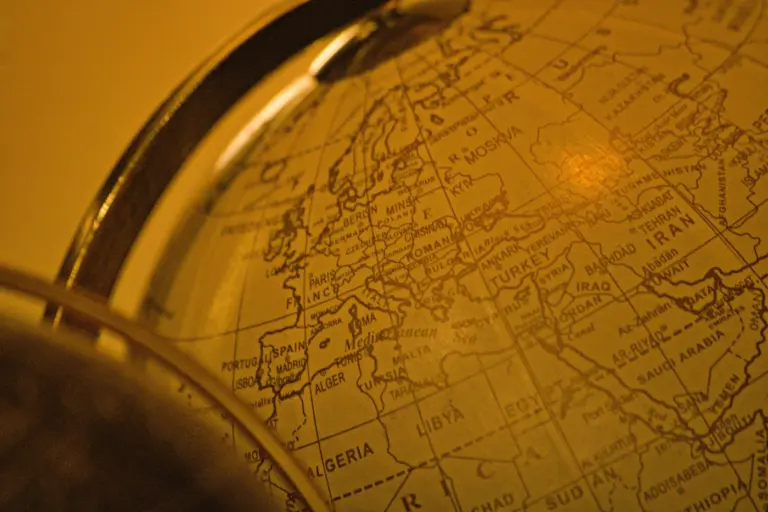
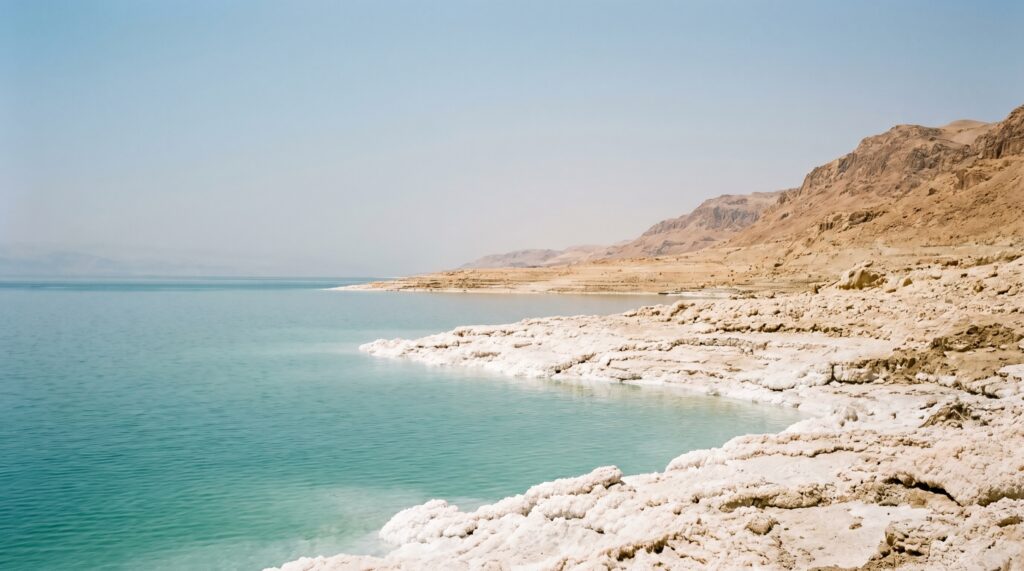
The Dead Sea is a hypersaline endorheic lake in the Jordan Rift Valley, with Jordan on the eastern shore and Israel and the West Bank on the western shore. Hypersaline just means far saltier than the ocean. Endorheic is the load-bearing word: a basin that drains inward, with no outlet to the ocean, so water can only leave by evaporating. Picture a bathtub with the taps running and the plug in, where the only way out is steam. Its main inflow is the Jordan River. Its only outflow is the sky.
You already know an Indian version of this, even if nobody labelled it. Sambhar Lake in Rajasthan is endorheic too: streams feed it, nothing drains it, the desert evaporates it, and what’s left is salt people have harvested for centuries. The Dead Sea is Sambhar’s logic at extreme scale, in a much deeper hole, over much longer. In your notes on important lakes of India, it sits at the far end of the saline column.
| Attribute | Detail |
|---|---|
| Type | Hypersaline endorheic (terminal) lake, not a sea |
| Borders | Jordan (east); Israel and the West Bank (west) |
| Surface elevation | About 430 m below sea level, falling roughly 1 m a year |
| Claim to fame | Lowest land elevation on the Earth’s surface |
| Maximum depth | About 298 m, putting the lakebed near 730 m below sea level |
| Size | Roughly 50 km long, up to 15 km wide |
| Salinity | About 34%, roughly ten times the ocean’s 3.5% |
| Density | About 1.24 g/cm3, against 1.03 for seawater |
| Inflow / outflow | The Jordan River / none |
| Dominant salts | Magnesium, calcium and potassium chlorides; highest bromide levels on Earth |
| Tectonic setting | Pull-apart basin on the Dead Sea Transform fault |
| Economic use | Potash and bromine extraction; health and spa tourism |
Why the shoreline is the lowest land on Earth
The Dead Sea shore sits about 430 metres below sea level, and nothing else exposed on the planet comes close. The reason isn’t erosion, and it isn’t the salt. It’s a fault.
The lake sits on the Dead Sea Transform, where the Arabian Plate slides north past the African Plate. This is a strike-slip boundary: the blocks grind sideways rather than colliding. Here’s the part that does the work. Where such a fault takes a small step sideways, the crust caught between the two offset strands gets stretched and drops, like the gap that opens when you slide two overlapping books past each other with a kink between them. That hole is a pull-apart basin, and the Dead Sea is the textbook one. The land didn’t sink because water sat on it. Water sits there because the land sank.
Anchor the number or it means nothing. The next-lowest exposed points are Lake Assal in Djibouti (about 155 m) and China’s Turpan Depression (about 154 m). The Dead Sea shore is nearly three times lower than its closest rival, and that’s just the surface: the lake runs about 298 m deep, so its floor lies near 730 m below sea level.
The Caspian Sea is also endorheic, also salty, also below sea level, but only by about 28 m. Same category, completely different hole, because it isn’t sitting in a pull-apart basin. When you revise plate tectonics, keep the Dead Sea as your worked example of what a transform boundary does to the land caught between its strands.
Why it is so salty: no outlet, plus relentless evaporation
The Dead Sea is about 34% salt, roughly ten times saltier than the ocean, and the recipe has two ingredients: water gets in but can’t get out, and the desert evaporates it hard.
Work it through one step at a time, because this is where people nod along without getting it. Every river carries dissolved salts weathered out of the rocks it crosses, and the Jordan is no exception. It delivers those salts in. Then the sun lifts pure water into the air and leaves every gram of salt behind. Run that cycle for tens of thousands of years in a basin with no drain, and the salt has nowhere to go but up in concentration. The ocean stays at 3.5% because it’s enormous and exchanges water with the whole planetary system. The Dead Sea is small, sealed, and baking.
Now the objection you should be forming: if the Jordan is fresh, how does it make anything salty? Because “fresh” doesn’t mean zero salt. It means a concentration too low to taste. The lake isn’t concentrating the river’s saltiness. It’s concentrating the river’s cargo, one evaporated litre at a time. That’s the whole secret, and it trips up almost everyone who meets it first.
The chemistry separates a careful answer from a lazy one. Ocean salt is overwhelmingly sodium chloride, ordinary table salt. Dead Sea brine is dominated by magnesium chloride, calcium chloride and potassium chloride, and carries the highest bromide levels of any water body on Earth. So it isn’t seawater turned up to ten. It’s a different mixture, which is exactly why it’s worth mining, and if you’ve worked through ocean salinity, it’s the extreme end of the same curve.
Why you float, and why almost nothing lives in it
Both famous facts fall out of that salinity. They’re the same physics read twice.
You float because the water is denser than you are. An object floats when it displaces a weight of fluid equal to its own weight. The human body, lungs full, has a density of about 0.98 g/cm3, just under fresh water’s 1.00, which is why you float in a pool but barely, nose scraping the surface. Seawater is about 1.03. Dead Sea brine is about 1.24. Do the arithmetic: in brine 24% heavier than fresh water, you displace your own weight after sinking only a fraction as far, so a good part of you stays above the surface. That’s why the famous photo exists, someone lying flat with knees and chest and newspaper clear of the water. They aren’t holding a pose. The physics is holding them. The postcards skip the other half: people have drowned by flipping face-down in water that refuses to let them right themselves.
Nothing you can see lives there, and the reason is osmosis. In water this salty, water gets pulled out of any cell faster than the cell can replace it. A fish carried down the Jordan doesn’t drown. It dehydrates, in water. But “dead” overstates it: the lake supports halophilic archaea, salt-loving microbes built for brine, plus a green alga called Dunaliella. After unusually rainy winters in 1980 and again in 1992, enough fresh water diluted the top layer that Dunaliella bloomed and turned patches of the lake visibly red. It isn’t sterile. Only the specialists survive, and they announce themselves whenever conditions relax.
Potash, bromine and mud: what the Dead Sea is worth
The lake pays for itself, which is a large part of why it’s being drained. The Dead Sea Works on the Israeli side and the Arab Potash Company on the Jordanian side both run vast evaporation ponds in the southern basin, pumping brine in and letting the sun concentrate it until minerals crystallise out in sequence.
The main prize is potash, potassium chloride, one of the three primary fertilisers, which means the Dead Sea quietly feeds farms on several continents. The lake is also a major world source of bromine, used in flame retardants and pharmaceuticals. These ponds aren’t a footnote in the water balance: they’re commonly reckoned to account for roughly a third of the lake’s total water loss. The industry that makes the Dead Sea valuable is also helping to end it.
The second income is tourism, and there’s medicine under the marketing. Resorts cluster at Ein Bokek in Israel and along Jordan’s eastern shore. At 430 m below sea level there’s about 5% more oxygen in the air than at the coast, and the extra thickness of atmosphere filters more ultraviolet, letting people with psoriasis take long, controlled sun exposure that would burn them anywhere else. Nearby sit Qumran, where the Dead Sea Scrolls were found in 1947, and the fortress of Masada. Both economies stand on the same shrinking shore.
The shrinking sea, the sinkholes, and the fix that has not happened
The Dead Sea is losing about a metre of water level every year, and the cause is upstream, not overhead. Its surface has dropped from roughly 390 m below sea level in the 1930s to about 430 m below today, and its area has shrunk from around 1,050 sq km to about 600 sq km. It has lost close to a third of itself within living memory.
The Jordan once delivered about 1.3 billion cubic metres a year, and now delivers a small fraction, because nearly all of it is taken first. Israel’s National Water Carrier, commissioned in 1964, diverts water upstream from the Sea of Galilee. Jordan’s King Abdullah Canal draws from the Yarmouk. Syrian dams take more. Add the evaporation ponds, and the lake is drained from both ends. Around 1978 the level fell below the sill dividing the two basins, and the southern basin ceased to exist as a natural water body.
The strangest consequence is the sinkholes. More than 6,000 now pit the retreating shoreline, opening without warning, big enough to swallow a road or a building. The mechanism is elegant and grim: as the brine pulls back, fresh groundwater flows into ground with thick salt layers buried in it, dissolves that salt, leaves a cavity, and the surface collapses in. This isn’t a slow abstraction like a retreating glacier. It’s a hole that appears in a car park on a Tuesday.
The headline fix is the Red Sea to Dead Sea Conveyance: pipe seawater about 200 km north from the Gulf of Aqaba, use the 400-metre drop for hydropower and desalination, and discharge the brine into the lake. A World Bank-led study ran for years, and in December 2013 Israel, Jordan and the Palestinian Authority signed a memorandum of understanding. Then it stalled, and in 2021 Jordan walked away. Two objections killed it. Chemically, the two waters are different mixtures, and mixing them at scale is predicted to precipitate gypsum and trigger algal blooms, so you’d stabilise the level and possibly destroy what you were saving. Politically, any pipeline here needs cooperation between parties who struggle to sustain much of anything together, a constraint running through every shared-resource question in the Israel-Palestine conflict. And the surest fix is the one nobody will say: let more of the Jordan reach the lake. That water is already spoken for.
How to study the Dead Sea, and where answers go wrong
Build this on one causal chain, not a list, because a chain survives revision and a list evaporates. The chain: transform fault makes a pull-apart basin, which makes it the lowest land on Earth, which makes it hot and endorheic, which makes it hypersaline, which makes it dense (you float) and lethal (nothing lives), which makes it valuable (potash), which, with upstream diversion, makes it shrink (sinkholes). Every question worth asking is a link in that chain.
Three traps, because this is where careless answers lose marks. First, keep “lowest land elevation on Earth” precise: it’s the shore, and the lakebed is lower still. Second, don’t call it the saltiest water body on the planet without a hedge, because some Antarctic ponds, like Don Juan Pond, run saltier; “one of the saltiest, and the largest and deepest hypersaline lake” can’t be marked down. Third, when asked why it’s shrinking, don’t reach for climate change first. The dominant driver is upstream diversion of the Jordan plus industrial evaporation, with a warming regional climate making it worse rather than causing it. That ordering separates understanding from a memorised paragraph, so when you revise climate change, file the Dead Sea under water governance and shared rivers, not warming alone.
Then pair it with contrasts and it locks: against the Caspian for endorheic lakes at different depths, against Sambhar for the same mechanism at different scale, against the ocean for chemistry. A fact next to a contrast becomes a concept.
Frequently Asked Questions
Where is the Dead Sea located?
It lies in the Jordan Rift Valley in West Asia, with Jordan on its eastern shore and Israel and the West Bank on its western shore. It’s a landlocked lake, not a sea, roughly 50 km long and up to 15 km wide.
Why is the Dead Sea the lowest point on Earth?
Its shore sits about 430 m below sea level because it lies in a pull-apart basin on the Dead Sea Transform, where the Arabian Plate slides past the African Plate. The crust between the offset fault strands stretched and dropped.
Why is the Dead Sea so salty?
It has an inflow, the Jordan River, but no outlet. Rivers carry dissolved salts in, evaporation takes only pure water out, so salt has piled up for tens of thousands of years. The result is about 34% salinity, roughly ten times the ocean’s 3.5%.
Why do people float so easily in the Dead Sea?
Because the brine’s density is about 1.24 g/cm3 while the human body is about 0.98. You displace your own weight after sinking only a fraction as far as you would in fresh water, so most of you stays above the surface.
Is anything alive in the Dead Sea?
No fish or plants, because osmosis pulls water out of their cells faster than they can replace it. But salt-loving archaea and the alga Dunaliella do live there, and Dunaliella bloomed visibly in 1980 and 1992 when heavy rain diluted the surface layer.
Why is the Dead Sea shrinking?
Mainly because the Jordan River is diverted upstream by Israel’s National Water Carrier, Jordan’s King Abdullah Canal and Syrian dams, and because mineral companies evaporate lake water in industrial ponds. The level falls about a metre a year.
What are the Dead Sea sinkholes?
More than 6,000 collapse holes along the retreating shoreline. As the brine withdraws, fresh groundwater dissolves salt layers buried underground, leaving cavities that the surface falls into. They’ve swallowed roads, farms and buildings on both shores.
Practice Questions
1. The Dead Sea is best classified as:
a) A marginal sea of the Mediterranean
b) A hypersaline endorheic lake
c) A freshwater rift lake
d) A coastal lagoon
Answer: b
2. The Dead Sea depression owes its origin to:
a) Collision of the Indian and Eurasian plates
b) A pull-apart basin along the Dead Sea Transform fault
c) A meteorite impact
d) Glacial scouring
Answer: b
3. The principal reason for the Dead Sea’s extreme salinity is:
a) Underwater salt volcanoes
b) Salt carried in by tides from the Mediterranean
c) An inflow with no outlet, combined with high evaporation
d) Its unusually great depth
Answer: c
4. A human body floats readily in the Dead Sea primarily because:
a) The salt reduces the pull of gravity
b) The brine’s density of about 1.24 g/cm3 exceeds the body’s density
c) The water is unusually warm
d) The lake lies below sea level
Answer: b
5. The dominant cause of the Dead Sea’s falling water level is:
a) Rising global temperatures alone
b) Diversion of the Jordan River upstream and industrial evaporation ponds
c) Leakage through the lakebed into the Red Sea
d) Increased outflow to the Mediterranean
Answer: b
Mains-style questions
1. Explain how a strike-slip plate boundary can produce a deep depression, using the Dead Sea Transform as an illustration. 2. “An endorheic basin is a salt trap.” Discuss with reference to the Dead Sea, and compare it with an Indian example. 3. Examine the causes of the Dead Sea’s shrinkage, distinguishing between upstream water diversion, industrial extraction and climatic change in order of significance. 4. Discuss the technical and political obstacles to the Red Sea to Dead Sea Conveyance, and assess whether it addresses the underlying cause of the lake’s decline. 5. Analyse the tension between resource extraction and ecological preservation in transboundary water bodies, using the Dead Sea as a case study.
The Dead Sea is the rare landscape that hands you a complete argument instead of a fact. A fault opened a hole, the hole had no drain, the sun did the rest, and the result is water so heavy it won’t let a person sink. Then people upstream took the river, the industry downstream took the brine, and now the shore collapses into itself at a rate you can measure with a tape. Learn the chain, keep the causes in the right order, and you’ll explain in five sentences what most people can only recite in two.
Tell Google you want more of this.
Add Anantam IAS as a preferred sourceOne tap, and this site shows up more often in your own Top Stories, AI Overviews and AI Mode. Remove it any time.