A mercy petition is the last constitutional door open to a death-row convict. After every appeal has been exhausted, after the Supreme Court has confirmed the sentence, the convict can ask the head of state for pardon, commutation, remission or respite. The petition is filed under Article 72 of the Constitution if the offence falls under Union law, or under Article 161 if it falls under state law. The decision is taken on the advice of the council of ministers and is one of the most consequential exercises of constitutional discretion in India.
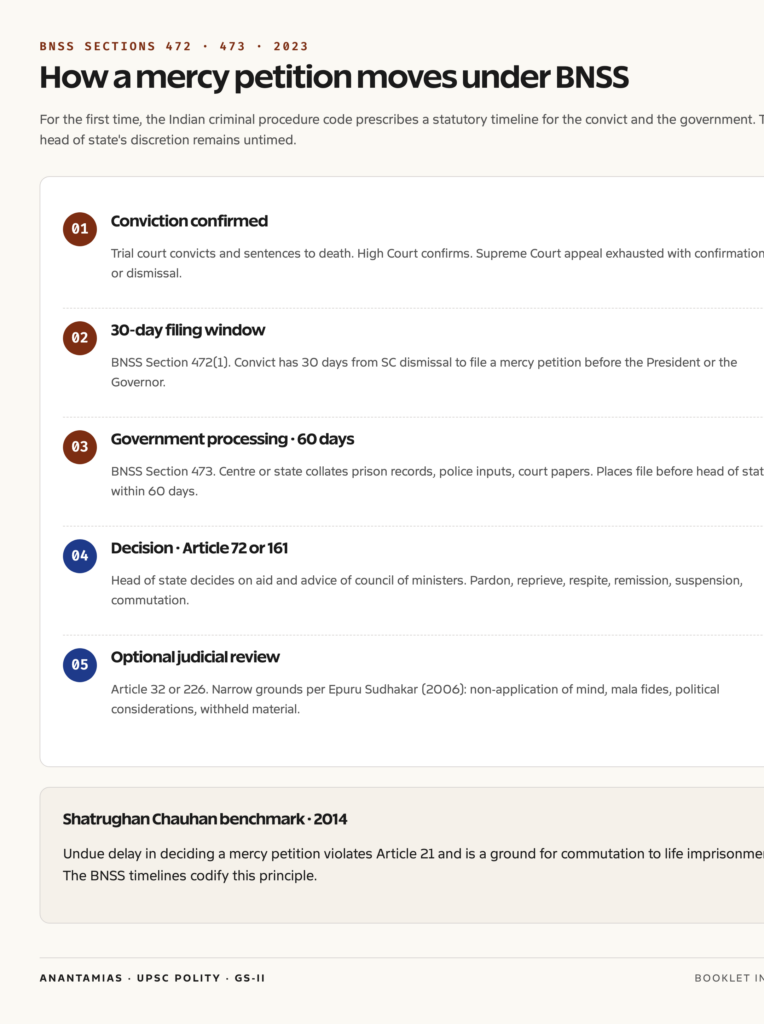
For decades, the procedure was largely a matter of convention. Files moved at the pace allowed by departmental routine, and delays of years were not unusual. The Supreme Court ruled in Shatrughan Chauhan v. Union of India in 2014 that inordinate delay in deciding a mercy petition violates Article 21 and is a valid ground for commuting the death sentence to life imprisonment. The Bharatiya Nagarik Suraksha Sanhita, 2023 has now codified what was earlier convention. Sections 472 and 473 prescribe a 30-day window for the convict to file and a 60-day timeline for the government to process the file before the head of state.
The Maharashtra Home Department’s recent decision to set up a dedicated mercy petition cell is a direct response to this new statutory regime. This guide walks through the cell, the BNSS framework, the constitutional powers under Articles 72 and 161, the Shatrughan Chauhan ruling, the Epuru Sudhakar test for judicial review, and the way in which the cell is meant to bring order to one of the slowest pieces of Indian criminal procedure.
Quick Facts on the Mercy Petition Cell
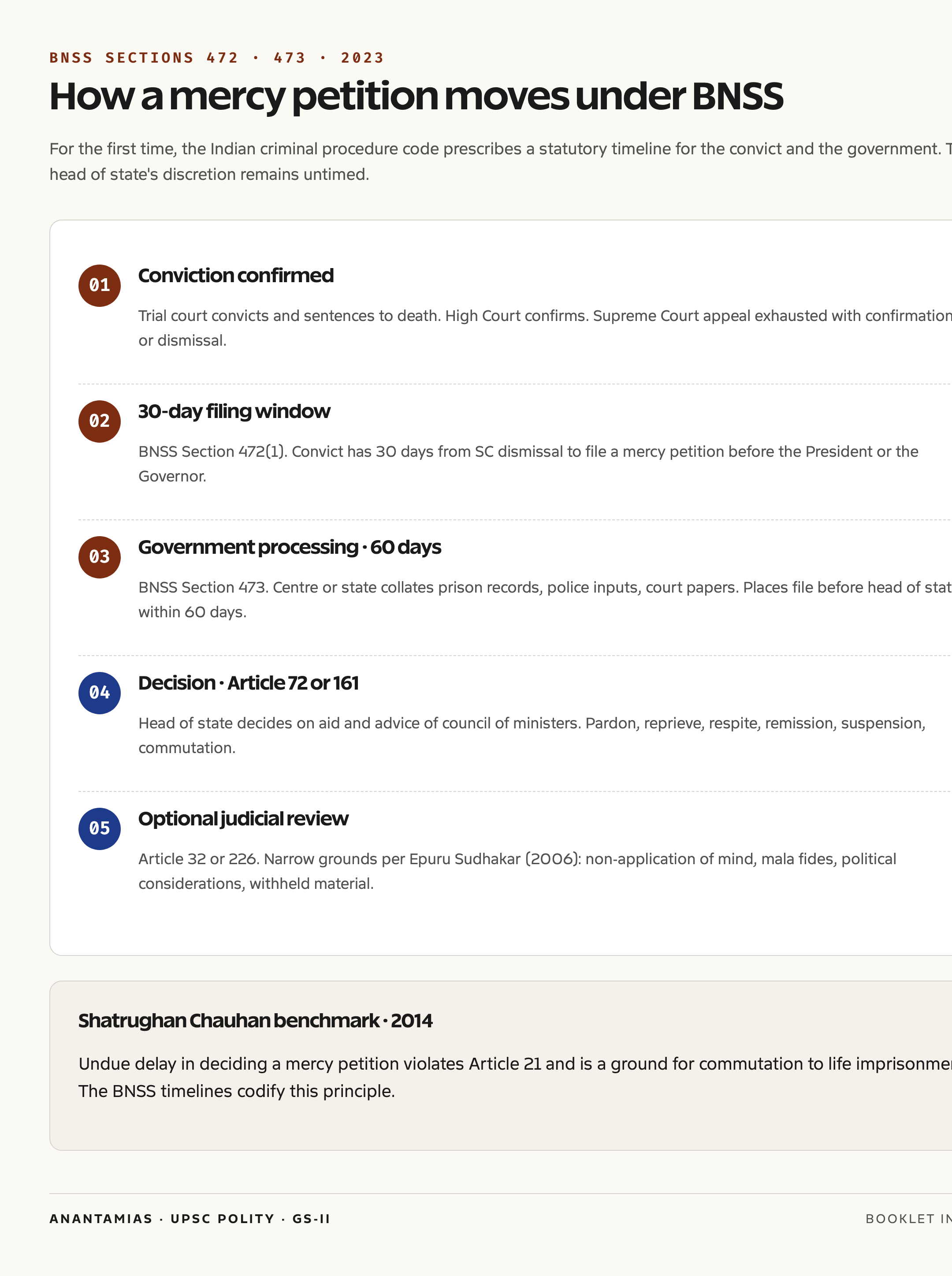
The Maharashtra Home Department established a dedicated Mercy Petition Cell in 2025 to expedite the processing of mercy petitions filed by death-row convicts. The trigger is the Bharatiya Nagarik Suraksha Sanhita, 2023, which replaces the Code of Criminal Procedure of 1973 and codifies the mercy petition procedure for the first time. Section 472 gives the convict a 30-day window from the dismissal of the Supreme Court appeal to file a petition before the President or the Governor. Section 473 obliges the central or state government to seek the head of state’s comments and place the petition before them within 60 days. The constitutional power to grant pardon flows from Article 72 for the President and Article 161 for the Governor. The Supreme Court ruled in Shatrughan Chauhan v. Union of India, 2014 that undue delay in deciding a mercy petition violates Article 21 and is a ground for commutation. The Court ruled in Epuru Sudhakar v. State of Andhra Pradesh, 2006 that the clemency power is subject to judicial review on narrow grounds.
What a Mercy Petition Actually Is
A mercy petition is a written request from a convict to the head of state asking for clemency. The constitutional vocabulary distinguishes between five forms. Pardon completely absolves the convict and erases both the conviction and the sentence. Commutation substitutes a lesser punishment for a more severe one, such as life imprisonment for a death sentence. Remission reduces the period of the sentence without changing the nature of the punishment. Respite awards a less severe punishment because of special facts like the convict’s pregnancy or physical disability. Reprieve is a temporary stay on a sentence, usually a death sentence, to allow the convict to seek further legal remedy.
The mercy petition is not an appeal. The head of state does not sit as a court of further review. The constitutional power is a sovereign act of clemency. It is exercised on the aid and advice of the council of ministers. The Supreme Court has held that the head of state is not bound by the views of the trial court or the appellate court. The clemency power is independent of the judicial process and stands outside the chain of appeals.
Background and Historical Context
The pardoning power has a long pedigree in common law. The English Crown exercised the prerogative of mercy as a sovereign attribute, and the power passed into the Indian constitutional framework through the Government of India Act, 1935 and ultimately the Constitution. Article 72 vests the power in the President, and Article 161 vests a parallel but narrower power in the Governor. The framers debated whether the power should be exercised independently or only on the advice of the council of ministers, and the Supreme Court has settled the question in favour of binding ministerial advice in Maru Ram v. Union of India, 1981 and confirmed it in Kehar Singh v. Union of India, 1989.
The procedural side of mercy petitions was not codified for most of independent India’s history. The CrPC of 1898 and the CrPC of 1973 said little about how a petition should move from the prison gate to the President’s desk. The Ministry of Home Affairs followed an internal manual. Most state governments had similar internal guidelines. Files were routed through the prison superintendent, the state government, and then the central government. Delays of five years and longer were common, and the Court repeatedly noted them with concern.
The Shatrughan Chauhan v. Union of India ruling in 2014 changed the calculus. A bench led by Chief Justice P. Sathasivam laid down 12 guidelines for the handling of death-row cases. The Court held that undue delay in deciding a mercy petition is a violation of Article 21, the right to life and personal liberty, because it prolongs the convict’s psychological agony. The Court commuted the sentences of 15 death-row convicts whose petitions had been pending for too long. The ruling did not lay down an exact timeline, but the principle of “undue delay” has been used in case after case since.
The BNSS, 2023 has now built the timelines into the statute. Section 472 sets the 30-day window for the convict. Section 473 sets the 60-day deadline for the government. The Maharashtra mercy petition cell is the operational unit that makes the 60-day deadline workable.
BNSS, 2023: The New Statutory Framework
The Bharatiya Nagarik Suraksha Sanhita, 2023 replaces the Code of Criminal Procedure, 1973 and is the procedural backbone of Indian criminal justice. The mercy petition provisions sit in Chapter 33 of the Sanhita, in Sections 472 and 473.
Section 472(1) gives a death-row convict 30 days from the dismissal of the appeal by the Supreme Court to file a mercy petition. The petition can be filed initially before either the President or the Governor. The convict need not file two petitions; one filed petition can be processed under Article 72 or Article 161 depending on whether the offence falls under Union or state law. Section 472(2) makes the decision on the petition final under the Sanhita, but the section does not, and cannot, oust judicial review under Articles 32 and 226 of the Constitution.
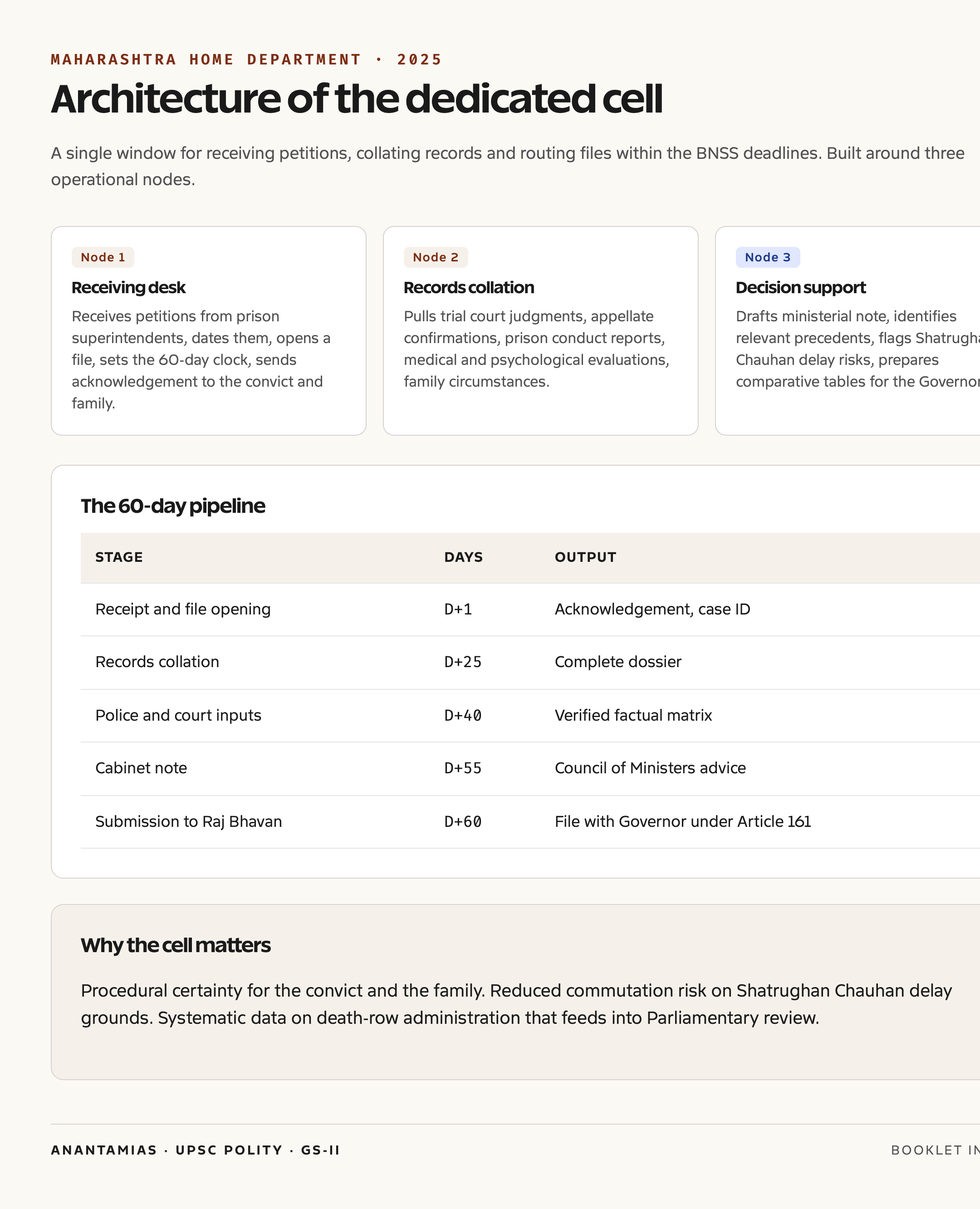
Section 473 prescribes the timeline for the government. On receipt of a petition, the central or state government must seek the comments of the relevant authorities, including the prison superintendent and the state government, and place the petition before the President or the Governor within 60 days. The Sanhita does not prescribe a timeline for the head of state’s decision, because that would intrude on a constitutional power. But the 60-day government timeline is meant to ensure that the file does not stagnate at the secretariat level, which has historically been the source of delay.
Why the Cell Matters
The Maharashtra cell matters because it operationalises a constitutional and statutory promise that has been breached for decades. Three benefits are visible already. The first is procedural certainty. The cell serves as a single window for receiving a petition, collating prison records, obtaining police and court inputs, and routing the file to the Governor or the President within the BNSS deadline. The convict, the family, and the Court all have a known address and a known clock.
The second is fairness in commutation jurisprudence. The Shatrughan Chauhan principle commutes death sentences for undue delay. A government that meets the BNSS timelines reduces the risk of commutation on procedural grounds. This sounds like a state-side gain, but it cuts both ways. Commutation on procedural grounds is a poor substitute for a substantive consideration of the petition. Both sides benefit from a record that is built fully and reviewed on time.
The third is data and accountability. A dedicated cell keeps systematic records of the number of petitions, the time taken at each step, and the outcomes. The data feeds into Parliamentary Standing Committee reports and into broader reform debates on death-row administration. It also helps the supreme court when it reviews the Shatrughan Chauhan compliance regime.
Detailed Analysis: Article 72 vs Article 161 Powers
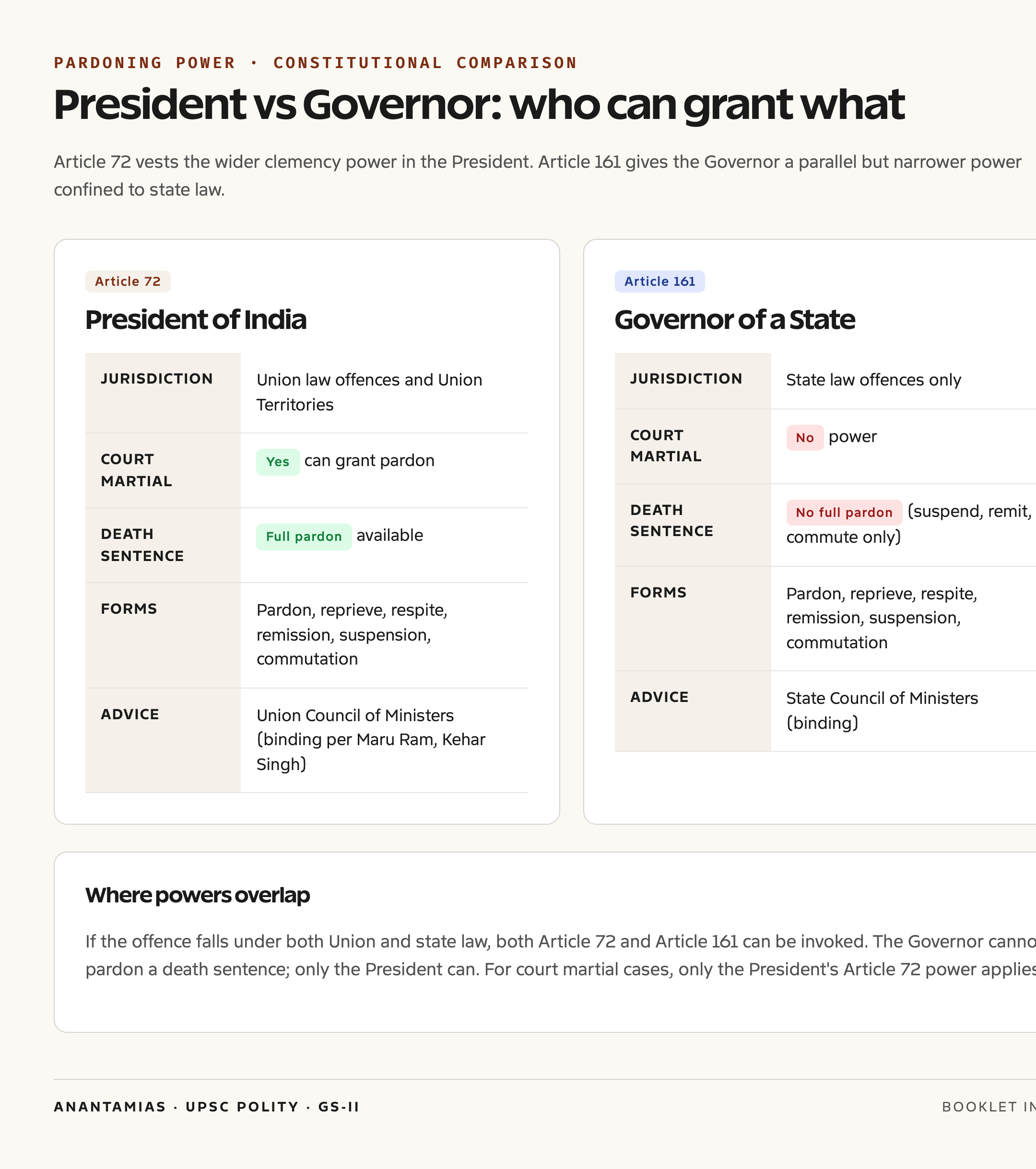
The pardoning power of the President under Article 72 and of the Governor under Article 161 are similar in structure but different in scope. Article 72(1) gives the President the power to grant pardon, reprieve, respite or remission, or to suspend, remit or commute the sentence of any person convicted of any offence. The power covers four kinds of cases: offences against laws relating to matters in the Union List, offences punished by court martial, offences for which the sentence is death, and offences in the Union Territories.
Article 161 gives the Governor the power to grant pardon, reprieve, respite or remission, or to suspend, remit or commute the sentence of any person convicted of an offence under any law relating to matters in the State List. The Governor’s power has three textual differences from the President’s. First, the Governor’s jurisdiction is confined to state law offences. Second, the Governor cannot grant pardon for sentences of court martial. Third, and most importantly, while the Governor can suspend, remit and commute a death sentence, the Governor cannot grant a full pardon for a death sentence. The full pardon power for death sentences sits exclusively with the President.
The two powers can co-exist on the same case in some scenarios. If the offence falls under both Union and state law, both Article 72 and Article 161 can be invoked. The Court has held in Maru Ram and Kehar Singh that the heads of state act on the advice of the council of ministers. The President acts on the advice of the Union Council of Ministers, the Governor on the advice of the state Council of Ministers. The advice is binding in form, although the head of state can return the file once for reconsideration.
Comparative Frame: Other Constitutions
The pardoning power is found in most modern constitutions, but its design varies. The President of the United States holds an almost unfettered pardoning power for federal offences under Article II, Section 2 of the US Constitution. The power is exercised personally and is not bound by ministerial advice. Critics argue this design invites political abuse. Defenders argue it preserves a sovereign safety valve.
The British monarch retains the prerogative of mercy, exercised on the advice of the Home Secretary or the Justice Secretary. The exercise is reviewable on narrow administrative law grounds. Most Commonwealth countries have transposed this design into their constitutions, with the head of state acting on ministerial advice and the courts reviewing only for jurisdictional and procedural errors.
The Indian model fits the Commonwealth pattern but has the distinctive Article 161 carve-out for state law offences and the federally divided structure of pardons. The Shatrughan Chauhan ruling brings the Indian model closer to a rights-based jurisprudence in which Article 21 protects the convict from procedural cruelty.
Challenges and Open Questions
Three challenges remain even with the new cell. The first is the absence of a statutory timeline for the head of state’s decision. The BNSS sets a 60-day deadline for the government but does not bind the President or the Governor. The Court is unlikely to fix a timeline for a constitutional functionary, but a soft norm of 90 days, established through practice and Cabinet guidelines, would meet the spirit of Shatrughan Chauhan.
The second is the integration of the cell with the prison administration. The cell can move only as fast as the prison records and the police inputs allow. Prison record digitisation, especially in older central prisons, is uneven. The cell needs an electronic case management system that talks to the prison records, the trial court records, and the appellate court records.
The third is the handling of multiple convicts in one case. When several convicts have been sentenced to death in a single case, the BNSS Section 472 starts the 30-day clock for each separately. The cell must handle simultaneous petitions, sometimes with conflicting facts, without creating delay for any of them. This is a significant operational challenge.
Prelims Pointers
The pardoning power of the President is contained in Article 72 of the Constitution. The pardoning power of the Governor is contained in Article 161. The President can pardon, reprieve, respite or remit, and suspend, remit or commute any sentence including death sentence, including for court martial cases. The Governor cannot pardon a death sentence and cannot deal with court martial cases. The mercy petition procedure is now codified in Sections 472 and 473 of the Bharatiya Nagarik Suraksha Sanhita, 2023. Section 472 prescribes a 30-day window for the convict to file. Section 473 prescribes a 60-day timeline for the government to process. The Shatrughan Chauhan v. Union of India ruling of 2014 held that undue delay violates Article 21. The Epuru Sudhakar v. State of Andhra Pradesh ruling of 2006 made the clemency power subject to limited judicial review.
Mains Practice Questions
A typical question is: “The Bharatiya Nagarik Suraksha Sanhita, 2023 has codified the mercy petition procedure for the first time. Critically examine the role of dedicated mercy petition cells in honouring the timelines under Sections 472 and 473 and the constitutional limits on judicial review of clemency decisions.” A second variant is: “The pardoning power of the President under Article 72 and the Governor under Article 161 raises questions about the limits of executive discretion in death-penalty cases. Discuss with reference to Shatrughan Chauhan and Epuru Sudhakar.” A third option focuses on the right-to-life jurisprudence and the death penalty: “Article 21 has been read by the Supreme Court to forbid undue delay in mercy petitions. Examine how this principle reshapes the administration of the death penalty in India.”
Way Forward
Three reforms can take the mercy petition system to a higher standard. The first is replication of the Maharashtra model in every state with active death-row cases. A standardised cell template, drafted by the Ministry of Home Affairs in consultation with state Home Departments, would speed up adoption. The second is a soft national norm of a total 180 days from petition filing to head-of-state decision, supported by a transparent dashboard. This would not bind the constitutional functionary but would bind the executive’s preparatory steps to a public timeline. The third is integration with prison record digitisation and the eCourts mission. A national case management system that pulls prison records, trial records, and appellate records into a single dossier would make the 60-day government deadline more realistic.
The mercy petition is the constitutional tail of the criminal process. The Maharashtra cell is a quiet reform. It does not change the law on the death penalty, the standard of “rarest of rare”, or the constitutional discretion of the head of state. But it makes the procedural promise of Articles 72 and 161 real for the convict who has run out of every other option, and that is a constitutional service worth taking seriously.
Frequently Asked Questions
What is a mercy petition?
A mercy petition is a written request by a convict to the head of state asking for pardon, reprieve, respite, remission, suspension, or commutation of the sentence. For Union-law offences, it is filed before the President under Article 72. For state-law offences, it is filed before the Governor under Article 161. The decision is taken on the aid and advice of the council of ministers.
What does the BNSS say about mercy petitions?
Sections 472 and 473 of the Bharatiya Nagarik Suraksha Sanhita, 2023 codify the procedure. Section 472 gives the convict a 30-day window from the dismissal of the Supreme Court appeal to file a petition. Section 473 obliges the central or state government to process the file and place it before the President or the Governor within 60 days. The Sanhita does not impose a timeline on the head of state’s decision.
Why has Maharashtra set up a dedicated mercy petition cell?
The cell is meant to comply with the BNSS, 2023 timelines and to honour the Supreme Court’s ruling in Shatrughan Chauhan v. Union of India, 2014, which held that undue delay in deciding a mercy petition violates Article 21. A dedicated unit handles the receipt of petitions, the collation of prison and court records, and the routing of the file to the Governor or the President within the prescribed 60-day window.
What is the difference between Article 72 and Article 161?
Article 72 gives the President a wider pardoning power. The President can pardon any sentence, including the death sentence and court martial sentences, for offences against Union law. Article 161 gives the Governor a narrower power confined to state law offences. The Governor can suspend, remit, or commute a death sentence but cannot grant a full pardon for one. The Governor has no power over court martial sentences.
Can the head of state’s decision on a mercy petition be challenged in court?
Yes, but only on narrow grounds. The Supreme Court ruled in Epuru Sudhakar v. State of Andhra Pradesh, 2006 that judicial review is available where the clemency decision was taken without application of mind, on political considerations, on mala fide grounds, or where relevant material was kept from the head of state. The Court does not sit in appeal over the substance of the clemency decision.
Is the President bound by the council of ministers’ advice on a mercy petition?
Yes. The Supreme Court ruled in Maru Ram v. Union of India, 1981 and Kehar Singh v. Union of India, 1989 that the President exercises the Article 72 power on the aid and advice of the Union Council of Ministers. The advice is binding in form. The President can return the file once for reconsideration but is then bound by the reconsidered advice.
What happens if the government misses the 60-day BNSS deadline?
The BNSS does not specify a consequence. In practice, missing the deadline weakens the government’s position before the courts. A convict whose petition is held up beyond the statutory window can move the Supreme Court or the High Court under Article 32 or 226 and ask for a writ of mandamus. The Shatrughan Chauhan principle of commutation for undue delay also remains available.
Does the mercy petition cell handle all death-row cases or only a few?
The Maharashtra cell handles all mercy petitions filed by death-row convicts under state-law offences in Maharashtra. It is the single point of contact for petitions filed under Article 161. Petitions under Article 72 for Union-law offences in Maharashtra are processed by the Ministry of Home Affairs at the centre, but the state cell prepares the input file.
Can a convict file a mercy petition after the 30-day BNSS window?
The Sanhita’s 30-day window is the statutory norm. Late petitions can be entertained on grounds of sufficient cause, especially where the delay is attributable to prison administration. The constitutional power under Article 72 and Article 161 itself does not have a time bar; it is a sovereign power that can be exercised at any time before execution.
How is the Shatrughan Chauhan ruling related to the BNSS timelines?
The ruling laid down the constitutional principle that undue delay in deciding a mercy petition violates Article 21 and is a ground for commutation. The BNSS timelines are the legislative response. By prescribing a 30-day filing window and a 60-day government processing window, the Sanhita codifies the Shatrughan Chauhan principle into the criminal procedure. The cell is the operational unit that delivers what the Sanhita prescribes.
Tell Google you want more of this.
Add Anantam IAS as a preferred sourceOne tap, and this site shows up more often in your own Top Stories, AI Overviews and AI Mode. Remove it any time.