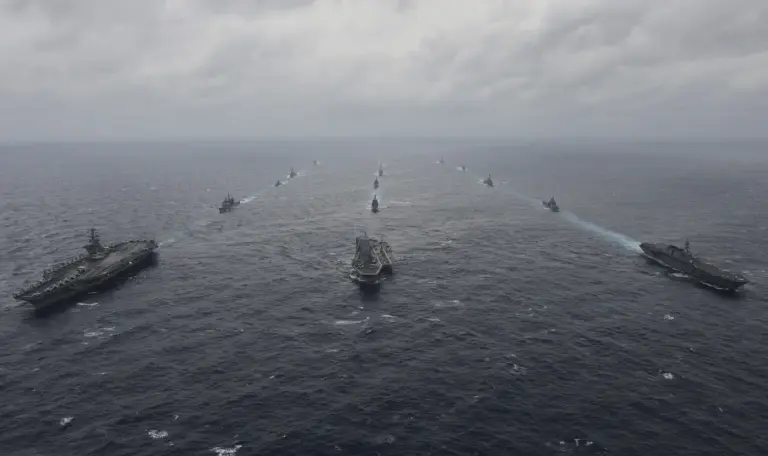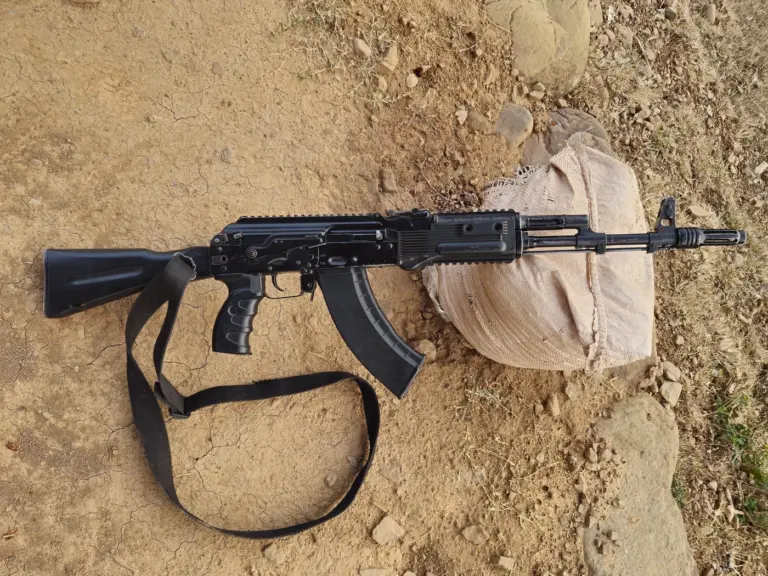
Defence hardware manufactured in India has moved from a token list of small-arms factories to a portfolio that includes fourth-generation fighters, main battle tanks, supersonic cruise missiles and warship hulls. The shift is recent. For most of the post-1947 decades India bought weapons off the shelf from the Soviet Union, the United States, France and Israel. The pivot toward licensed production and indigenous design accelerated after the 1999 Kargil conflict, and the Atmanirbhar Bharat push from 2020 onwards has turned defence manufacturing into a measurable industrial sector.
Knowing what is genuinely built in India, what is licence-assembled, and what is still imported or leased matters for any reader tracking strategic affairs. The same platform name can mean very different things depending on whether the airframe was riveted in Nashik or flown in from Russia.
Su-30 MKI: The Largest Licensed Build in Asia
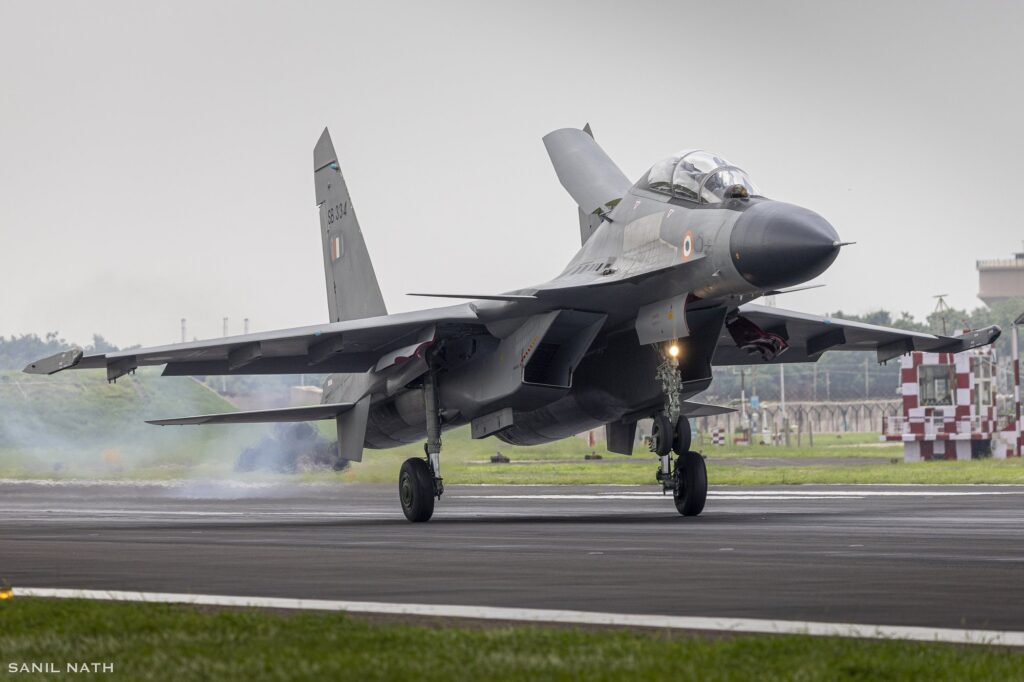
The Sukhoi Su-30 MKI is the backbone of the Indian Air Force fighter fleet. The aircraft is a derivative of the Russian Su-30, customised for India with French avionics, Israeli electronic warfare suites and an Indian mission computer.
Hindustan Aeronautics Limited (HAL) manufactures the Su-30 MKI at its Nashik facility under a transfer-of-technology agreement signed in 2000. More than 220 airframes have been delivered. The Nashik line handles airframe assembly, engine integration, flight testing and lifetime maintenance. So yes, the Su-30 MKI is defence hardware manufactured in India in any meaningful sense, even though the original design came from Sukhoi.
Why Su-30 MKI Counts as Indian-Built
- Airframe sub-assemblies and final assembly happen at HAL Nashik
- Engines (AL-31FP) are licensed-produced at HAL Koraput
- Mission computer is Indian
- Lifetime overhaul stays in India
T-90 MK-III Bhishma: AVNL Avadi
The T-90 main battle tank is the muscle of the Indian Army’s armoured corps. The Russian design was inducted in 2001, and licensed manufacturing began at the Heavy Vehicles Factory in Avadi, Tamil Nadu. Following the corporatisation of the Ordnance Factory Board in October 2021, the Avadi facility now operates under Armoured Vehicles Nigam Limited (AVNL).
The latest variant, the T-90 MK-III (also marketed as T-90MS Tagil internationally), is being produced at AVNL Avadi under a contract for 464 tanks. Welding, casting, gun integration, fire-control system fitment and final acceptance trials all happen on Indian soil. The T-90 MK-III is therefore correctly described as defence hardware manufactured in India.
Akula Class Submarine: Leased, Not Manufactured
This is the entry that catches readers out. The Akula class is a Russian nuclear-powered attack submarine. India operated INS Chakra (a Project 971 Akula I boat) on lease from Russia between 2012 and 2021, and a successor boat was contracted in 2019 for delivery later in this decade.
But these submarines are not built in India. They are constructed at Russian shipyards (Komsomolsk-on-Amur, Severodvinsk) and leased to the Indian Navy under a bilateral arrangement. No Akula hull has ever been welded in India, and no plan exists to localise its production. India’s own nuclear submarine programme runs separately under the Arihant class, built at the Ship Building Centre in Visakhapatnam.
The Akula belongs to a different category of defence hardware in India: imported or leased platforms.
Other Major Indigenous Platforms
The list of platforms truly built in India has expanded sharply in the last decade.
Aircraft and Helicopters
- HAL Tejas Mk1 and Mk1A light combat aircraft (HAL Bengaluru)
- HAL Dhruv advanced light helicopter and its weaponised Rudra variant
- HAL Light Combat Helicopter Prachand
- HAL HTT-40 basic trainer
Land Systems
- Arjun Mk1A main battle tank (HVF Avadi, DRDO design)
- Dhanush 155 mm artillery gun (AWEIL Jabalpur, based on Bofors transfer)
- ATAGS 155 mm towed gun (DRDO with Bharat Forge and Tata Advanced Systems)
Naval Platforms
- INS Vikrant indigenous aircraft carrier (Cochin Shipyard, 2022)
- Project 17A Nilgiri-class stealth frigates (MDL Mumbai, GRSE Kolkata)
- Scorpene-class submarines (MDL Mumbai under French ToT)
- Arihant-class SSBN (SBC Visakhapatnam)
Missiles
- BrahMos supersonic cruise missile (BrahMos Aerospace, an Indo-Russian JV with manufacturing units at Hyderabad, Pilani and Thiruvananthapuram)
- Akash surface-to-air missile (BEL Hyderabad, BDL)
- Astra beyond-visual-range air-to-air missile
- Agni and Prithvi ballistic missile series (DRDO with BDL)
Manufactured, Assembled, Imported: The Distinction
A consistent confusion when reading about Indian defence procurement is the difference between three categories.
- Indigenous design and manufacture: Tejas, Arjun, BrahMos, INS Vikrant
- Licensed manufacture under transfer of technology: Su-30 MKI, T-90 MK-III, Scorpene submarine
- Imported or leased platforms: Rafale fighter, S-400 air defence system, Apache and Chinook helicopters, Akula-class submarine, MQ-9B drones
All three flow through Indian acquisition pipelines, but only the first two qualify as defence hardware manufactured in India. The 2020 Defence Acquisition Procedure made this distinction explicit by creating separate procurement categories such as Buy (Indian-IDDM) and Make-I, which favour platforms designed and produced domestically.
Why This Matters: Strategic Autonomy and the Economy
India is the world’s largest arms importer by value over the last decade. Cutting that dependence is the explicit objective behind the Defence Industrial Corridors in Tamil Nadu and Uttar Pradesh, the positive indigenisation lists notified by the Ministry of Defence since 2020, and the rising share of capital procurement reserved for domestic vendors.
Defence exports from India crossed Rs 21,000 crore in financial year 2023-24, with BrahMos missiles to the Philippines and Dornier maritime aircraft to multiple countries leading the order book. The growth confirms that the manufacturing base is no longer a parade-ground story; it is producing systems that other governments are willing to buy.
For the 73rd Amendment of Indian Constitution and other foundational topics, the Atmanirbhar Bharat in defence is a parallel structural reform that has reshaped the public-sector industrial landscape.
FAQs
Is the Su-30 MKI manufactured in India?
Yes. HAL Nashik assembles the airframe, HAL Koraput produces the engines under licence from Sukhoi, and lifetime overhaul stays in India. The original design is Russian but the platform is built domestically.
Is the T-90 tank made in India?
Yes. The T-90 Bhishma and the latest T-90 MK-III variant are manufactured at the Heavy Vehicles Factory in Avadi, now operating under Armoured Vehicles Nigam Limited.
Is the Akula class submarine manufactured in India?
No. Akula-class boats are built in Russian shipyards and leased to the Indian Navy. They are not produced in India and there is no plan to localise their manufacture.
What is the most advanced fully indigenous Indian fighter?
The HAL Tejas Mk1A is the most advanced fully indigenous fighter currently in series production. The Advanced Medium Combat Aircraft is under development.
Where is BrahMos manufactured?
BrahMos Aerospace, the Indo-Russian joint venture, runs production lines at Hyderabad (Telangana), Thiruvananthapuram (Kerala) and Pilani (Rajasthan). A new facility in Lucknow handles the next-generation variants.
What is the difference between licensed manufacture and indigenous design?
Licensed manufacture means producing a foreign design domestically under a transfer-of-technology agreement, paying royalties. Indigenous design means the platform is conceived and engineered in India, with manufacturing rights held entirely by Indian entities.
Is the Rafale fighter built in India?
No. Rafale aircraft are built by Dassault Aviation in France and flown to India. The 2016 inter-governmental agreement is a direct purchase, not a licence-build contract.
How much defence equipment does India still import?
India remains a top arms importer, though the share of domestic procurement in the defence capital budget has risen to over 65 percent in recent years under positive indigenisation policies.
Tell Google you want more of this.
Add Anantam IAS as a preferred sourceOne tap, and this site shows up more often in your own Top Stories, AI Overviews and AI Mode. Remove it any time.