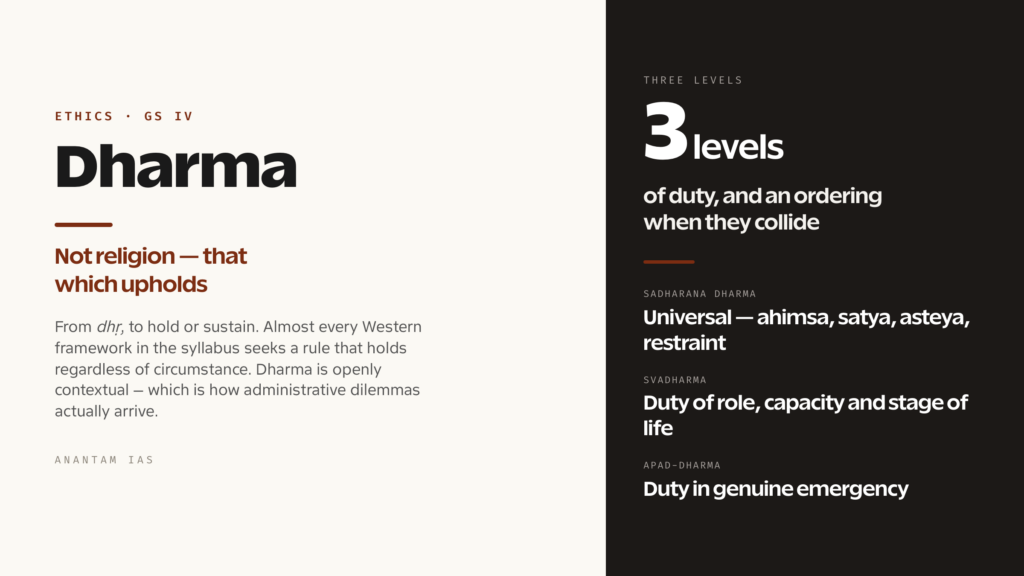
Dharma is routinely mistranslated as religion, and the mistranslation destroys the concept. The word comes from the root dhṛ, to hold or sustain, and it means roughly that which upholds — the order that keeps a person, a role, a society or a cosmos from collapsing. A closer English approximation is not “religion” but something like the right thing to do, given who and where you are.
That last clause is what makes dharma interesting as an ethical framework rather than merely as cultural background. Almost every Western system in the syllabus seeks a rule that holds regardless of circumstance: Kant’s universalisable maxim, Bentham’s calculus, Rawls’ principles chosen behind a veil. Dharma is openly contextual — what you ought to do depends on your role, your stage of life, your capacity, and the situation, including whether it is an emergency. For a paper about officials facing conflicting obligations, a framework built to handle exactly that is worth having, provided its serious problems are stated rather than skipped.
The Four Sources
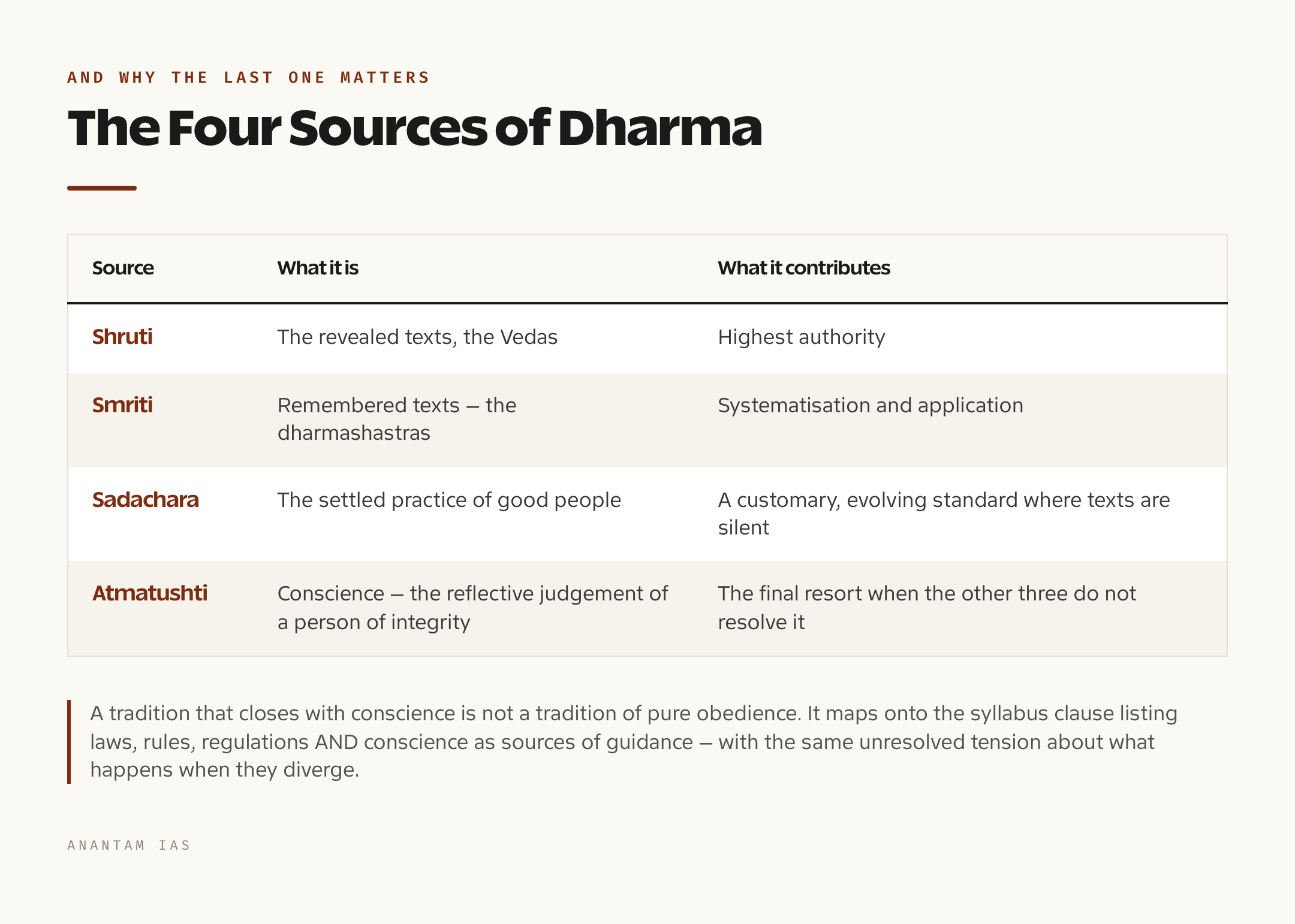
Classical texts identify four sources from which dharma is known, and their ordering matters because it shows the framework is not simply scriptural command.
Shruti — the revealed texts, the Vedas, treated as the highest authority.
Smriti — remembered texts, the dharmashastras, which systematise and apply.
Sadachara — the practice of good people. Where texts are silent or unclear, the settled conduct of the virtuous supplies the standard. This is a customary and evolving source.
Atmatushti — literally the satisfaction of one’s own self, that is, conscience. When the other three do not resolve the question, the reflective judgement of a person of integrity is the final resort.
The presence of atmatushti is the point most worth noticing. A tradition that closes with conscience is not a tradition of pure obedience, and it maps onto the syllabus clause that lists laws, rules, regulations and conscience as sources of ethical guidance — a hierarchy with the same shape and the same unresolved tension about what happens when conscience and text diverge.
Three Levels of Duty
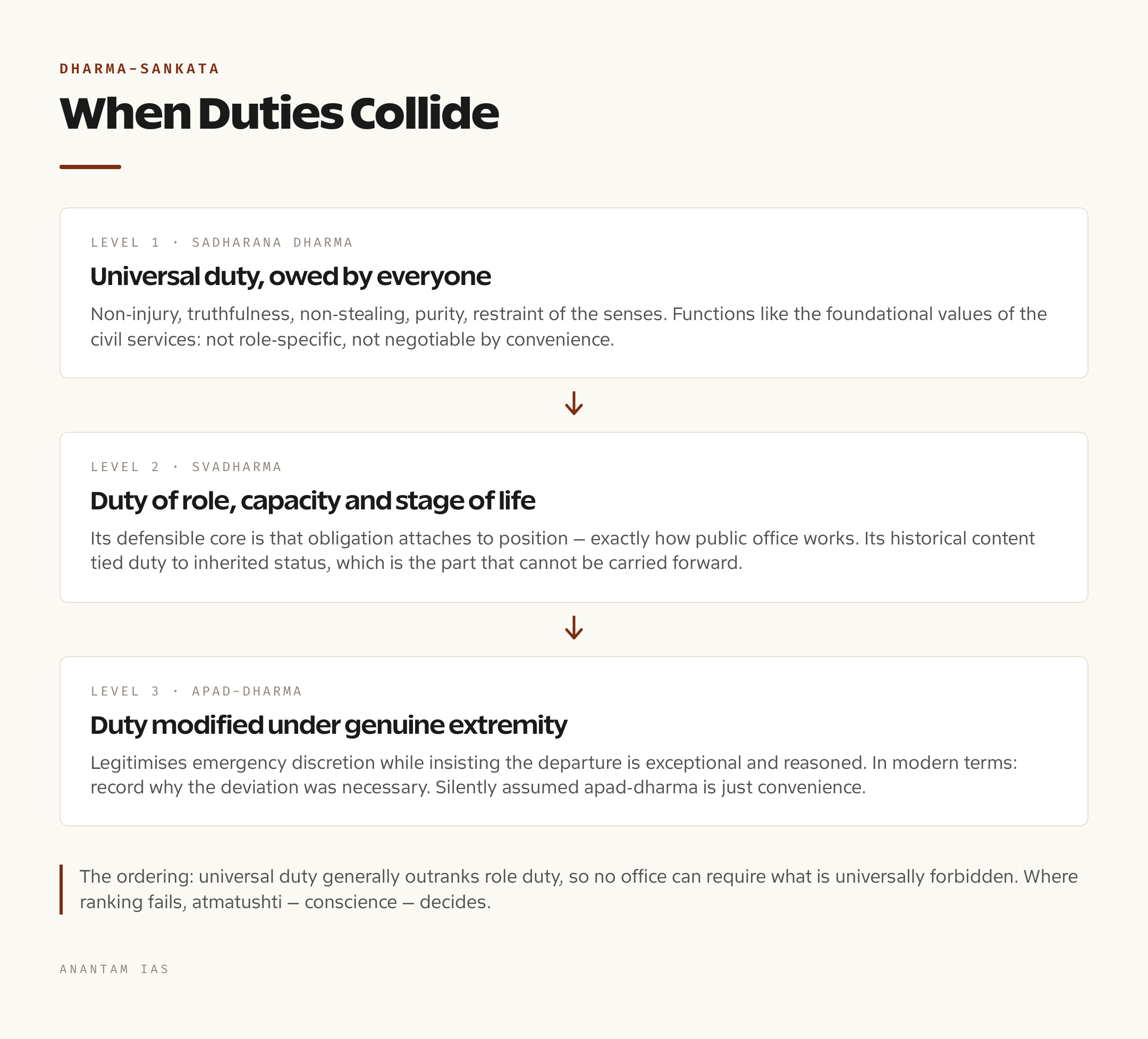
The framework operates at three levels, and most confusion about dharma comes from collapsing them.
Sadharana or samanya dharma is universal duty, owed by everyone irrespective of station. The recurring list includes ahimsa (non-injury), satya (truthfulness), asteya (non-stealing), shaucha (purity), indriya-nigraha (restraint of the senses), and in various formulations dama, danam, kshama. These function much like the foundational values in the civil-service syllabus: not role-specific, not negotiable by convenience.
Svadharma is one’s own duty — what follows from your particular role, capacity and stage of life. A soldier’s duty differs from a teacher’s; a householder’s from a renunciate’s. Its defensible core is the idea that obligation attaches to position, which is exactly how public office works: a District Magistrate has duties an ordinary citizen does not, arising purely from the office.
Apad-dharma is dharma in distress or emergency — the recognition that ordinary rules may be suspended or modified when circumstances are extreme, without the suspension becoming the new norm. It is the most administratively interesting of the three, and the most dangerous.
The Caste Problem, Stated Honestly
Svadharma cannot be taught without its history, and an answer that presents it as neutral role-ethics is not credible.
In the dharmashastra tradition svadharma was substantially varna-ashrama dharma — duty determined by inherited social position and life-stage. Read that way, it supplied the moral vocabulary for a hereditary hierarchy: it told people that fulfilling the duties of the station they were born into was itself righteousness, and that aspiring beyond it was not. The framework’s contextual flexibility, which is its intellectual strength, became in practice a justification for fixing people in place.
Two responses exist within the tradition and one against it, and a strong answer knows all three.
The guna-karma reading holds that varna properly refers to disposition and conduct rather than birth, citing textual support for classification by quality and action. It is a genuine interpretive tradition and it is also, historically, a minority reading against overwhelming practice.
The reformist reading, advanced by figures from Ram Mohan Roy onward and by Gandhi in his own way, retains dharma’s moral vocabulary while rejecting the hierarchy — Gandhi’s insistence on the dignity of all labour is an attempt to keep svadharma without its birth-basis.
The rejectionist position is Ambedkar’s, and it is the most serious. His argument was not that the texts had been misread but that a graded social order was intrinsic to them, and that no reinterpretation could make a hierarchy of birth into a foundation for equal citizenship — which is why he grounded India’s constitutional order in constitutional morality rather than in inherited dharma, and eventually turned to Buddhism. This is developed in Ambedkar’s philosophy and in constitutional morality.
The honest position for an answer is that dharma’s structure — universal duties, role-specific duties, emergency modification, conscience as final resort — is usable and illuminating, while its historical content on social hierarchy is not, and that saying so is not cultural disloyalty but the same critical reading one applies to Aristotle on slavery or Kant on race.
Rajadharma: The Duty of Those Who Govern
Rajadharma is the dharma specific to rulers, and it is the part of the tradition closest to public-service ethics. Its recurring claims are that authority exists for the protection of the people rather than for the ruler’s enjoyment; that the ruler is subject to dharma rather than its source; that danda, the power to punish, is held in trust and is illegitimate when arbitrary; and that the ruler’s own conduct sets the standard for the realm.
The Mahabharata’s Shanti Parva develops it at length, and Kautilya gives it a hard-edged, statecraft version in which the king’s happiness lies in the happiness of his subjects while the machinery of surveillance and coercion is elaborated without embarrassment — the tension explored in Kautilya and Indian political ethics.
The idea that power is held on trust and that its holder is bound by the same order they enforce is, in substance, the accountability principle. Its Indian expression predates its Western formulation and is worth citing for that reason.
Dharma-Sankata: When Duties Collide
The tradition’s most distinctive feature is that it takes conflict of duties as normal rather than as a sign that something has gone wrong. Dharma-sankata is the situation of being bound by two duties that cannot both be discharged.
The epics are largely a study in it. Bhishma’s oath binds him to a throne whose occupant is unjust. Yudhishthira’s commitment to truth collides with the consequences of telling it. Arjuna’s duty as a warrior collides with his duty to kin — the dilemma the Bhagavad Gita takes up, and the reason its answer is framed as action without attachment to result rather than as a ranking of the two duties.
The tradition’s method of resolution is instructive because it is not a formula. It ranks: sadharana dharma generally outranks svadharma where the two collide, so a role cannot require you to do what is universally forbidden — the classic answer to the officer told that the duties of the post require a falsehood. It admits apad-dharma, allowing departure under genuine extremity. And it falls back on atmatushti, conscience, when ranking fails. That is close to how a well-reasoned case-study answer actually proceeds.
What Is Usable in Administration
Apad-dharma is the concept most worth carrying, and the most easily abused. It legitimises emergency discretion — the officer who departs from procedure during a flood to move relief — while insisting the departure is exceptional, temporary and justified by genuine extremity, not by convenience. The abuse is obvious: every ordinary pressure gets reclassified as an emergency. The tradition’s own guard is that apad-dharma must be declared and reasoned, not silently assumed, which in modern terms means recording why the deviation was necessary.
Sadharana dharma over svadharma gives a principled answer to “the requirements of my post”. Universal duties bound role duties, so no office can require what is universally forbidden.
Rajadharma frames power as trust rather than possession — a stronger formulation than “public servant” because it carries the implication that misuse forfeits legitimacy.
Atmatushti locates conscience as a real source, not a private feeling to be overridden by any written instruction.
Where the framework is weakest is precisely where modern administration needs most help: it supplies no procedural guarantees, no rights held against authority, and no equality of standing. Those come from the constitutional tradition, which is why the two are complements and why a good answer uses dharma for the texture of duty and constitutional morality for the floor beneath it.
FAQ
Does dharma mean religion? No. It derives from dhṛ, to hold or sustain, and means that which upholds — closer to duty, right conduct or the order proper to a thing. Translating it as religion imports a category the word does not carry.
What are the four sources of dharma? Shruti (revealed texts), smriti (remembered texts such as the dharmashastras), sadachara (the practice of good people), and atmatushti (conscience, the satisfaction of one’s own reflective self) as the final resort.
What is the difference between sadharana dharma and svadharma? Sadharana or samanya dharma is universal duty owed by everyone — non-injury, truthfulness, non-stealing, restraint. Svadharma is duty arising from your particular role, capacity and stage of life. Where they conflict, universal duty generally prevails.
What is apad-dharma? Dharma in distress or emergency: the recognition that ordinary rules may be modified under genuine extremity without the modification becoming the norm. It is the tradition’s account of emergency discretion, and it requires that the departure be reasoned rather than silently assumed.
What is rajadharma? The duty specific to rulers: that authority exists to protect the people, that the ruler is subject to dharma rather than its source, and that the power to punish is held in trust and is illegitimate when arbitrary.
Is svadharma the same as caste duty? Historically it was largely read as varna-ashrama dharma, duty by inherited position, and supplied moral cover for hereditary hierarchy. There is a minority guna-karma reading based on disposition and conduct, a reformist reading that keeps the vocabulary and rejects the hierarchy, and Ambedkar’s rejectionist position that graded inequality was intrinsic to the texts.
Can dharma be used in a GS IV answer? Yes, for its structure — universal duties bounding role duties, emergency modification, conscience as final resort, power as trust. Its historical content on social hierarchy should be handled critically, as one handles Aristotle on slavery.
Practice Questions
Prelims MCQs
- The word dharma derives from the root dhṛ, meaning: (a) to worship (b) to hold or sustain (c) to renounce (d) to command — Answer: (b) This is the source of its sense as that which upholds, rather than religion.
- Which of the following is the fourth and final source of dharma, applied when the others do not resolve a question? (a) Shruti (b) Smriti (c) Sadachara (d) Atmatushti — Answer: (d) Atmatushti is conscience, the reflective judgement of a person of integrity.
- Sadharana dharma refers to: (a) duty determined by inherited status (b) universal duty owed by everyone irrespective of station (c) duty of the ruler (d) duty modified in emergencies — Answer: (b) It includes ahimsa, satya, asteya and restraint.
- Apad-dharma is best described as: (a) the duty of renunciates (b) dharma modified under genuine extremity, exceptionally and with reasons (c) the dharma of the householder stage (d) a permanent exemption for officials — Answer: (b) The departure must be exceptional and reasoned, not silently assumed.
- Ambedkar’s position on svadharma as varna-ashrama dharma was that: (a) the texts had been misread and could be reinterpreted (b) graded inequality was intrinsic to the texts and could not found equal citizenship (c) it should be retained for administrators only (d) it was identical to constitutional morality — Answer: (b) Which is why he grounded the constitutional order elsewhere.
Mains Practice Questions
- “Dharma’s structure is usable; its historical content on hierarchy is not.” Examine this proposition with reference to svadharma. (15 marks, 250 words)
- Explain apad-dharma and discuss the safeguards needed before an officer may invoke emergency discretion. (15 marks, 250 words)
- “Rajadharma frames power as trust rather than possession.” Compare this with the modern principle of public accountability. (15 marks, 250 words)
- Dharma-sankata treats conflict of duties as normal rather than as an error. Discuss what this assumption offers to ethical reasoning in administration. (10 marks, 150 words)
- Discuss the significance of atmatushti being listed as a source of dharma, alongside the syllabus clause on conscience as a source of ethical guidance. (10 marks, 150 words)
Tell Google you want more of this.
Add Anantam IAS as a preferred sourceOne tap, and this site shows up more often in your own Top Stories, AI Overviews and AI Mode. Remove it any time.